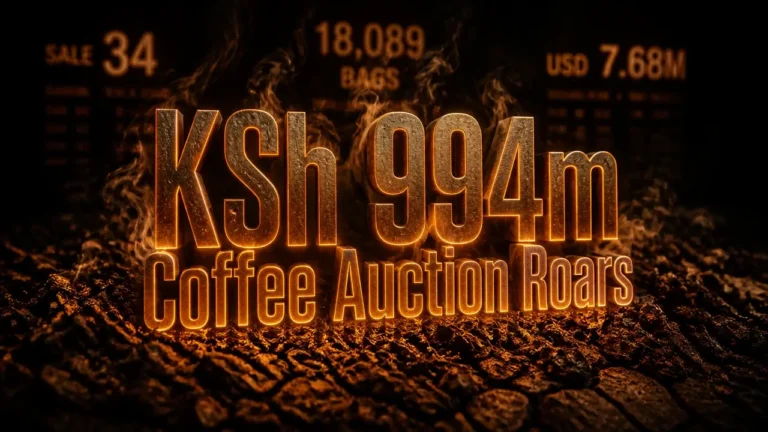

Kenya’s weekly Nairobi Coffee Exchange (NCE) posted one of its strongest sessions of the season on 4 August, when Sale 34 moved 18,089 bags of green coffee worth about KSh 994 million (USD 7.68 million), raising fresh questions about how rising auction prices and market reforms will flow back to farmers.
According to Kenya Broadcasting Corporation (KBC/KNA), the auction at the NCE trading floor in Nairobi averaged KSh 44,503 per 50 kg bag for the 1,115 tonnes sold. Kilimo News calculated a market average of USD 344 per 50 kg bag, or about USD 6.89 (KSh 891) per kilogram of clean coffee, and translated the result to roughly KSh 137 per kilogram of coffee cherry using a standard 6.5:1 cherry-to-green outturn ratio, before marketing, milling and brokerage deductions.
That price level marks a step up from recent seasons. Kilimo News reports that Sale 34 in August 2025 moved 7,278 bags for USD 2.85 million at an average of USD 313 per 50 kg bag, while Sale 39 in August 2024 averaged USD 246 per bag on 9,618 bags. KBC/KNA notes that prices at the NCE are largely shaped by bean quality, cup profile, global demand and prevailing international market conditions, and states that the strong Sale 34 performance is expected to boost farmers’ earnings, particularly for those who delivered high-quality coffee.
The structure of the market at this sale was highly concentrated on both the selling and buying side. Kilimo News and KBC/KNA each report that fifteen licensed marketing agents presented coffee. On the buying side, Kilimo News describes the auction as “less a contest than a coronation”, with the top six buyers absorbing 87% of the sale’s value. The outlet reports that C. Dormans SEZ Ltd bought 425,021 kg, about 38% of the volume, for USD 3.19 million, while KBC/KNA values this at KSh 412.5 million and about 42% of total value. Ibero Kenya Ltd purchased 234,404 kg, which KBC/KNA translates as 3,790 bags worth KSh 208.5 million (about 21% of value).
Kilimo News further reports that Kenyacof Limited bought 130,602 kg, valued at USD 867,256 (KSh 112.1 million), representing roughly 11% of sale value, with Louis Dreyfus Company taking about 5% at USD 406,491. Mumbi Coffee Merchants and Taylor Winch (Coffee) Limited each accounted for a further 4%, illustrating how a handful of international buyers shaped price discovery at this auction.
On the producer side, 15 marketing agents channelled coffees from Kenya’s main growing counties. Kilimo News and KBC/KNA both note that New Kenya Planters Co-operative Union (New KPCU) traded 4,907 bags weighing 300,835 kg at an average of USD 344 per 50 kg, valued at KSh 267.9 million (USD 2.07 million). Alliance Berries Limited moved 4,000 bags weighing 247,966 kg for KSh 233.2 million at USD 364 per bag, with KBC/KNA attributing much of this volume to the central counties of Nyeri, Kirinyaga and Murang’a.
Meru County Coffee Marketing Agency recorded the day’s highest broker average, according to Kilimo News, trading 1,288 bags at USD 375 per 50 kg and realizing KSh 75.9 million from factories including Mukiria and Kathera. Other notable averages reported by Kilimo News include Kirinyaga Slopes Coffee Brokerage at USD 345 per bag for 1,726 bags (KSh 94.3 million), United Eastern Kenya at USD 353 for 802 bags, and Kinya Coffee Marketing at USD 277 for 638 bags, with Kinya’s softer result linked to a grade mix heavier in TT, MH and lower grades.
Quality differentials remained pronounced across grades and origins. KBC/KNA states that Grade AB coffee led the day with 7,761 bags fetching KSh 461.1 million, while 1,738 bags of Grade AA earned KSh 107.8 million. Kilimo News notes that clean AA and AB lots from Kirinyaga, Nyeri, Embu and Meru regularly crossed USD 380–410 per 50 kg, with Kirinyaga’s Ngugu-ini AA topping at USD 410. KBC/KNA reports that Ngugu-ini Factory in Kirinyaga County also achieved the highest price on the day at KSh 53,041 per 50 kg bag, ahead of Muisuni Farmers’ Co-operative Society in Machakos County at KSh 52,912 and Kiriaini Factory in Kirinyaga at KSh 52,653.
These auction dynamics are unfolding against a backdrop of ongoing regulatory and structural change. Business news outlet Business Now reports that the Capital Markets Authority has regulated the NCE since 2020 under the Capital Markets (Coffee Exchange) Regulations, licensing exchanges and brokers with the aim of strengthening transparency and efficiency. NCE chief executive Lisper Ndung’u told Business Now that improved farmer returns are due to these reforms and to collaboration with value-chain players to improve both the auction system and farmer earnings.
Despite the robust prices at Sale 34, volumes remain modest by historical standards. Business Now cites current Kenyan coffee production at around 50,000 metric tonnes annually, far below a peak of 130,000 tonnes in the 1987/1988 season. Co-operatives Cabinet Secretary Wycliffe Oparanya told the same outlet that the government is pressing ahead with reforms to revive the industry and attract new investment, and urged investors to “partner with our cooperatives, entrepreneurs, MSMEs and counties” and invest in modern factories, digital systems, quality laboratories, packaging and logistics.
KBC/KNA underscores that the weekly NCE auction remains Kenya’s principal coffee-marketing platform, bringing together licensed marketing agents and international buyers in what it describes as a transparent price-discovery system, and notes that coffee continues to rank among the country’s leading foreign exchange earners.