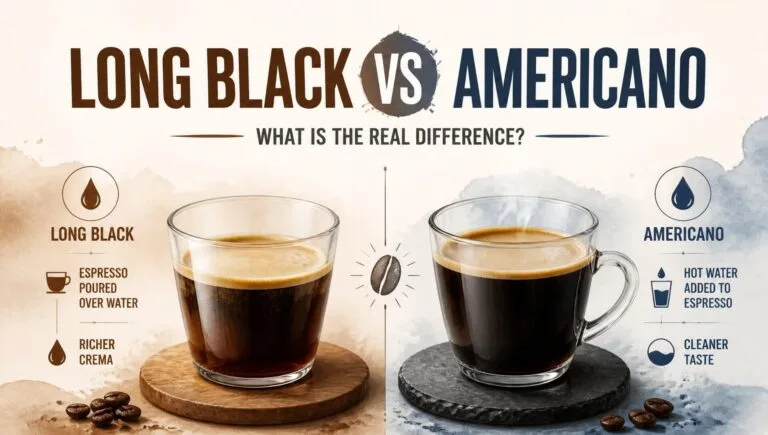

Identical ingredients, opposite logic. The long black pours espresso over hot water, protecting the crema, concentrating the flavor. The Americano inverts that sequence, diluting the shot after the fact. One choice changes everything: aroma, mouthfeel, how the first sip lands.
That preparation order isn’t trivial. It’s the entire argument. Australian specialty coffee culture built the long black around crema preservation. World War II necessity built the Americano around volume. Same cup, different philosophy, and once you taste them side by side, there’s no going back to not caring.
What Makes a Long Black and an Americano Different?
Both drinks share exactly two ingredients: a shot (or double shot) of espresso and hot water: but the order you combine them is what separates a Long Black from an Americano, and that single choice ripples through the drink’s concentration, crema, and the very first sip you take.
Here’s the split: with an Americano, the espresso goes in first, then hot water is poured on top. With a Long Black, the hot water goes in first, and the espresso is pulled directly onto the water. Same two ingredients. Completely reversed sequence.
That reversal shows up immediately in the glass. An Americano looks fairly uniform, the espresso and water mix together as the water falls through, leaving only a thin, broken layer of foam on top. A Long Black looks layered. Because the espresso lands on top of the water rather than getting diluted from above, its crema stays intact: a thick, tan, aromatic foam sitting right on the surface where your nose hits it first.
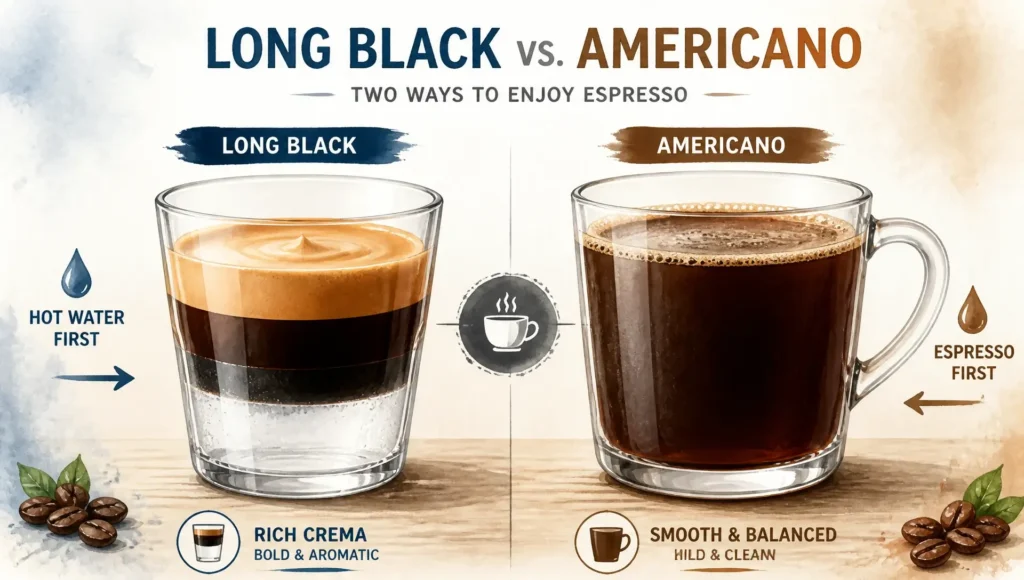
This isn’t just a visual difference. That preserved crema on a Long Black concentrates the aromatics at the surface, which means your first sip carries more intensity than the body of the drink. An Americano distributes everything more evenly: smoother, more consistent from first taste to last, but without that punchy top layer.
Shanny, a career barista with seven years behind the bar in Melbourne, puts it plainly:
“Americanos are the same in Melbourne as they are in the USA: a double shot of espresso poured over a cup ¾-full of hot water. Our Long Blacks are similar to what the Americans call a Little Buddy. A cup is filled with one- to two-ounces of hot water and topped with a double shot of espresso.”
Notice the volume difference buried in that description. A Long Black uses far less water (one to two ounces) versus a cup three-quarters full. That means the Long Black is also a more concentrated drink by default, not just a different-looking one. The preparation order and the water volume work together to create something genuinely distinct in the cup.
That one rule (which ingredient goes in first) turns out to have a history behind it, a measurable effect on flavor and strength, and a practical workflow that makes both drinks easy to recreate at home or order confidently at any café.
Where These Two Drinks Actually Come From
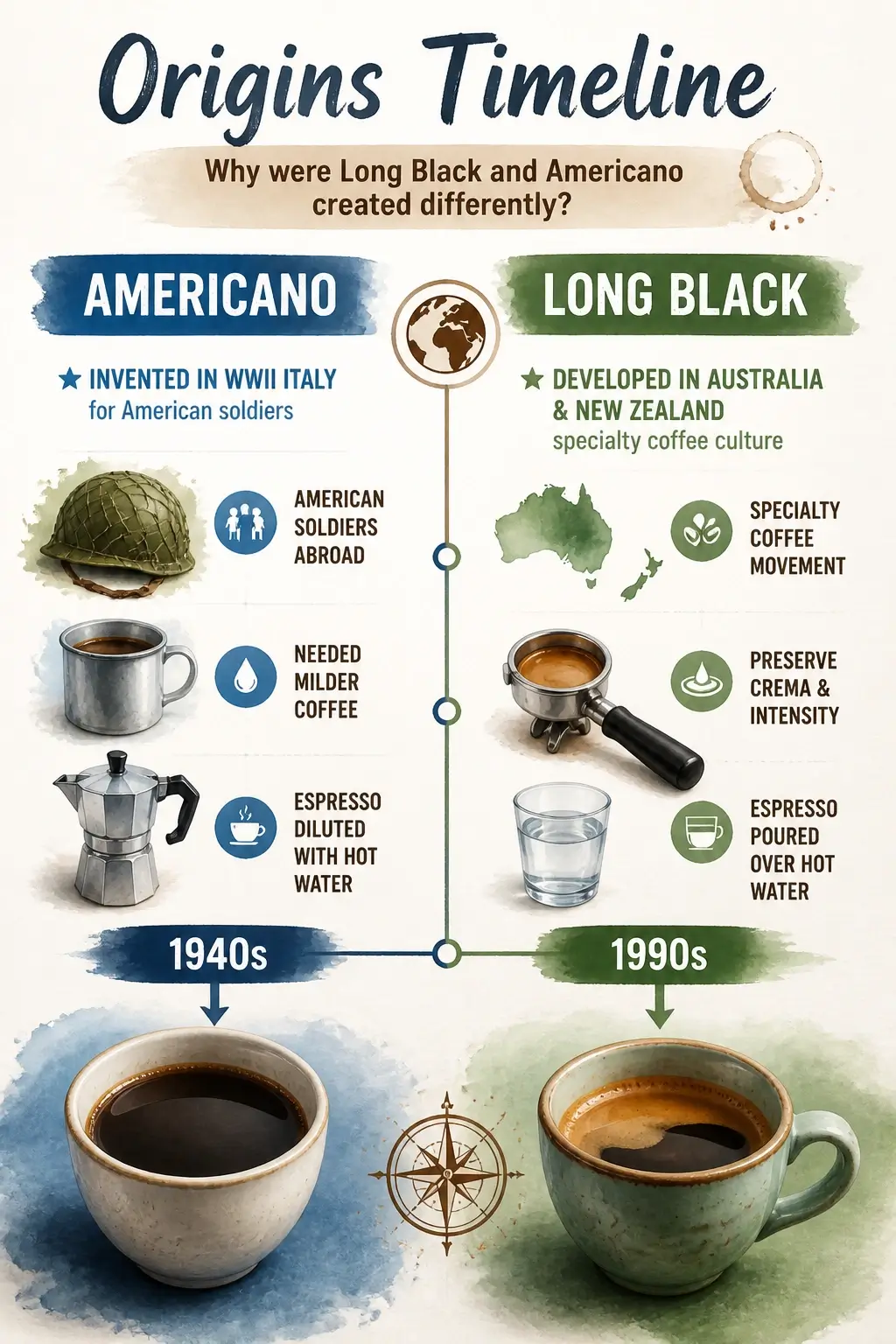
Historical origins rarely explain flavor, but for the Long Black vs Americano comparison, they explain almost everything. Both drinks are espresso diluted with water, yet they were invented to solve completely opposite problems, and that gap is why they taste so different in the cup.
To fully appreciate these variations, it helps to understand the broader history of espresso extraction that paved the way for both Italian and Anglo-Saxon adaptations.
The Americano: A WWII Menu Workaround
The Americano story starts in World War II Italy. American soldiers stationed there encountered traditional espresso and found it too intense: too small, too sharp, too far from the drip coffee they grew up with. Italian baristas found a practical fix: pour hot water into the cup first, then pull the espresso shot on top, or simply add water after. The result was something closer in volume and mildness to what the soldiers expected. It wasn’t a craft decision. It was a cultural translation: espresso made palatable for a different palate.
The drink that came out of that wartime shortcut was designed to mellow the espresso out, stretch its volume, and soften its edges. That’s still exactly what an Americano does today.
The Long Black: Australian Specialty Coffee’s Contribution
The Long Black came from a completely different pressure. Australian and New Zealand specialty coffee culture, one of the most technically demanding café scenes in the world, wasn’t trying to make espresso more approachable. It was trying to make it more expressive.
The method that emerged was deliberate: pull the espresso shot directly onto a bed of hot water already sitting in the cup. That reversed pour preserves the crema layer, which floats intact on the surface instead of getting broken up by water poured on top. The result is a drink with more aromatic intensity on the nose, a bolder first sip, and a flavor profile that actually showcases what’s in the bean. In Sydney or Melbourne, a Long Black isn’t a diluted espresso; it’s a concentrated black coffee where the extraction is the point.
James Hoffmann, the World Barista Champion and author of The World Atlas of Coffee, frames this distinction clearly:
“The long black is made by adding espresso to water, rather than water to espresso as with an Americano, and this preserves the crema and gives a stronger flavour.”
That one sentence captures the entire design philosophy behind the drink.
Technical Differences and Ordering Logic
Here’s the thing worth sitting with: these two drinks were invented to solve opposite problems. The Americano was a fix for a cultural taste mismatch: espresso was too strong, so dilute it. The Long Black was an innovation for flavor maximization: espresso is extraordinary, so protect it.
That divergence has a practical consequence most coffee blogs skip right over. Outside Australia and New Zealand, “Long Black” simply doesn’t appear on most café menus, especially in the U.S. So if you want one, you have to speak the language the menu already knows.
The workaround that’s spread across specialty coffee communities: order an Americano in the smallest cup available, usually around 6 oz. A smaller cup forces a lower water-to-espresso ratio, and you land functionally in Long Black territory without using the name. A cleaner version is to ask directly: “Can I get an Americano with half the water?” Most baristas will know exactly what you’re after.
The historical divergence between these two drinks isn’t just a coffee trivia footnote; it’s the reason one drink sits on every menu in the world and the other requires a workaround to order.
Head-to-Head: Ratio, Crema, and Why “Stronger” Isn’t Always What You Think
Pouring order isn’t just a ritual: it’s the mechanical switch that determines how concentrated your cup feels, whether your crema survives, and whether the first sip tastes bold or mellow. The comparative attributes that separate a Long Black from an Americano all trace back to that single upstream decision. Once you see the chain of events it sets off, the rest of the comparison writes itself.
Ratio and Crema Dynamics in Each Cup
Ratio and crema dynamics are where the physical differences between Long Black and Americano become concrete and measurable. A Long Black typically sits at a 1:2 water-to-espresso ratio, sometimes as tight as 1:1.5, keeping the total volume in the 150–180 ml range. An Americano stretches that out to 1:3 or 1:4 and beyond, landing in a 250–300 ml cup. That’s not just a size difference. It’s a concentration difference you’ll feel on your palate from the first sip.
The crema story follows directly from that. Crema is the aromatic foam that forms during espresso extraction, a thin emulsion of oils, CO₂ bubbles, and dissolved solids that carries most of the drink’s fragrance and top-note flavor. When you pour water onto espresso (Americano), you’re hitting that foam layer with force. It breaks apart, disperses into the liquid, and mostly disappears. When you pour espresso onto water (Long Black), the crema rides the shot down and settles on top, intact.
Water temperature plays a role here too. Levent Doganay, a Melbourne coffee expert at Coffee Brewmasters, is specific about this:
“Levent recommends using water that is heated to around 70°C. He says this gives a long black ‘greater clarity in flavour and a clean finish’. It will also keep the drink sweet, and help it to retain the layer of crema over the top.”
Cooler water is gentler on the crema structure and keeps the aromatic foam from collapsing on contact. That intact layer isn’t cosmetic; it’s the delivery mechanism for the Long Black’s signature aroma.
Calibrating these precise proportions requires familiarizing yourself with a standard espresso volume measurement guide to ensure your extraction parameters remain consistent.
| Feature | Long Black | Americano |
|---|---|---|
| Water-to-Espresso Ratio | 1:1.5–2.5 (typically 1:2) | 1:3–4+ (typically 1:3–4) |
| Total Volume | 150–180 ml (100–200 ml range) | 250–300 ml (200 ml+ range) |
| Crema Status | Intact / preserved | Broken / mostly dissipated |
| Perceived Concentration | Higher (stronger, richer, espresso-forward) | Lower (milder, more diluted) |
Taste Intensity and the “Stronger” Fallacy
Taste intensity is the attribute that causes the most confusion in the Long Black vs Americano debate (specifically around the word “stronger”) which is doing two completely different jobs and most coffee guides never stop to separate them.
Here’s what’s actually happening. A Long Black hits the palate with a bold, concentrated first sip. The preserved crema delivers aroma before the liquid even reaches your taste buds. The lower dilution means a higher density of dissolved coffee solids per milliliter: what coffee scientists call Total Dissolved Solids, or TDS. That’s what you’re tasting when a Long Black feels intense and espresso-forward. An Americano, by contrast, tastes uniform and mellow from first sip to last. The crema is gone, the dilution is higher, and the flavor is spread evenly across a larger volume of water.
But here’s where the “stronger” label breaks down. TDS, how intense one sip feels, is not the same thing as Extraction Yield, which measures the total mass of coffee compounds dissolved from the grounds. Research on TDS and sensory perception confirms that these are independent variables: identical extraction yields can coexist with very different TDS levels depending on how much water you add. In plain terms: if a Long Black and an Americano are both built on the same double shot, they started with the same espresso. The total caffeine extracted from those grounds doesn’t change because you added less water. What changes is how concentrated that caffeine feels per sip.
This is why some people who love the bold taste of a Long Black are genuinely surprised they don’t feel a stronger caffeine effect. They’re experiencing higher concentration, not higher dose.
One more variable almost nobody mentions: water quality. Hard water amplifies perceived bitterness, and because a Long Black uses less water to dilute that effect, mineral-heavy tap water can make it taste noticeably more bitter than the same shot pulled into a softer-water Americano. If a Long Black ever tasted harsher than you expected, your water was likely doing some of that work.
On everything else, the two drinks are essentially identical. Both clock in at 2–5 kcal per serving: negligible either way. Both need the same equipment: an espresso machine and a source of hot water. The only thing separating them is the order you pour, and the ratio you pour to.
The debate over strength often shifts when altering the base extraction, as explored in an espresso and ristretto comparison.
How to Make Both at Home and Order Anywhere
Practical preparation for Long Black vs Americano comes down to two things: which liquid hits the cup first, and how you communicate that to whoever’s holding the portafilter. Get those two details right, and everything else falls into place.
Home Brewing Workflow for Long Black and Americano
The home brewing workflow for each drink is genuinely simple: the only real friction is water temperature and cup geometry, and both are easy to manage once you know what to watch for.
For an Americano at home:
- Pull your espresso shot directly into your cup.
- Add hot water from your machine’s steam wand spout or a kettle until you reach your desired volume, typically filling a 6–8 oz cup.
- Stir and drink.
For a Long Black at home:
- Pour your hot water into the cup first (around 2–3 oz).
- Place the cup under the group head (this is the step that catches people off guard: your cup needs to physically fit under there with water already in it).
- Pull the espresso shot directly onto the water.
- Don’t stir yet; let that crema sit on top.
That cup-size constraint is real. A tall, narrow mug often won’t clear the group head once it has water in it. A shorter, wider cup around 6–8 oz is your best bet: it fits under the machine and gives the espresso room to land gently on the water without blasting through the crema.
On water temperature: you’ll see a range of advice out there, and honestly, none of it is wrong: it just depends on your beans. One grinder manufacturer’s guide recommends 70°C (158°F), citing Perfect Daily Grind. A coffee educator and café operator standard sits at 80–85°C (176–185°F), backed by a Scientific Reports study on extraction chemistry. Neither controls for roast level or bean origin, so there’s no universal magic number.
Here’s the practical starting point: use water just off the boil (around 85°C) for both drinks. If your Long Black tastes harsh or bitter, drop the temperature by 5°C and try again. For an Americano, you have more flexibility because the larger volume self-corrects; hotter water is fine since it cools as it mixes.
One thing the expert blogs consistently skip: water quality. A Reddit practitioner flagged it clearly: hard water can quietly ruin both drinks, and it hits a Long Black harder because the smaller volume concentrates any off-flavors. If your cup tastes flat or metallic even with good beans, filtered water is worth trying before you adjust anything else.
Here’s a hands-on look at both pouring sequences with real equipment:
Video: [How to Make an Americano & Long Black – Barista Tips] –
Café Ordering Script for Long Black and Americano
The café ordering script for a Long Black is straightforward, until you realize that fewer than 5% of U.S. cafés list it on their menu, according to The SCA’s 2023-2024 U.S. Menu Survey. The drink is so tightly woven into Australian and New Zealand coffee culture that most American baristas simply haven’t been trained on it. That’s not a problem; it just means you need a workaround.
Here’s the script that works anywhere:
- If “Long Black” is on the menu, order it directly, nothing more needed.
- If it’s not, say: “Can I get an Americano in the smallest cup you have?” or “An Americano with half the normal water, please.”
Either version signals to the barista that you want a concentrated, crema-preserved drink rather than a diluted 12 oz cup. Most baristas will understand immediately. If they look uncertain, add: “Water in the cup first, then the espresso on top”: that’s the whole instruction.
Once your drink arrives, how you approach the first sip matters. With a Long Black, hold off on stirring. That crema sitting on top is carrying the most aromatic compounds in the cup: your first few sips will hit differently than anything that comes after. Let the layers do their thing.
With an Americano, go ahead and stir right away. The goal there is consistent flavor throughout, and the crema has already mixed in during the pour. Stirring just finishes what the build already started.
Long Black or Americano: Which One Fits Your Daily Life?
Your daily coffee choice comes down to three things: how bold you want that first sip, how much liquid you want in your hand, and where you’re actually drinking it. The Long Black vs Americano decision isn’t about which drink is better: it’s about which one matches the way you already live.
If you want bold, aromatic, and layered: go Long Black. This is the drink for you if you’re drawn to specialty beans, if you want to actually taste what the roaster was going for, and if a smaller, punchy cup feels satisfying rather than insufficient. The preserved crema and concentrated flavor intensity hit differently than a diluted cup, and that difference is exactly the point. Yes, you’ll occasionally have to ask for a smaller cup or explain the pour order to a barista who’s never heard of it. That minor ordering workaround is a small price for a drink that treats the espresso as the star.
If you want long, smooth, and effortless: go Americano. If your morning routine means a big mug you sip for 20 minutes while answering emails, if you travel and drink coffee wherever you land, if you just want something that’s virtually impossible to mess up, the Americano is your drink. The cup volume is generous, the flavor is mellow enough to drink without pause, and café availability is universal. You’ll never have to explain it.
But here’s the part most coffee guides skip: these aren’t two tribes you have to pick between. Ask for a half-water Americano, or request it in a smaller cup, and you’ve already closed most of the gap in flavor intensity. You haven’t learned a new drink: you’ve just dialed the one you already know. That single adjustment gets you closer to Long Black territory without needing the name on the menu.
One honest warning on both sides: a Long Black made with water that’s too hot will scald the crema and taste harsh. An Americano with too much dilution will taste thin and flat. The ideal ratio (roughly 1:3 to 1:4 espresso to water) is the lever that fixes both problems. Now that you know it exists, you have the standing to ask for an adjustment at any café or make it yourself at home.
The real difference between these two drinks is pouring order, and that one choice cascades into everything: crema preservation, flavor intensity, aroma, and cup volume. Use your preference for boldness versus smoothness as your daily compass, and let the setting (home espresso machine versus café counter) guide the rest. You don’t need a scoring rubric. You have the map. The drink you actually want is already within reach.
Key Takeaways on Long Black vs Americano
- Pour water first for a Long Black—this one choice preserves crema, aromatics, and yields a bolder first sip.
- Order a small-cup or half-water Americano to get a Long Black anywhere outside Australia.
- Hard water amplifies bitterness; filtered water is non-negotiable for a clean Long Black.
- Long Black feels stronger, but caffeine content stays identical to an Americano made with the same shot.
- Water temperature near 70-85°C protects crema and prevents harsh, scalded flavors.
Frequently Asked Questions About Long Black vs Americano
Q: Does a Long Black have more caffeine than an Americano?
A: No. Both drinks use the same espresso shot, so caffeine content is identical. The Long Black tastes stronger because its crema preserves aromatic intensity and the lower water volume concentrates the dissolved solids, making each sip feel bolder without actually packing more caffeine.
Q: Why does hard water hit a Long Black harder than an Americano?
A: Hard water magnifies bitter, metallic off-flavors due to minerals. In a Long Black, the tiny water volume concentrates those defects without dilution. An Americano’s larger water content spreads them out, muting the impact. Filtered water is crucial for a clean Long Black.
Q: Why does water temperature affect a Long Black’s bitterness more?
A: A Long Black uses less water, so any scalding from overly hot water hits the crema directly and isn’t diluted away. Cooler water (70-85°C) preserves the foam and avoids extracting harsh, bitter notes that a larger Americano would mellow out naturally.
Q: Why shouldn’t you stir a Long Black immediately?
A: The crema on top holds the most intense aromatic compounds. Stirring disperses them, flattening that layered first sip. Drinking through the crema first gives you a bold, fragrant introduction; wait to stir until after you’ve enjoyed the espresso-forward top notes.
Q: What do you lose when an Americano’s crema disappears?
A: You lose the aromatic top notes—floral, fruity, and acidic highlights that define a coffee’s character. Without intact crema, the Americano tastes flatter and more uniform, offering a smoother cup but sacrificing the vibrant sensory introduction a preserved crema would deliver.
Q: Can you fix an Americano to taste like a Long Black after it’s made?
A: No. Once water is poured onto espresso, the crema is broken and the concentration is set. You can’t un-mix them. To get a Long Black’s bold, layered character, you must start over, pouring the espresso onto the water to protect the foam from the start.
Q: Why can’t you get a 12 oz Long Black?
A: The Long Black’s identity relies on a tight 1:2 espresso-to-water ratio, keeping total volume around 5-6 oz. Scaling to 12 oz with one shot would dilute it into a weak Americano. Multiple shots could maintain concentration, but then it’s no longer the traditional, punchy small drink.
References
- Shanny’s Guide to Ordering Coffee in Melbourne – Barista Magazine
- James Hoffmann YouTube Channel – YouTube
- What is a Long Black? – Perfect Daily Grind
- Effects of Total Dissolved Solids, Extraction Yield, Grinding, and Method of Preparation on Antioxidant Activity in Fermented Specialty Coffee – ResearchGate
- Extraction chemistry study – Scientific Reports (Nature)
- 2023–2024 U.S. Coffee Shop Menu Survey – Specialty Coffee Association
- How to Make an Americano & Long Black – Barista Tips – YouTube