Layered Yemen coffee history runs deeper than most specialty drinkers realize. Ethiopia grew the tree. Yemen built everything else around it – the ritual, the port, the monopoly, the flavor language, and eventually the genetic repository that modern breeders are only beginning to map.
This is the story of how a Sufi prayer vigil in 15th-century Aden became a global trade chokepoint, how a Red Sea port named Mokha gave the world a flavor vocabulary it still uses, and why a cup of Yemeni coffee today – if you can find an authentic one – carries 600 years of agricultural and cultural weight in every sip.
Key Takeaways on Yemen Coffee History
- Ethiopia is the botanical homeland of Coffea arabica, but Yemen is where the plant became a brewed, traded, and culturally practiced beverage – these are separate facts.
- The Sufi Shadhiliyya order created qahwa for nocturnal prayer vigils in the 15th century; that ritual became the world’s first coffeehouse culture within decades.
- Mokha’s Red Sea port gave coffee its first global trade language – the word “Mocha” is a port name, not a botanical variety or a single flavor profile.
- Yemen enforced its coffee monopoly through heat-treatment of export seeds to kill embryos; the breach came through individual smuggling acts over roughly two centuries, not a single event.
- The 2020 genomic sequencing identified “Yemenia” as a genetically distinct mother group of Coffea arabica, separate from Bourbon-Typica and Ethiopian landraces – a meaningful finding with real implications for breeding and flavor diversity.
- Authentic specialty Yemeni coffee commands $80–$150/lb today not as a brand premium but as a direct reflection of extreme scarcity, hand production, and difficult logistics from an active conflict zone.
From Ethiopian Forest to Yemeni Qahwa: Botanical Origin vs. Beverage Birth
Coffea arabica is native to the highland forests of Ethiopia, specifically the Kaffa region, where the plant grew wild long before anyone brewed it into anything. That botanical fact is not in dispute. But there is no confirmed evidence of coffee as a roasted, ground, and decocted beverage anywhere before the 15th century. The tree is Ethiopian. The drink is Yemeni.
Here’s where the distinction matters. By at least the 13th century, Yemeni farmers had already established terraced cultivation of coffee plants on mountain slopes. But it was the Sufi mystics of the Shadhiliyya order – led by figures such as Sheikh Muhammad al-Dhabhani – who transformed the raw cherry into something culturally irreversible. They roasted the beans, ground them, and brewed a dark decoction they called qahwa to sustain wakefulness through nocturnal prayers and dhikr vigils. That specific act – roasting, grinding, decocting, drinking with intention – is the birth of coffee as a beverage practice.
By the mid-15th century, qahwa had migrated out of the Sufi lodge and into Yemen’s urban coffeehouses. The ritual drink became a social one. The word qahwa itself – the Arabic term Yemenis coined for coffee – traveled with the trade routes and eventually gave us the Turkish kahve, the English coffee, and the Italian caffè.
[Photo]: https://coffeefactz.com/wp-content/uploads/2024/05/yemen-coffee-history.jpeg
Christophe Montagnon, Founder and CEO of RD2 Vision and former Chief Scientific Officer of World Coffee Research, noted that while it’s well established that nearly all cultivated Coffea arabica varieties trace their origins to Yemen – after seeds were first introduced there from neighboring Ethiopia – the actual genetic heritage of Yemeni coffee and its significance to the broader coffee world had never been properly explored before his team’s research.
That gap between “botanical homeland” and “beverage birthplace” is the central confusion in most coffee origin narratives. Ethiopia gave the world the plant. Yemen gave the world the cup, the coffeehouse, the trade network, and the cultural framework that every coffee tradition since has inherited or reacted against. Keep those two things separate and the rest of the history makes much more sense.
Some sources cite figures suggesting Yemen’s coffee genetic material accounts for a substantial share of global cultivar lineages. Those claims vary widely – numbers like “90%” or “98%+” appear in circulation – but the methodologies behind them are rarely spelled out in full. Treat them as directional attribution, not precise measurement. The genetic significance of Yemeni coffee is real. The specific percentages are contested.
The Port of Mokha and the World’s First Coffee Monopoly
Mokha – also written Al-Makha – is not a flavor. It’s a geography lesson that became a flavor descriptor by accident. The ancient Red Sea port on Yemen’s western coast was, from the 15th through the late 17th century, the only point on earth through which coffee legally left for the rest of the world. That made it the most important chokepoint in the history of any agricultural commodity.
Every sack of coffee bound for Persia, the Ottoman Empire, Egypt, and eventually Europe passed through Mokha. Merchants from across the known world anchored there. The port’s name became shorthand for the commodity itself – “Mocha” coffee – and when traders eventually noticed that beans from this region carried a distinctive earthy, chocolatey character, the port name fused permanently with a flavor profile. Today, “mocha” means a chocolate-coffee combination in most cafés. The etymology traces straight back to a Yemeni harbor.
[Photo]: https://coffeefactz.com/wp-content/uploads/2024/05/yemen-coffee-trade-mocha-port.jpg
Distinguish three separate things that the word “Mocha” now carries: the port city, the trade-era shorthand for Yemeni coffee, and the modern flavor descriptor. They’re historically connected but functionally distinct. No single botanical variety is called Mocha. No single flavor profile defines all Yemeni coffee. The port just happened to be where everything converged for two centuries.
[Photo]: https://coffeefactz.com/wp-content/uploads/2024/05/yemen-coffee-journey-map.jpg
Yemen’s dominance during this period wasn’t accidental. The country combined exclusive cultivation knowledge, geographic control of the Red Sea exit point, and – critically – an active policy of keeping that knowledge from leaving. Which brings us to the mechanism behind the monopoly.
The Germination Embargo and the Espionage That Broke Yemen’s Grip
A trade monopoly only holds as long as the underlying production stays exclusive. Yemen and its Ottoman governors understood this clearly. Their solution was elegant and brutal in equal measure: make sure no living seed ever left the country.
Export Seed Sterilization Policy
The germination embargo worked through heat. Every coffee bean destined for export was scalded, parched, or boiled before it crossed the port threshold. The goal was to kill the embryo inside the seed – to export the flavor without exporting the means of production.
One source describes this as an Ottoman policy with death-penalty enforcement for violations. The enforcement claim appears in the historical record but without detailed legal documentation, so it’s best understood as a claimed deterrent rather than a fully evidenced legal code. The heat-treatment mechanism, though, has a clear physiological basis.
A study published in Pesquisa Agropecuária Brasileira on Coffea arabica seed viability found that drying seeds at 60°C reduced germination rates to 60% at higher moisture levels and to zero percent at lower moisture levels. At 60–70°C, all seeds died. The Lercafé test used in that study classified heat-damaged seeds by their green-stained endosperm – a reliable marker of non-germinable material. The Ottoman method, whether scalding or parching, operated on exactly this principle: apply enough heat to the embryo and you ship a dead seed that tastes like coffee but can never become a tree.
Historic Seed Smuggling Routes
The embargo held for roughly two centuries. Then it broke in stages, through a series of acts that read less like geopolitical maneuvering and more like individual audacity.
Around 1670, an Indian Sufi saint named Baba Budan completed his pilgrimage to Mecca and returned home with seven fertile coffee seeds strapped to his body. He planted them in the Chandragiri Hills of what is now Karnataka, India. Seven seeds. That’s how thin the margin was.
The Dutch VOC moved more systematically. In 1696, their merchants smuggled live coffee seedlings out of Yemen to Java, establishing the plantation that would eventually make Dutch colonial coffee a global force. Then in 1723, a French naval officer named Gabriel de Clieu carried cuttings across the Atlantic to Martinique, planting the tree that would seed much of the Western Hemisphere’s coffee production.
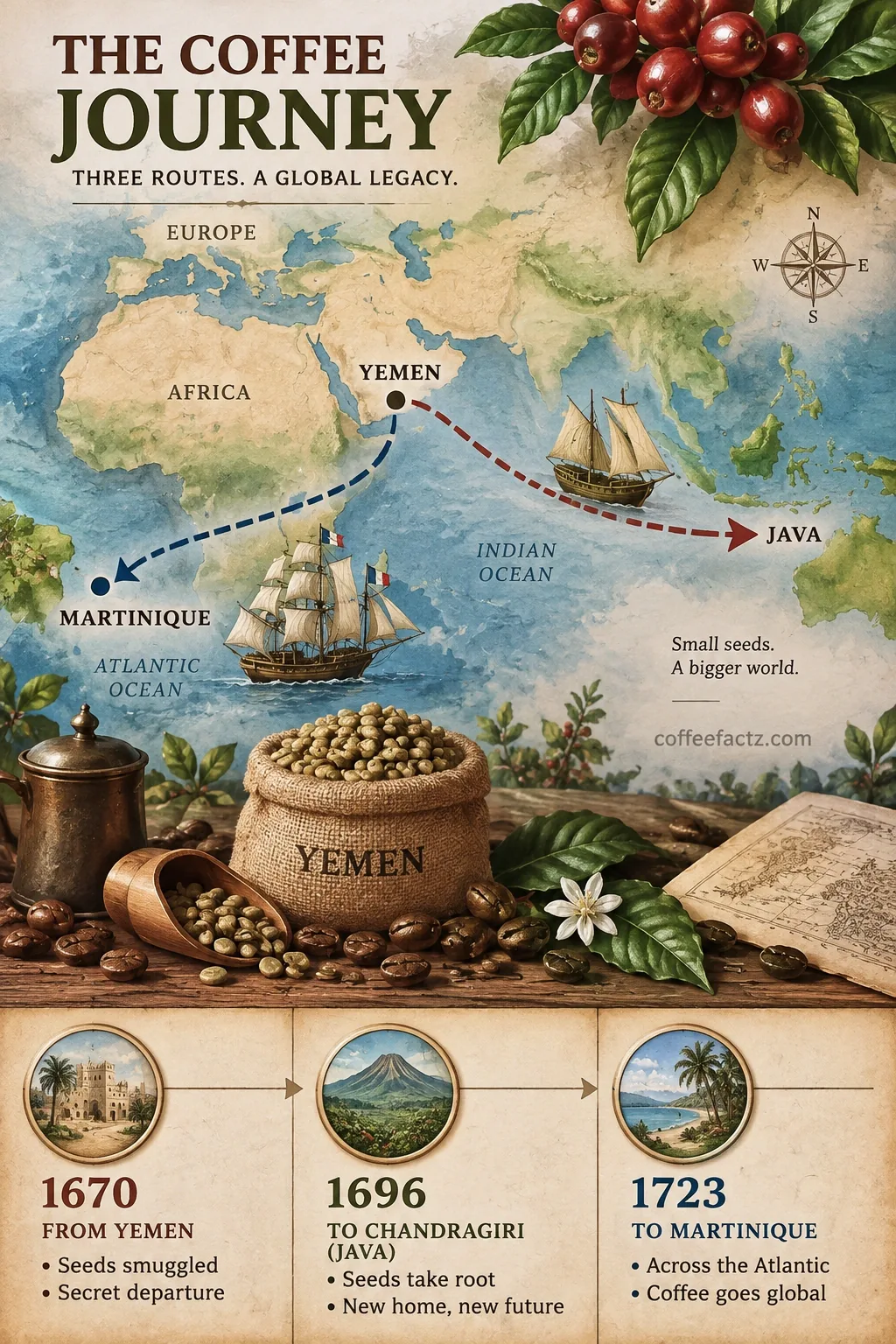
The monopoly’s end date is fuzzy across sources – some say mid-1600s, others say late 1600s or early 1700s, and a few describe it as lasting “about 200 years.” The precise year matters less than the pattern: the breach was incremental, not sudden. Each smuggling event opened a new production zone, and Yemen’s exclusive grip loosened one seed at a time. What remained after the monopoly collapsed was the question of whether Yemeni coffee itself – the terroir, the flavor, the genetics – still held something no one else had replicated.
Terraces, Rooftops, and Qishr: Yemen’s Extreme Terroir and Daily Cup
Yemeni terroir is not a marketing term dressed up in geography. It’s the product of a specific agricultural system built on stone, altitude, and centuries of accumulated knowledge – one that produces a flavor profile genuinely difficult to replicate anywhere else.
High-Altitude Microclimates and Stone Farming
The coffee-growing regions of Haraz (also spelled Haraaz), Bani Matar, Hayma, and Sanani sit at elevations between 2,000 and 2,500 meters. At that altitude, the temperature swings are wide, the sun is intense, and the soil drains fast through ancient volcanic rock. These aren’t the lush, humid highlands of Ethiopia or Colombia. They’re harsh, arid mountain environments where coffee plants stress-develop over long growing seasons.
The terraces themselves are hand-built from stone – some of them centuries old – cut into near-vertical slopes to capture the thin, precious topsoil and whatever rainfall the mountains receive. There are no machines on these terraces. The grade is too steep, the plots too small, the infrastructure too absent. Everything is hand-picked, which means selective harvesting at peak ripeness rather than strip-picking.
[Photo]: https://coffeefactz.com/wp-content/uploads/2024/05/yemen-coffee-monopoly-village.webp
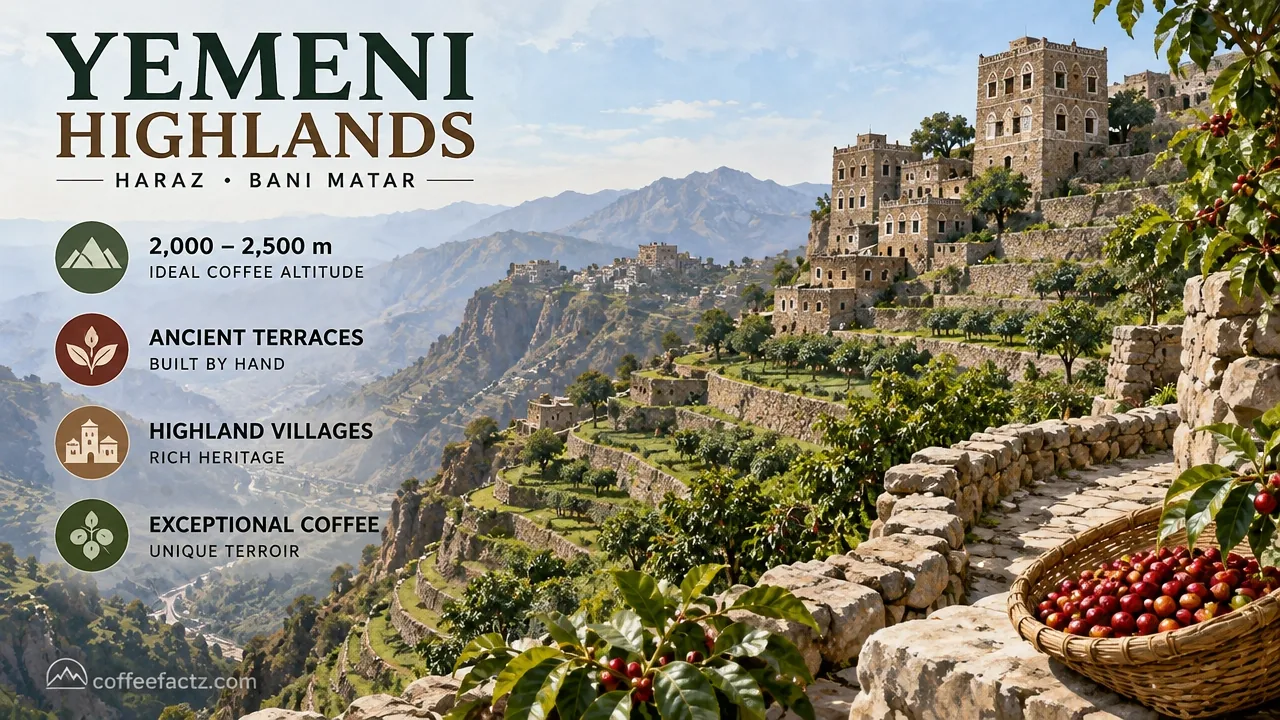
These are claimed terroir and quality factors, not certified production standards. Not every Yemeni coffee is organically certified, chemically free, or produced under identical conditions. The system described here represents traditional practice in the mountain regions, not a uniform national standard. What’s consistent is the structural constraint: low yields, high altitude, drought-prone growing conditions, and difficult export logistics.
Whole-Cherry Drying and Husk Infusions
After harvest, the cherries go to the rooftops. Flat stone surfaces on the upper floors of centuries-old Yemeni tower houses become drying beds – whole cherries spread in the mountain sun, turning slowly through a natural dry-processing fermentation that can last weeks.
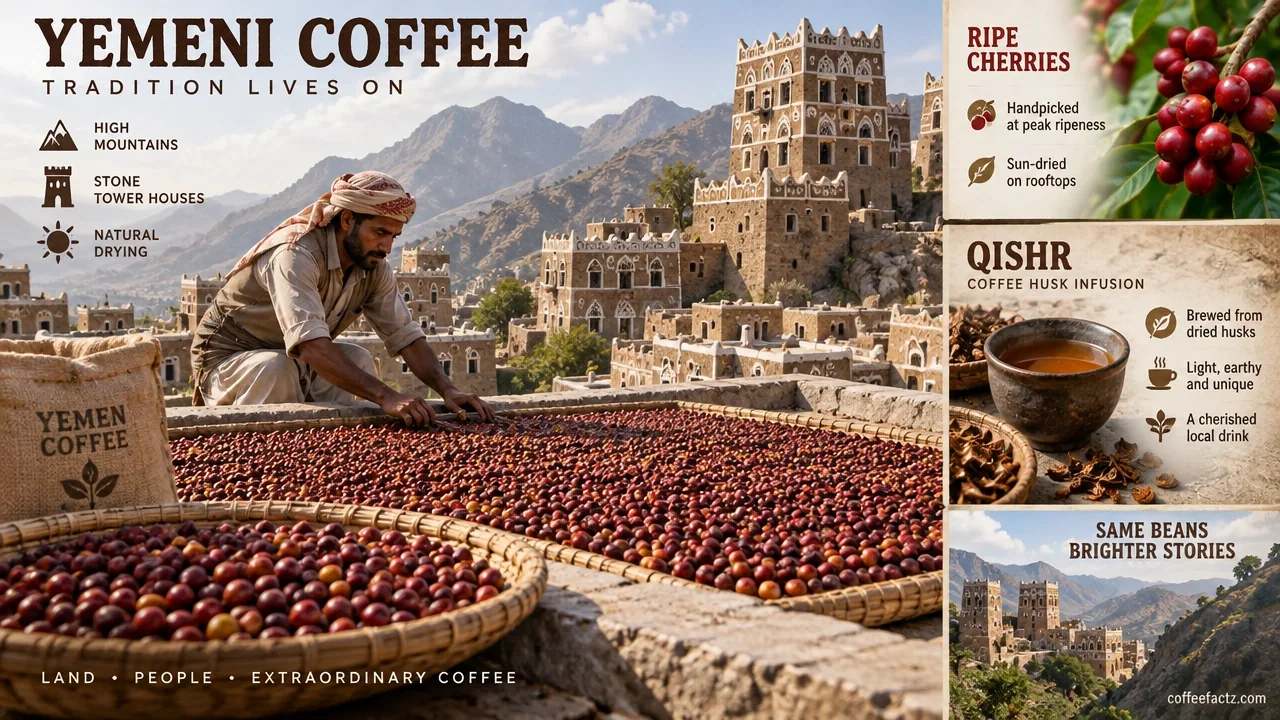
That extended contact between the drying fruit and the seed inside is what drives the flavor. The sugars in the cherry pulp migrate inward. The result is coffee with deep, wine-like body, chocolate weight, and often a cardamom or dried-fruit character that washed-process coffees from the same region simply don’t produce. This isn’t a stylistic choice. It’s a system built around the available infrastructure – flat rooftops, mountain sun, no wet-processing mills.
Here’s the economic detail most people miss: the valuable green beans were exported. Yemeni farmers kept the dried husks.
From those husks came qishr – a traditional daily brew made from dried coffee-cherry husks steeped with ginger and cinnamon. Lighter than brewed coffee, warming, and restorative, qishr was the everyday drink of Yemeni households while the beans that produced it shipped to Mokha and onward to the world. It’s a separate tradition from bean coffee entirely, one that survived precisely because it used what the market didn’t want.
[Photo]: https://coffeefactz.com/wp-content/uploads/2024/05/yemen-coffee-legacy.jpg
Most drinkers know Yemeni coffee as “Mocha” – chocolate, wine notes, earthy depth. The deeper reality is a specific rooftop-and-terrace production system running alongside a parallel qishr culture that never needed the green bean at all.
Yemenia: The 2020 Genetic Revelation and the Limits of Genetic Hype
Yemenia is the name given to a genetic grouping of Coffea arabica varieties identified through genomic sequencing work published around 2020. The claim is significant: these Yemeni varieties do not cluster with the Bourbon-Typica lineage that dominates global commercial coffee, nor do they map cleanly onto known Ethiopian landraces. They appear to represent a distinct mother group – a third recognized branch of cultivated Coffea arabica.
[Photo]: https://coffeefactz.com/wp-content/uploads/2024/05/Yemen-Ethiopian-Coffee-Genetic-Diversity.png
The chart above shows the genetic distance between Yemeni varieties, Bourbon-Typica descendants, and Ethiopian landrace populations. What it demonstrates is separation – distinct clustering that suggests a separate evolutionary and cultivation path. What it does not demonstrate is that Yemen is the sole botanical origin of all coffee, or that every cup of Yemeni coffee carries this distinct genetic profile. Those are different claims, and conflating them is how “Yemenia” slides from a genuine scientific finding into a marketing slogan.
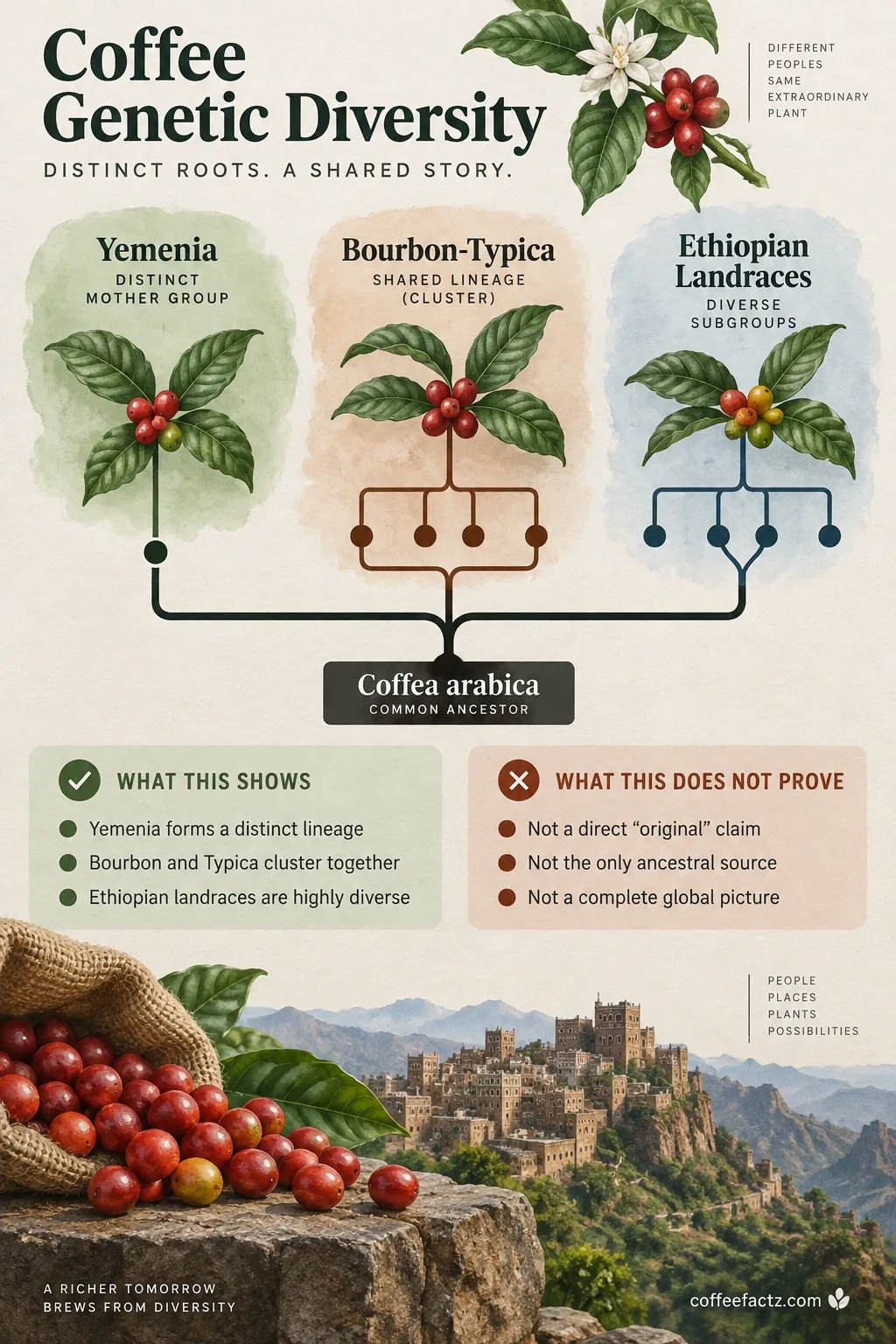
The practical significance for specialty coffee is real, though. A distinct genetic repository means distinct flavor potential – compounds and characteristics that Bourbon-Typica breeding programs don’t have access to. It also means Yemeni varieties carry breeding value for disease resistance, climate adaptation, and cup quality that the global coffee industry hasn’t fully mapped. If those varieties disappear because the farming system collapses, the genetic material goes with them.
The honest framing: Yemenia is a recognized genetic finding with meaningful implications for flavor diversity and coffee breeding. The supplied research corpus attributes the finding without providing a full primary-source methodology chain, so the article treats it as a significant attributed claim rather than a settled consensus. That’s not skepticism about the science – it’s accuracy about what the current evidence base can support. Seek out the primary genomic research if you want to go deeper. Don’t let a percentage or a brand name substitute for it.
The Extinction Crisis: Qat, Water Scarcity, Blockades, and the $80–$150/lb Paradox
Yemeni coffee’s extinction crisis is not a future risk. It’s a present condition. The country that held a global coffee monopoly for two centuries now produces less than 0.1% of the world’s coffee supply, according to one attributed source. That collapse didn’t happen overnight, and it didn’t happen for a single reason.
Premium Price Formation
Authentic specialty Yemeni coffee commands $80–$150 per pound today. That price is not a branding premium. It’s a scarcity calculation.
The math works like this: extreme altitude farming with hand-built terraces, no mechanization, low yields per tree, difficult logistics out of a conflict zone, and a specialty-market buyer base willing to pay for traceability. Every factor that makes Yemeni coffee distinctive also makes it expensive to produce and nearly impossible to scale. The price reflects the real cost of the system, not the perception of prestige.
Yemen once held a dominant position in world coffee trade. By 1800, its share of global production had fallen to roughly 6%, as Dutch, French, and British colonial plantations in Java, Martinique, and the Americas came to dominate. The trajectory from there continued downward – the “less than 0.1% today” figure, while requiring a sourced date and methodology caveat, points in a direction that every observer of the Yemeni coffee sector confirms directionally.
Cultivation Threats and Supply Collapse
The threats are structural, not cyclical. Water scarcity is perhaps the most fundamental: the ancient aquifers beneath Yemen’s mountain regions are depleting faster than rainfall can replenish them, and coffee is a thirsty crop.
Qat compounds the problem directly. The narcotic shrub is more profitable per acre than coffee, requires less water, and has a guaranteed domestic market. Farmers facing economic pressure don’t abandon coffee because they want to. They abandon it because qat pays the bills.
[Photo]: https://coffeefactz.com/wp-content/uploads/2024/05/yemen-coffee-collapse.jpg
Then add geopolitical conflict. The civil war that escalated in 2015 disrupted supply chains, damaged infrastructure, and created logistical blockades around key export routes including the port of Hodeida. Smallholder cooperatives – the backbone of Yemen’s coffee production – operate under conditions that would collapse most agricultural systems entirely. They persist not because the economics are favorable but because coffee farming is cultural identity in these mountain communities.
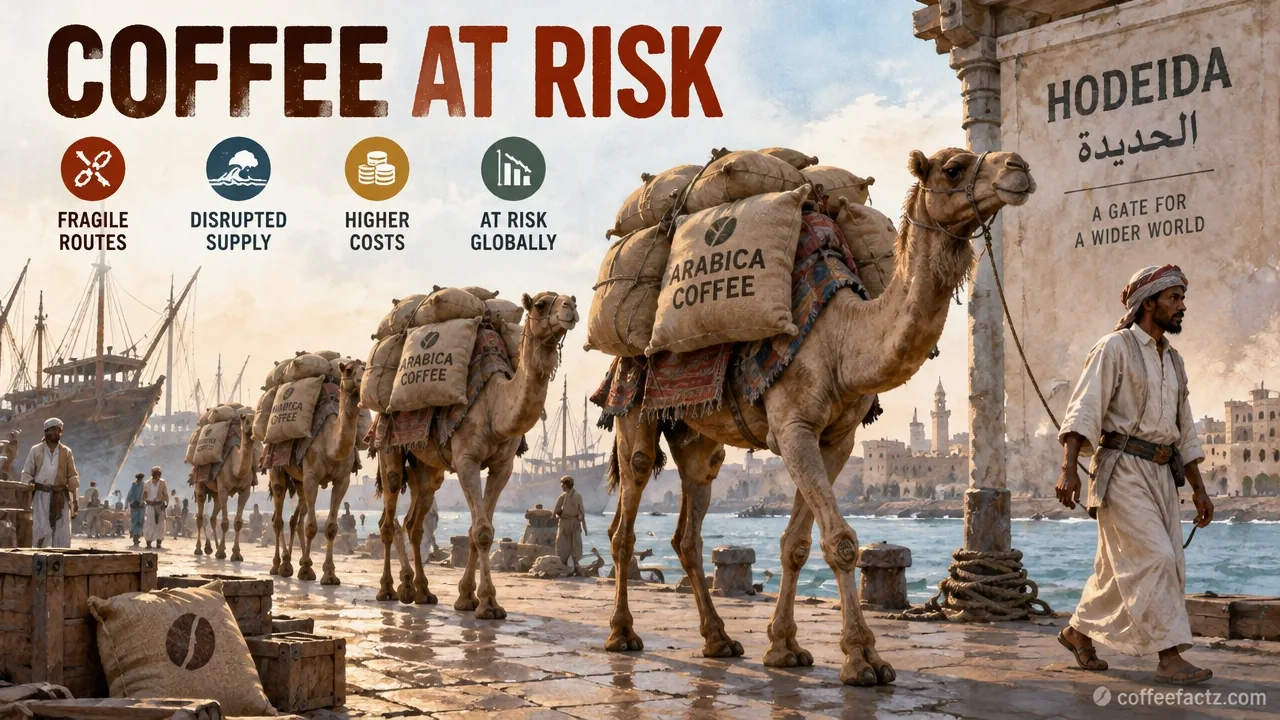
The combination of colonial-era smuggling that ended the monopoly, cheap competition from industrialized plantation coffee, decades of economic hardship, Qat expansion, and active conflict has compressed Yemen’s coffee sector into a narrow, fragile corridor. High price and low volume coexist not as a market strategy but as a survival condition.
The Modern Renaissance: What Yemeni Coffee History Means for Specialty Coffee Today
Yemeni coffee’s modern renaissance is real, but it’s small and deliberate – not a market surge. The evidence is in the infrastructure being built, not the volume being shipped.
The UNDP has documented concrete capacity-building in Yemen’s coffee sector: 45 young Yemenis trained in roasting and cupping, with 8 of them receiving international coffee-cupping certification through training in Amman in July 2023. Separately, 300 farmers received grants and technical training, and 45 small coffee enterprises received direct support. These are not numbers that signal a solved crisis. They signal an active rebuilding effort – people investing in the skills and infrastructure that traceable specialty coffee requires, under conditions that make that investment genuinely difficult.
Organizations like Qima Coffee have worked to build direct, traceable value chains between Yemeni farming cooperatives and specialty buyers internationally. The model matters: when buyers pay $80–$150/lb through transparent chains, more of that premium reaches the farming family rather than disappearing in intermediary margins. That economic signal is what makes it rational for a Yemeni farmer to keep terracing and hand-picking instead of switching to Qat.
The full weight of Yemen coffee history lands here. Yemen is not a historical footnote in coffee’s story. It’s the culture-birthplace – the place where the Sufi ritual became the coffeehouse, where the coffeehouse became the trade monopoly, where the monopoly built the port vocabulary we still use today. It’s a genetic repository that the specialty industry is only beginning to understand. And it’s a fragile, living benchmark for what coffee can taste like when the system is extreme, ancient, and intact.
What that means practically: seek out traceable Yemeni coffee from producers and importers who can name the farm, the region, and the cooperative. Respect qishr culture as a legitimate and distinct tradition, not a curiosity. Treat genetic claims like “Yemenia” with the precision they deserve – significant, attributed, and worth investigating further, but not a marketing shorthand for superiority. And recognize that every authentic bag of Yemeni coffee sold through a transparent chain is a small economic argument for keeping those terraces alive.
The world’s coffee culture started in a Yemeni prayer hall in the 15th century. Whether it still has a living Yemeni chapter in the 22nd is a question the specialty market is actively answering, one purchase at a time.
Frequently Asked Questions About Yemen Coffee History
Did coffee actually originate in Yemen?
Coffee the plant originated in Ethiopia. Coffee the beverage – roasted, ground, brewed with intention – originated in 15th-century Yemen, where Sufi mystics created qahwa for prayer rituals. Botanical homeland and beverage birthplace are two different things.
What made the Port of Mokha so historically important?
Mokha was the only legal exit point for coffee from the 15th through the late 17th century. Every bag of coffee that reached Persia, the Ottoman Empire, or Europe passed through that single Red Sea port, which is why the port’s name became the world’s first flavor descriptor for coffee.
How did Yemen enforce its coffee monopoly?
Export beans were heat-treated – scalded, parched, or boiled – to kill the seed embryo before shipment. A living seed could grow a tree. A dead seed could only be brewed. One source attributes death-penalty enforcement to Ottoman governors, though the legal documentation for that deterrent is not fully evidenced.
What is qishr and why did Yemenis drink it instead of coffee?
Qishr is a spiced brew made from dried coffee-cherry husks with ginger and cinnamon. Yemeni farmers exported the valuable green beans and kept the husks, turning them into a daily restorative drink. It’s a separate tradition from bean coffee with its own flavor profile and cultural identity.
Is “Yemenia” a real scientific discovery or a marketing term?
It started as a real genomic finding: sequencing work around 2020 identified Yemeni coffee varieties as a distinct genetic grouping, separate from both Bourbon-Typica and Ethiopian landraces. Whether individual brands use it accurately or inflate it into a superiority claim is a different question – the underlying science is attributed and significant, but the full methodology chain isn’t publicly exhaustive, so treat specific percentage claims with appropriate skepticism.
Why is Yemeni coffee so expensive today?
The price reflects real production constraints: hand-built stone terraces at 2,000–2,500 meters altitude, no mechanization, low yields, selective hand-picking, whole-cherry rooftop drying, difficult logistics through a conflict zone, and a global supply that amounts to less than 0.1% of world production. The $80–$150/lb range is a scarcity calculation, not a prestige markup.
Does Yemen still produce coffee despite the ongoing conflict?
Yes, though in very small volumes. Smallholder cooperatives in mountain regions like Haraz and Bani Matar continue farming. Organizations including the UNDP have supported capacity-building efforts – training in roasting, cupping, and cooperative management – but the sector remains fragile, not recovered.
What’s the difference between Yemeni coffee and Ethiopian coffee?
Ethiopia grows Coffea arabica in its wild-origin environment, typically with washed or natural processing across diverse landrace varieties. Yemeni coffee comes from a distinct genetic grouping cultivated on ancient stone terraces using whole-cherry rooftop drying, producing deeper, drier, more wine-like and chocolate-forward profiles shaped by altitude, arid climate, and centuries of selection.
References
- Characterization of injuries in coffee seeds through Lercafé test | Pesquisa Agropecuária Brasileira (Embrapa)
- Genetic diversity of Yemeni Coffea arabica – Christophe Montagnon et al. | link.springer.com