
South Korea’s era of ultra-cheap takeaway coffee is being steadily chipped away, as Mammoth Coffee joins a wave of budget chains nudging up prices in response to higher bean, labor and input costs.
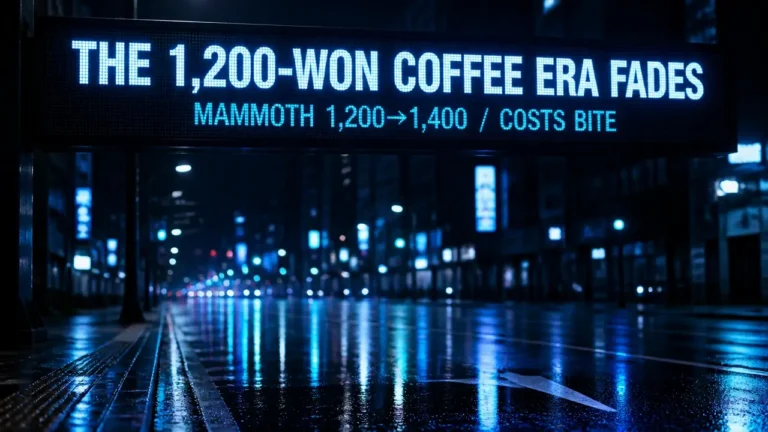
According to Seoul Economic Daily and Korea JoongAng Daily, Mammoth Coffee will raise selected iced Americano and iced decaf Americano prices by 200 won (about US$0.15) per cup from August 11, 2026, while leaving hot Americanos and large sizes unchanged. The small iced Americano will move from 1,200 to 1,400 won, the medium from 1,600 to 1,800 won, with similar 200-won jumps for iced decaf sizes.
Mammoth Coffee, which recently surpassed 1,000 stores in Korea and operates four locations in Tokyo, framed the change as a break from its previous approach. A company official told Seoul Economic Daily that, “Despite rising raw material costs, we have maintained our existing prices by internally absorbing the factors driving increases in order to minimize the burden on customers,” adding that “recent instability in the international situation and rising overall costs” had made price adjustments “unavoidable.”
The move follows a series of increases across Korea’s budget and mid-market cafe sector this year. Seoul Economic Daily reported that Mega MGC Coffee lifted three items in its Halmega lineup by 200 won from June 19, 2026, while The Venti raised many drinks by 100 to 500 won from May 29, 2026. Earlier in March, Banapresso and Brewda (also reported as Bruda) Coffee raised prices on selected menus by up to 700 won and 300 won respectively, according to Seoul Economic Daily.
Premium and retail-focused brands have also adjusted. Korea JoongAng Daily and Seoul Economic Daily both reported that The Coffee Bean increased small drip coffee from 4,700 to 5,000 won and regular drip from 5,200 to 5,500 won, while Ediya Coffee lifted prices on stick coffee and coffee mix products by 4.3% to 15.2% from June 6, 2026. Ediya had already raised cafe drink prices by around 300 won on 31 menu items while increasing serving size from 14 to 18 ounces late last year.
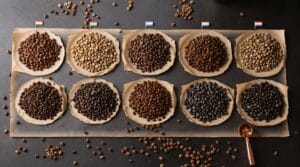
The domestic pressure comes on top of marked rises in global coffee prices. Citing international market data, Seoul Economic Daily reported that arabica coffee futures climbed more than 30% over the past year, from around $2.50 per pound to nearly $4.00. Over 2024, the average arabica bean price jumped 57.37% year-on-year to $8,116 per ton, while robusta beans more than doubled from $1,800 per ton in January 2023 to $3,872 per ton at the end of 2024, the paper added in a June 15 report.
Those global benchmarks are feeding into Korean import costs. Korea’s coffee import price index rose 3.6% year-on-year as of November, and total coffee imports reached a record $1.861 billion last year, up 35% from the previous year, according to Seoul Economic Daily. The outlet also noted that international coffee bean prices had risen for three consecutive years.
Rising wages and other inputs are adding to the squeeze on Korea’s low-margin, high-volume cafe model. Seoul Economic Daily reported that the country’s minimum wage for 2027 has been set at 10,700 won per hour, an increase of 3.7%, and that prices for milk, sugar, syrups, packaging and other materials are rising faster for latte, decaf and cold brew drinks than for basic Americanos.
In a market where price is a primary differentiator, even small increases matter. A Korea Consumer Agency survey of 1,600 cafe users found 37.2% named price as the most important factor in choosing a budget coffee chain, nearly double the 19.2% who cited flavor, according to Korea JoongAng Daily. Seoul Economic Daily calculated that a 200-won rise per cup adds up to 4,000 won per month, or 48,000 won per year, for someone buying 20 coffees monthly.
Some regulars are already changing habits. “Buying an iced Americano at a budget cafe every morning used to be my routine, but with prices constantly rising, I now get by with the office coffee machine more often these days,” an office worker commuting to Gwanghwamun told Seoul Economic Daily, adding, “I can’t quit coffee, but I think I have no choice but to change the way I drink it.”
The tension between Korea’s intense coffee demand and the rising cost of supplying it is significant for the industry. Seoul Economic Daily noted that Koreans drank an average of 416 cups of coffee per person in 2024—2.7 times the global average of 152 cups and second only to France’s 551 cups—while an Open Survey report cited by the same outlet found budget chains such as Mega Coffee and Compose Coffee were the most frequently visited brands among 2,000 cafe users.
Policymakers are watching the situation. An official at the Ministry of Economy and Finance told Seoul Economic Daily that the government is “comprehensively monitoring weather conditions in overseas producing countries and exchange rate fluctuations” and will review measures to stabilize consumer prices, while tariff quotas on coffee and nine other food ingredients are set to be extended through the end of next year.