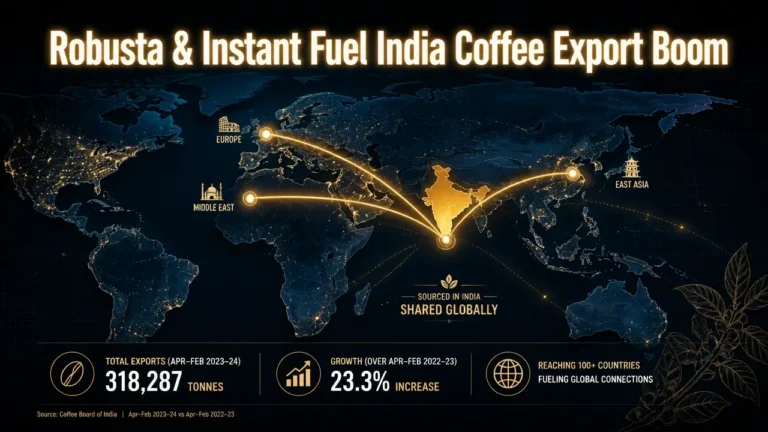

India’s coffee shipments are extending last season’s record run, with provisional exports reaching 318,287 metric tonnes between 1 January and 23 August 2026, according to the AgroSpectrum India report that cites the latest daily bulletin from the Coffee Board of India.
The figure, which includes re‑exports, is up from 258,066 tonnes in the same period of 2025, an increase of about 23.3 per cent. Exports excluding re‑exports climbed to 239,828 tonnes from 193,975 tonnes, a rise of roughly 24 per cent over the previous year, AgroSpectrum noted, underlining that the growth is broad‑based rather than confined to transit trade.
Robusta is at the centre of the expansion. AgroSpectrum reported that provisional robusta cherry exports reached 135,480 tonnes between January and 23 August, compared with 105,223 tonnes a year earlier, an increase of about 29 per cent. Arabica parchment shipments also grew, to 39,380 tonnes from 31,400 tonnes, while arabica cherry exports rose to 10,360 tonnes from 8,715 tonnes, and robusta parchment eased slightly to 18,896 tonnes from 19,230 tonnes.
Value‑added and soluble coffees are playing a larger role in India’s export basket. AgroSpectrum stated that provisional instant coffee exports stood at 35,297 tonnes in the year to 23 August, versus 29,066 tonnes in the same 2025 period, while instant coffee re‑exports rose to 78,459 tonnes from 64,090 tonnes. Combined instant coffee shipments, including re‑exports, reached 113,756 tonnes, up from 93,156 tonnes, and accounted for more than one‑third of total coffee shipments.
The current surge builds on a record 2025–26 fiscal year. In April, The Hindu BusinessLine reported that India’s coffee exports in the 2025–26 financial year reached $2.136 billion, up 17 per cent from $1.82 billion in the previous year. Export volumes rose 4.65 per cent to 4.07 lakh tonnes from 3.88 lakh tonnes, while per‑tonne realisation increased 17 per cent to ₹4,64,041 from ₹3,96,525.
Commenting on that performance, Ramesh Rajah, president of the Coffee Exporters Association, told The Hindu BusinessLine that “a five per cent growth in volumes is a commendable performance on a higher base.” The same report described India as the world’s seventh‑largest coffee producer and fifth‑largest exporter and noted that shipments had nearly doubled over the preceding four years.
Officials at the Coffee Board linked the earlier record year to both policy and product shifts. Kurma Rao M, chief executive officer and secretary of the Coffee Board of India, said in the BusinessLine report that “the initiatives taken by the Government towards ease of doing business helped boost the shipments. Besides the demand for value‑added coffees also contributed to the growth.”
More recent trade data suggest that higher unit values have carried into 2026 alongside larger volumes. The Economic Times reported that India’s coffee exports in the first four months of 2026 reached 1.74 lakh tonnes, up 26.6 per cent year‑on‑year, with export earnings of ₹936.57 crore compared with ₹757.07 crore a year earlier. The paper calculated a unit value of ₹4,94,766 per tonne for January–April 2026, higher than ₹4,75,023 per tonne in the same period of 2025.
Within that January–April window, robusta again led volumes and instant coffee added momentum. Economic Times data showed robusta exports of 85,168 tonnes, up from 62,736.92 tonnes, an increase of about 36 per cent, while instant coffee shipments rose to 20,332 tonnes from 17,504 tonnes. The report also noted that India exported 3.82 lakh tonnes of coffee in calendar year 2025, while the Coffee Board’s post‑blossom estimate for the 2025–26 crop year (October–September) stood at a record 4,03,000 tonnes, with arabica at around 1,18,000 tonnes and robusta over 2,84,000 tonnes.
Weather, however, is beginning to temper the production outlook even as exports expand. Commodity Board News reported on 27 August that India’s 2026–27 coffee crop is facing a weather‑driven setback of about 4 per cent, with production projected at roughly 368,000 tonnes, or 6.1 million 60‑kilogram bags. The publication attributed the downgrade to weak pre‑monsoon rainfall in the key coffee districts of Kodagu, Chikkamagaluru and Hassan in Karnataka and Wayanad in Kerala and noted that the USDA’s Mumbai office had reiterated a similar 4 per cent decline scenario.
Against that backdrop, AgroSpectrum highlighted that the Coffee Board’s daily market report for 24 August used an exchange rate of ₹95.72 to the US dollar, and pointed to pressure on global prices from expectations of a faster Brazilian harvest and rising robusta inventories, with December arabica futures down 2.02 per cent to 322.65 US cents per pound and September ICE robusta futures 2.81 per cent lower at $3,598 per tonne.
Taken together, the official export tallies, trade data and market reports depict India moving more coffee, especially robusta and instant formats, into international channels in 2026 on the back of a record 2025–26 season, even as weather‑related production risks emerge for the 2026–27 crop.