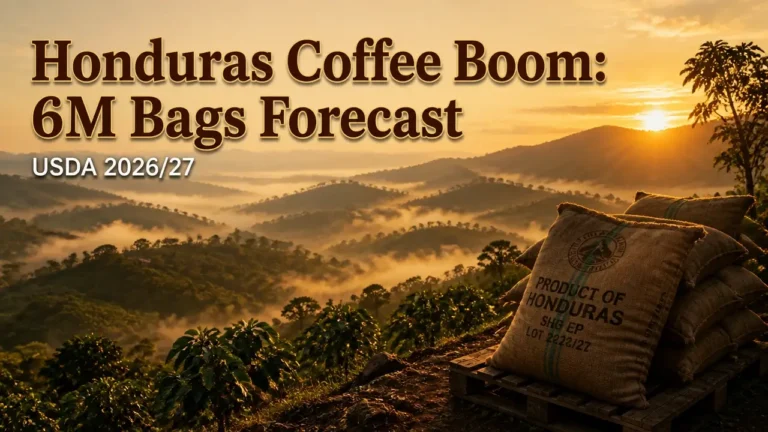

Honduras is on course to produce 6.03 million 60-kilogram bags of coffee in marketing year 2026/27, according to a late-April forecast from the U.S. Department of Agriculture’s Foreign Agricultural Service — a figure that would represent a significant step up from the 5.53 million bags the agency projects for the current marketing year, 2025/26, which runs from October through September.
The USDA report, published on 29 April 2026, also forecasts Honduran coffee exports at 5.03 million bags for MY 2025/26, rising to 5.50 million bags in MY 2026/27. Those projections arrive against a backdrop of sharply higher prices: according to Qahwa World, the average Honduran export price reached $345.82 per 60-kg bag in April 2025, an 81 percent increase from $191.34 the previous year, with total export earnings rising to $1.02 billion in MY 2025/26 — roughly double the $507 million recorded the prior year. Qahwa World attributed the price spike to global supply disruptions in Brazil and strong international demand.
The current USDA production outlook for MY 2025/26 is notably lower than projections published a year earlier. In May 2025, both Coffee Geography Magazine and Qahwa World reported forecasts of 5.80 million bags for that same marketing year, with exports of 5.50 million bags — figures also cited by Daily Coffee News. The USDA’s revised 2026 report now places MY 2025/26 production at 5.53 million bags, a difference of approximately 270,000 bags from those earlier estimates. No named source in the available data explicitly accounts for the revision.
The USDA cited improved plant nutrition, favorable biennial production cycles, expansion of productive areas, enhanced pruning and crop management, and the maturation of new plantations as factors supporting growth. Disease pressure has also eased: Daily Coffee News reported that coffee leaf rust incidence was forecast to average 2.9 percent nationwide through August 2025, and a survey by the Honduran Coffee Institute (IHCAFE) found that 76 percent of sampled farms had low rust levels as of April 2024.
The sector’s commercial profile has also shifted. Specialty and differentiated coffees accounted for 52 percent of total exports — approximately 2.6 million bags — in MY 2023/24, according to Qahwa World. Export contracts increased to 3.33 million bags, a 19 percent rise year-over-year. Coffee Geography Magazine identified the United States, Europe, and Asia as key destination markets, with Qahwa World noting the United States, Germany, Belgium, Italy, and Canada among the top buyers and South Korea emerging as a market through a free-trade agreement.
The outlook is not without risk. Coffee Geography Magazine reported that industry observers caution the forecast is vulnerable to volatile global coffee prices, climate variability, and logistical bottlenecks at Honduran ports. A separate and countervailing force is building on the supply side: expectations of a record Brazilian coffee crop of approximately 75 million bags are putting downward pressure on global prices, according to financial data provider Barchart, which published that assessment on 21 April 2026. Honduras ranks as the eighth-largest coffee exporter globally, according to Daily Coffee News, and the sector supports more than 100,000 smallholder families, Coffee Geography Magazine reported.