Global coffee drinkers are facing what one major industry figure calls a “delicate situation,” as historically high prices coincide with a projected record crop in Brazil and persistent vulnerabilities in fertilizer supply chains. Speaking in São Paulo on 7 May, Andrea Illy, chairman of Italian coffee company
Illycaffe, warned that these conditions could pave the way for future price crises.“We are also experiencing a scenario of historically high prices; this creates a delicate situation,” Illy said at a press conference, according to
Reuters. The same report noted that while Arabica coffee recently touched an 18‑month low of
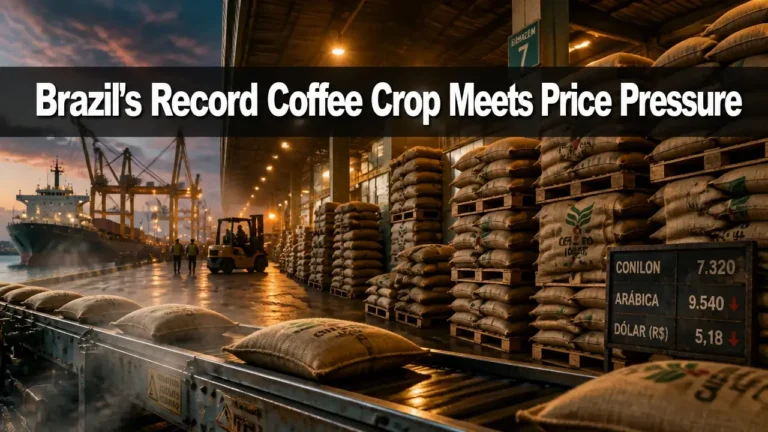
$2.7280 per pound, prices remain elevated compared with the last decade.Brazil, the world’s largest coffee producer, is expected to harvest a record 66.2 million 60‑kilogram bags in 2026, according to government projections cited by Reuters and detailed by Brazilian crop agency
CONAB in estimates reported by
Global Coffee Report. CONAB forecasts that this total would represent a 17.1% increase over 2025, with 44.1 million bags of Arabica and 22.1 million bags of Conilon.Illy linked today’s market to rapid expansion on the ground. “We observed a greater number of new crops, a consequence of higher and more attractive prices for increasing production,” he told reporters, according to Reuters. He cautioned that “there is a risk of excessive production expansion and future price crises, as well as the opposite risk of reduced supply caused by extreme weather events.”The production surge comes after a strong export year for Brazil. CONAB figures cited by Global Coffee Report show that Brazil’s coffee exports reached a record US$16.1 billion in 2025, underscoring robust international demand for both green and processed coffee from the country.Futures markets have started to react to expectations of ample Brazilian supply. On 6 February, Arabica coffee futures for March delivery on the New York exchange slipped 0.08% to $3.0840 per pound, according to
Valor International. In the same report, Pine Agronegócios analyst Vicente Zotti projected that July coffee contracts could fall toward [UNVERIFIED] $2.50 per pound.Despite these shifts on the screen, Illy and Brazilian officials highlighted structural pressures that keep the sector exposed. Reuters reported that Brazil’s government relies on external sources for approximately 85%–90% of its fertilizer needs, a dependence made more costly by the war in Iran and related geopolitical tensions. This exposure directly affects coffee production costs in Brazil, which is heavily dependent on fertilizer imports.Illy pointed to farming practices as a partial buffer against such shocks. “Regenerative agriculture has played an important role in reducing the Brazilian coffee industry’s exposure to problems facing imported mineral fertilizers,” he said, according to Reuters. He added that the current environment “highlights the need to increase efficiency, productive autonomy, and resilience in the field.”Alongside climate risks and fertilizer dependence, Illy’s warning about high prices and expanding plantings frames a market where both oversupply and shortage are seen as real possibilities. For producers, exporters and roasters, this combination of record Brazilian output, elevated international prices and fragile input supplies is defining the current coffee landscape, according to the assessments from Reuters, Global Coffee Report and Valor International.

 By | May 23, 2026