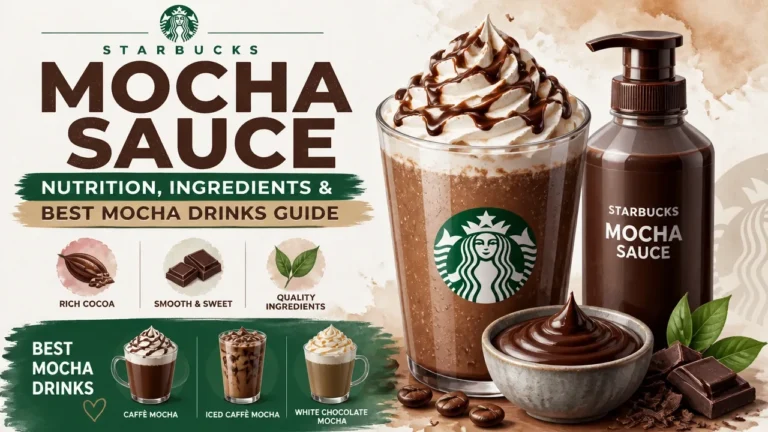

Starbucks Mocha Sauce is one of the most ordered flavoring components on the menu, yet its per-pump nutrition is nowhere on the board. Starbucks publishes finished-drink totals, not component-level labels, which means the calories, sugar, and dairy status of the sauce itself stay buried inside a composite number most people never question.
That gap matters more than it sounds. Dark mocha and white chocolate mocha sauce behave like completely different ingredients – different calorie density, different dairy status, different scaling behavior as pump count rises. Once you understand how each one works, the customization math becomes straightforward.
Starbucks Mocha Sauce Nutrition Card: Per-Pump Baseline and Ingredient Decode
Starbucks Mocha Sauce nutrition starts at the pump level, but that number is harder to find than it should be. The official Starbucks app and website organize every calorie figure around finished drinks – a Grande Caffè Mocha, a Venti White Mocha – not around the sauce component sitting inside them. So the per-pump baseline has to be reconstructed from community measurement, reverse calculation, and ingredient-level sourcing.
Here’s what that reconstruction produces.
Standard Dispenser Portion and Caloric Ranges
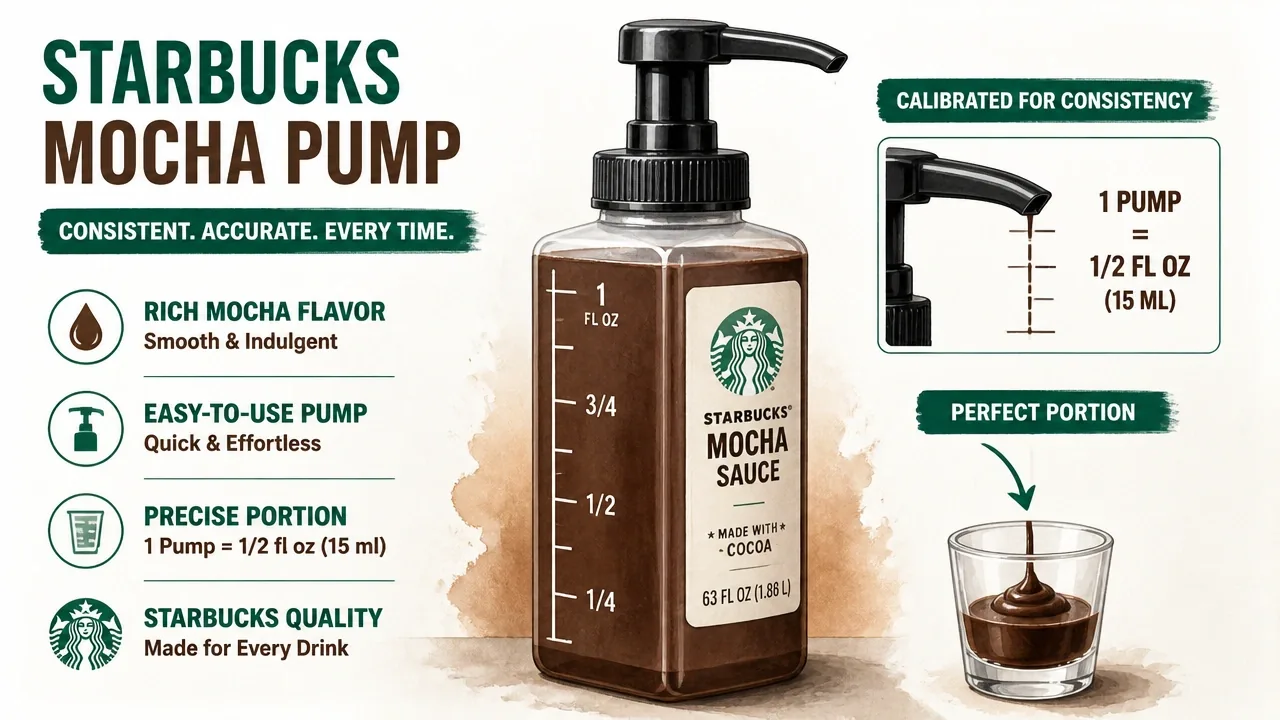
One pump of regular dark mocha sauce delivers roughly 25–35 kcal, approximately 5g of total sugar, 0.5–1g of fat, and a trace caffeine contribution near 5mg. Those ranges exist because a “pump” is a practical dispenser portion, not a lab-certified volume. Starbucks calibrates its pumps by product type, and the exact milliliter output can vary between sauce viscosities and dispenser generations – which is exactly why the per-pump calorie card is hard to pin down with precision.
The deeper reason this component-level data is difficult to locate is structural: Starbucks builds its public nutrition system around the finished drink, not the sauce inside it. A barista knows how many pumps go into a Grande, but that pump count is embedded in a total that also includes milk, espresso, and any toppings. Isolating the sauce requires working backward from the drink total – which is doable, but it means the number you find is always an estimate, not a label.
Understanding how these chocolate and dairy components interact provides essential context when evaluating the structural mocha latte and cappuccino profiles.
Cocoa Composition and Dairy-Free Status
The ingredient list for regular dark mocha sauce is short: water, sugar, cocoa processed with alkali, and natural flavors. No milk. No cream. No dairy derivative of any kind in the standard U.S. formulation.
The phrase “cocoa processed with alkali” – also called Dutch-processed or Dutched cocoa – refers to a treatment that raises the cocoa’s pH using an alkaline solution, heat, and pressure. A peer-reviewed review in Comprehensive Reviews in Food Science and Food Safety explains that this alkalization process darkens cocoa’s pigment from light brown toward deeper red-brown or near-black tones, while simultaneously reducing the perceived acidity, astringency, and bitterness that characterize natural cocoa. The same treatment modifies volatile aroma compounds in ways that shift the flavor profile toward the smoother, more rounded chocolate character you taste in the sauce. None of that requires dairy – it’s a chemical transformation of the cocoa itself.
This matters practically: regular dark mocha sauce is dairy-free and vegan-friendly in its standard U.S. form. The sauce that is not dairy-free is White Chocolate Mocha Sauce, which contains condensed skim milk as a core ingredient. That distinction is the single most important split on the mocha sauce menu for anyone managing dairy intake.
Dark Mocha Sauce vs. White Chocolate Mocha Sauce: Calorie Density and Dairy Split
The choice between dark mocha and white chocolate mocha sauce isn’t just a flavor preference – it’s a nutritional fork in the road that compounds with every pump added to the drink.
Dark Mocha Sauce runs 25–35 kcal per pump. The flavor is bittersweet, with genuine cocoa depth and low residual sweetness. It contains no dairy. White Chocolate Mocha Sauce runs approximately 49–60 kcal per pump – nearly double the calorie load – with a buttery, vanilla-forward sweetness and a richer mouthfeel that comes directly from its condensed skim milk base. White mocha is also a thicker sauce by consistency, which affects how it disperses in the drink and how it scales as pumps increase.
The calorie multiplier becomes significant fast. A standard Grande White Chocolate Mocha uses four pumps of white mocha sauce, contributing roughly 200–240 kcal from sauce alone before milk, espresso, or whipped cream enter the equation. A Grande built on regular dark mocha sauce uses the same four pumps but generates only 100–140 kcal from the sauce component. That’s a 100-calorie gap from a single ingredient swap – one that most people ordering by drink name never see.
Community measurement has produced a more concrete portion reference for white mocha: one pump weighs approximately 13 grams (0.459 oz), which gives a physical anchor to what “a pump” actually means when the label stays vague. For dark mocha, no equivalent community weight measurement has been as consistently documented, reinforcing the point that per-pump data is estimated, not standardized.
One common parsing error worth flagging: a Grande White Chocolate Mocha cited at around 400 calories is typically the figure without whipped cream. Add whip, and the number climbs further. That means sauce reduction – cutting pumps or switching sauce type – carries even more weight as a calorie-control lever than the menu total suggests.
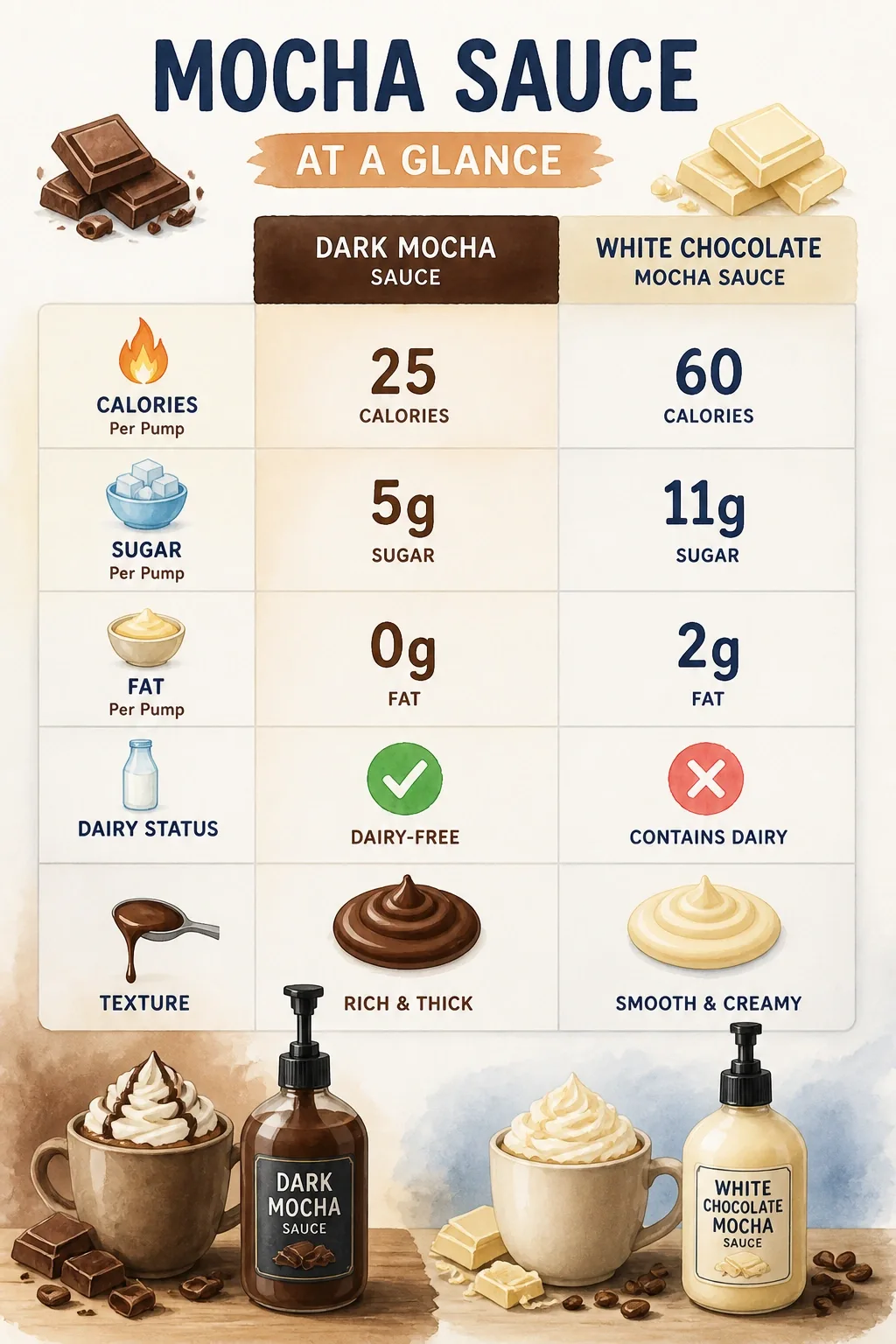
| Feature | Dark Mocha Sauce | White Chocolate Mocha Sauce |
|---|---|---|
| Calories per pump | 25–35 kcal | ~49–60 kcal |
| Sugar per pump | ~5g | Higher (condensed milk adds sugar) |
| Fat per pump | 0.5–1g | Higher (milk fat present) |
| Dairy-free | Yes | No |
| Vegan-friendly | Yes | No |
| Flavor profile | Bittersweet, cocoa-forward | Sweet, buttery, vanilla-cocoa |
| Grande sauce calories (4 pumps) | ~100–140 kcal | ~200–240 kcal |
Why Total Drink Calories Only Tell Half the Story: Reverse-Calculation and Pump Calibration
Every calorie figure on the Starbucks menu is a composite. The total you see for a Grande Caffè Mocha is the sum of milk volume, espresso shots, mocha sauce pumps, and any toppings – blended into a single number that doesn’t separate its parts. Starbucks organizes its public nutrition data around finished drinks, not around the individual components inside them, which is why per-pump sauce data doesn’t appear on the menu board or the app’s nutrition panel.
For a health-focused drinker, this creates a real problem. If you want to know how much of that Grande’s 370 calories comes from the mocha sauce versus the 2% milk, you have to work backward.
The reverse-calculation method works like this: take the total drink calories, then subtract the known contributions from each component. Espresso shots contribute roughly 5–10 kcal each. Milk calories depend on type and volume – a Grande uses approximately 12 oz of steamed milk, and calorie figures for each milk type are available on the Starbucks app. The residual after subtracting milk and espresso gives you a rough sauce estimate. That estimate then divides by pump count to produce a per-pump figure.
The method is practical, but it’s fragile. It depends on accurate milk volume, consistent shot count, known pump count, and stable pump calibration. Any variation in barista execution – a slightly heavier pour, a pump that dispenses 10% more than calibrated – shifts the math. This is why the per-pump calorie figures for mocha sauce should always be treated as working estimates, not certified labels. The information gap isn’t total drink calories; that data exists. The gap is component-level nutrition, which the community consistently wants and Starbucks doesn’t publish in accessible form.
Top 7 Starbucks Mocha Drinks: Flavor Profiles and Sauce Pairings
Knowing the sauce baseline is only useful if you can apply it to actual drinks. These seven mocha builds cover the full range of what’s available – from the stripped-down classic to the layered seasonal construction – with the sauce type called out for each.
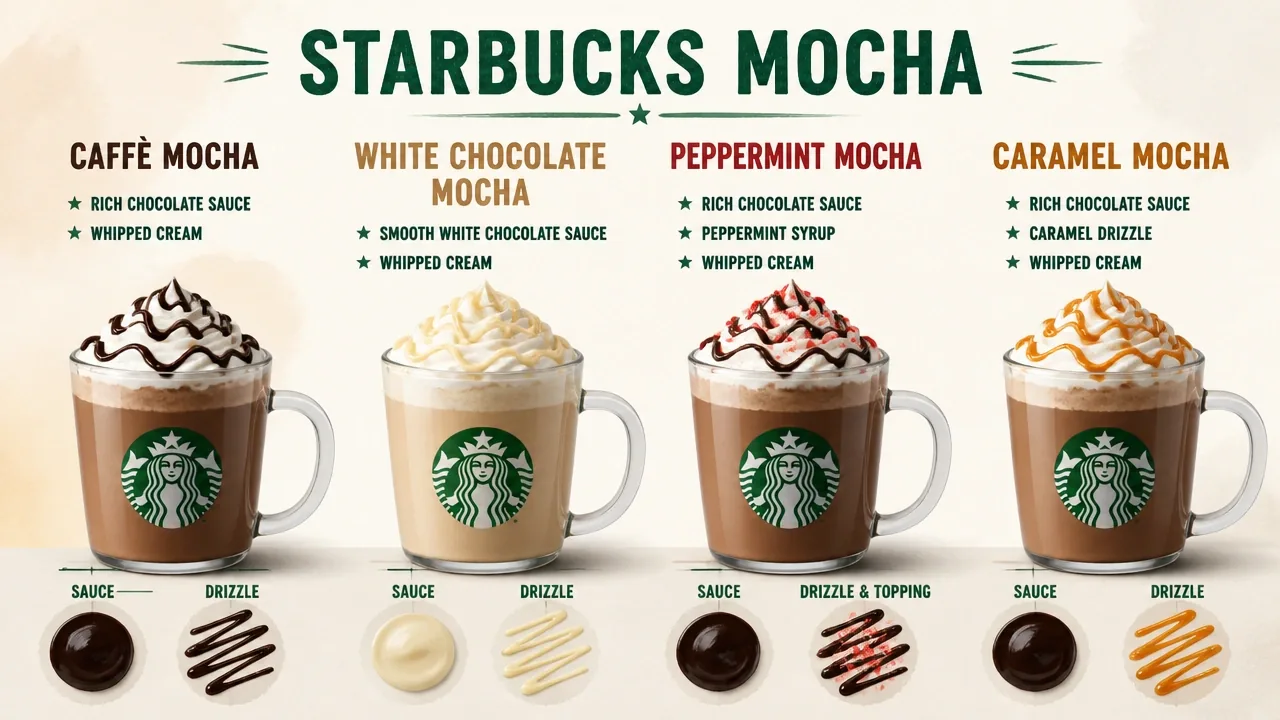
1. Classic Caffè Mocha The foundational build: espresso, steamed milk, dark mocha sauce, and sweetened whipped cream. Bittersweet and balanced. Dairy-free only if you hold the whip and swap the milk. This is the cleanest starting point for customization.
2. White Chocolate Mocha Espresso, steamed milk, and white chocolate mocha sauce. Sweeter, richer, and higher-calorie than the classic – and not dairy-free at any configuration, because the sauce itself contains condensed skim milk. Whipped cream is standard unless removed.
3. Black and White Mocha (Tuxedo Mocha) A split build using half dark mocha sauce and half white mocha sauce. The result sits between the two flavor extremes – less bittersweet than the classic, less sweet than the white mocha. Calorie density lands in the middle range. Still not dairy-free because white mocha is in the build.
4. Iced Dark Chocolate Mocha Built on dark mocha sauce with extra cocoa emphasis, served cold. The iced format tends to emphasize the bitterness of the cocoa more than the hot version, making it feel bolder. Dairy-free when ordered with non-dairy milk and no whip.
5. Peppermint Mocha Dark mocha sauce plus peppermint syrup, steamed milk, and whipped cream. A seasonal build. The peppermint syrup adds calories and sugar beyond the mocha sauce alone – factor that into pump-reduction math if you’re customizing. Chocolate curls are sometimes added as a topping and contain dairy.
6. Salted Caramel Mocha A layered seasonal construction: dark mocha sauce, toffee nut syrup, steamed milk, whipped cream, caramel drizzle, and sea salt. Multiple sauce and syrup components means multiple calorie sources beyond the mocha sauce. The caramel drizzle is a hidden dairy source for strict dairy-free ordering.
7. Mocha Frappuccino Blended coffee base with dark mocha sauce and a mocha drizzle finish. The blended format adds a milk-heavy base, making it the highest-calorie mocha build on this list before customization. Whipped cream is standard. The mocha drizzle is a separate sauce application layered on top.
These foundational chocolate builds establish the baseline metrics necessary to accurately calculate your total peppermint mocha calorie count during the winter holiday season.
How to Order a Skinny Mocha: The Customization Formula for Lower Calories and Dairy-Free
The “Skinny Mocha” as a pre-configured menu item no longer exists – Starbucks discontinued its pre-mixed Skinny Mocha syrup, and it hasn’t been replaced with an equivalent. What exists instead is a component-level customization formula that recreates the intent using current ingredients.
Here’s the exact sequence:
Step 1: Order a Caffè Mocha, hot or iced. This sets the base as dark mocha sauce – lower-calorie and dairy-free compared to white mocha.
Step 2: Request nonfat milk or unsweetened almond milk. Nonfat milk cuts fat while keeping protein; unsweetened almond milk reduces both calories and total sugar relative to 2% or whole milk.
Step 3: Say “no whipped cream.” Standard sweetened whipped cream adds roughly 70–100 kcal to the drink. Removing it is the single highest-calorie swap available without touching the sauce.
Step 4: Cut the mocha pumps in half. The standard pump counts by size are approximately 3 pumps for a Tall, 4 for a Grande, and 5 for a Venti. Halved, that becomes 2 pumps for a Tall, 2 pumps for a Grande, and 3 pumps for a Venti.
The caloric outcome of this build: a Grande that starts around 370 kcal drops to approximately 130–150 kcal – a reduction of more than 200 calories without changing the drink’s core identity.
For a true dairy-free build, the customization goes one level deeper. Beyond swapping milk and holding whip, you also need to hold chocolate curls, which are a standard topping on some mocha builds and contain dairy. The clean dairy-free ordering phrase becomes: regular mocha sauce, unsweetened almond milk, half pumps, no whip, no chocolate curls. That removes every dairy-containing component from the drink in one instruction set.
The Precision Mocha Checklist: Data-Driven Final Answer
After working through the sauce breakdown, the comparison, the reverse-calculation gap, the menu options, and the customization formula, the practical question is: what does the most precise mocha order actually look like?
Start with the sauce type. Choose regular dark mocha sauce as the base. It’s lower-calorie, dairy-free in the standard U.S. formulation, and gives you the most control over the drink’s calorie floor. White mocha is not a viable base for dairy-free or lower-calorie builds.
Apply targeted swaps in this order of impact: nonfat or unsweetened almond milk, no whipped cream, half pumps. For dairy-free precision, add “no chocolate curls” to the instruction. Each of these swaps addresses a specific calorie or dairy source – this is component-level thinking applied to a drink order.
Hold the calorie math loosely. Every per-pump figure in this article – and in any community or third-party source – is a working estimate derived from reverse calculation or measurement, not a published Starbucks label. Pump calibration is not officially standardized in public materials. Treat the numbers as directionally accurate, not lab-certified.
Don’t conflate dairy-free with vegan or allergy-safe. The regular dark mocha sauce clears the dairy-free bar in standard formulation, but that doesn’t automatically mean it’s safe for strict vegans (sugar refining processes can involve animal-derived bone char) or for people with cross-contamination concerns. Starbucks equipment handles multiple dairy-containing products, and shared surfaces are a real cross-contact variable. For strict allergen needs, ask the store directly about current formulation and cross-contact policy – don’t rely on ingredient lists alone.
The final ordering script: “Caffè Mocha with regular mocha sauce, nonfat or unsweetened almond milk, half the mocha pumps, no whip.” That’s four targeted substitutions – sauce type, milk, pump count, topping – covering the highest-impact variables. The cleanest mocha order isn’t a secret menu item. It’s a component-level custom build you construct from publicly available ingredients using the fewest high-leverage swaps.
The unresolved gap in all of this is structural: without official per-pump portioning data, certified pump calibration, and published cross-contamination standards from Starbucks, both the calorie math and the allergen guidance remain estimates. That’s not a reason to avoid mocha. It’s a reason to order with precision rather than assumption.
Key Takeaways on Starbucks Mocha Sauce
- One pump of regular dark mocha sauce delivers roughly 25–35 kcal, ~5g sugar, and trace caffeine – but these are estimates, not published labels.
- Regular dark mocha sauce is dairy-free and vegan-friendly in the standard U.S. formulation; white chocolate mocha sauce is not.
- White mocha nearly doubles the calorie load at ~49–60 kcal per pump, and a Grande build generates up to 240 kcal from sauce alone.
- Starbucks publishes finished-drink nutrition, not component-level data, so per-pump figures require reverse calculation and carry inherent imprecision.
- Cutting pumps in half, swapping milk, and removing whipped cream reduces a Grande Caffè Mocha from ~370 kcal to roughly 130–150 kcal.
- Dairy-free does not mean allergy-safe – shared equipment and cross-contamination are separate concerns that require direct store-level verification.
Frequently Asked Questions About Starbucks Mocha Sauce
How many calories are in 1 pump of mocha sauce at Starbucks?
One pump of regular dark mocha sauce contains roughly 25–35 kcal, though this is a community-derived estimate – Starbucks doesn’t publish per-pump component data publicly.
How much sugar is in Starbucks Mocha Sauce?
A single pump of regular dark mocha sauce delivers approximately 5g of total sugar, with water, sugar, and Dutch-processed cocoa as the primary ingredients.
How many calories are in 2 pumps of Starbucks white mocha sauce?
Two pumps of white chocolate mocha sauce add approximately 100–120 kcal to a drink, based on the community-measured range of 49–60 kcal per pump.
Does Starbucks mocha sauce contain caffeine?
Yes, but only in trace amounts – roughly 5mg per pump – because cocoa naturally contains a small quantity of caffeine. It’s not a meaningful caffeine source compared to the espresso in the drink.
Is there a real “Skinny Mocha” at Starbucks anymore?
No – Starbucks discontinued the pre-mixed Skinny Mocha syrup. The current workaround is a custom build: dark mocha sauce, non-dairy milk, half pumps, and no whipped cream.
Can I order a fully dairy-free mocha at Starbucks?
Yes, with the right swaps: regular dark mocha sauce, non-dairy milk, no whipped cream, and no chocolate curls. Cross-contamination from shared equipment is still possible, so confirm with your store if you have a strict allergy.
Why does the Starbucks app calorie count change when I customize my drink?
The app recalculates based on the finished-drink formula – milk type, pump count, and toppings each carry their own calorie values. Changing any one of them shifts the total, which is exactly why pump-count reduction is such a high-leverage customization.
What’s the lowest-calorie mocha option at Starbucks?
A Tall Caffè Mocha with 2 pumps of dark mocha sauce, unsweetened almond milk, and no whipped cream sits at the low end of what’s achievable while still tasting like a mocha – likely in the 80–110 kcal range depending on exact milk volume and pump calibration.
References
- Changes in cocoa properties induced by the alkalization process: A review | Comprehensive Reviews in Food Science and Food Safety (Wiley) | ift.onlinelibrary.wiley.com