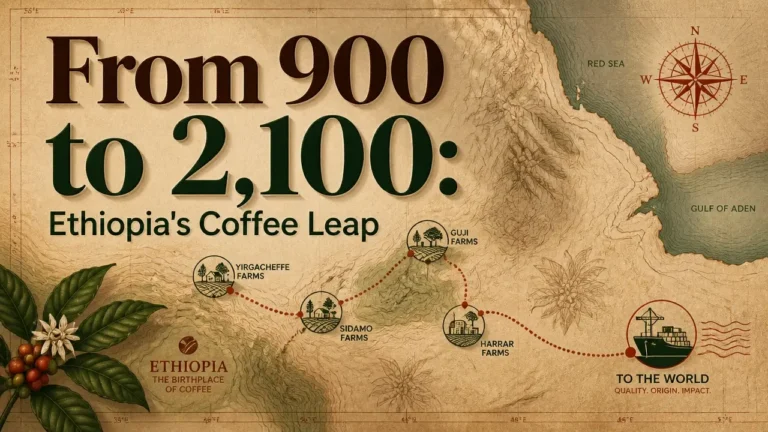

Ethiopia has begun rolling out a 10-year national plan to modernize its coffee value chain and more than double average productivity, a move officials say is central to strengthening an industry that already earns over US$3 billion in annual export revenue.
The new flagship initiative was announced on 11 August 2026 by the Ethiopian Ministry of Agriculture and reported by The Star. According to the ministry, effective implementation over the coming decade is intended to raise average coffee productivity from the current 900 kg per hectare to 2,100 kg per hectare and to significantly boost output across more than 1.15 million hectares of coffee land.
The Star reported that Ethiopia’s annual coffee production has already climbed from 500,000 tonnes five years ago to 1.5 million tonnes in 2026. Over the 2025/26 Ethiopian fiscal year ending 7 July, coffee export earnings exceeded US$3 billion, according to the Ethiopian Coffee and Tea Authority as cited by the same outlet.
Unveiling the productivity drive, Minister of Agriculture Addisu Arega described the effort as a shift in how the country approaches its signature crop. “Our strategic direction is to transform this immense potential through higher productivity, improved quality and sustainable production, moving from production to value, and from value to global markets,” he said, according to The Star.
To reach its targets, the ministry’s initiative promotes a package of agronomic and post-harvest measures. The programme focuses on improved coffee varieties, increased coffee-tree density, better pruning, improved harvesting and post-harvest handling, as well as integrated pest management, irrigation and fertilizer applications, The Star reported. Officials say the plan is also meant to bring producers, researchers, technical experts and local leaders onto a single national coffee development agenda.
The productivity push forms part of a broader national coffee strategy outlined earlier in 2026. According to a report from Food Business Middle East & Africa, that strategy aims to more than double coffee production and increase annual export earnings to US$6 billion by 2031. It likewise sets a goal of lifting average yields from 900 kg per hectare to 2,100 kg per hectare within the next five years, a shorter time frame for the same yield level cited in the 10‑year ministry announcement.
Food Business MEA reported that the national programme incorporates nine strategic interventions, including expanding improved coffee varieties, increasing planting density, strengthening agronomic practices, upgrading post-harvest processing systems and reinforcing agricultural research. A major component is construction of a tissue culture facility at the Jimma Agricultural Research Center in partnership with the Agricultural Transformation Institute, intended to enable large-scale production of disease-resistant, climate-resilient and high-yield hybrid coffee seedlings for distribution to farmers nationwide.
Commenting on the strategy, Addisu Arega told Food Business MEA that “the strategy focuses on developing and multiplying new, high-yielding, disease-resistant, and climate-resilient hybrid coffee varieties” and said the plan “aims to make history in the coffee sector by properly executing this package within the next two to three years.”
Beyond productivity targets, policymakers are positioning coffee as a continued anchor for foreign exchange earnings. Food Business MEA noted that Ethiopia generated approximately US$3 billion in coffee export revenue in a recent Ethiopian budget year and reported that the new productivity programme is designed to double that figure over the coming years, while operational preparations have been completed to support implementation and strengthen farmer livelihoods.
As summarized by The Star, Ethiopian authorities describe coffee production as a major pillar of the national economy that supports the livelihoods of millions of farmers and serves as a primary catalyst for overall export trade, underscoring why the government has placed coffee at the center of its new 10‑year development agenda.