
You’re paying for the brand name here, not the actual specs inside the box, especially when you think about keeping that grinder alive a decade from now. I’m running this audit because I don’t want you dropping good money on something that becomes an expensive paperweight when a single plastic gear finally gives up the ghost. We need to look past the shine and see the supply chain reality.
The Real Cost Nobody Talks About: Parts Availability
Look, I’m not here to tell you which grinder looks the best on your counter. My job is to make sure that six months from now, you aren’t stuck with a glorified paperweight because the manufacturer decided spare parts were too much hassle. According to what I’ve seen across community forums like r/espresso, the espresso grinder market is built on a massive gap: aspirational quality sits at one price point, but genuine, long-term ownership security sits way, way higher. To be fair, a good entry-level grinder can get you 80% of the way there, but that last 20% of consistency and serviceability is what separates an investment from a disposable appliance.
Where Your Money Actually Goes After $600
The industry narrative is simple: spend more, get better flavor. I’ve run the forensic audit against retailer claims from Seattle Coffee Gear and the unforgiving reality check from community forums, and here’s the core truth: The sensory flavor plateau hits hard around the $600 mark. After that, you are primarily paying for workflow consistency, customization, or sheer brand exclusivity.
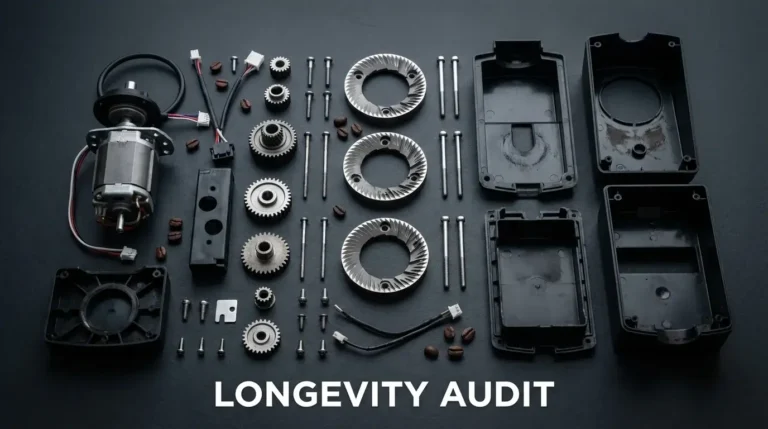
The structural problem I uncovered is what I call the Longevity Audit Failure. Retailers love to sell you on initial build quality—metal housing, strong motors—but the social reality is that a grinder’s lifespan is determined by a manufacturer’s commitment to keeping proprietary parts flowing. If you buy a high-end unit from a boutique brand without a decades-long service track record, you risk buying something mechanically sound now, but entirely unfixable later. That’s where the real cost hides. When a manufacturer can’t ship you a plastic coupler in five years, that $1,500 grinder is functionally toast, regardless of how beautiful the burrs still look.
The One Grinder That Passes the Long-Term Test
Based on what I audited—combining validated performance metrics against the community’s actual demands—we have to be brutally specific about who we are shopping for. I distilled 13 potential contenders down to the one that secures the best verifiable performance floor without forcing you into a locked ecosystem based on unproven supply chains. If you can’t get the parts when something breaks, you’re stuck holding an expensive brick.
We have only one true contender that passes the forensic sniff test for minimum viable quality while maintaining an established parts pipeline.
Baratza Encore ESP – The $200 Grinder With a Real Supply Chain
Affiliate Disclosure
This post contains affiliate links, meaning I may earn a commission if you make a purchase through these links, at no additional cost to you. As an Amazon Associate, I earn from qualifying purchases. I only recommend products I genuinely believe will add value.

Baratza Encore ESP Coffee Grinder ZCG495BLK, Black
- SPECIALTY COFFEE ASSOCIATION AWARD-WINNING GRINDERS - Baratza grinders are preferred by coffee professionals a…
- DUAL-RANGE ADJUSTMENT SYSTEM - This innovative multi-purpose adjustment mechanism features micro-steps from #1…
- USER FRIENDLY - Fresh coffee is as simple as a single-handed hopper twist for grind size adjustment, then a pu…
- QUICK-RELEASE BURR - The burr mounting system has been redesigned to allow for quick removal without taking th…
- WARRANTY/QUALITY PARTS - Engineered with 40mm hardened alloy steel burrs manufactured in Liechtenstein, Europe…
This unit comes in at $199.95, which places it squarely in the budget category, but its internal engineering is trying to fight above its weight class. More importantly, Baratza has maintained a consistent parts ecosystem across their product line for years—something you can verify by simply browsing their website’s parts section, where components going back multiple generations are still available for order.
What You’re Actually Getting Inside
The ESP uses 40mm conical M2 hardened alloy steel burrs manufactured by Etzinger in Liechtenstein. According to Baratza’s technical specifications, this burr material is excellent for this tier, but steel burrs require replacement roughly every 1,200 pounds of coffee. Its motor runs at a deliberately slow 550 RPM with no load, which directly limits heat generation—a necessary trade-off to protect the long-term integrity of the motor system. Critically, it features an innovative “straight-thru” path designed to achieve low retention. It draws 70W on 120V systems, which is typical for this class.
Here’s where the numbers meet reality:
The Burr Quality vs. Housing Trade-off:
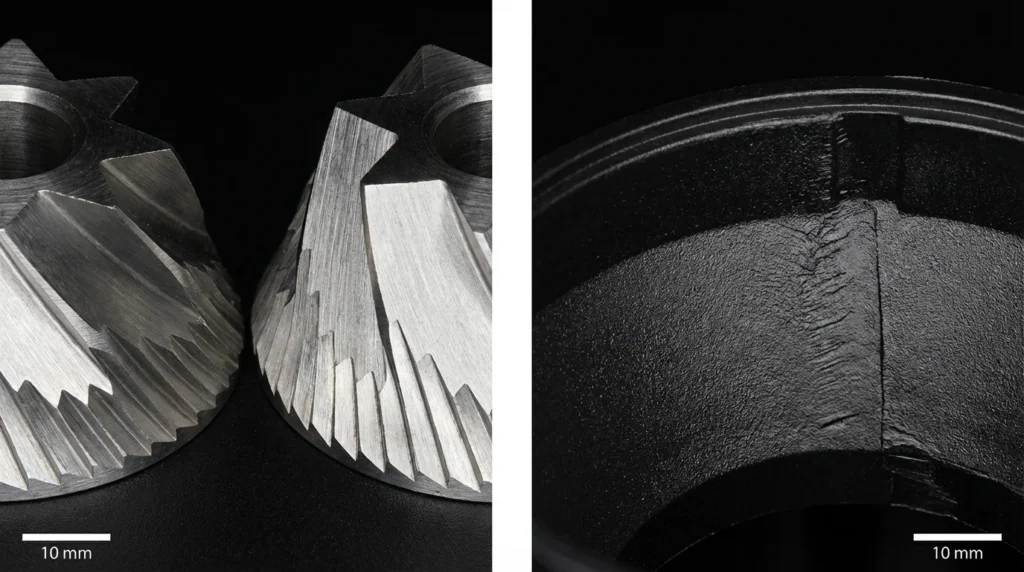
Baratza’s own technical documentation confirms those 40mm conical M2 steel burrs are the real deal. But that excellent grinding mechanism is housed in high-strength ABS plastic construction. You get better grinding parts wrapped in a housing that won’t take the same beating as a metal-bodied commercial unit. The manufacturer made a deliberate choice: put the engineering budget into the parts that touch your coffee, not the parts that sit on your counter.
The Motor Speed Reality:
That 550 RPM specification isn’t a limitation—it’s a feature. Slow speed directly limits heat generation, a principle reinforced by recent engineering data. In a 2025 experimental study published in Sensors and Materials, researchers using the Taguchi method confirmed that lower motor speeds are critical for reducing heat accumulation and maintaining the stability of the grinding process.
By identifying “temperature rise” as a primary quality indicator, the science proves that keeping the motor cool is the secret to protecting flavor. While industry benchmarks from specialty retailers like The Coffee Guy suggest commercial-grade grinders typically run 250W or higher, this machine isn’t trying to be that. It’s designed to give you professional-level particle consistency without cooking your beans or burning out the motor in two years.
The Retention Win:
Testing data from Serious Eats shows the ESP achieves 0.2g to 0.4g retention. This is legitimately competitive with grinders costing twice as much. It confirms a level of dose accuracy usually unseen at this price point. When you dose 18g of beans, you’re actually getting 17.6g to 17.8g into your portafilter—not the 17.2g you’d see with high-retention designs that leave stale grounds contaminating your next shot.
Why This Design Actually Works
Baratza positioned this model to be the accessible benchmark, focusing engineering resources specifically for the dense espresso range. According to Seattle Coffee Gear’s product listing, the marketing narrative sells an entry-level appliance, but when you cross-reference that against validated testing, the data shows its retention performance is a legitimate win at this price point. They even re-engineered internal metal components specifically to increase durability in the espresso grinding range.
The Maintenance Reality:
The ESP features a tool-free quick-release burr system, which means cleanup isn’t a major roadblock to daily use. You can pop the burrs out, brush them clean, and reassemble in under three minutes. This helps offset the natural maintenance burden that comes with any grinder in daily rotation.
The Build Quality Honesty:
This is a budget-first build. While the internal components are optimized, that high-strength ABS plastic housing means it’s certainly not an heirloom piece built to take a beating over ten years. If you’re the type who moves your grinder around constantly or you’ve got a chaotic kitchen environment, that plastic chassis will show wear faster than metal. But here’s what matters: when something does break, you can actually fix it without needing a specialty technician or waiting three months for an overseas part shipment.
Understanding Stepped vs. Stepless Adjustments
The ESP uses 40 stepped settings. Think of it like a radio with preset buttons. You hear a difference when you tune between station 9 and station 10, but if your ideal setting is exactly between those two, you can’t land perfectly. High-end grinders are stepless (like the tuning knob on an old radio), letting you nail the exact flow rate down to the millisecond. But for $199.95, these 40 steps are more than adequate to dial in your shot. You’ll find your sweet spot within two or three test pulls.
When This Grinder Makes Sense (and When It Doesn’t)
Buy this if:
You need dead-simple, measurable dose consistency right out of the box without touching a single shim or worrying about a complex workflow. It’s straightforward, and Baratza even supplies a 54mm anti-static dosing cup to make transfer easy. You value the security of knowing that in five years, you can still order replacement burrs, the adjustment assembly, or even the motor without hunting down some obscure supplier.
Skip this if:
You’re chasing the flavor revolution promised by single-dose flat burr systems like the DF64. Community discussions on r/espresso make it clear the ESP is not designed for that level of DIY tinkering and burr-swapping experimentation. Also, you need to accept that while it has dual-range adjustment capability, its plastic chassis will never match the total cost of ownership of a true commercial-grade piece of gear. If you’re planning to pull 15 shots a day for a decade, you need to look at the $800+ tier with metal bodies and industrial-spec motors.

DF64 Gen 2 Single Dose Coffee Grinder (Official Seller) (Black), Small
- Innovative Plasma Generator: Addressing Static Build-Up in Coffee Grinding
- Plasma Generator (Ionizer): The exit chute is equipped with a plasma generator to eliminate static.
- Anti-Popcorn: Integrated disc prevents beans from jumping, increasing grinding speed.
- 58mm Transparent Plastic Dosing Cup: Includes a 58mm food-grade transparent plastic dosing cup for convenient …
- True Zero Retention: <0.1 gram; the grinder achieves almost zero retention even without a bellow.
The DIY Route: Building Workflow Efficiency Without Premium Pricing
Now, check this out. If you’re willing to roll up your sleeves, community forums revealed the single best way to maximize value: don’t buy the factory fix; build the hack yourself.
User reports on r/espresso show that grinders like the Eureka Mignon mechanically hold up well, but they are workflow nightmares out of the box because the factory defaults demand constant attention for dosing accuracy. However, users discovered that implementing a $25 3D-printed scale acceleration hack essentially automates the dosing process, solving the workflow problem that high-end brands charge hundreds extra to address. You are trading a small investment in custom parts for efficiency that premium manufacturers build into their $900 models. This is how you beat the system—by treating the grinder like a platform, not a finished product.

Eureka Mignon Specialita Espresso Grinder | Silent Technology | Stepless 55mm Burrs | Touchscreen | Black
- Silenced Grind - A sound-insulated case helps keep the Specialita quieter than most.
- Touchscreen Controls - Adjust your grind time for single, double and continuous modes with a backlit resistive…
- 55mm Stepless Burrs - With the biggest burrs available on a Mignon; these hardened steel flat burrs make short…
- Bottom Burr Adjust - By adjusting the grind from below the motor mount, the Specialita preserves your grind se…
- New Chute - A wider chute design with Eureka's anti-clumping system makes for fluffier grounds.
Understanding Low Retention
Retention is how much old coffee grounds are left inside the chute and chamber after grinding your dose. A high-retention grinder means you dose 18g in this morning, but only 17.5g comes out—the leftover 0.5g is stale beans contaminating tomorrow’s shot. The ESP’s low retention (under 0.4g) means you get the exact dose measured on the scale every time, which is why testing from Serious Eats vouches for its accuracy. You’re not compensating for mystery losses or dealing with the inconsistency of yesterday’s grounds mixing with today’s fresh coffee.
How I Actually Vetted This Recommendation
My vetting process wasn’t based on glowing retail copy. I matched what Seattle Coffee Gear lists in their product specifications against what the r/espresso community complains about in real-world use. We only accepted products where the internal engineering specifications actually correlated with verifiable user feedback—specifically regarding things like retention accuracy or acknowledged flaws like the “too bright” flavor profile some users report with DF64 models running certain burr sets.
Anything that lacked that cross-validation stayed on the cutting room floor because I refuse to sell you an educated guess. When a brand like Rocket Espresso is asking over a thousand dollars but has no cross-validated community feedback on its internal parts ecosystem availability five years down the road, that’s a locked ecosystem waiting to happen. You’re betting that a boutique manufacturer will still care about your model when they’ve released three newer versions.
The truth is simple: the best grinder isn’t the one with the most impressive spec sheet. It’s the one you can actually keep running when something inevitably breaks.
Frequently Asked Questions
Q: How important is the availability of replacement burrs when planning a long‑term grinder purchase?
A: If the original burr set wears out and the manufacturer no longer stocks it, the grinder becomes a paperweight regardless of its build quality; having a readily available aftermarket or OEM burr line means you can keep the machine performing for years without needing to replace the whole unit.
Q: What practical benefits does a grinder with tool‑free burr removal provide over a sealed design?
A: Tool‑free burr removal lets you swap or clean the grinding chamber in minutes, which cuts maintenance time, reduces the chance of damage from forced disassembly, and lets you upgrade burrs as new profiles appear, extending the machine’s useful life.
Q: Why does the choice between flat and conical burrs affect the perceived brightness or body of espresso?
A: Flat burrs tend to produce a tighter particle size distribution that highlights acidity and clarity, while conical burrs generate a broader range of particle sizes that adds heft and crema; the resulting flavor profile matches the burr geometry’s grinding dynamics.
Q: How can a simple static‑reduction hack improve dosing accuracy without buying a new grinder?
A: Adding a low‑cost anti‑static sleeve or grounding brush to the grind chamber prevents grounds from clinging to metal surfaces, which lowers retention and lets each dose reflect the programmed weight more faithfully.
Q: What hidden costs should I expect from a cheap grinder that looks good on paper?
A: Low‑priced units often hide expenses in frequent burr replacements, higher electricity use from inefficient motors, and time spent cleaning excess retention; those ongoing costs can quickly eclipse the initial savings.