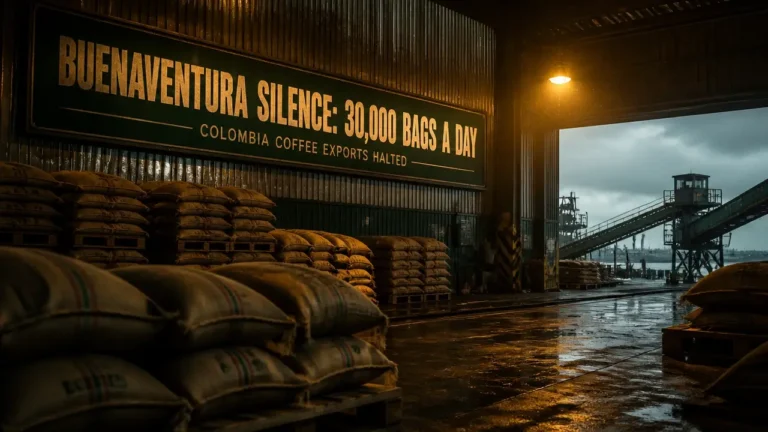

Colombia’s strongest earthquake this century has effectively frozen coffee exports through its main Pacific port, temporarily choking shipments from the world’s third-largest coffee exporter just as harvests move toward the coast.
The magnitude 7.4 quake struck western Colombia at 07:34 local time on 10 August at a depth of 107 km, and Colombia’s Geological Service called it the country’s strongest earthquake in the 21st century, according to The Star. Coffee-growing departments including Risaralda, Valle del Cauca, Caldas, Antioquia, Chocó and Quindío were among the affected areas, Comunicaffe and Semana reported.
Access to the Pacific port of Buenaventura, Colombia’s main outlet for coffee exports, has been severely disrupted. The Cali–Buenaventura and Buga–Buenaventura road corridors are blocked at multiple points, particularly in tunnel sections, due to landslides and damage reported by the National Infrastructure Agency, with three road-project workers killed, according to Comunicaffe and Splash247. Buenaventura has become effectively inaccessible for coffee, and terminal operators have suspended or restricted coffee-receiving operations, La República reported.
Gustavo Gómez, president of exporters’ association Asoexport, said that “coffee export operations have been halted” and that “for the time being coffee exports have come to a standstill,” according to Comunicaffe and Livemint. He added that “there has been no official announcement regarding when the roads will fully reopen,” Aju Press reported.
Colombia typically exports about 1 million 60‑kg bags of coffee per month, according to Splash247 and La República. Asoexport estimates that each day of disruption is holding back more than 30,000 60‑kg bags—roughly 2,000 tonnes—creating the risk of congestion and bottlenecks once traffic resumes, Splash247 and La República reported.
The timing is particularly sensitive because the current harvest is concentrated in Cauca, Nariño, Valle del Cauca, Huila and the Eje Cafetero (coffee axis), and much of this coffee normally moves through Buenaventura, according to La República and Livemint. Caldas and Risaralda alone account for about a quarter of Colombia’s coffee production, Barchart reported.
Within producing regions, the National Federation of Coffee Growers of Colombia (FNC) temporarily suspended operations in affected areas because of damage to logistics facilities and processing plants, Comunicaffe reported. FNC, working with logistics arm Almacafé, activated business-continuity protocols and suspended green-coffee operations in Armenia, Manizales, Pereira, Tuluá and Buga pending safety inspections, according to Notícias Agrícolas.
Gómez said that “so far, there have been no reports of serious structural damage to the coffee-processing facilities,” but noted that operations are being affected by “electricity outages, connectivity problems and the personal impact on workers, including people who have lost their homes,” according to Comunicaffe and Livemint. Cartagena and Santa Marta, Colombia’s Caribbean ports, reported no major disruptions, but serious truck shortages are complicating rerouting of coffee away from Buenaventura, Comunicaffe, Splash247 and Livemint reported.
The disruption has fed directly into global price moves. Colombia is the world’s third-largest coffee exporter and the second-largest Arabica producer, according to Aju Press, Barchart and Livemint. On 11 August, Arabica futures in New York rose 1.6% to 2.6% on most‑traded contracts, with the September contract at 339.95 cents/lb, December at 318.95 cents/lb and May 2027 at 307.10 cents/lb around 12:15 Brasília time, Notícias Agrícolas reported. By 12 August, September Arabica futures had reached a five-week high of $334.75 on the ICE exchange, Aju Press reported, while Barchart described prices consolidating below a recent one‑month high.
Livemint reported that Arabica futures briefly swung from multiweek highs into slight losses as traders weighed the balance between crop damage and the primarily logistical nature of the shock, while Barchart noted that ICE-certified Arabica inventories had fallen to a 2.5‑year low of 241,838 bags. Analysts and international consultants cited by Notícias Agrícolas said the effects on futures prices were “punctual” because the true impact on processing, storage, transport and loading capacity was still being assessed.
Within Colombia, President Abelardo de la Espriella—who took office on 7 August—declared a national emergency and state of calamity on 10 August, with Aju Press and Notícias Agrícolas reporting that his next destination was the coffee-producing region. FNC general manager Germán Bahamón Jaramillo stated that “la prioridad absoluta es salvar vidas, encontrar a quienes necesitan ayuda y atender la emergencia,” according to Semana, while FNC and departmental coffee committees continue to compile information in the first 72 hours after the quake and coordinate with municipal, departmental and national authorities on restoring access routes, Semana and La República reported.