
Targeted caffeine hits different when the dose is right. At 3–6 mg per kg of body weight, taken 45–60 minutes before effort, it spares glycogen, sharpens force production, and pushes the pain threshold further than most athletes expect.
The gains are measurable, 2–4% in endurance tasks, meaningful lifts in sprint and strength output. But your CYP1A2 genetics and biological sex shape exactly how much you benefit, and when you take it determines whether it builds you up or quietly wrecks your sleep and recovery.
Beyond fueling athletic output, research also highlights how liver health and daily consumption are closely linked, showing that moderate intake provides profound protective benefits against chronic disease.
The Caffeine Dose-Timing Blueprint Every Athlete Needs
Effective caffeine dosing follows a precise, body-weight-anchored formula: 3–6 mg per kilogram of body weight, taken 30–60 minutes before exercise, timed to align with peak plasma concentration so your muscles feel the full effect at the starting gun. For a 150-pound (68 kg) athlete, that translates to roughly 200–400 mg: about the amount in one to two strong cups of coffee. Those numbers aren’t conservative estimates or rough guidelines; they’re the window where performance benefit is real and side effects stay manageable.
Here’s why that window matters. Caffeine reaches peak plasma concentration somewhere between 30 and 60 minutes after ingestion, depending on the person. If you drink your coffee two hours before a race, you’ve already crested that peak and you’re riding the downslope. If you take it five minutes before the gun, you’re racing ahead of your own dose. The timing isn’t a preference: it’s a pharmacokinetic fact.
Beyond maximizing your athletic output and focus in the gym, learning about Coffee Benefits Unlocked The Definitive can also help you understand how regular consumption supports your overall long-term wellness.
The 3–6 mg/kg range is also where the research is most consistent. Peter M. Christensen of the Section of Integrated Physiology at the University of Copenhagen put it plainly after reviewing the evidence:
“Caffeine doses in the included studies ranged from 2 to 6 mg/kg body weight, which is in accordance with previous guidelines.”
That alignment across multiple independent studies tells you something important: this isn’t a range researchers are still debating. It’s a settled dose baseline and safety ceiling for where caffeine reliably does its job.
If you’re sensitive to caffeine, you know who you are, because one espresso has you staring at the ceiling at 2 a.m. The minimal effective dose sits around 1.5–2 mg/kg. That’s roughly 100–135 mg for a 68 kg person, closer to a single shot of espresso. You don’t need to match the dose of a 220-pound linebacker to get a measurable benefit. The mechanism still fires; it just fires at lower intensity.
For long events, anything pushing past 90 minutes, plasma concentration will start to drop before you cross the finish line. Small top-up doses of around 0.5 mg/kg every 60 minutes can keep levels in the effective range without stacking too much caffeine at once. Think of it less like re-dosing and more like keeping a slow drip going so the system doesn’t go quiet mid-race.
On the upper end, the safety ceiling lands at roughly 9 mg/kg. Beyond that point, the research is consistent: side effects climb sharply: jitteriness, elevated heart rate, GI distress, while additional performance gains flatten out. More caffeine stops being more effective and starts being more disruptive. Staying inside the 3–6 mg/kg range gives you most of the benefit with a fraction of the risk.
These dose and timing limits aren’t arbitrary lines drawn by cautious researchers. They reflect something specific happening at the molecular level, the way caffeine interacts with adenosine receptors and how that interaction changes the ionic balance within your cells. That’s the next piece of the puzzle.
Caffeine Shifts Your Muscle Chemistry in Two Powerful Ways
Precise intracellular ionic balance, sharpened by caffeine, drives better force production by stabilizing calcium handling and simultaneously boosting fat oxidation: sparing the glycogen you’ll desperately need in the final miles. Those two mechanisms sound separate, but they’re running in parallel the moment caffeine reaches peak plasma concentration. Together, they explain why a well-timed dose doesn’t just make you feel more capable; it measurably changes what your muscle fibers can do.
Start with the calcium side of the equation. Every time a muscle fiber contracts, it needs a calcium signal: released from the sarcoplasmic reticulum, triggering the contraction, then pulled back in so the fiber can reset and fire again. Caffeine interferes with that uptake-and-release cycle in a way that keeps calcium available for longer, making each contraction stronger and more reliable. The International Society of Sports Nutrition’s 2023 position stand documents this directly, noting that caffeine “has been found to alter the release … or uptake … of calcium by the sarcoplasmic reticulum,” a mechanism that enhances the muscle’s contractile sensitivity without requiring you to recruit extra fibers to hit the same force output.
Think of it this way: your muscle fibers are already capable of producing the force you need. Caffeine just makes the signaling cleaner, so less of that signal gets lost in transit.
The glycogen-sparing effect works through a different lever. During sustained exercise, your body is constantly choosing between burning fat and burning stored muscle glycogen. Glycogen is faster and more powerful, but it’s also finite: once it’s gone, your pace drops hard. Caffeine nudges the fuel-selection dial toward elevated fat oxidation earlier in the effort, so fat oxidation increases while glycogen sits in reserve. By the time you’re 90 minutes in and the race is actually decided, you still have fuel in the tank.
Both mechanisms are dose-dependent. Below roughly 3 mg per kilogram of body weight, the ionic and metabolic effects are modest. Above 6 mg/kg, you start trading performance gains for side effects: jitteriness, elevated heart rate, disrupted coordination, without getting proportionally more benefit. The 3–6 mg/kg window is where the calcium sensitization and the fat-oxidation shift are both operating near their peak.
That pairing is also why the timing rule from the previous section isn’t arbitrary. When plasma caffeine peaks around 60 minutes after ingestion, both the ionic environment in active muscle and the substrate-utilization shift are optimized simultaneously. As the research synthesis from GSSI and Healthline-cited low-dose studies shows, that combination of glycogen sparing and ionic optimization is what produces the consistent 2–4% endurance boost seen repeatedly across controlled trials, a number that sounds modest until you translate it into race minutes.
Real-World Performance Gains Across Activity Types
Measurable caffeine performance gains show up across every major training modality: endurance, strength, and skill, but the numbers are specific enough that you can actually plan around them. This isn’t a vague “you’ll feel better” story. We’re talking about documented percentage improvements that, at the elite level, separate podium finishes from also-rans. Here’s what the research actually shows, broken down by the type of work you’re doing.
Caffeine lifts endurance and skill execution under fatigue
Consistent aerobic endurance improvement from caffeine lands in the 2–4% range, and that number is more meaningful than it sounds. A systematic review of 84 randomized, placebo-controlled trials found that caffeine doses of 3–6 mg·kg⁻¹ reliably produced those gains across cycling time trials, running, and rowing. Two to four percent doesn’t feel dramatic until you realize that in a 40-minute time trial, that’s nearly two minutes of free time handed back to you, without changing your training load.
The endurance effect works because caffeine doesn’t make your engine bigger. It makes the same engine feel less painful to run. Perceived exertion drops, your brain stops screaming at your legs to quit, and you hold a harder pace longer before the wheels come off.
Team-sport athletes get a different but equally real benefit. Skill execution under fatigue: think passing accuracy in the final 20 minutes of a soccer match, improves by roughly 10% with caffeine. That’s not a small edge. Late-game decision quality and motor precision are exactly where matches get decided, and fatigue is the enemy of both. Caffeine blunts that degradation.
The research coming out of high-altitude contexts makes the endurance case even sharper. Exercise physiologists publishing in Frontiers in Nutrition reported a striking finding from their intermittent sprint testing:
“In the caffeine trial, total work done during the IST (2 × 40 min) was 6.2% higher in first half (g = 0.7) and 5.3% higher in second half (g = 4) compared to placebo.”
That’s not just more output at the start: it’s sustained output across both halves. Most ergogenic effects fade as fatigue accumulates. Caffeine’s endurance benefit held its ground even as the session wore on, which tells you something important about where in the physiology the effect is anchored.
Caffeine drives strength and sprint performance gains
Strength and power performance respond to caffeine too, just with tighter margins than endurance. Typical improvements in bench-press or squat bar velocity run 1–3%, which in a loaded movement translates to real mechanical output: more force expressed per rep, not just a psychological boost. For athletes chasing a competition total or a new one-rep max, that velocity delta matters.
Sprint performance follows a similar pattern. Trained athletes see 1–2% reductions in sprint time on short, high-intensity efforts. That might sound small, but in a 100-meter sprint, 1–2% is the difference between a personal best and a frustrating plateau. The mechanism here is the same calcium mobilization story from the cellular level: faster, more forceful muscle contractions mean the ground gets pushed harder, and the clock reflects it.
One practical angle worth watching is delivery format. Fast-acting caffeine gum, for example, absorbs through the oral mucosa and hits peak plasma levels faster than a capsule or pre-workout drink. For sprint athletes where timing precision matters most, that absorption speed changes the pre-event calculation. This video walks through the application:
What all these numbers share is a common ceiling: they assume the right dose, the right timing, and a body that processes caffeine efficiently. Two athletes can follow the identical protocol and land at opposite ends of that 1–4% range, or outside it entirely. That variability isn’t random. It has a biological explanation, and it’s where the real personalization work begins.
Why Caffeine Hits Your Friend Harder Than You
Deeply individual genetics split caffeine users into fast and slow metabolizers, which means the same 3 mg/kg dose that sharpens one athlete’s focus can leave another jittery and flat. The enzyme responsible is CYP1A2, and the version of it you inherited determines how quickly your liver clears caffeine from your system. That clearance rate isn’t a minor footnote: it’s the difference between a clean performance window and a two-hour anxiety spiral before the gun goes off.
Two athletes, same body weight, same dose, opposite experiences. That’s not a placebo effect. That’s biology doing exactly what it’s supposed to do.
Your CYP1A2 gene shapes your caffeine response
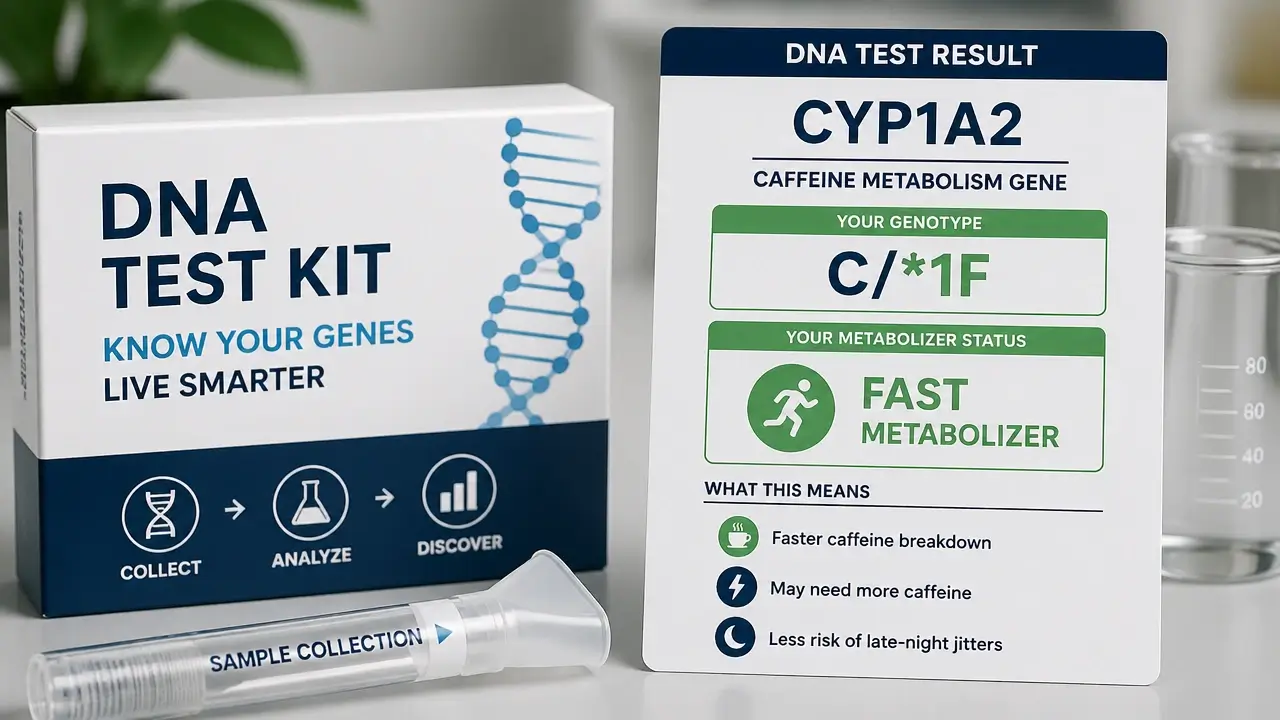
The CYP1A2 enzyme handles roughly 95% of caffeine metabolism in your liver, and your genetics, specifically the CYP1A2 polymorphism, determine whether you clear caffeine quickly or slowly. Fast metabolizers clear caffeine quickly, keeping plasma concentrations in a productive range during exercise. Slow metabolizers hold caffeine in their system longer, which sounds like an advantage until the accumulation starts working against them.
For fast metabolizers, the timing window is forgiving. Caffeine peaks, does its job at the adenosine receptors, and clears before it compounds into noise. For slow metabolizers, that same dose can still be sitting in circulation hours later, interfering with sleep, spiking cortisol, and blunting the recovery you were trying to protect.
Kyle Southward of Massey University from the School of Sport, Exercise and Nutrition at Massey University puts it plainly:
“CYP1A2 and ADORA2A are two of the genes which are thought to have the largest impact on the ergogenicity of caffeine. CYP1A2 is responsible for the majority of the metabolism of caffeine, and ADORA2A has been linked to caffeine‑induced anxiety.”
That second gene, ADORA2A, is worth noting here. It governs how sensitive your adenosine receptors are to begin with. So even if your CYP1A2 type clears caffeine efficiently, a high-sensitivity ADORA2A variant can amplify the anxiety response at the same dose. Genetics isn’t one dial. It’s at least two, running simultaneously.
Men and women respond more similarly than you’d think
Sex differences in caffeine response are real but narrower than most people assume. The research is fairly consistent: both male and female athletes capture similar aerobic benefits from identical supplementation doses. Endurance performance, time-to-exhaustion, and fatigue index improvements track closely between sexes when dose is matched to body weight.
Where the gap opens up is in anaerobic output. Men tend to see a larger boost in short-burst, high-intensity work: think sprint intervals or max-effort lifting sets. The exact mechanism isn’t fully settled, but it likely ties to differences in muscle fiber composition and testosterone-mediated adaptations in fast-twitch recruitment.
What matters more than sex, though, is this: identical doses can produce genuinely opposite responses in athletes who look identical on paper, same sex, same weight, same training history, same dose. One athlete gets a clean ergogenic effect. The other gets vasoconstriction, GI distress, or a performance dip. That’s not statistical noise. That’s the CYP1A2 polymorphism, ADORA2A sensitivity, habitual intake, and a handful of other variables converging into a personal response profile that no population average can predict for you.
The practical takeaway is that your friend’s protocol is data about your friend. It’s a starting hypothesis for you, nothing more.
How to Take Caffeine for Performance Without the Side Effects
Strategically timed caffeine form determines whether you get a clean performance window or a spike-and-crash, and the gap between coffee, capsules, and gum is wider than most athletes realize. Each delivery form hits your bloodstream at a different speed, and that speed needs to match the cellular window we mapped earlier: adenosine receptors need to be blocked before fatigue sets in, not after. So the form you choose isn’t a preference question: it’s a timing question.
The matrix around your caffeine matters as much as the caffeine itself. Coffee carries chlorogenic acids and other compounds that can slow gastric emptying, meaning the caffeine in your cup may take twice as long to peak compared to an isolated capsule. That’s not a knock on coffee: it just means you need to account for the lag.
Which caffeine form fits your timing window?
Fast-acting caffeine forms like gum and strips absorb partly through the oral mucosa, the tissue lining your mouth, which bypasses the digestive queue entirely. That’s the mechanical reason gum can start working in 15 minutes while a capsule might need 45. The table below maps each form against the variables that actually matter when you’re planning a dosing window:
| Delivery Form | Onset Time | Duration of Effect | Dosing Precision | Typical Performance Impact |
|---|---|---|---|---|
| Capsules | 15–60 mins | 4–6 hours | High (exact mg dosing) | Most effective for time-trial endurance; enhances cognitive and physical performance |
| Coffee | 15–120 mins (avg 20–45 mins) | 3–5 hours | Low (variable per cup) | Quick energy boost; improves endurance but less precise |
| Gum | 15–30 mins | 3–5 hours | Moderate (chew-to-release) | Strong ergogenic effect; rapid absorption is the key advantage |
| Strips | 15–45 mins | 3–5 hours | Moderate (dissolve dose) | Comparable quick-onset benefits to gum |
| Gel | 15–60 mins | 4–6 hours | Moderate (squeeze packet) | Supports endurance with steady release; convenient mid-event |
| Bar | 30–60 mins | 4–6 hours | Moderate (per bar serving) | Enhances endurance and cognitive tasks; better for pre-loading than last-minute dosing |
The practical read: if you’re warming up 10 minutes before a race and realize you haven’t dosed yet, gum or strips are your only real options. Capsules and coffee need to be in your system 45–60 minutes out. Gels and bars work best for mid-event top-ups during long efforts: think an hour into a marathon or a cycling gran fondo, where you need sustained fuel alongside the caffeine.
Understanding those absorption kinetics is what lets you align your dosing with the glycogen-sparing and ionic mechanisms we covered earlier. You can’t spare glycogen in mile two if your caffeine hasn’t peaked until mile four.
The safety ceiling: and why dehydration isn’t the risk you think
The hard safety ceiling for caffeine sits at 9 mg per kilogram of body weight per day. For a 75 kg athlete, that’s 675 mg, well above any performance dose. The effective performance range (3–6 mg/kg) sits comfortably below that ceiling, which gives you real working room. But pushing toward the upper boundary isn’t a performance strategy; it’s where side effects start stacking up.
The dose-dependent side effects worth knowing:
- Anxiety and jitteriness: typically appear above 6 mg/kg, especially in slow metabolizers
- GI distress: nausea and cramping are common when caffeine is taken on an empty stomach or in high doses before intense effort
- Irregular heartbeat: elevated heart rate is expected; arrhythmia is a signal to pull back and talk to a physician
- Sleep disruption: caffeine’s 5-hour half-life means a 3 PM dose can still be active at 8 PM
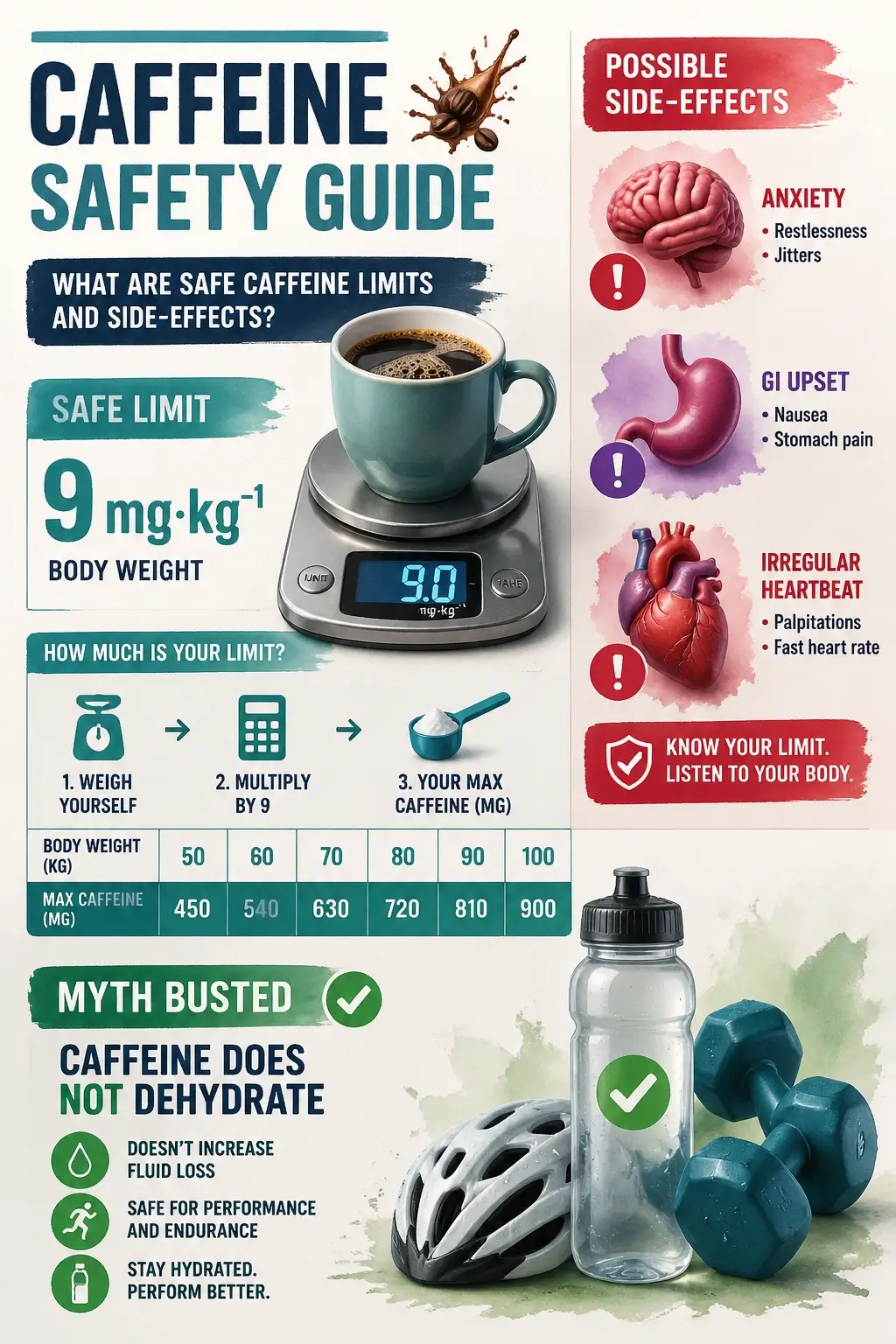
Now, the dehydration myth. It persists because caffeine is a mild diuretic: it nudges your kidneys to produce slightly more urine. That’s true at high doses. What’s also true is that at the doses athletes actually use (3–6 mg/kg), the diuretic effect is too small to meaningfully shift your fluid balance. The fluid you consume with your coffee, gel, or capsule offsets it. You don’t need to add extra water to “cancel out” your caffeine. Train and race with your normal hydration protocol.
The European Food Safety Authority (EFSA) put a clear line in the sand on the broader safety picture:
“habitual caffeine consumption of up to 400 mg per day does not give rise to safety concerns for non‑pregnant adults.”
That 400 mg figure is a conservative daily ceiling for the general population: most performance doses fall right inside it. What EFSA’s position also tells you is that the risk from caffeine, at sensible doses, is not the caffeine itself. It’s the timing, the form, and the individual variability we’ll look at next.
Caffeine also cuts muscle pain: here’s the full protocol
Targeted pain modulation works through caffeine’s direct block of adenosine receptors, the same receptors that would otherwise amplify your perception of muscle burn during hard efforts. When those receptors go quiet, the discomfort signal doesn’t disappear, the work is still hard, but the volume gets turned down enough that you can push through a higher training load before your brain calls it quits. That’s not a placebo effect. It’s a measurable shift in pain modulation, changing how your nervous system processes exertion signals.
Here’s why that matters for recovery: more quality reps completed at higher intensity means a stronger training stimulus. Caffeine isn’t just a pre-race tool. It’s also shaping the ceiling of what you can do in training, which directly shapes what you adapt to over time.
The catch is on the back end. Caffeine’s half-life runs 5–7 hours, which means an afternoon dose is still circulating at bedtime. And since adenosine is the molecule your body uses to build sleep pressure, the biological signal that says it’s time to shut down, blocking it late in the day delays sleep onset, reduces deep sleep, and undercuts the recovery you just worked for. The standard sleep cutoff is 6 hours before bedtime, and for slow metabolizers, moving it even earlier is worth testing.
So here’s how to put it all together into a personalized protocol that actually holds up:
- Pre-exercise dose: 3–6 mg · kg⁻¹ body weight, taken 30–60 minutes before training or competition. This window gives caffeine time to reach peak plasma concentration right as you need it.
- Mid-event top-ups: An optional 0.5 mg · kg⁻¹ during long efforts (ultra-endurance events, multi-hour competitions) can sustain the effect without front-loading too much.
- Hard ceiling: Stay under 9 mg · kg⁻¹. The performance gains plateau around 3 mg · kg⁻¹ for most people, and performance data from ScienceForSport notes that adverse effects: anxiety, GI distress, cardiac arrhythmia risk, climb sharply above 9 mg · kg⁻¹. More caffeine isn’t more performance. It’s just more risk.
- Delivery form: For competition, choose a fast-acting form, anhydrous caffeine or a gel, over slow-digesting sources like cold brew, which can peak too late to matter.
- Respect your genetics: CYP1A2 variants, sex-based hormonal differences, and training status all shift how hard a given dose hits and how long it lingers. If 6 mg · kg⁻¹ leaves you jittery and wrecked, that’s information. Drop to 3 mg · kg⁻¹ and reassess.
The simplest framing: caffeine works best when it’s treated like a tool with a specific job, not a default habit. Use the right dose, time it to the work, cut it off before it steals your sleep, and adjust based on how your own body actually responds. That’s the whole protocol.
Real Talk: What Most People Miss About Caffeine
Q: What if you’re a slow CYP1A2 metabolizer and 3 mg/kg still wrecks you?
A: Drop to 1.5-2 mg/kg; the mechanism still kicks in at lower doses without the jittery overload. Fast clearance isn’t required for benefits, but slow means caffeine lingers, hitting sleep and recovery hard, so test smaller hits to find your clean window.
Q: Why does coffee peak slower than gum even at the same dose?
A: Coffee’s chlorogenic acids slow gastric emptying, doubling the time to plasma peak versus gum’s oral mucosa absorption. You’re not racing the caffeine; you’re waiting on the matrix, so plan 45-60 mins ahead or switch forms for tight timing.
Q: What happens if you top-up too often in a long race?
A: Stacking 0.5 mg/kg every 60 mins keeps levels steady without overload up to 90+ mins, but exceed that and you hit the 9 mg/kg ceiling fast, trading glycogen sparing for GI distress and heart spikes. Drip, don’t flood.
Q: Does caffeine actually dehydrate you during a marathon?
A: No, at 3-6 mg/kg the diuretic nudge is trivial and offset by your drink volume; fluid balance holds with normal hydration. The myth sticks from high-dose studies, but athlete protocols don’t shift sweat rates meaningfully.
Q: Why might one twin get a boost while the other tanks the same dose?
A: ADORA2A receptor sensitivity amps anxiety in one despite identical CYP1A2; it’s dual genetics, not just metabolism. Same weight and protocol, opposite vasoconstriction or calm—test your response, don’t copy.
Q: Can you stack caffeine late and still recover if you’re fast metabolizer?
A: Even fast types have a 3-5 hour window; push past 6 hours pre-bed and adenosine block delays deep sleep regardless. Cutoff’s non-negotiable for recovery gains, genetics just buy a bit more wiggle room.
Q: What if anaerobic work gives you a dip instead of sprint gains?
A: Men often see bigger 1-2% boosts from fast-twitch calcium tweaks, but high ADORA2A or sensitivity flips it to coordination loss. Drop dose or skip for power days—endurance protocols don’t always cross over clean.