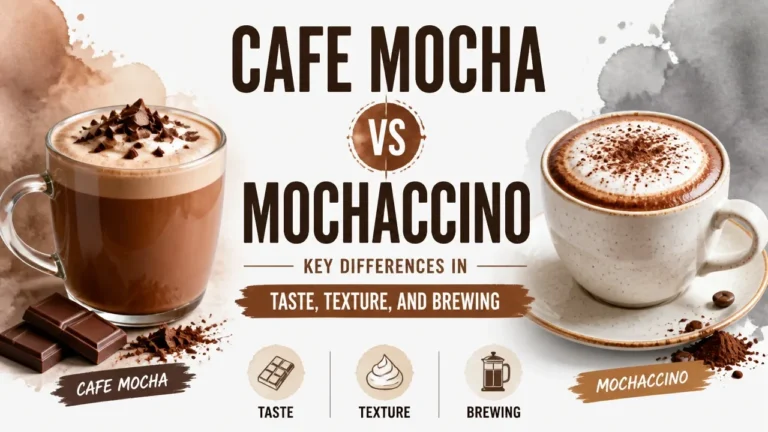

Cafe mocha and mochaccino are not the same drink, even though every coffee shop menu makes them look interchangeable. They share espresso, chocolate, and milk. What changes is the ratio and the way the milk is prepared.
One is a creamy, chocolate-forward latte. The other is a lighter, frothier build that leans closer to a cappuccino. Understanding that single structural difference clears up most of the confusion around these two drinks.
Key Takeaways on Cafe Mocha vs Mochaccino
- A cafe mocha and a mochaccino share the same three ingredients; the ratio and milk preparation are what separate them.
- Mocha uses a 1:3 or 1:4 espresso-to-milk ratio with microfoam; mochaccino uses a 1:1:1 ratio with airy froth.
- “Mochaccino” has no universal definition – always order by build, not by name, to get the drink you actually want.
- Espresso delivers 63-126 mg of caffeine per shot; chocolate adds 5-15 mg more, plus theobromine for a longer-lasting secondary lift.
- A decaf mocha still contains 5-10 mg of caffeine from the cocoa, so it is never truly caffeine-free.
- The chocolate format – syrup, sauce, powder, or solid – changes sweetness, texture, and cocoa-solid content more than any other single variable.
Quick Answer: Is a Mochaccino Different From a Cafe Mocha?
Yes, they are different drinks – built from the same ingredients, but assembled differently.
Quick Answer Box
>
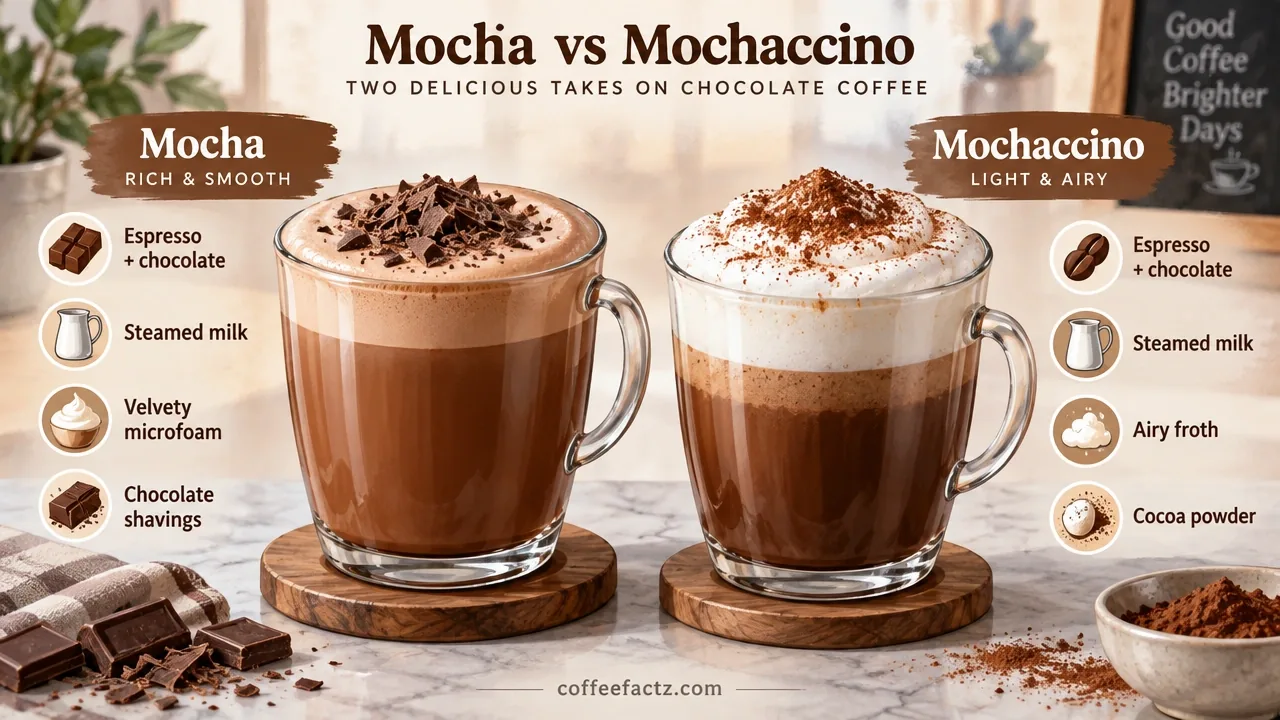
A cafe mocha is espresso combined with chocolate and a large pour of steamed milk, built like a latte. The ratio runs 1:3 or 1:4 (espresso to milk), topped with whipped cream and a thin layer of microfoam. It’s creamy, chocolate-forward, and filling.
>
A mochaccino (also spelled Mokachino or Mocaccino) uses the same espresso, chocolate, and milk as a Cafe Mocha, but it’s assembled like a cappuccino. The ratio is 1:1:1 (equal parts espresso, chocolate, and milk), with airy froth instead of microfoam. The result is lighter, foam-forward, and sharper on the espresso.
>
The ingredients are identical. The structure is what changes.
The alternate spellings – mochaccino, mokachino, mocaccino – all refer to the same concept: a frothy, cappuccino-structured variation of a mocha. You’ll see all three on menus depending on the country and the cafe. They mean the same thing, or close enough that the distinction between spellings is irrelevant.
What is relevant: a mochaccino’s 1:1:1 ratio produces a much smaller, more concentrated drink than a traditional mocha’s latte-sized pour. If you order a mochaccino expecting a mocha, you’ll get something noticeably airier and smaller.
Head-to-Head: Milk Texture, Ratios, Toppings, and Flavor Balance
The two drinks diverge across four specific dimensions. Here’s exactly where each one lands.
| Category | Cafe Mocha | Mochaccino |
|---|---|---|
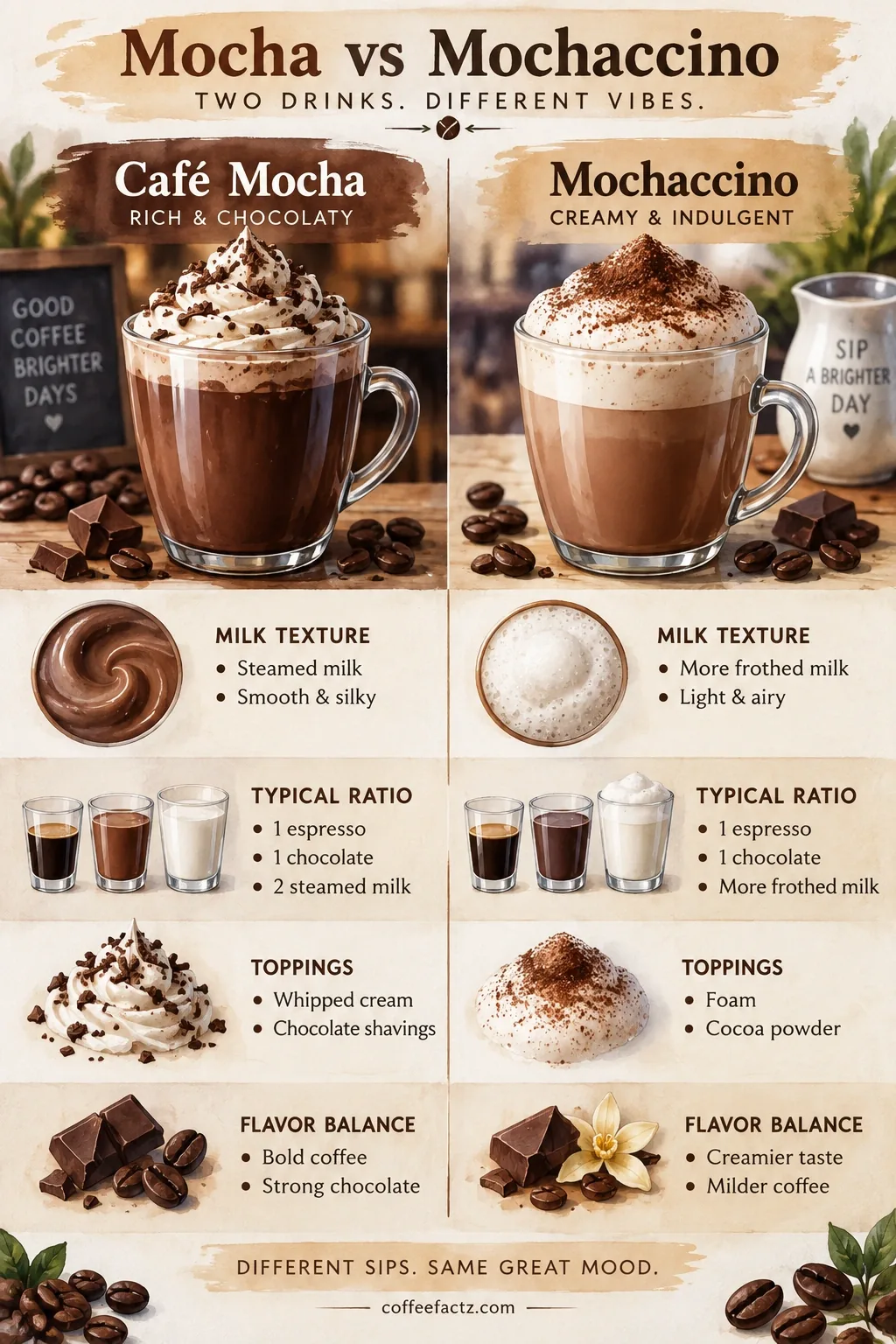
| Milk Texture | Steamed microfoam – velvety, integrated, blended into the drink | Aerated froth – light, airy, sits on top and dominates the first sip |
| Ratios | 1:3 or 1:4 (espresso to milk) with chocolate added | 1:1:1 (espresso : chocolate : milk) |
| Toppings | Whipped cream is standard | Whipped cream optional; cocoa dust is more common |
| Flavor Balance | Creamy and chocolate-forward; the milk softens everything | Lighter and foam-forward; the espresso comes through more sharply |
Milk texture is the most important row in that table. Microfoam is dense and integrates into the liquid, making a mocha feel like one unified, smooth drink. Aerated froth is lighter and sits above the espresso-chocolate base, so a mochaccino feels layered and less rich.
Ratios explain the size difference. A standard mocha is a full latte-sized drink because of all that extra milk. A mochaccino is smaller and more concentrated, closer to a cappuccino in volume.
Toppings are a tell. Whipped cream on a mocha adds richness that fits the latte structure. A mochaccino’s lighter build usually just gets a dusting of cocoa powder.
Flavor balance comes down to how much milk you’re pouring. More milk means more dilution of the espresso and chocolate, which is why a mocha tastes creamier. The mochaccino’s equal-parts ratio keeps the espresso present and the drink less sweet.
The difference lives in build and texture. Change the ratio or the milk preparation, and you’ve switched drinks.
Why “Mocha” Means Three Things (And Why “Mochaccino” Is Even Messier)
The naming confusion around these drinks is not your fault. “Mocha” has three completely separate meanings in coffee culture, and “mochaccino” adds a fourth layer of instability on top of that.
Historical Coffee Term Evolution
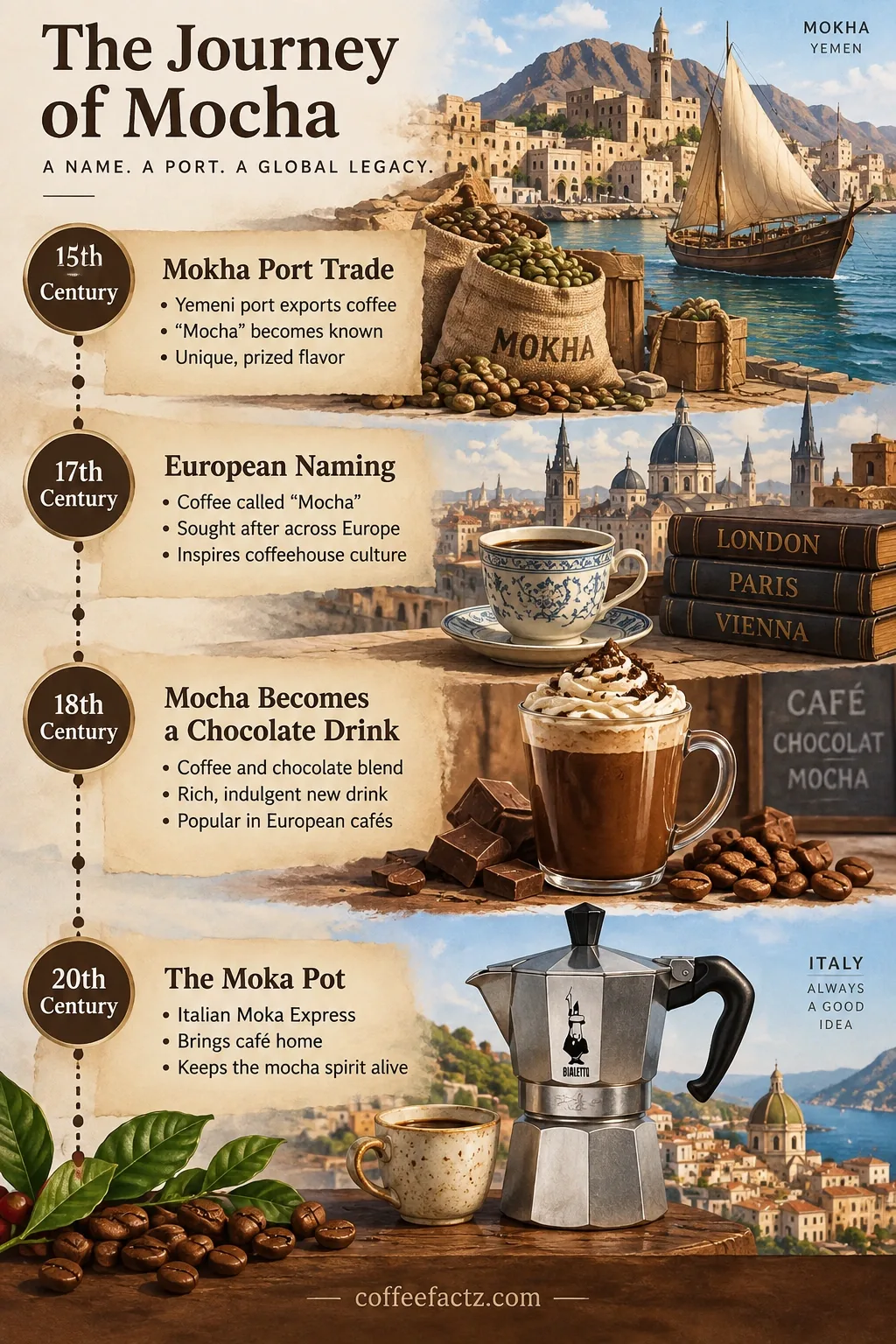
“Mocha” started as a geography word, not a flavor descriptor. The port city of Mokha (also spelled Mocha) in Yemen was one of the world’s dominant coffee-export hubs from the 15th through the 17th centuries. When Arabian coffee beans arrived in Europe through that port, traders called them “Mochas.” The word became synonymous with high-quality coffee itself.
That’s the first meaning: a Yemeni coffee bean defined by its origin.
The second meaning is the Italian stovetop moka pot, named by inventor Alfonso Bialetti in the 1930s. The spelling differs slightly, but the word root is the same port city.
The third meaning – the chocolate-coffee drink – emerged around the turn of the 20th century. The exact mechanism isn’t documented with precision, but the semantic chain is logical: Yemeni Mocha beans had a natural chocolatey character, European drinkers associated “mocha” with that flavor profile, and the word eventually attached itself to any coffee drink that combined coffee with chocolate.
Three meanings. One word. That’s already a problem.
Menu Naming Instability
“Mochaccino” doesn’t resolve the confusion – it adds to it. There is no universal, standardized definition for the term. Some sources treat mochaccino as a direct synonym for mocha. Others define it as a cappuccino-style variation. Others still use it for something entirely different.
The inconsistency is global and well-documented. Some sources treat mocha and mocaccino as interchangeable near-synonyms. Others specifically define mocaccino as a cappuccino-style variation with a distinct froth structure. In parts of Australia, a “mochaccino” can refer to a child’s drink – hot milk foam with chocolate powder and no espresso at all – or it can mean a cappuccino with a shot of espresso added.
That’s the same word covering drinks that range from zero caffeine to a full double shot.
The practical fix: stop relying on the word “mochaccino” as a fixed order. If you want a latte-sized chocolate espresso drink, ask for a “mocha latte.” If you want the cappuccino-style frothy version, say “cappuccino with chocolate.” And whenever you’re unsure, ask whether the mochaccino on a particular menu contains espresso. The answer is not guaranteed.
Caffeine and Chocolate: What’s Really in the Cup
Both drinks have two stimulant sources, and most people only account for one of them.
Stimulant Source Contributions
Espresso carries the bulk of the caffeine. A single shot delivers roughly 63 mg, a double shot around 126 mg, with variation depending on the bean and the extraction. The chocolate adds a smaller but real amount: approximately 5-15 mg of caffeine per serving.
But caffeine isn’t the only active compound the chocolate contributes.
A peer-reviewed methylxanthine study published in Foods measured espresso at 88-116 mg of caffeine per serving and found that dark chocolates contain 4-10 mg of theobromine per gram of chocolate. The study also confirmed that in cocoa-containing foods, theobromine is present at levels 3 to 10 times higher than caffeine – making it the dominant methylxanthine in the chocolate portion of your drink. – From the study “Methylxanthine Content in Commonly Consumed Foods in Spain“
Theobromine is not caffeine. It’s a milder stimulant with a slower onset and a longer duration. It doesn’t spike your alertness the way caffeine does, but it does contribute to the sustained, pleasant lift you feel after a mocha. When people say chocolate gives them a gentle energy boost that lasts longer than coffee, theobromine is the mechanism behind that experience.
So a mocha or mochaccino delivers: espresso caffeine for the immediate kick, a small additional caffeine hit from the chocolate, and theobromine for the longer tail.
Decaf Residuals and Serving Strength
A decaf mocha is not caffeine-free. Cocoa retains roughly 5-10 mg of caffeine regardless of what you do to the espresso. If you order a decaf mocha because you’re trying to avoid caffeine entirely, the cocoa is still working against you. It’s a small amount, but it’s real.
For a mochaccino specifically, caffeine tracks directly with the espresso shot count. One shot puts it in cappuccino territory. Two shots make it a more serious stimulant load. The chocolate adds its small contribution either way.
At the finished-drink level, a full-sized mocha (approximately 350 ml / 12 oz) can reach around 152 mg of caffeine total – a useful upper-bound figure that most cafe menus and nutrition guides don’t publish. They list the espresso shot and stop there, which underestimates the actual content of the complete drink.
The Chocolate Format Factor: Syrup, Sauce, Powder, or Solid?
This is why your mocha tastes different at every cafe, even when the menu lists the same drink.
Sweetener and Cocoa-Solids Balance
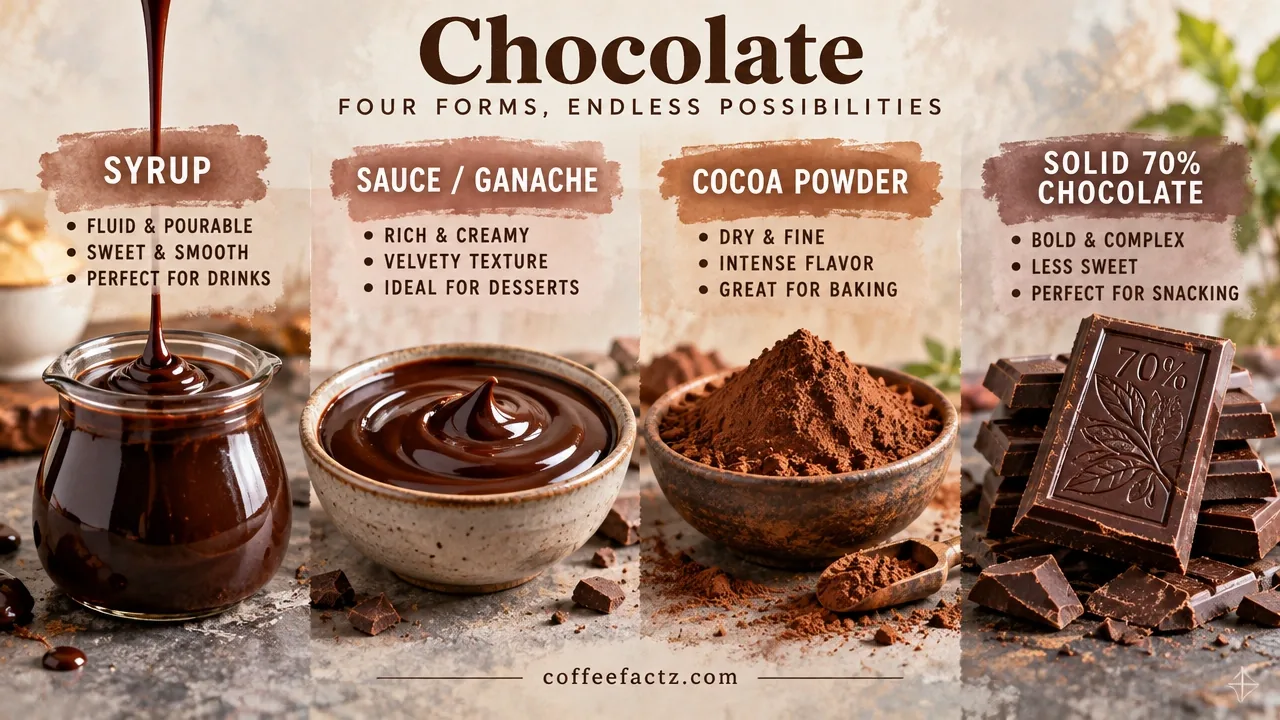
Chocolate arrives in four distinct formats, and each one produces a different drink even when the remaining ingredients stay identical.
Syrup is the sweetest chocolate format. It’s sugar-forward, dissolves instantly, and carries the least cocoa-solid content. Most chain cafes use syrup because it’s fast and consistent.
Sauce or ganache is a step up in richness. It has more cocoa solids than syrup, blends smoothly into hot liquid, and carries a more rounded chocolate flavor with less raw sweetness.
Cocoa powder is the most variable format. It has real cocoa solids, minimal added sugar, and a more bitter, intense chocolate character. The problem is solubility.
Solid chocolate (70% or higher) is the least sweet and the most complex. Melted directly into hot espresso, it delivers the highest cocoa-solid load and the most theobromine per gram.
Solubility and Mouthfeel Mechanics
Texture is where the format differences become physical. Syrup and sauce dissolve cleanly into hot liquid. Cocoa powder is hydrophobic – it resists water and can leave gritty, undissolved particles at the bottom of the cup unless you whisk it thoroughly or dissolve it in a small amount of hot water first. Solid chocolate must be melted directly into the hot espresso before the milk is added; pour it in cold or into already-diluted liquid and you get clumps.
The practical consequence: two cafes can both call their drink a “mocha” while one uses chocolate syrup and the other uses a melted 70% bar. The syrup version will be sweeter, smoother, and lighter. The solid-chocolate version will be richer, slightly bitter, and more texturally complex.
Format choice – not simply “chocolate vs. no chocolate” – is the actual variable. Powder, syrup, sauce, and solid chocolate each change sweetness, texture, solubility, and the cocoa-solid load. Higher cocoa-solid formats carry more theobromine and less sugar. Syrups carry the most sugar and the least cocoa. Every cafe menu lists “mocha” as if it’s one ingredient. It isn’t.
Variations That Rewrite the Rules: Bicerin, White Chocolate, Iced, and Blended
The mocha family is larger than most menus suggest, and a few of its members have centuries of history behind them.
Specialty Ingredient and Historical Forms
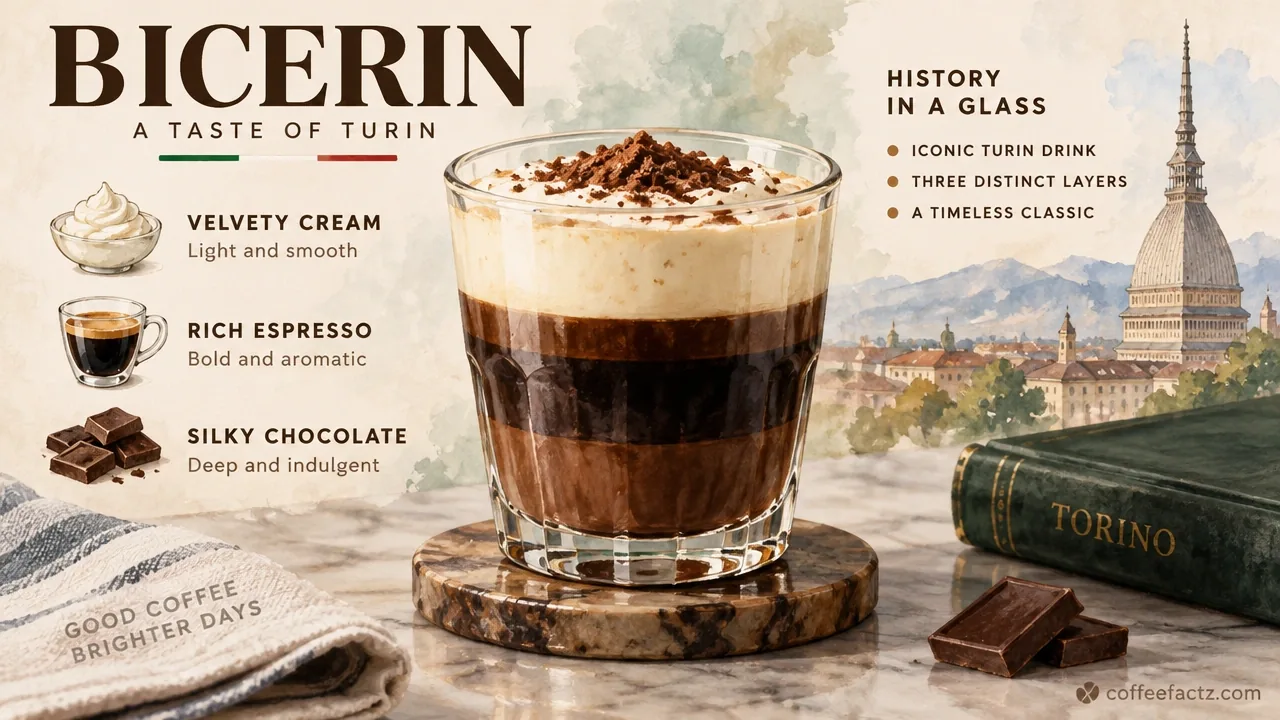
Bicerin is the oldest documented ancestor of the modern mocha, and it’s a distinct drink in its own right. It originated in Turin, Italy, and combines coffee, chocolate, and cream in distinct visible layers – not blended together, but stacked. The drink traces back to the 18th century, with roots in an earlier Turin preparation called bavareisa that mixed the same three elements.
The lineage is longer than most people realize. Chocolate drinks reached Italy in the 17th century. Turin’s bavareisa blended chocolate, coffee, and cream. That evolved into the bicerin by the 1700s. A documented “Chilled Mocha” recipe from 1920 represents the earliest known cold-mocha ancestor. The modern cafe mocha is not a recent invention – it’s the end point of a 300-year evolution.
White Chocolate Mocha uses the same structural build as a standard mocha, but substitutes white chocolate for dark or milk chocolate. White chocolate is made from cocoa butter with no cocoa solids. That single change has two consequences: it eliminates theobromine entirely (no cocoa solids, no theobromine), and it makes the drink noticeably sweeter because cocoa butter carries none of the bitterness that cocoa solids provide.
Cold and Frozen Menu Adaptations
Iced mocha keeps the same espresso-chocolate-milk formula but replaces steamed milk with cold milk poured over ice. Sweet garnishes like whipped cream or chocolate drizzle are common. The texture is thinner than the hot version because there’s no foam structure, and the cold temperature mutes some of the chocolate intensity.
Blended mocha – often listed as a “frozen mocha” on chain menus – takes the same ingredients and blends them with ice into a milkshake-like consistency. It’s the most dessert-adjacent version of the drink, with a texture closer to a frappe than a traditional espresso beverage. Cocoa-solid content and espresso strength both matter less here because the ice and blending process dilute everything.
Make It at Home: The 4-Step Barista-Style Method
Every distinction covered above – structure, chocolate format, milk texture, caffeine load – collapses into four steps when you make this at home. Here’s how to build either drink correctly.
Prerequisites before you start: freshly ground espresso (burr grinder, beans roasted within 5-30 days), good chocolate at 70% cocoa minimum or a quality sauce/syrup, milk of your choice, a milk steamer or frother, and a scale accurate to 0.1g for repeatability. Brew water should be 195-205°F (90-96°C).
Step 1 – Pull the espresso. Brew a single or double shot. The espresso is the base of everything, so pull it fresh and don’t let it sit. Stale espresso produces a flat, bitter mocha regardless of how good your chocolate is.
Step 2 – Add the chocolate. Melt 15-20 g of chocolate at 70% cocoa or higher directly into the hot espresso and stir until fully dissolved. If you’re using sauce, stir it in. If you’re using syrup, adjust the amount down because syrup is sweeter per gram than solid chocolate. This step happens before the milk goes in – the hot espresso does the melting work.
Step 3 – Steam the milk. For a mocha, steam approximately 150 ml of milk to a velvety microfoam: small, uniform bubbles fully integrated into the liquid, no visible foam layer. For a mochaccino, aerate the milk more aggressively to create a lighter, airier froth that will sit visibly on top of the drink.
Step 4 – Build and finish. Pour the steamed milk into the espresso-chocolate base. For a mocha, top with whipped cream. For a mochaccino, skip the whipped cream and finish with a light dusting of cocoa powder if you want it. Serve immediately.
A 250 ml cup built this way with whole milk lands around 180-250 kcal. With semi-skimmed milk and slightly less chocolate, closer to 140 kcal. These aren’t estimates – they’re the numbers that come from using a measured 15-20 g chocolate portion and a 150 ml milk pour consistently.
The steps are simple. The measurements are what make it repeatable.
Frequently Asked Questions About Cafe Mocha vs Mochaccino
What is a poor man’s mocha?
A poor man’s mocha is typically drip coffee mixed with hot chocolate or chocolate syrup, skipping espresso entirely. It replicates the chocolate-coffee flavor at much lower cost, though the caffeine profile and texture differ significantly from an espresso-based mocha.
Which is stronger, cappuccino or mochaccino?
They’re roughly equivalent in caffeine because both are built on the same espresso shot count. A mochaccino adds a small caffeine contribution from the chocolate (5-15 mg), so it edges slightly ahead of a plain cappuccino at the same shot count.
Which is better, cafe latte or cafe mocha?
Neither is objectively better – they solve different cravings. A latte is milk-forward and subtle. A mocha adds chocolate, making it sweeter and richer. If you want coffee flavor with less sweetness, choose a latte. If you want a dessert-adjacent drink, choose a mocha.
Which Starbucks mocha is best?
That depends entirely on what you want from the drink. Their standard Cafe Mocha uses mocha sauce and is topped with whipped cream. The White Chocolate Mocha swaps in white chocolate sauce for a sweeter, less bitter result. The Iced versions work well if you prefer cold drinks. Try the standard mocha first, then adjust from there.
Can I make a mochaccino without an espresso machine?
Yes. Brew a strong shot using a moka pot, AeroPress, or Nespresso capsule, dissolve your chocolate into it, then froth milk using a handheld frother. The froth structure won’t be identical to a professional steam wand, but the 1:1:1 ratio and airy foam will get you close enough.
Does the type of milk change a mocha significantly?
It changes texture and sweetness more than most people expect. Whole milk produces the richest microfoam and the creamiest mouthfeel. Oat milk froths well and adds a slight sweetness. Almond milk is thinner and froths less reliably. The chocolate flavor itself stays consistent – the milk is what shifts the body of the drink.
Is a bicerin the same as a mocha?
No. A bicerin is a layered Italian drink from Turin that keeps its coffee, chocolate, and cream in distinct strata rather than blending them. It’s the historical ancestor of the modern mocha family, but the two drinks are structurally different. A bicerin is not mixed; a mocha is.
Why does my mocha taste different at every coffee shop?
Almost certainly because of the chocolate format. Cafes use syrup, sauce, powder, or solid chocolate interchangeably under the same menu label. Syrup is sweeter and thinner; solid dark chocolate is richer and more bitter. The espresso roast and milk type also vary. There’s no standardized mocha recipe across the industry.
References
- Methylxanthine Content in Commonly Consumed Foods in Spain and Determination of Its Intake during Consumption | mdpi.com