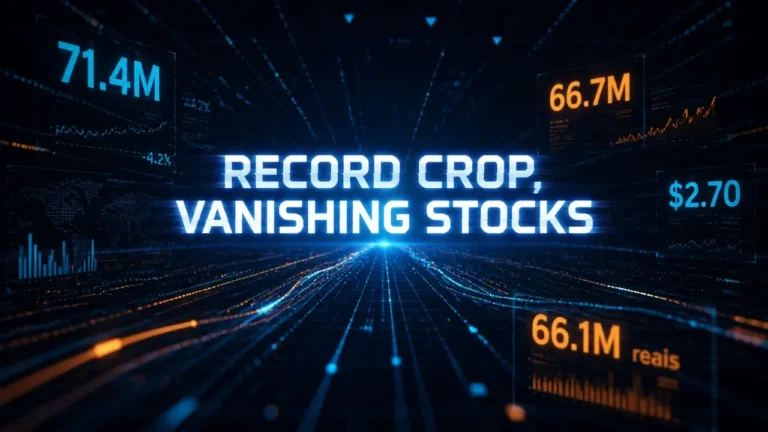

Brazil’s next coffee harvest is shaping up as one of its biggest ever, but a mix of tight inventories, high costs and export bottlenecks is keeping prices elevated and dividing market opinion on how far they can fall. New surveys and official estimates released between February and May put the 2026/27 crop between 66.7 million and 71.4 million 60‑kg bags, even as New York futures still hover around $2.70 per pound.
A farmer survey by the Coffee Trading Academy (CTA) (https://www.coffeetradingacademy.com) published via Reuters/KELO-AM on 29 April projects a record 71.4 million bags for 2026/27, based on responses from 758 growers across all Brazilian regions. CTA sees arabica output at 47.9 million bags, up 13.5% year on year, and robusta at 23.5 million bags, up 7.6%. The same survey reports that 63.5% of farmers said off‑season rain had a major positive impact, total acreage rose 2.97% year on year, and fertilizer application increased 5.4% compared with the previous season.
Government agency Conab offers a more conservative view. In its first 2026 crop estimate released on 5 February, Conab forecast 66.2 million bags, up 17.1% from the previous season, with arabica at 44.1 million bags and conilon (robusta) at 22.1 million, and reported productivity of 34.2 bags per hectare, according to its own February report. An updated estimate cited by Xinhua on 22 May lifted the forecast slightly to 66.7 million bags, an 18% year‑on‑year increase and a new record in Conab’s series, with arabica at 45.77 million bags and robusta at 20.9 million.
The gap between CTA’s 71.4‑million‑bag projection and Conab’s 66.7‑million‑bag estimate mirrors broader uncertainty. Business daily Valor reported on 21 May that unnamed private consultancies expect production potentially above 70 million bags, while CTA’s own series of surveys has fluctuated from 73.7 million bags in July 2025 to 69 million in November and then 71.4 million in April, according to Reuters/KELO-AM.
At the International Coffee Seminar held in Santos on 20 May, industry leaders said expectations of a robust Brazilian crop are weighing on prices, but pointed out that futures remain historically high. Analyst Eduardo Carvalhaes of Escritório Carvalhaes told Valor that, in the minds of major buyers, coffee prices will keep falling because they anticipate a large crop; yet he noted that even after recent declines prices are still around $2.70 per pound in New York, and argued that the balance between production and consumption is fragile and there are no inventories.
Pavel Cardoso, president of the Brazilian Coffee Industry Association (ABIC), described how this volatility complicates stocking decisions for roasters. Speaking to Valor, he said that if companies build long inventory positions and prices fall, margins are hurt, while if they keep inventories short and prices rise, they are left uncovered. Cardoso added that companies have passed part of recent price declines on to retailers, and cited concern over El Niño as another risk factor.
Upstream, Vinicius Estrela of the Brazilian Specialty Coffee Association (BSCA) told Valor that coffee is a long‑term crop, yet producers are having to make short‑term decisions amid higher costs and uncertainty over commercialization. Researcher Vegro from Brazil’s Institute of Agricultural Economics (IEA) said in the same report that consumption has grown so much while supply has been constrained that larger supply now does not offset the imbalance, and warned that logistics costs will eat into part of profitability.
Those logistics pressures are already visible at Brazil’s ports. The exporters’ council Cecafé reported through Valor that coffee exporters incurred an additional 66.1 million reais in 2025 due to port inefficiencies, and technical director Eduardo Heron stated that losses could be even greater in the second half of 2026 with a large volume to ship and the same infrastructure. Heron also called the war in the Middle East and the closure of the Strait of Hormuz risk factors for the entire supply chain because they create disruptions to foreign trade.
Despite Brazil’s larger crop outlook, export volumes have been constrained this year. Brazil’s coffee exports fell 22.5% year on year to 11.5 million bags in the January–April 2026 period, according to figures cited by Xinhua. Conab’s February report, referencing a United States Department of Agriculture (USDA) forecast, noted that world coffee consumption is expected to reach a record 173.9 million 60‑kg bags in 2026, mainly driven by demand growth in China, Indonesia and Vietnam.
For Brazilian producers, meeting that demand has become part of the strategic discussion. During the Santos seminar, Cooxupé president Carlos Augusto Rodrigues de Melo told Valor that Brazil needs to produce 70 million bags, otherwise it will lose market share, and said he expects a good crop both in quality and quantity.