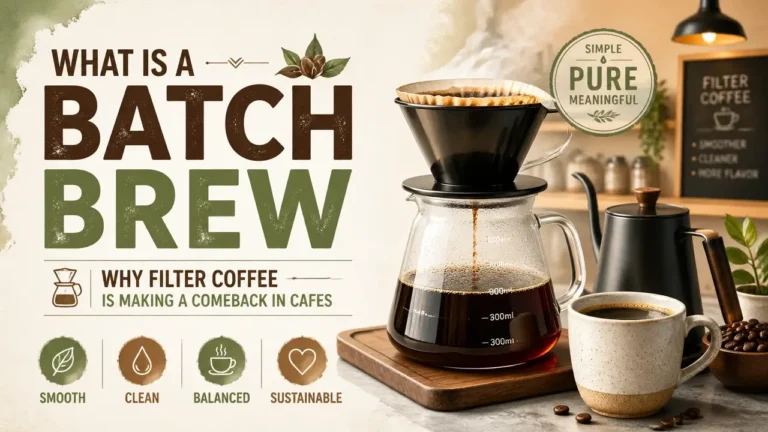

Automated batch brew coffee isn’t the burnt diner swill it used to be. Today’s specialty shops are dialing in grind settings, water profiles, and fresh-ground beans to produce filter coffee that rivals a careful pour-over, cup after cup, without the bottleneck.
The business case is just as sharp as the flavor. Lower cost per cup, dramatically higher throughput, and tighter extraction yield variance mean batch brew isn’t a compromise. It’s a calculated upgrade hiding in plain sight.
Automatic batch-brew coffee brews in fixed volumes for consistent results
Automatic batch-brew coffee works by running a precise, measured amount of hot water through a bed of ground coffee in one continuous cycle, filling a thermal carafe or air-pot, then holding that finished brew until it’s served or replaced. That’s the whole system. You grind, dose, brew, and serve from that vessel until it’s empty or its clock runs out.
What separates batch-brew from a continuous-flow setup is the discrete nature of each cycle. There’s no drip running constantly into a warming pot. Instead, one batch brews completely, gets served, and then, when it’s time, the whole process starts fresh. That rhythm is what gives batch-brew its consistency edge: every cup drawn from the same batch was extracted under the same conditions.
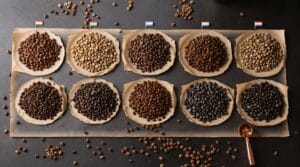
The grind is where most of the flavor control lives. Most specialty cafés land on a medium-coarse grind for a standard 2-liter batch (think coarse sand, not powder). Go too fine and the water lingers too long in the bed, pulling bitter, over-extracted compounds. Go too coarse and it races through, leaving the cup thin and sour. That sand-like texture hits the sweet spot for extraction time and flavor clarity at scale.
Nailing this requires precision, which is why mastering grinding beans for batch brew makes all the difference between a dull cup and a vibrant, balanced brew.
Water temperature is the other non-negotiable. The Specialty Coffee Association’s Standards Committee puts it plainly:
“To achieve the Golden Cup Standard, water temperature, at the point of contact with coffee, is recommended to fall between 200°F ±5° (93.0°C ±3°).”
That narrow window exists because extraction chemistry is temperature-sensitive. Drop below it and certain soluble compounds, the ones carrying sweetness and body, simply don’t dissolve. Exceed it and you’re scorching delicate aromatics, before they ever reach the cup.
The standard batch-brew workflow follows a tight loop:
- Grind: Fresh ground coffee, dialed to medium-coarse
- Dose: Weighed and loaded into the filter basket
- Brew: Full cycle completes into a sealed thermal carafe or air-pot
- Serve: Poured to order from the vessel
- Refresh: Batch discarded or replaced after 2–2.5 hours maximum
That last step matters more than most people expect. Even in a sealed thermal carafe, coffee continues to change after brewing, oxidation and off-gassing slowly flatten the flavor. The 2–2.5 hour window isn’t arbitrary; it’s the practical edge before the cup quality noticeably drops. Holding past it is where batch-brew gets its undeserved reputation for stale, cafeteria-style coffee. The machine isn’t the problem. The clock management is.
Batch Brew Wins on Speed and Consistency
Automated batch brew coffee removes the two biggest sources of cup-to-cup variance (human pour speed and temperature drift) by locking every variable into a repeatable machine cycle. Once a recipe is dialed in, the machine runs the same bloom time, flow rate, and water temperature on every single batch. The result isn’t just faster service: it’s a floor under your quality that no amount of skilled hand-pouring can reliably match during a morning rush.
That’s the core trade-off worth understanding here. A great barista can pull off a flawless pour-over. But “great barista, fully focused, no line pressure” is a controlled-lab condition, not a Tuesday at 8 a.m. Batch brew doesn’t depend on ideal conditions: it creates them mechanically, every time.
Automatic timing locks out human variability
A precise timing mechanism is what separates batch brew from every manual method: it controls flow rate and bloom duration the same way a metronome controls tempo, removing the human hand from the equation entirely. When you pour manually, your speed drifts. Your temperature drops between the kettle and the cup. You get distracted on pour two of three. Each of those micro-variations nudges the extraction in a different direction.
The machine doesn’t drift. It delivers the same water volume at the same temperature over the same time window, batch after batch. That mechanical repeatability is why top-tier specialty shops don’t just set a batch and walk away: they dump and brew fresh every 30 minutes during peak hours to keep vibrancy alive, and they keep each batch within a 2 to 2.5-hour window before it goes stale. The machine handles the how; the SOP handles the when.
Here’s a real-world look at how that automatic timing and flow system operates in practice:
One honest caveat: the machine solves the execution problem, but it doesn’t solve the knowledge problem. Many cafés run batch brew without written SOPs for humidity-adjusted grind settings or without training baristas on how the system actually behaves. When that happens, the gap between what batch brew can do and what it actually delivers on the floor stays wide. The hardware is only half the equation.
The numbers show how big the gap really is
Measured cup-to-cup variance is where batch brew separates itself most clearly from manual pour-over, and the difference isn’t marginal. According to industry analysis from The Way to Coffee, commercial batch brew systems hold extraction yield variance below 2% (with a standard deviation of roughly ±0.05% TDS). Manual pour-over typically runs above 5% variance, with standard deviations reaching ±0.15% TDS. That’s a three-times-wider spread in what ends up in the customer’s cup, driven entirely by the accumulated small errors of human execution under real working conditions.
The throughput rate tells the same story from the speed side. A 2-liter batch serves 20 to 25 cups in under 5 minutes: roughly 2.9 cups per minute. A skilled barista doing pour-overs delivers about one cup every 3 to 4 minutes, or around 0.3 cups per minute. During a morning rush, that’s not a small operational difference: it’s the difference between a line that moves and one that doesn’t.
The practical implication for brew water is worth flagging here too. Because batch brew machines run the same thermal profile every cycle, any mineral imbalance in your water hits every batch equally and predictably. That’s actually useful: it means a consistent water problem produces a consistent symptom, which is diagnosable. With manual pour-over, water quality issues get masked by all the other variables shifting around them.
With speed and consistency secured mechanically, the real challenge shifts to the variables the machine can’t control: grind size, water chemistry, and the equipment choices that determine whether a high-consistency batch is also a high-quality one.
Good Batch-Brew Flavor Starts With the Right Gear
Flavor-rich batch brew coffee depends on three interlocked variables (machine, filter, and water), each one either compounding or canceling out what the others do. Think of it like a relay race: the best runner in the world can’t save a bad handoff. Your grinder sets the particle size, your machine controls the thermal environment, your filter decides what gets through, and your water chemistry determines how aggressively extraction happens. Get one wrong, and the other three can’t compensate.
The good news is that once you understand why each variable matters, the right choices become obvious. Let’s build that picture from the hardware up.
What machine and filter actually do for your cup
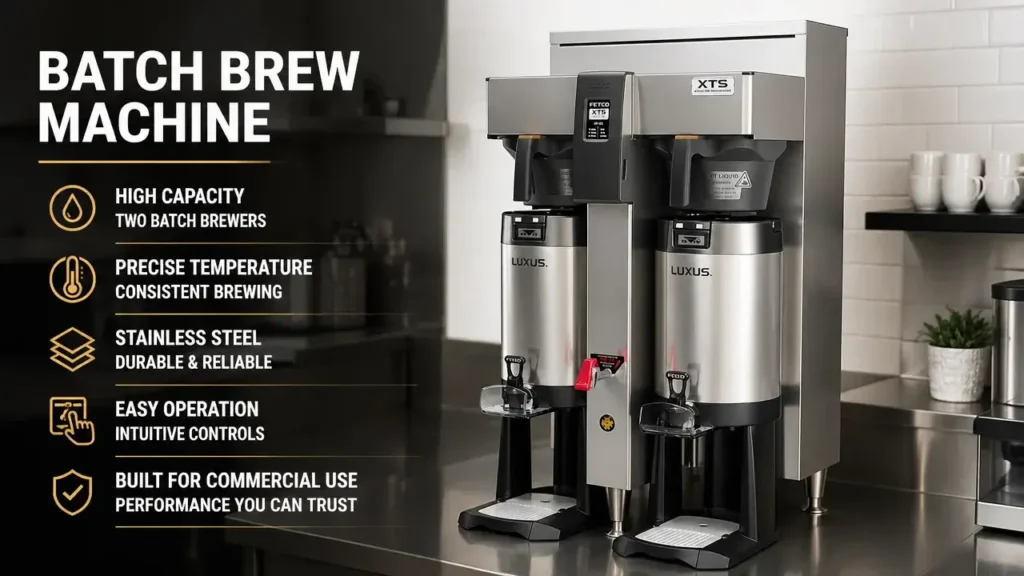
Commercially proven batch-brew hardware: the Fetco CBS-2 and the Bunn Trifecta: earns its place in specialty cafés because both machines hold brew temperature within a tight window (typically 200–205°F) and deliver water through a spray head that distributes flow evenly across the entire coffee bed. That even saturation is the mechanical reason batch brew can rival a pour-over: you’re not relying on a barista’s pouring technique to wet the grounds uniformly. The machine does it the same way every single time.
The filter choice matters more than most people expect. High-quality white, bleached paper filters, not the brown unbleached kind, remove the fine sediment and oils that would otherwise make the coffee taste muddy or flat in a carafe over time. Bleached filters also carry less papery taste, which is a real variable when you’re brewing at volume. If you’re using a Kalita Wave for batch-style brewing, the flat-bed design already works with this principle: it shortens the water’s path through the grounds and reduces channeling.
On water: filtered and re-mineralized is the standard. The logic is straightforward: municipal tap water has chlorine and inconsistent mineral content, both of which interfere with extraction chemistry. Re-mineralized water gives you a controlled starting point. The target most specialty labs work toward is calcium around 50 ppm and magnesium around 30 ppm. Calcium drives extraction efficiency; magnesium enhances sweetness and complexity. Specific mineral-profile numbers are rarely disclosed by cafés publicly, but those benchmarks are where the science points. Most cafés use an inline filtration system with a remineralization cartridge rather than building custom water from scratch: it’s repeatable and low-maintenance.
Grind size and batch volume set your extraction ceiling
Correctly calibrated grind settings are the single highest-leverage variable in batch brew coffee, because particle size controls how fast water moves through the bed and how much surface area it contacts. Too fine, and water slows down, over-extracts, and turns bitter. Too coarse, and it rushes through, under-extracts, and tastes thin and sour. The target is medium-coarse: think coarse sand or kosher salt, produced by a flat-burr grinder that creates a unimodal particle distribution. “Unimodal” just means most particles are the same size, with minimal fines. Fines are the enemy here: they clog the filter, slow the flow unevenly, and extract faster than the larger particles around them, creating a muddy, astringent cup.
Here’s a quick reference for how grind size affects extraction variance and batch volume:
| Grind Size | Extraction Yield Variance | Recommended Batch Size | Recommended Grind | Particle Distribution | Optimal Batch Volume for Flavor Consistency |
|---|---|---|---|---|---|
| Medium-Coarse | Low (balanced flow prevents over/under-extraction) | 40-60g | 1100-1300 µm (kosher salt/coarse sand) | Even, gritty particles for steady water flow | 600-1000ml (1:15-1:17 ratio, 3-4.5 min brew) |
| Fine | High (finer particles increase surface area and yield variability) | 15-20g | 300-800 µm (table salt-like) | Uniform fines for controlled pressure/flow | 240-340ml (1:15-17 ratio, 2.5-3.5 min) |
| Extra-Fine | Very High (extreme surface exposure risks over-extraction) | 14-18g | 180-380 µm (flour-like) | Tight distribution for high-pressure stability | 28-60ml (1:2 ratio, 25-30 sec) |
Batch size is where a lot of cafés quietly lose quality. Keep each batch at or under 2 liters. Beyond that threshold, two things happen: extraction becomes uneven because the water-to-coffee contact time varies across a deeper bed, and the brewed coffee starts oxidizing in the carafe faster than it gets served. Smaller batches brewed more frequently is the operational discipline that separates good batch brew from the forgettable stuff.
Scott Rao, coffee author and consultant frames the grind-and-bed relationship this way:
“Use a shorter brew time for thicker beds. This will allow you to keep the same overall contact time, regardless of the time it takes for the water to flow through the thicker coffee bed. Two, keep your grind on the side to prevent grinds from rising up the filter bed and creating uneven extraction.”
That second point is something most guides skip entirely. When fine particles migrate upward through the bed during brewing, they redistribute unevenly, and you get extraction that varies cup to cup from the same batch. Staying coarser than you think you need to, and keeping the bed depth manageable, is what keeps every pour consistent.
Even with the right machine, the right filter, dialed-in grind, and clean water, cafés still stumble. The failures tend to be subtle, and they compound quietly until the whole program starts underperforming in ways that are hard to diagnose. That’s where we’re headed next.
Most Batch-Brew Failures Trace Back to Three Fixable Gaps
Poorly managed batch brew coffee (stale hold times, wrong filter choice, and grind misconceptions) quietly destroys cup quality before the customer even orders. The grind sets the extraction foundation, the filter either adds flavor or stays neutral, and water temperature interacts with both to determine whether you get a clean, bright cup or a flat, papery one. Once you understand where the breakdown actually happens, the fixes become obvious.
Let’s start with the variable most cafés underestimate: time.
Freshness isn’t a preference: it’s chemistry. Brewed coffee is an unstable solution. The moment extraction stops, oxidation starts. Aromatic compounds off-gas, acids degrade, and the cup flattens. The rule of thumb in specialty circles is simple: never let a batch sit longer than 2 to 2.5 hours. During a morning rush, high-volume cafés refresh every 30 minutes, not because the coffee looks bad, but because it is bad by then, even if it’s still hot.
Batch size compounds this. Brewing more than 2 liters at a time sounds efficient, but it works against you in two ways. First, larger volumes extract unevenly: the coffee closest to the shower head pulls differently than the coffee at the edge of the bed. Second, more liquid means more surface area exposed to oxygen during the hold. You get oxidation before the last cup is even poured.
A batch freshness sensor can take the guesswork out of hold time in higher-volume operations (some brewers now integrate time-based alerts directly into the machine), but even a simple timer and a written SOP gets the job done.
The filter is a flavor variable most people ignore. Low-quality brown (unbleached) filters carry residual wood pulp compounds that leach into the brew. That faint cardboard note you’ve tasted in diner coffee? That’s often the filter, not the beans. White bleached filters have had those compounds removed, which is why specialty cafés default to them. The filter’s job is to be invisible: to let the coffee speak without adding its own character.
Now for the grind myths, because this is where a lot of received wisdom falls apart.
There’s a persistent belief that batch brew requires the coarsest possible grind, sometimes framed as a hard rule, like “always use the 15% coarsest setting on your grinder.” The logic sounds reasonable: longer contact time, so coarser grind to avoid over-extraction. But cafés consistently achieve excellent results with finer grinds by adjusting three other variables: dose, bloom time, and water temperature. A slightly finer grind with a reduced dose and a proper bloom can produce more clarity and sweetness than a coarse grind brewed on autopilot.
The coarser-is-always-safer rule is really a shortcut for under-dialed recipes: not a fundamental truth about how water and coffee interact.
The pre-ground myth is less subtle and more damaging. Using pre-ground beans in a batch brewer isn’t just a quality compromise: it’s a chemistry problem. Ground coffee has an enormous surface area exposed to air. Volatile aromatics escape within minutes. What’s left behind are the slower-to-escape bitter compounds, including quinic acid, which builds up as coffee ages and stales. The result is a cup that tastes bitter and hollow at the same time: all the harsh notes, none of the bright ones. Fresh-ground beans aren’t a luxury preference in batch brew; they’re the baseline requirement for the system to work as intended.
This is also where the pricing conversation gets interesting. Some coffee drinkers have started pushing back on $5–$6 pour-overs, viewing the price as a markup that’s harder to justify when the labor component is obvious. But the critique isn’t really about price: it’s about perceived value. When a pour-over is executed well and the ritual is part of the experience, customers pay willingly. When it feels like a slow process that produces a mediocre cup, the price feels like a penalty. Batch brew, ironically, sidesteps this tension: the cost is lower, the consistency is higher, and the flavor can be just as good when the SOP is tight. The value equation just needs to be communicated honestly.
All of these failures (stale holds, oversized batches, cheap filters, grind myths, pre-ground shortcuts) share a common root. They’re SOP gaps dressed up as equipment problems. The machine isn’t the issue. The process around the machine is.
Why Specialty Cafés Are Choosing Batch Brew Over Pour-Over
Strategically sound batch brew coffee connects cost efficiency, throughput rate, and flavor preservation into a single system that specialty cafés are choosing not out of compromise: but out of calculation. The idea that batch brew is the “lazy” option has quietly collapsed under the weight of real operational data. What’s replacing it is a clearer picture: when you build the right SOPs around it, batch brew doesn’t trade quality for speed. It earns both.
That’s the shift worth understanding. The two variables cafés care most about: serving great coffee and serving it fast: used to feel like a tension. Pour-over sat on one side: expressive, craft-forward, but slow and labor-intensive. Batch brew sat on the other: fast, but historically associated with diner coffee and low expectations. Specialty cafés figured out how to collapse that tension. Here’s how they did it.
Batch Brew Cuts Cost Without Cutting Corners
Efficient batch brew coffee compresses cost per cup by spreading labor and equipment overhead across a full carafe rather than a single serving, and the numbers make that concrete. A hand-crafted pour-over in a specialty café typically runs between $5 and $8 per cup once you account for barista time, equipment wear, and the slower throughput rate that limits how many drinks you can move in an hour. Batch brew averages $2 to $3 per cup under the same quality inputs. That gap isn’t just a margin story: it’s a capacity story.
During peak service windows, throughput rate is the real constraint. A skilled barista can produce one pour-over every three to four minutes. A properly dialed batch brewer produces eight to twelve cups in roughly the same window, and those cups are ready before the customer finishes ordering. analysis of wait times confirms this directly: batch brewers allow “high-quality filter coffee immediately upon request,” which isn’t just a convenience feature. It’s a throughput multiplier that changes the economics of a busy morning shift.
What the market narrative around speed tends to miss, though, is that faster service only pays off when the coffee is worth ordering again. Cafés that treat batch brew as a set-it-and-forget-it system don’t capture the full advantage. The ones that build concrete protocols around brew water temperature, dose, and hold time, and then train their staff to execute those protocols consistently, are the ones that turn throughput into a genuine competitive edge. Speed gets customers through the door. Repeatable quality keeps them coming back.
Good SOPs Are What Make Flavor Preservation Real
Reliable flavor preservation in batch brew depends on three variables that most cafés underinvest in: water mineral profile, grind freshness, and parameter adjustments that account for real-world conditions. Get these right, and batch brew doesn’t just match a well-executed pour-over: it can surpass it in cup-to-cup consistency, because the machine removes the human variability that even skilled baristas introduce at scale.
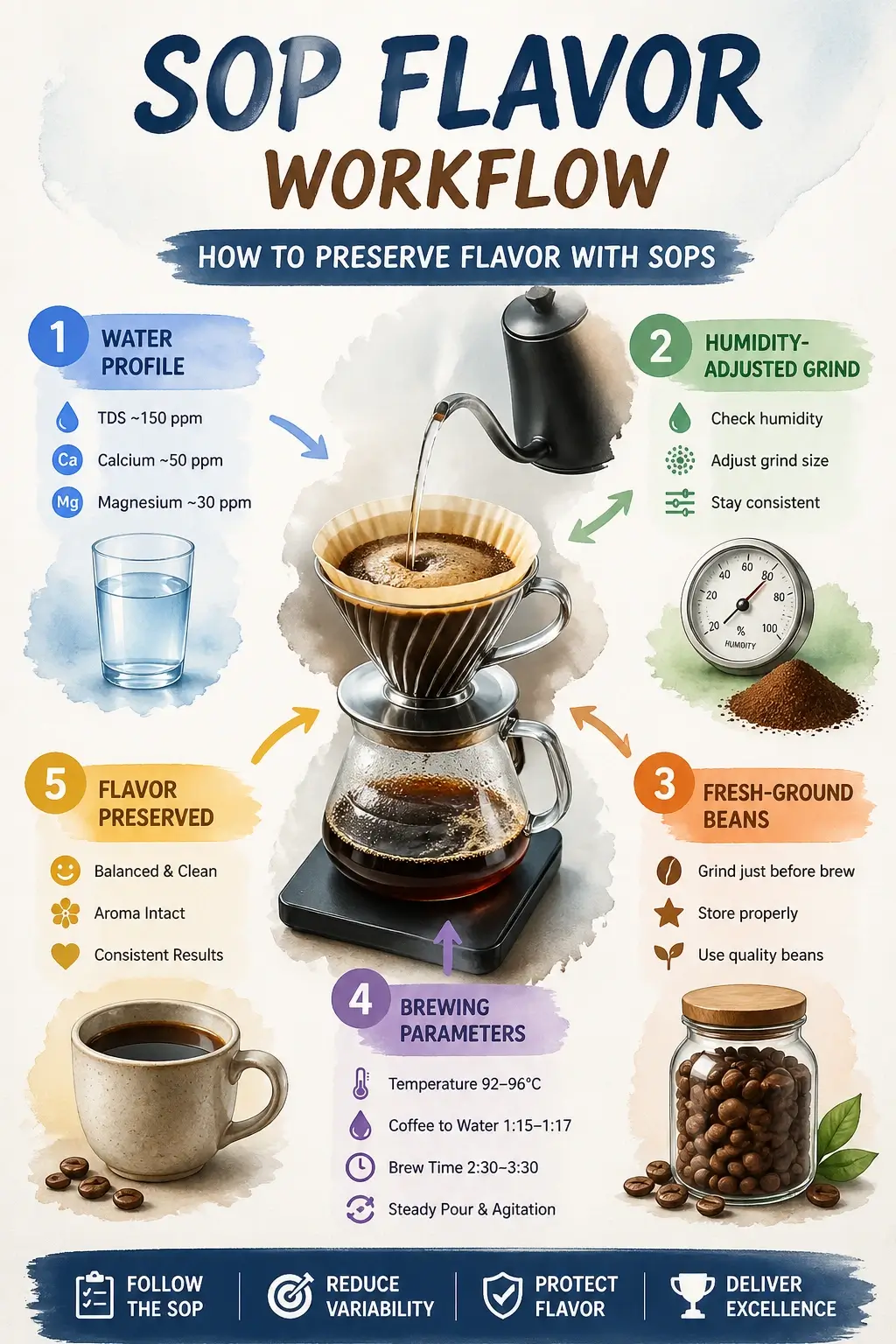
Start with brew water. A target TDS around 150 ppm, with calcium near 50 ppm and magnesium near 30 ppm, gives your extraction the mineral scaffolding it needs to pull sweetness and clarity from the grounds. Water that’s too soft under-extracts. Water that’s too hard mutes acidity and muddies the finish. This isn’t a detail you dial in once, and it belongs in a written guide that gets checked when your water source changes or when seasonal shifts affect municipal supply.
Fresh-ground beans are non-negotiable. Pre-ground coffee loses volatile aromatics within minutes of grinding, and batch brew’s longer contact window with air between the grind and the brew amplifies that loss. Grind to order, or grind in tight batches immediately before brewing.
The grind adjustment piece is where a lot of cafés stumble into a myth. When humidity rises or a new bean lot behaves differently, the instinct is to chase extraction yield purely by going finer. But a finer grind without adjusting dose, bloom time, or brew temperature creates a different set of problems, uneven extraction, over-development in parts of the bed, and a bitter finish that gets blamed on the machine instead of the recipe. The protocol needs to treat grind size, dose, bloom, and temperature as a system, not as independent dials.
Here’s a visual map of how those variables connect in a functioning SOP workflow:
The market is already moving in this direction. Customers who pay specialty prices expect specialty results, and they’re increasingly sophisticated enough to notice when batch brew is done well versus when it’s just fast. Cafés that have built their batch brew program around these SOPs aren’t apologizing for not offering pour-over. They’re serving a cup that holds up on its own terms, at a price point and a pace that the business can sustain.
That’s the real argument for batch brew in specialty coffee right now. Not that it’s easier. Not that it’s cheaper. But that when it’s built correctly, it’s a system where cost efficiency, throughput, and flavor preservation stop competing with each other, and start reinforcing each other.
Real Talk: Batch Brew Myths That Kill Your Coffee Game
Q: What if your batch brew tastes papery even with fresh beans?
A: It’s the cheap brown filters leaching wood pulp compounds into your brew. Switch to white bleached paper filters that stay neutral and let coffee flavors shine without adding cardboard notes. Most cafes ignore this but it’s a quick fix for cleaner cups every time.
Q: Why does grind migration ruin even perfect batches?
A: Fine particles float up during brewing creating uneven extraction across the bed so first pours taste different from last. Stay coarser than you think with a flat burr grinder for unimodal distribution and keep bed depth shallow. That’s how pros avoid cup-to-cup weirdness in the same carafe.
Q: How does humidity screw up your dialed-in batch recipe?
A: Rising humidity slows water flow so grounds extract more without grind tweaks leading to bitter surprises. Adjust dose down bloom time shorter or temperature slightly higher instead of just going finer. Treat grind dose bloom and temp as a linked system not solo knobs.
Q: What happens if you brew bigger than 2 liters thinking it’s efficient?
A: Extraction goes uneven with edge grounds under-extracted versus center plus faster oxidation in the bigger carafe volume. Stick under 2 liters and refresh every 30 min in rush; small frequent batches beat one giant stale one hands down for flavor consistency.
Q: Why can’t you taste water issues in pour-over but spot them in batch?
A: Batch brew’s locked variables make mineral imbalances hit every cup predictably so bad water shows as consistent flatness or mud. Pour-over hides it behind human errors. Use inline filtration with 50ppm calcium 30ppm magnesium targets for repeatable extraction chemistry.
Q: Is pre-ground okay for batch if you’re in a pinch during rush?
A: No it loses bright aromatics in minutes leaving bitter quinic acid dominant for hollow harsh cups. Fresh grind right before brewing is non-negotiable; batch’s hold time amplifies staleness way worse than single pours. Grind in tight batches max.