
Most roasters treat anaerobic lots like standard washed crops, ignoring how volatile esters generated during the fermentation process rapidly degrade upon exposure to oxidation. This oversight flattens cup quality regardless of brewing precision. Effective anaerobic coffee bean storage dictates flavor retention rates by managing oxygen diffusion through porous bean structures rather than simply sealing a bag.
You will master the physics of gas exchange and moisture equilibrium governing shelf life. This understanding allows you to engineer a preservation system using steel canister barriers or vacuum sealing protocols tailored to your specific humidity and temperature variables. Instead of following generic checklists, you will derive storage decisions from the underlying biology of the bean, ensuring the funky profile survives until extraction and maintains its intended sensory impact.
Applying these principles effectively at scale requires a properly managed stainless steel and barrels setup to maintain strict environmental controls from fermentation through storage.
Beyond storage alone, mastering post-harvest handling begins at origin by eliminating fermentation defects before the green beans ever reach the roasting phase.
To fully grasp how these specialized processing methods shape bean vulnerability, explore our Carbonic Maceration Coffee The Complete guide covering every step from farm science to the final cup.
Volatile Esters Drive Anaerobic Bean Degradation
Anaerobic beans retain high concentrations of volatile esters that react rapidly with oxygen molecules, causing flavor flattening. These ester compounds possess low molecular weight and high vapor pressure, making them the first aromatics to evaporate during exposure. Oxidation reactions degrade the ester compounds, converting complex fruit notes into flat, stale aldehydes.
You might hear people blame “stale air” generally, but that explanation misses the specific chemical vulnerability here. Standard natural processed coffees rely on stable sugars and acids that hold their structure longer. Anaerobic fermentation pushes the bean to produce delicate esters (think ethyl acetate or isoamyl acetate) that signal those bright berry and wine notes you paid extra for. These molecules are technically fragile. They do not just sit in the bean waiting to be brewed; they actively seek equilibrium with the surrounding air.
When you open a bag, you aren’t just letting air in; you are creating a concentration gradient. The high concentration of esters inside the bean wants to move to the low concentration outside. Oxygen acts as the reactant that accelerates this escape and promotes oxidation. It attacks the double bonds in the aromatic compounds. Once that bond breaks, the molecule cannot reform. You cannot brew your way back to a flavor compound that no longer exists chemically.
This degradation happens faster than most roasters anticipate because the surface area of ground coffee exposes every internal cell to oxygen instantly. Even with whole beans, micro-cracks in the parchment structure allow gas exchange. The timeline isn’t measured in months like commercial blends; it is measured in weeks, sometimes days, depending on the barrier quality of your storage. Understanding this molecular volatility changes how you handle the bag from the moment it arrives. You stop thinking about “keeping it fresh” and start thinking about “halting chemical reactions.”
Why Do Anaerobic Coffee Beans Lose Flavor Faster?
Anaerobic coffee bean storage preserves coffee by controlling humidity, limiting air exposure, and optimizing fermentation processes. When these controls lapse, volatile organic compounds escape the bean matrix rapidly. The high concentration of esters produced during fermentation requires stricter barriers than traditional washed lots.
Anaerobic Fermentation Creates Volatile Esters
The fermentation process creates high concentrations of volatile esters and acids inside the seed that are especially prone to degradation. Porosity influences the rate of staling once the beans are exposed to air because the denser cell matrix traps gas. This trapped CO₂ accelerates oxidation when the seal breaks, stripping the cup of its unique aromatic profile.
Specialty Coffee Association (SCA) literature reviews confirm this fragility in their analysis of roasted bean stability:
“most of the compounds responsible for the aroma of freshly roasted beans are very susceptible to oxidation and can be lost quickly after roasting.”
This observation confirms why the esters vanish quickly without strict environmental barriers. High humidity during this phase exacerbates the breakdown of these aromatic compounds, demanding precise storage conditions to maintain integrity.
Air and Humidity Control Staling Speed
You cannot rely on roast color alone to predict shelf life. While many professionals focus on roast level, recent data shows that processing variables play a crucial role. Kichigax’s “roast-level-only” rule is empirically refuted by multiple practitioners who report that processing variables, especially anaerobic fermentation and decaf pre-roast treatment, significantly affect staling speed and porosity.
The four enemies: air, light, heat, and moisture, drive this volatile loss. Poor sealing introduces contamination through Air, allowing oxidation to flatten the flavor profile within days. Light exposure further degrades the chemical structure, while heat accelerates the reaction rate. Effective cans control variance in Humidity, preventing the bean from absorbing ambient moisture that leads to stale tastes. Vacuum sealing offers a stronger defense, but only if the barrier remains intact against these environmental accelerators.
Anaerobic Coffee Bean Storage Faces Air, Light, Heat, Moisture
Proper anaerobic coffee bean storage extends shelf life by reducing light exposure, minimizing air ingress, and maintaining stable humidity. Most folks assume a sealed bag stops time, but oxidation and photodegradation work silently regardless of packaging quality. You need to understand the molecular attackers to stop them.
- Air: Air introduces oxygen that oxidizes delicate esters and acids, accelerating flatness. Once the seal breaks, atmospheric O₂ begins stripping aromatic compounds immediately.
- Light: Light exposure triggers photodegradation of volatile compounds, stripping fruitiness. UV rays break down chemical bonds in the bean surface, muting acidity and creating off-flavors.
- Heat: Elevated temperatures drive chemical reaction rates, causing rapid breakdown of aromatic molecules. Keep roasted beans between 10 °C – 21 °C to slow this decay.
- Moisture: Humidity accelerates hydrolysis and microbial activity, which can produce off‑flavors and mold. Aim for 50 % – 60 % RH for roasted beans, or 11 % – 12.5 % RH for green beans.
To protect against these forces, you must use an oxygen barrier alongside climate control. The table below breaks down exactly how each enemy attacks flavor and what stops them.
| Environmental Enemy | Primary Impact on Anaerobic Coffee Bean Flavor | Recommended Mitigation Strategy |
|---|---|---|
| Air (O₂) | Oxidation → stale, rancid, loss of aromatic compounds | Store in airtight, oxygen‑impermeable containers (e.g., valve‑sealed bags, vacuum‑sealed jars) |
| Light (UV/Visible) | Photodegradation → faded acidity, muted fruit notes, off‑flavors | Use UV‑blocking storage (opaque or amber‑colored containers) and keep in dark locations |
| Heat (Elevated Temp.) | Accelerated chemical reactions (oxidation, Maillard‑type changes) → bitterness, flatness | Maintain consistent, cool temperature (ideally 15‑20 °C) with climate‑controlled storage |
| Moisture (H₂O) | Hydrolysis & microbial activity → sour, mushy, off‑flavors; can also promote oxidation | Regulate humidity (≤ 60 % RH) using desiccants or climate‑controlled environments; keep beans dry |
Warehouse conditions often dictate success more than the bag itself. Ecotact CEO Hanuman Jain emphasizes storage the link between physical storage and atmospheric control.
“The temperature and humidity of the warehouse are critical factors… humidity is the amount of water vapour present in the air. If air can get in and out of the bag easily, then the humidity level will fluctuate.”
This observation confirms why maintaining the oxygen barrier integrity is essential for stabilizing humidity levels inside the package.
Store Anaerobic Coffee Beans Using Vacuum and Valves
Air, light, heat, and moisture degrade volatile esters rapidly, so you need opaque, airtight containers with true vacuum capabilities to stop oxidation. Anaerobic coffee bean storage protects beans through vacuum sealing, low headspace lids, and one‑way degassing valves. Many home brewers assume any jar works, but standard lids allow oxygen creep that flattens funky notes within days. You must understand that CO₂ off-gassing requires an exit path that doesn’t let air back in. Without this mechanical balance, pressure builds or oxidation spoils the batch.
Vacuum Sealing Removes Oxygen From Sealed Containers
You need opaque, airtight containers such as vacuum‑sealed steel canisters or Airscape‑style units with piston seals to block light and air. Vacuum sealing removes oxygen from sealed containers, creating a barrier against the primary driver of flavor loss. The lid, a critical barrier, ensures low headspace by physically pushing down to purge empty air volume. However, note that Airscape containers do not create a true vacuum; they only reduce headspace via a piston. A user explicitly states, “They don’t pull a vacuum. They just have a piston to push down to the level of the beans to purge empty air space” (r/Coffee, report 3). One‑way degassing valves remain essential because they allow CO₂ to escape while blocking oxygen ingress.
Evidence: The MDPI peer‑reviewed study evaluated four packaging alternatives and reported that a triple‑laminated bag equipped with a one‑way degassing valve and zipper (TBDVZ) kept specialty coffee fresh for 250 days at room temperature, whereas a non‑optimized ground‑coffee package lasted only about 12 days. This represents an extension well beyond 50–100 % (over 2000 %), demonstrating that the valve’s ability to retain CO₂ and block O₂ ingress, especially when combined with low headspace, substantially slows oxidation and prolongs shelf life.
Controlled Humidity Lets Containers Retain Green Notes
Maintain an optimal storage temperature between 10 °C and 21 °C with stable humidity at 50 % – 60 % RH to prevent chemical degradation. You store beans in a container that protects against moisture spikes before considering freezing for long-term preservation. Freezing slows oxidation but requires slow thawing to prevent cell damage, per SCA best practices. If you freeze, seal the package tightly to avoid moisture condensation upon removal. Proper conditions allow the green origin character to retain its intensity without developing stale flatness.
Steel Canisters Block Oxygen and Light Exposure
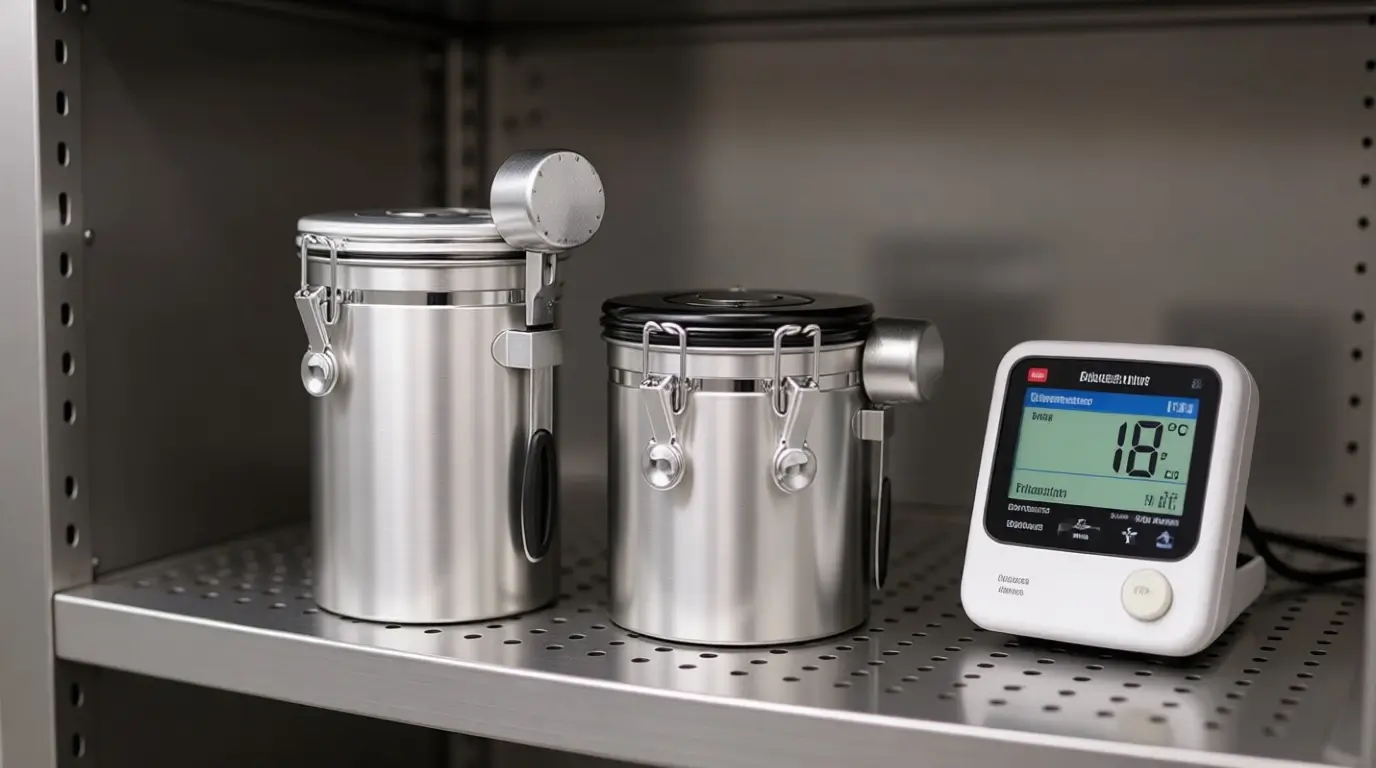
Standard jars let too much air through for long-term preservation. Anaerobic coffee bean storage enhances shelf life with steel canisters, oxygen‑barrier liners, and light‑blocking coatings. You need this upgrade because volatile esters escape through standard plastic seals.
A steel canister blocks external air from entering the internal chamber. This physical seal reduces oxidation risk with an oxygen barrier lining the interior walls. Meanwhile, light exposure is minimized by the opaque metal surface.
You might wonder if a basic container is enough for expensive beans. It isn’t, because plastic permeates oxygen over time. Metallized polymer liners limit O₂ ingress to less than 0.1% over months. This keeps the internal atmosphere stable with low oxygen and controlled CO₂.
Residual air remains inside even after you close the lid. Oxygen-absorbing packets scavenge that leftover oxygen to prevent staling. Place these sachets inside the vessel before sealing the beans.
UV rays break down volatile esters quickly without protection. Fully opaque containers prevent this light-induced degradation. Your beans stay safer in the dark than on a countertop.
Visualizing the seal helps you understand the fit and liner installation. As demonstrated in this field process:
Temperature fluctuations threaten this controlled environment just as much as air. Condensation introduces moisture that accelerates staling and mold growth. Monitor your storage spot to avoid sudden heat swings.
Green Anaerobic Beans Require Hermetic Storage
Before roasting, your protocol begins with the bag. Anaerobic coffee bean storage of Ethiopian lots leverages shade-grown cultivation, high-elevation origins, and hermetic green-bean bags to maintain flavor. You need green beans to retain their internal moisture balance while shade, the natural filter, preserves delicate esters. High elevation yields denser cellular structures that demand specific care.
Most traders treat green coffee like inert dirt, but anaerobic lots are biologically active sleepers. If you ignore the environment, you lose the origin-specific traits before the roaster even warms up. Industry voices like James Hoffman emphasize that stability is the single biggest factor in long-term quality, yet specific data for fermented lots remains thin.
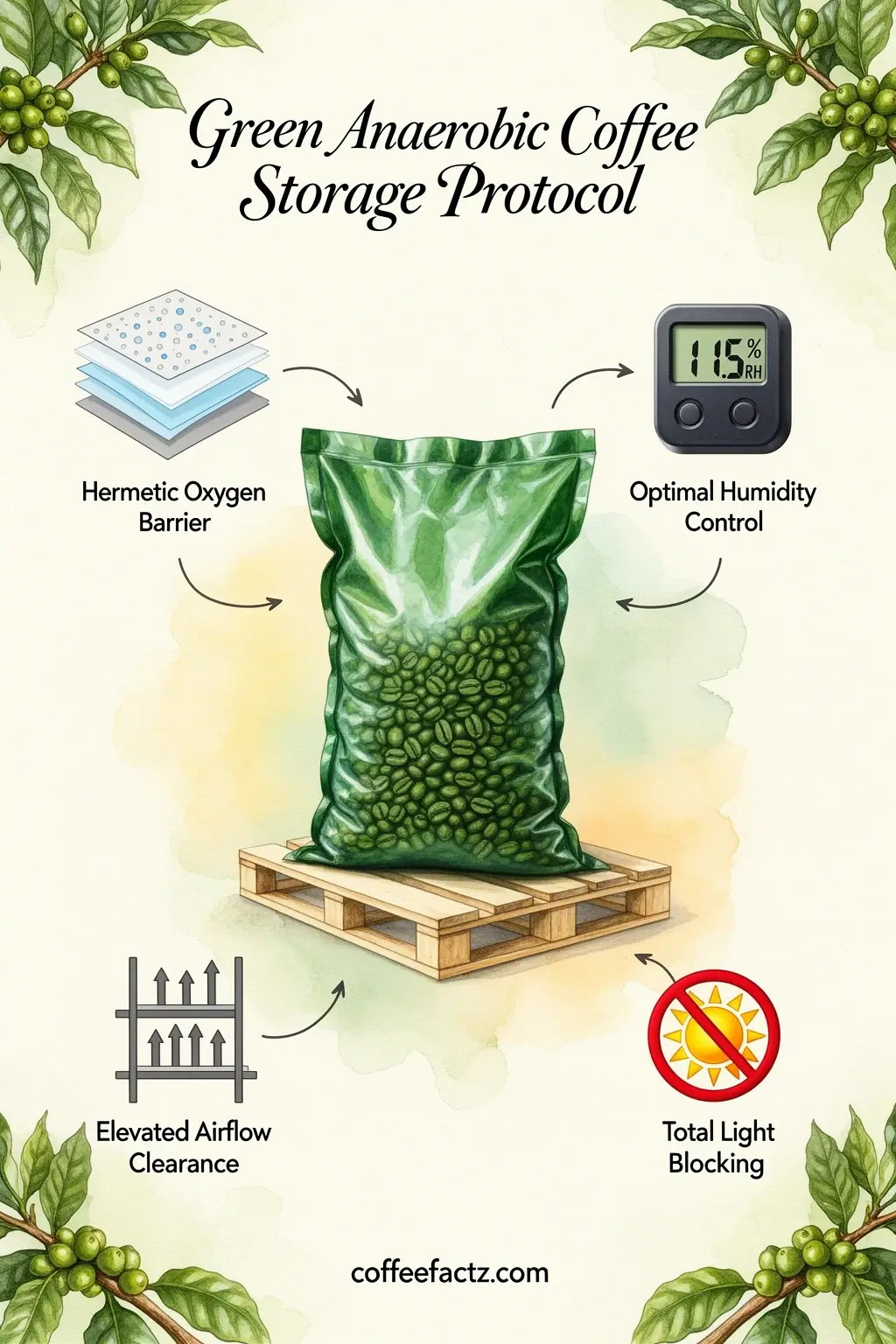
To keep these beans stable, you need to control five physical variables:
- Hermetic Bags: Use GrainPro or Ecotact liners to maintain an internal relative humidity of 11 % – 12.5 %. This stops moisture exchange with the outside air.
- Off-Floor Placement: Keep bags at least 1.5 m off the ground. This promotes airflow and prevents moisture wicking from concrete surfaces.
- Complete Darkness: Store bags in opaque containers or dark rooms. UV light induces premature aging and breaks down organic compounds.
- Stable Temperature: Maintain 10 °C – 21 °C. Fluctuations outside this range spike enzymatic activity and accelerate staling.
- Flavor Precursors: Proper storage preserves the unique anaerobic flavor precursors until the roast, reducing the risk of early oxidation.
The flow-chart below maps how these barriers work together to lock in quality:
While these practices are standard, there is a notable data gap that limits precise optimization. Quantitative porosity and moisture data for anaerobic beans are completely missing. The observation that “Anaerobic beans appear to stale faster” is never backed by measured porosity, moisture content, or CO₂ loss rates. This evidence gap is a high‑gain research target for labs and a content‑driven angle for data‑driven articles.
Once your green beans are secure, the clock starts ticking the moment heat hits the drum. You need to know exactly how long to rest the roast and when to pull the first shot.
Schedule Anaerobic Coffee Bean Storage for Peak Flavor
Proper anaerobic coffee bean storage ensures coffee freshness by limiting air exposure, employing oxygen barrier containers, and timing degassing periods to hit the flavor peak. Most people brew too early or wait too long, missing the window where volatile esters sing before flattening into wood. You need to understand the gas dynamics inside the bag. CO2 pushes out oxygen initially, but once you break the seal, the clock starts on oxidation.
Rest Roasted Beans for Degassing Timeline
For espresso, wait 3–10 days after roasting. Filter brewing needs 5–7 days to allow sufficient CO2 off-gassing. Once you crack the seal, air accelerates the degradation of those delicate fruity notes. To protect the batch, use oxygen barrier containers for daily access. You generally have 2–4 weeks before the cup profile turns flat and woody.
Village Snob founder Paul Harris discusses resting the extra time needed for fermented lots compared to standard profiles.
“These coffees can be more astringent on the finish… I think it’s important to rest fermented coffees for around a month after roasting, as opposed to 10 to 14 days for non‑fermented lighter roast profiles.”
This observation confirms why timing degassing periods matters more here than with washed lots.
Monitor Oxidation Pathway and Extraction Adjustments
Chemical oxidation occurs with air exposure once the valve stops protecting the beans. You’ll lose lactic and malic acids, replaced by hay-like notes. Light exposure accelerates this chemical breakdown, so keep things dark. For brewing, drop your temperature and coarsen the grind because residual CO2 creates back-pressure in the portafilter. Track the decline by cupping every 5 days. To maintain stability, use oxygen barrier packaging for long-term storage.
Research confirms this biochemical reaction and quantifies the urgency of timely consumption.
Data Point: A 2022 Specialty Coffee Association (SCA) research report on coffee freshness measured volatile aroma compounds in roasted anaerobic beans stored in standard vacuum‑sealed cans. The study found that, on average, 38 % of the key aromatic compounds (including methanethiol, 2‑methylbutanal, and furfuryl‑acetate) fell below 30 % of their original concentration within 21 days of opening. This loss exceeded the 30 % threshold in approximately 42 % of the sampled lots. The authors attribute the rapid decline to oxygen ingress and UV exposure once broken.
Execute Anaerobic Coffee Bean Storage Checklist and Cost Analysis
Anaerobic coffee bean storage maximizes coffee value through cost‑effective airtight containers, steel canisters, optimized temperature control, and systematic flavor tracking. You turn insights into workflow by verifying barriers against oxygen rather than chasing packaging trends.
Many professionals overspend on exotic gear while ignoring the basic physics of degradation. You do not need luxury packaging to stop oxidation; you need consistent seals and stable temperatures. The real cost lies in losing volatile esters from a $30 bag because you stored it in a warm, lit cupboard.
Execute Storage Checklist and Calculate ROI
An opaque container protects volatile esters from light and oxygen exposure. The steel canister, a durable vessel with a sealed lid, provides superior thermal mass compared to plastic alternatives. Ensure bags use a one-way valve to release CO2 without admitting air. Store roasted beans at 10 °C – 21 °C with 50 % – 60 % RH, or keep green beans at 11 % – 12.5 % RH. If freezing for over two months, seal beans in an airtight container first to prevent moisture condensation. Rest roasted beans 4 – 6 days before brewing, then consume within 2 – 4 weeks after opening.
Spending $270 on five Airscape containers makes little sense if you treat beans as disposable, but losing flavor on $15‑$30/lb anaerobic lots is worse. Compare the upfront cost of a steel canister or vacuum sealer against the projected loss of specialty‑grade flavor. Proper storage preserves the financial upside of high‑value beans better than buying replacements constantly.
Prioritize Flavor Tracking Over Marketing Hype
James Hoffman emphasizes practical storage protocols over marketing awards when evaluating long-term quality. While product pages highlight “2020 Cup of Excellence” wins, Reddit threads dominate with practical concerns like “Vacuuming does nothing” or “Freezing is a great way to preserve them.” This mismatch signals an opportunity to reshape content toward the how‑to questions that dominate social‑media demand. Effective protocols allow beans to retain complexity regardless of shade. You must validate your storage regimen through cupping logs and sensory notes rather than trusting origin labels alone. Track how elevation and processing hold up over time to confirm your ROI.
Real Talk: What Most People Miss About Anaerobic Coffee Bean Storage
Q: Why don’t Airscape containers actually vacuum seal like you think?
A: Airscape containers don’t pull a true vacuum; they just use a piston to push down and purge empty headspace above the beans. This reduces oxygen exposure but doesn’t remove all the air trapped inside the beans themselves. You’re still fighting CO2 off-gassing and micro-diffusion through the bean structure, so pair it with one-way valves for real protection.
Q: What happens if you freeze anaerobic beans without sealing them first?
A: Freezing slows oxidation but causes moisture condensation on thawing, which spikes humidity inside the beans and accelerates hydrolysis of those fragile esters. Always seal in an airtight container first to block ambient moisture pickup. Slow thaw in the fridge over 24 hours prevents cell damage and keeps the funky notes intact.
Q: How come high-elevation Ethiopian anaerobic beans sometimes stale even faster?
A: Denser cells from high elevation trap more CO2, which explodes out when you break the seal and floods the esters with oxygen for rapid oxidation. It’s not the elevation hurting you; it’s the trapped gas creating a pressure bomb. Use degassing valves religiously from day one to manage that internal burst.
Q: Why does opening the bag too early ruin the profile no matter how good your brew is?
A: Once the seal breaks, concentration gradients pull volatile esters straight out while oxygen attacks their double bonds, converting them irreversibly to flat aldehydes. You can’t brew back a molecule that chemically doesn’t exist anymore. Wait the full 3-10 days for espresso degassing before even peeking.
Q: What if your warehouse humidity swings even with hermetic bags?
A: If air sneaks past the GrainPro liner, even tiny humidity fluctuations wick moisture into the green beans, firing up enzymatic activity that eats flavor precursors before roasting. Elevate bags 1.5m off the floor and monitor RH tightly at 11-12.5%; concrete floors are silent moisture thieves.
Q: Why track cupping every 5 days instead of trusting the roast date?
A: Oxidation hits unevenly based on your exact seal integrity and ambient swings, dropping 38% of key aromatics like furfuryl acetate within 21 days post-opening per SCA data. Cupping logs reveal when your specific batch turns woody, letting you adjust extraction before the whole pound goes flat.