
Same Verb, Two Different Drinks
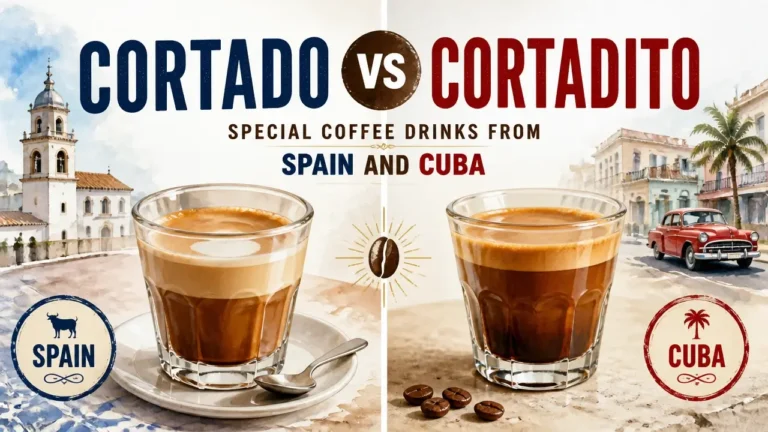
Cortado and cortadito are not regional synonyms – they are distinct drinks that happen to share a root word and a basic structure. Both names descend from the Spanish verb cortar, meaning to cut. The idea: a shot of espresso is “cut” with milk to soften its intensity. That’s where the common ground ends.
The Spanish cortado is an unsweetened drink – espresso and steamed fresh milk in a 1:1 ratio, served in a 4–5 oz glass. No sugar, no foam, no ceremony. The goal is balance: the milk tames the espresso’s edge without burying its flavor. Spain’s coffee culture, shaped by a working-class tradition of quick, satisfying breaks, wanted something efficient and clean.
The Cuban cortadito – the little cut – takes the same foundation and rebuilds it from a different set of values. In Cuba, coffee has always been sweetened, and the cortadito reflects that. Sugar or sweetened condensed milk enters the process before the cup reaches you, and the drink is traditionally crowned with espumita, a hand-whipped foam made from the first drops of espresso and raw sugar. It’s served in a 3 oz demitasse or small cup – concentrated, bold, and unapologetically sweet.
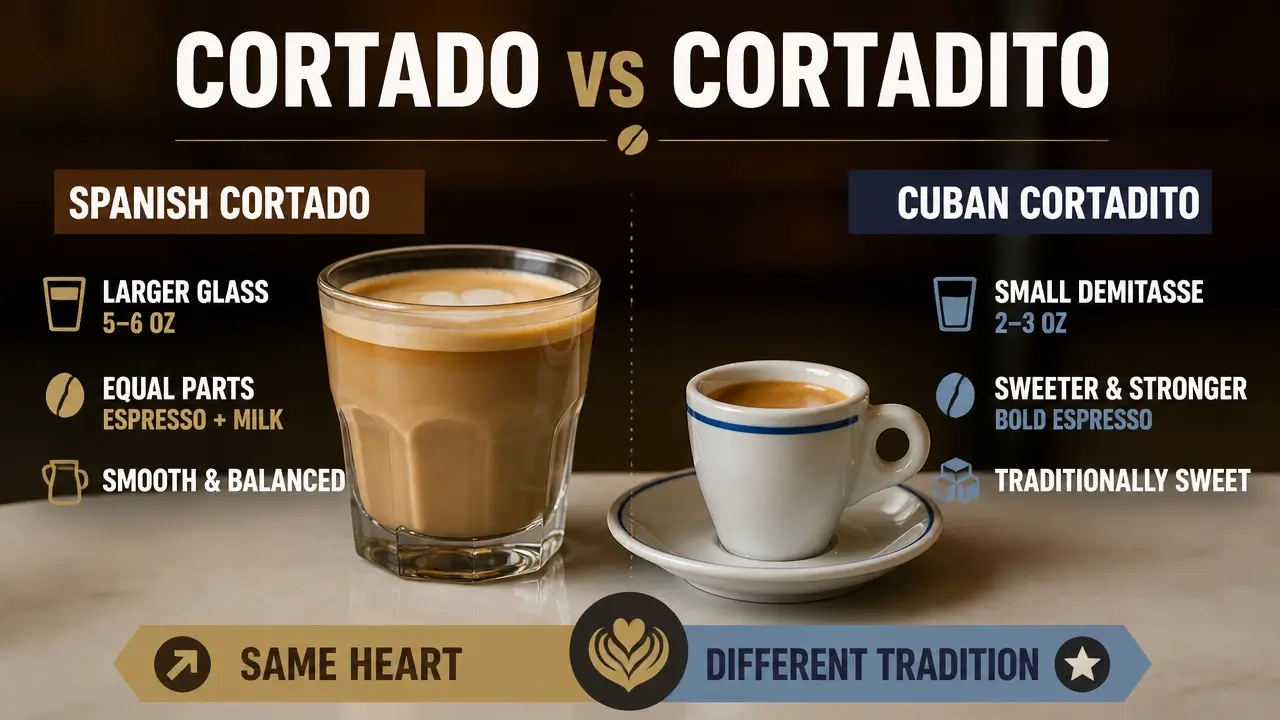
The four dimensions that separate them run deeper than sweetness alone: the default sugar level (none vs. built-in), the milk character (fresh dairy vs. condensed or evaporated), the espresso-to-milk ratio (balanced vs. espresso-forward), and the preparation technique (a clean pour vs. a sugar-whipping ritual). Each one shapes a completely different sensory experience.
Barista Magazine, the leading trade publication for the professional coffee community, traces this split to its historical roots – the cortado emerged in early 20th-century Spain as a practical fix for workers who needed a quick but balanced caffeine hit during short breaks, while the cortadito’s sweetness is directly tied to Cuba’s deep history with sugarcane production and a cultural preference for sweeter flavors that’s woven into everyday Cuban coffee life.
That context matters for a practical reason. Because both names circulate in the same cafés, on the same menus, and sometimes in the same sentence, the risk of ordering one and receiving the other is real. A documented Reddit exchange captures this perfectly: a user ordered a cortado from a Cuban-trained barista and was handed a sweetened cortadito. The drink was good – just not the unsweetened balance they were after. The name alone is not a guarantee. Understanding what’s actually in each cup is the only reliable protection.
Milk, Sweetness, and Ratio: How the Two Drinks Really Compare
Fresh milk and sweetened condensed milk are not interchangeable ingredients – they produce fundamentally different cups, and this is the axis on which the cortado and cortadito most clearly diverge. Understanding what each milk does to the drink’s body, sweetness, and flavor is what separates a casual preference from a confident order.
Sweetness structure is the first dividing line. A cortado carries zero added sugar by default. Every flavor note you taste – the chocolate undertones, the toasted nuttiness, the slight bitterness at the back – comes from the espresso itself, softened but not altered by the fresh steamed milk. A cortadito, by contrast, is sweetened during the brewing process. Sugar or sweetened condensed milk is incorporated before the shot completes, meaning the sweetness is structural, not an afterthought.
The comparison sharpens when you look at the milk side by side:
Here’s a direct comparison across the five dimensions that matter most:
| Dimension | Cortado | Cortadito |
|---|---|---|
| Sweetness Default | None – unsweetened | Built-in – sugar or condensed milk added during brewing |
| Milk Type | Fresh whole milk, steamed | Sweetened condensed milk or evaporated milk (sometimes fresh) |
| Espresso-to-Milk Ratio | 1:1 – balanced | Espresso-forward – small milk splash |
| Flavor Profile | Bittersweet chocolate, toasted nuts, clean finish | Caramelized sugar, dense sweetness, syrupy body |
| Serving Vessel | 4–5 oz clear glass | 3 oz demitasse or small cup |
The fresh milk in a cortado creates a silky, clean mouthfeel – creamy enough to smooth the espresso’s edges, light enough to let the coffee’s natural character come through. The condensed or evaporated milk in a cortadito does something structurally different: it adds viscosity, a syrupy density, and a pronounced sweetness that coats the palate. As Janice Chinna Kanniah, a coffee journalist writing on the subject, explains, evaporated milk – with most of its water removed – produces a thicker, more intense drink, while condensed milk pushes the cortadito fully into dessert-coffee territory. These aren’t subtle variations on the same theme; they’re two different sensory outcomes from two different dairy choices.
The flavor profiles follow directly from the structure. A cortado lands as a balanced, naturally bittersweet cup – the espresso’s roasted notes are present and clean, softened by milk without being masked. A cortadito is bold and unapologetically sweet, with caramelized-sugar notes dominant, a thicker mouth-coating feel, and often a frothy top. The espresso is still there, but it’s a supporting character in a sweeter story.
There’s one invisible differentiator that the ingredient list doesn’t capture: when the sugar meets the espresso changes everything you taste. In an authentic cortadito, sugar is whipped into the very first drops of the espresso pull to create espumita – a creamy, integrated foam that produces a rounded caramel sweetness. Stir the sugar in after the full shot is pulled, as many baristas do without realizing the difference, and the drink tastes sharply acidic by comparison. Two cortaditos, same ingredients, completely different cups. That technique is the next piece of the puzzle.
Espumita: The Technique That Makes a Cortadito
Espumita – the pale, airy foam that crowns an authentic Cuban cortadito – is not a garnish. It’s the result of a deliberate flavor-engineering step that changes the chemistry of the drink before a drop of milk is added. Without it, you have a sweetened espresso. With it, you have a cortadito.
The traditional sequence works like this: a small amount of raw sugar – often demerara – goes into the cup or a separate small vessel. The very first few drops of the espresso pull are captured and whisked vigorously with a spoon directly into the sugar. This is the critical window. Those first drops are the brightest, most acidic, most volatile portion of the extraction. Beating them furiously into the sugar aerates the mixture, partially dissolves the sugar crystals, and creates a light, creamy foam before the rest of the shot finishes pulling. Once the foam is formed, the remainder of the espresso flows through and is added on top, followed by a small pour of hot milk or condensed milk.
Barista Magazine documents the technical reason this sequence matters: the high temperature of those first espresso drops causes the sucrose to partially hydrolyze – the sugar molecules begin to break down – producing a flavor profile that is measurably different from sugar stirred into a fully extracted, cooled-down shot. You can’t reverse-engineer espumita by adding sugar at the end. The window has closed.
This is precisely what peer-reviewed research on espresso sensory science confirms. A 2015 study published in Food Research International examined how sugar addition affects espresso perception, using in-vivo nosespace analysis to monitor volatile compound release in real time. The finding: sugar addition didn’t significantly change the aroma-release profile of espresso volatiles, but it dramatically altered mouthfeel and taste perception. Sweet taste became dominant, suppressing bitter and sour sensations, and caramel and nutty notes were enhanced while roasted and burnt attributes receded. The mechanism is a taste-smell congruence effect – the presence of sweetness on the palate interacts perceptually with coffee’s aromatic compounds, effectively rebalancing the entire flavor experience. When sugar is whipped into the most acidic portion of the pull, that suppression of sourness and amplification of caramel character is maximized. Add the sugar after, and you’re working against a flavor profile that’s already locked in.
Contrast this with cortado preparation, and the philosophical gap becomes concrete. A cortado involves no whipping, no sugar, no timing strategy – just a clean espresso pull into a glass, followed by a direct pour of steamed fresh milk. The barista’s craft is in the milk texture and the pour, not in any pre-cup ritual. The result is transparency: you taste the espresso as it is, softened but not transformed.
Some modern cortadito versions skip the espumita and use condensed milk alone to achieve body and sweetness without the foam step. The result is still sweet and dense, but it’s a shortcut – the integrated, caramel-rounded character that espumita produces is absent. It’s a decent approximation, but if you’ve had an authentic cortadito made the traditional way, the difference is immediately obvious in the first sip.
The Barista Trap: When “Cortado” Gets You a Cortadito
Knowing the difference between these two drinks is genuinely useful – but only if the person making your coffee shares the same definition. In many American cities, that’s not a safe assumption, and the gap between what you ordered and what lands on the counter can leave you with a cup that’s delicious but completely wrong for what you wanted.
The cultural reality is this: in communities with a strong Cuban coffee presence – Miami, Tampa, Hialeah, parts of New Jersey – “cortado” and “cortadito” are often used interchangeably. For many ventanita baristas and Cuban-trained coffee makers, the default cortado already comes sweetened, because that’s the only version of the drink that has ever existed in their tradition. This isn’t a mistake on their part. It’s a legitimate linguistic overlap where two different coffee cultures have assigned overlapping names to different recipes. The result for you, though, is the mild sting of receiving something you didn’t intend to order.
A documented Reddit exchange captures the exact frustration: a user ordered a cortado at a Cuban-influenced café, received a thick, sweet cortadito, and described the experience as “still decent, just not what I ordered.” That gap – between a good drink and the right drink – is what purely definitional articles never address. You can memorize every ingredient in both recipes and still walk away with the wrong cup if you rely on the name alone.
Sprudge Coffee, a prominent coffee industry publication, offers a useful parallel here: the Gibraltar – a name used more frequently on the West Coast to describe essentially the same drink as a cortado, served in a specific 4.5 oz Libbey rocks glass – emerged precisely because naming confusion around “cortado” made a new, unambiguous label appealing. Blue Bottle Coffee in the Bay Area popularized it in the mid-2000s as an off-menu item, and the name spread because it removed the guesswork. The naming problem is not new, and the industry has been quietly working around it for years.
The root problem isn’t a bad definition – it’s assuming a shared one. The verified community solution is straightforward and effective: never rely on the name alone. Instead, describe the drink you want. “Espresso with equal parts steamed milk, no sugar, in a glass, please” is a sentence that translates cleanly across every coffee culture. A barista trained in Havana, Barcelona, or San Francisco will understand exactly what you mean. The name gets you into ambiguity; the description gets you the cup.
Cortado or Cortadito: Choosing the Right Cup
Cortado and cortadito are both excellent drinks – they just serve different people at different moments. Now that you understand exactly how they work, the choice comes down to what you actually want from a small cup of coffee.
The Purist – you want the espresso to speak for itself, softened but not altered. The cortado is your drink. Fresh steamed milk in a 1:1 ratio with espresso, served unsweetened in a clear glass, gives you the clean, bittersweet balance that lets the roast and the pull do the talking. No sugar, no foam, no competing sweetness. Just espresso and fresh milk in seamless harmony.
The Sweet Tooth – you want dessert-coffee energy in a small format. The cortadito is your drink. Its pre-sweetened richness, condensed or evaporated milk body, and espumita foam turn a 3 oz cup into a full sensory experience. The caramelized sweetness, syrupy mouthfeel, and frothy top make it feel indulgent without being large.
The Adventurous Orderer – you don’t want to pick a camp, or you’re somewhere in between. You don’t have to commit to either label. Use the description method to customize exactly what you want: specify your sweetness level, your milk type, and your ratio regardless of what the menu calls it.
The structural milk difference is worth one final note. Fresh dairy gives the cortado its clean finish – the fat and protein in whole milk integrate with espresso cleanly and then step back. Condensed or evaporated milk gives the cortadito its syrupy body – the reduced water content and added sugar create a density that coats the palate differently. If dairy-heavy sweetness isn’t what you’re after, the cortado is the safer default at any café.
To see the cortadito’s preparation – including the espumita technique – in action, this video walks through both Café Cubano and cortadito from start to finish:
The foolproof ordering script, regardless of where you are: “Cortado, unsweetened, equal parts milk and espresso in a glass, please.” One sentence overrides every cultural default and naming overlap. As Janice Chinna Kanniah notes in her research on coffee ordering behavior, consumer confusion around drink names is significant enough that some shops are already moving toward description-based ordering – asking customers to describe what they want rather than name it. You’re just ahead of the curve.
The final takeaway isn’t which drink is better. It’s that you now hold both the knowledge and the language to walk into any café – Spanish, Cuban, or third-wave – and get exactly the cup you intended.
Key Takeaways on Cortado and Cortadito
- Both drinks descend from the Spanish verb cortar but represent completely different coffee traditions with different sweetness defaults.
- A cortado is unsweetened, uses fresh whole milk in a 1:1 ratio with espresso, and is served in a 4–5 oz glass.
- A cortadito is pre-sweetened, espresso-forward, and traditionally uses condensed or evaporated milk in a 3 oz cup.
- Espumita – whipped from the first drops of espresso and raw sugar – is the technique that makes a cortadito taste caramel-sweet rather than acidic.
- In Cuban-influenced cafés, “cortado” often defaults to a sweetened cortadito, so the drink’s name alone is not a reliable order.
- Describing your drink instead of naming it – “unsweetened, equal parts espresso and milk in a glass” – is the one ordering move that works everywhere.
Frequently Asked Questions About Cortado and Cortadito
How do Cubans typically drink their coffee?
Cuban coffee culture defaults to sweetness – espresso is almost always served with sugar, either pre-sweetened during the pull or accompanied by raw sugar on the side. The cortadito and café cubano are the everyday staples, both built around a small, concentrated, sweet shot.
Is a cortado the same thing as a flat white?
They’re close but structurally different. A cortado uses a 1:1 espresso-to-milk ratio and is served in a 4–5 oz glass with minimal foam. A flat white uses more milk, typically a 1:2 ratio, and is served in a 5–6 oz cup with microfoam integrated throughout – the result is creamier and larger than a cortado.
Is a cortado the strongest coffee drink you can order?
Not by a long shot. A cortado uses a standard double espresso cut with equal parts milk, so the caffeine content is the same as any double shot – roughly 120–140 mg. Drinks like a straight double espresso or a lungo carry similar or higher caffeine without the milk dilution.
Can you make espumita without an espresso machine?
Yes – a Moka pot works well for this. The first few drops from the Moka pot are captured and whisked vigorously into sugar, exactly as you would with an espresso machine. The high temperature and concentrated extraction from a Moka pot are close enough to produce a functional espumita, which is how it’s traditionally made in Cuban homes.
What’s the difference between a cortadito and a café cubano?
A café cubano is a straight sweetened espresso shot with espumita on top – no milk at all. A cortadito adds a small splash of milk (or condensed milk) to that base, making it slightly less intense and creamier. Think of the café cubano as the foundation and the cortadito as its milk-cut variation.
Why does my cortadito sometimes taste sharp and acidic instead of sweet?
The most likely cause is that the sugar was stirred in after the full shot was pulled rather than whipped into the first drops to create espumita. Research confirms that sugar added to a fully extracted shot can’t suppress the acidity the way the espumita technique does – the early high-temperature interaction between sugar and espresso is what produces the rounded, caramel sweetness.
Does the type of sugar matter when making espumita?
It does make a difference in texture and flavor depth. Demerara or raw sugar – coarser crystals with residual molasses – whips into a richer, more complex foam than refined white sugar. The larger crystals also take slightly longer to dissolve, which helps build the airy structure of the foam during whisking.
Can you order a cortadito without condensed milk?
Absolutely. Fresh whole milk is a perfectly legitimate option and produces a lighter, less syrupy cortadito. The sweetness still comes from the espumita technique, but the body will be cleaner and less dense than the condensed milk version. Just ask for fresh milk and specify your sweetness preference – most baristas familiar with the drink will adapt without hesitation.
References
- The Cortado: A Brief History of the Spanish Coffee Drink – Barista Magazine
- Café Cubano: The History and Culture of Cuban Coffee – Barista Magazine
- What Is a Gibraltar Coffee? – Sprudge Coffee
- What Is a Cortadito? The Complete Guide – Homegrounds.co
- Coffee Shop Ordering Confusion and Description-Based Solutions – Homegrounds.co
- Understanding Flavour Perception of Espresso Coffee by the Combination of a Dynamic Sensory Method and In-Vivo Nosespace Analysis – openpub.fmach.it