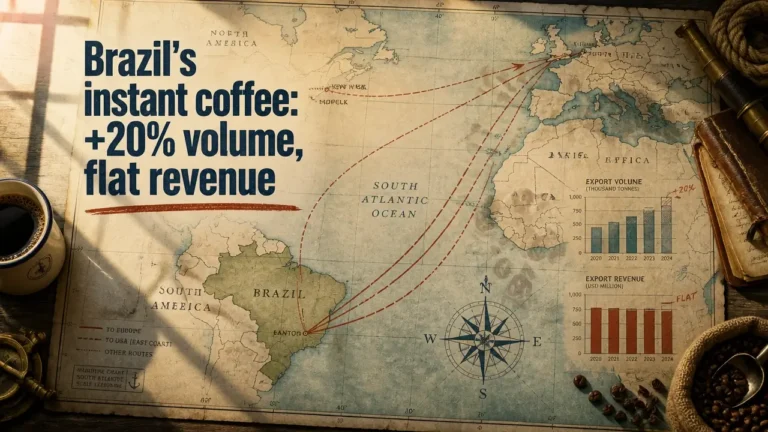

Brazilian instant-coffee exports and domestic consumption are climbing in tandem, with shipments abroad rising 20% in July 2026 even as lower international prices kept export revenue almost flat, according to trade group Brazilian Instant Coffee Industry Association (Abics) cited by DatamarNews on August 18.
DatamarNews reported that Brazil shipped 8,161 tonnes of instant coffee in July 2026, equivalent to 353,761 60‑kg bags of green coffee, up 20% from July 2025. Between January and July 2026, exports totaled 57,400 tonnes, or 2.488 million bags, a 10.9% increase over the 51,700 tonnes (2.243 million bags) recorded a year earlier.
Despite the higher volume, instant-coffee export revenue reached US$663.5 million in the first seven months of 2026, down 2.5% from the same period in 2025, DatamarNews noted. The publication said Abics attributed this divergence mainly to international prices that remain below the elevated levels seen in 2025. “We shipped considerably more coffee and generated practically the same revenue,” Abics executive director Aguinaldo Lima told the outlet.
While exports expand, Brazil’s home market for instant coffee is also growing. Domestic consumption reached 17,300 tonnes between January and July 2026, equivalent to 751,000 bags, a 14.4% year-on-year increase, according to DatamarNews. The report said Abics pointed to a broader product mix, including organic, decaffeinated, premium and specialty instant coffees, as well as use in ready-to-drink beverages, powdered products and protein supplements, as factors supporting this rise.
Abics domestic-market consultant Eliana Relvas highlighted the diversification of the category in comments to DatamarNews, saying, “Today, we have a very broad range of instant coffees, including organic, decaffeinated, premium and specialty products—in other words, options for different consumption occasions.” In a separate interview with CNBC via Times Brasil, she described instant coffee’s growing use as an ingredient in products aimed at protein supplementation.
On the trade front, Brazil’s export pattern is being reshaped by two recent policy shifts. The Mercosur–European Union Interim Trade Agreement came into force on 1 May 2026, and between May and the end of July, Brazilian instant-coffee shipments to the European Union rose 51.4% to 5,200 tonnes, DatamarNews reported.
In the United States, a new 25% tariff package announced on 15 July 2026 initially covered a broad range of Brazilian agricultural products, but instant coffee was added to the list of exemptions in the second half of July, ending nearly a year in which the segment had faced additional duties, according to DatamarNews. The outlet said Brazilian instant coffee had been the only part of Brazil’s coffee sector subject to those tariffs, which did not apply to green coffee beans, roasted and ground coffee, or flavored instant coffee.
The exemption for soluble coffee from the new U.S. tariff package was anticipated by the industry and ultimately granted by the Office of the United States Trade Representative, mirroring existing treatment for other coffee forms, according to Brazillian Confederation of Agriculture and Livestock (CNA) reporting in Valor International. In a joint statement quoted by Valor International, Abics, the Brazilian Coffee Industry Association (Abic) and the Brazilian Coffee Exporters Council (Cecafé) said, “This decision protects Brazilian coffee exports and reinforces Brazil’s position as the world’s largest coffee producer and exporter.”
Even under the earlier tariffs, the United States remained Brazil’s leading market for instant coffee. Between January and July 2026, the U.S. imported 8,400 tonnes of Brazilian instant coffee, 12% less than in the same period of 2025, according to DatamarNews. The same report noted that Brazilian instant-coffee exports to the U.S. had fallen by close to 30% in 2025 versus the previous year while the tariffs were in place.
Recent monthly figures suggest some recovery in the U.S. market alongside the upturn in overall export volumes. In July 2026, Brazil shipped 1,300 tonnes of instant coffee to the United States, up 9.5% from July 2025, DatamarNews reported. Abics’ Aguinaldo Lima told Times Brasil, as cited by CNBC, that the Mercosur–EU agreement and the U.S. tariff exemption are “achievements” whose effects were too recent to fully explain July’s shipped volumes, but that “we can already see these markets responding.”