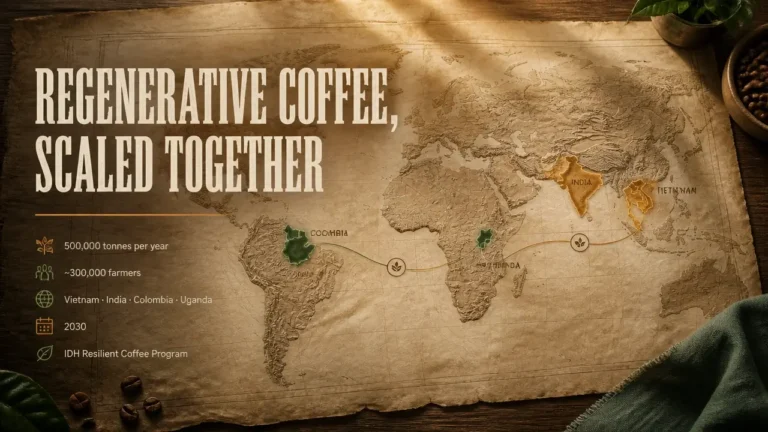

A new four-year initiative led by IDH aims to mobilise shared investment in regenerative coffee across Vietnam, India, Colombia and Uganda, targeting around 500,000 tonnes of regenerative production annually and approximately 300,000 farmers by 2030, according to an IDH launch announcement from Hanoi on 11 August 2026.
IDH describes the Resilient Coffee Program (RCP) as a pre-competitive platform where companies, governments and other partners can co-invest in value-chain resilience, with outcomes tracked through shared measurement, reporting and verification, traceability and co-claiming systems. The organisation says the program was co-developed with growers, companies and partners in the four origin countries and is scheduled to run through 2030.
Vietnam is the first country component to launch, with German retailer ALDI SÜD Group confirmed as the initial “front-runner investor,” IDH reported in the same statement. For Vietnam, the program aims to reach around 75,000 coffee farmers—about 10% of the country’s coffee-growing households—covering roughly 14% of its coffee area, and to see regenerative practices adopted on up to 70% of participating farms by 2030.
Across the Vietnamese component, IDH forecasts a 15% increase in farmer incomes and an estimated 240,000 tonnes of CO₂ emissions avoided, which it says represents around 15% below a 2026 baseline. Regenerative practices within RCP are defined using the Sustainable Agriculture Initiative Platform’s Regenerating Together Framework, according to the IDH announcement.
Launching the program, IDH CEO Daan Wensing said “a resilient coffee sector cannot be built by any one company, or any one country, alone,” adding that climate pressure, evolving market expectations and the need to support farmers call for “an open, pre-competitive platform where roasters, traders and governments can co-invest in resilient coffee value chains, together,” as quoted in the same IDH release.
ALDI SÜD framed its participation as part of a broader push on regenerative sourcing. “Through initiatives like the Resilient Coffee Programme, we aim to work with partners across the value chain to promote regenerative farming practices, strengthen livelihoods, and support greater transparency and emissions reduction efforts in coffee production,” Sustainability Director Rachel Vujovic said in comments reported by Global Coffee Report.
Other large buyers signalled support for the collaborative model. JDE Peet’s Sustainability Manager for Asia Pacific, Sy Do, told Global Coffee Report that “building resilience of the coffee as a sector is a shared responsibility” and said the company was glad to take part in the Hanoi round table and “to see a program that invites the whole sector to invest together,” noting that JDE Peet’s supports the direction of RCP and will explore how it can contribute.
The new platform emerges against a backdrop of mounting climate risk for coffee producers. IDH stated that climate shocks are already reducing coffee yields by an estimated 10–30%, and that rising temperatures could shrink the area suitable for coffee cultivation by 20–50% by 2050. In Vietnam specifically—the world’s second-largest coffee producer—IDH cited a 20% cut to national output in the 2024–25 season due to drought, followed by late-season flooding in the Central Highlands.
Vietnam is also the focus of a separate regenerative initiative by Japan’s UCC Group, which is partnering with ECOM Group subsidiary ACOM on a new production project in the country, according to Global Coffee Report. UCC plans to establish a pilot farm to verify techniques such as shade trees and organic compost, test a carbon inset model using biochar and reduced chemical fertilisers, and assess farm-level greenhouse gas reductions as part of its goal to achieve carbon neutrality by 2040.
ECOM Vietnam Sustainable Management Services Manager Thuan Sarzynski said the project offers “a fantastic opportunity to strengthen the relationship between ECOM and UCC for sustainable coffee sourcing in Vietnam,” and that the company will document carbon emission reduction efforts “which can be scaled over the next few years,” in comments reported by Global Coffee Report.
Underlying these moves is an emerging investment case for regenerative coffee. A study led by TechnoServe and supported by JDE Peet’s, Nestlé and the Rudy & Alice Ramsay Foundation analysed opportunities in nine major producing countries whose farms account for roughly 70% of world coffee, according to coverage in Global Coffee Report.
The study found that helping 3.2 million smallholder farmers adopt regenerative practices would require an average of US$560 million in investment per year over seven years, and modelled that this spending would generate US$2.6 billion in additional coffee exports and US$2.1 billion in additional farmer income each year. Across the sample, smallholder incomes increased by an average of 62%, exports by 30%, and greenhouse gas emissions fell by 46% on Brazilian Arabica farms, with one scenario indicating a 196% increase in farmer income in Kenya and a 52% rise in Uganda’s Robusta exports.
TechnoServe Global Coffee Director Paul Stewart said these findings “confirm what TechnoServe has observed over decades of working with coffee farmers,” describing regenerative agriculture as “essential for smallholder livelihoods and the future of the industry” and “an investment that pays off for farmers, businesses, and the planet,” according to the Global Coffee Report article.
IDH said it is inviting roasters, traders, governments and buyers across Europe and America to co-invest in the Resilient Coffee Program as it scales, positioning Vietnam’s newly launched component as the first step in a multi-country platform designed to channel collaborative capital into regenerative coffee at origin.