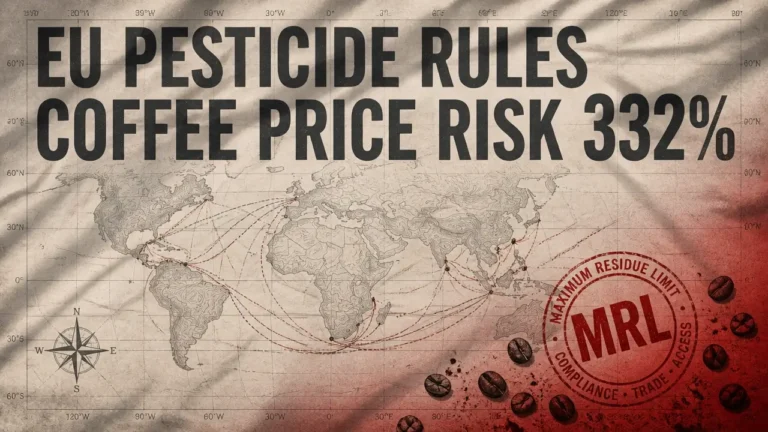

A new study from the European Commission’s Joint Research Centre (JRC) suggests that tightening pesticide residue limits on food imports could sharply increase coffee prices in the European Union, with a modeled worst-case jump of 332% for consumers if producers do not adjust their practices.
The JRC analysis, published on 11 August and described by EUobserver, modelled the economic effects of lowering maximum residue levels (MRLs) for 18 hazardous pesticide substances banned in the EU but still detected on some imported products. According to EUobserver’s reporting on the study, cutting import MRLs for these substances down to the analytical limit of quantification (LOQ) “could lead to a 41 percent drop in agricultural imports and higher consumer prices across the bloc,” including the 332% coffee price increase and an 82% rise for citrus fruit under a worst-case scenario.
In a key passage quoted by EUobserver, the JRC study states that “across all scenarios, the direction of effects resulting from lowering the MRLs to the LOQ is similar — imports decline, EU production rises, and consumer prices increase.” The study is part of the evidence base for the EU’s food and feed safety omnibus law, according to EUobserver, and its preliminary modelling covers 235 commodities and 86 exporting countries, including coffee, as summarized by Daily Coffee News.
The JRC also modelled how outcomes change if producers in exporting countries adapt to the stricter residue limits. In a quote carried by EUobserver, the study notes that the initial 41% import decline “declines to 8 percent and then to 0.4 percent depending on the cost of adaptation.” In other words, the extent to which coffee and other agricultural suppliers adjust their pesticide use is central in the model to whether EU agricultural trade sees modest or severe shifts in volumes and prices.
The proposed residue-limit changes sit within an evolving EU regulatory framework for pesticides. Regulation (EC) No 396/2005, published via legislation.gov.uk, has long defined MRLs for pesticides in or on food and feed of plant and animal origin. More recently, Implementing Regulation (EU) 2026/748, published on 31 March and available on EUR-Lex, sets out a coordinated control programme for checking MRL compliance in 2027, 2028 and 2029, while repealing an earlier 2025 implementing regulation.
EUobserver reports that the proposed drop in residue limits has also been “designed to address the concerns of European farmers that the EU’s new trade deals, particularly the pact with the South American Mercosur bloc … will lower standards.” EUobserver notes that the EU-Mercosur trade pact came into effect in May 2026, adding a trade-liberalisation backdrop to the JRC’s modelling of stricter import requirements.
For coffee exporters, the combination of existing and proposed rules is not entirely new. Daily Coffee News writes that tighter EU pesticide residue rules have previously raised concerns among Vietnamese coffee exporters, indicating that some suppliers are already wary of how compliance expectations in Europe might affect their access to the market. Although the new JRC scenarios do not single out individual countries, they suggest that exporting regions’ responses to any future MRL changes could strongly influence how much of the modeled import decline and price increase actually materialises for coffee.
According to Daily Coffee News, the JRC’s preliminary study spans a wide basket of agricultural products and 86 exporting nations, positioning coffee alongside many other commodities that are exposed to European demand. EUobserver reports that the modelling feeds into the EU’s ongoing food and feed safety omnibus process, and that its quantified scenarios of import declines, higher EU production and higher consumer prices are being circulated as policymakers and stakeholders debate how far new pesticide-residue limits for imports should go.