
Brazil opened its 2026/27 coffee year with higher export volumes but sharply lower earnings, as official July data confirm a marked shift away from Arabica and toward Robusta and soluble coffees.
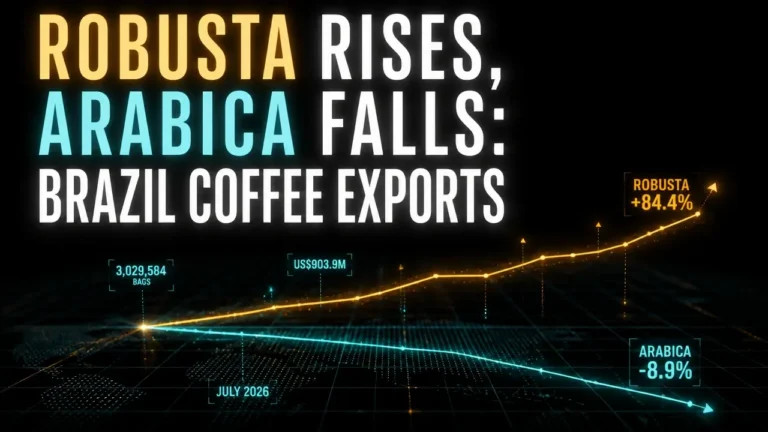
According to Conselho dos Exportadores de Café do Brasil (Cecafé), Brazil exported 3,029,584 60-kg bags of all coffee forms in July 2026, an increase of 9.9% compared with July 2025. Yet data compiled by eComercio Agrario and Revista Cultivar show that export revenue fell 13.2% year-on-year to US$903.9 million, from US$1.042 billion a year earlier.
The composition of those shipments underscores the change in Brazil’s export mix. July green coffee exports reached 2,669,379 bags, up 8.7% year-on-year, but Arabica shipments dropped 8.9% to 1,818,144 bags, their lowest July volume since 2018, Comunicaffe reported. In contrast, Robusta/conilon exports jumped 84.4% to 851,235 bags, the second-highest level on record after 2024. Processed coffee exports, mostly soluble, totaled 360,205 bags in July, an increase of 19.9% over the same month last year, according to Comunicaffe.
Over the first seven months of 2026, this pattern becomes more pronounced. Comunicaffe and eComercio Agrario place Brazil’s January–July exports at 20,896,547 bags, 5.9% below the same period in 2025. Export revenue declined more sharply, by 13.1%, to US$7.449 billion, while the average export price slipped 7.7% to US$356.45 per bag, eComercio Agrario and Revista Cultivar reported.
Within that total, Arabica exports fell 16.6% to 14,987,335 bags between January and July 2026 and were described by Comunicaffe and eComercio Agrario as the lowest volume since 2018, accounting for 71.7% of shipments. Robusta exports, by contrast, rose 73.5% to 3,386,930 bags and reached 16.2% of total exports in the same period, the two outlets said. Comunicaffe added that green coffee exports overall fell 7.8% to 18,374,265 bags in the first seven months of the year, while processed coffee exports increased 10.7% to 2,522,282 bags.
Specialty and differentiated coffees have been particularly affected in value terms. Revista Cultivar and eComercio Agrario reported that differentiated coffee exports between January and July 2026 generated US$1.468 billion, equivalent to 19.7% of Brazil’s coffee export revenue. Their average export price reached US$419.57 per bag, yet revenue from this segment declined 27.6% year-on-year.
Several structural constraints are shaping how this changing export mix reaches the market. In an earlier assessment of the 2025/26 crop year, Cecafé president Márcio Ferreira said that the average export price of US$379.48 per bag was the highest in history and 17.4% above the previous record, but argued that “logistical bottlenecks” had prevented the shipment of “hundreds of thousands of bags,” limiting total revenue, according to Valor International. A detailed April analysis by DATAGRO added that, on average, 55% of ships at Brazilian ports experienced delays or schedule changes in 2025, preventing the export of 1,824 coffee-filled containers per month and resulting in an estimated US$2.640 billion in lost foreign-exchange revenue.
Ferreira has also linked the current tightness in Arabica availability to earlier supply and stock movements. He noted that Brazilian inventories declined significantly after record exports in 2024 and that the 2025 harvest was affected by adverse weather, which reduced coffee supply, as reported by Comunicaffe and Valor International. Valor International further highlighted that above-average rainfall in key Arabica-growing regions such as southern Minas Gerais, Cerrado Mineiro and Média Mogiana delayed the 2026 harvest and caused cherries to fall and deteriorate, leaving overall quality uncertain.
Trade policy has added another layer to Brazil’s export rebalancing. Comunicaffe and Valor International reported that a 50% United States tariff on Brazilian coffee, in place for roughly four months, contributed to a drop of more than 50% in shipments to that market during the affected period. Over January–July 2026, exports to the US fell 30.5%, while shipments to Germany declined 8.9% and exports to Italy and Belgium grew 8.3% and 14.4% respectively, according to Comunicaffe.
Cecafé has pointed to July 2026 as the formal start of the new crop year, following a 2025/26 season in which Brazil’s coffee exports fell 15.7% to 38,461,846 bags, the lowest volume since 2022/23, even as earnings of US$14.59 billion were the second-highest on record, Valor International and Comunicaffe reported. Against this backdrop, July’s combination of rising volumes, a heavier share of Robusta and soluble, and weaker prices signals that Brazil’s role in supplying the global market is being reshaped not only by harvest size but also by what types of coffee it can move out of congested ports and into an increasingly fragmented set of destination countries.