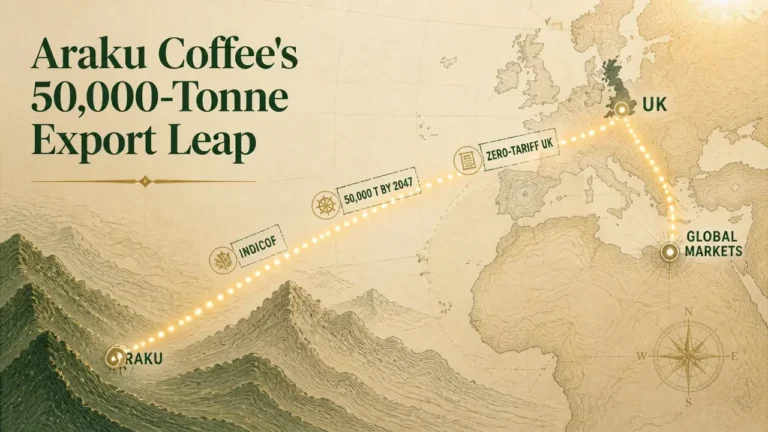

India has set a new long-term goal for its best-known tribal coffee origin, with the Coffee Board of India targeting 50,000 tonnes of Araku coffee by 2047 while rolling out sustainability and quality frameworks aimed at sharpening the country’s profile in export markets, according to reports in Deccan Chronicle and The New Indian Express.
Speaking in Araku Valley in India’s south-eastern Andhra Pradesh, Coffee Board chairperson M.J. Dinesh was reported to have confirmed the 50,000-tonne target as part of coverage of the Regional Coffee Research Station’s golden-jubilee programme, the two newspapers stated. They reported that Araku’s production has climbed from 15 tonnes five decades ago to around 15,000 tonnes a year, even as a separate Coffee Board regional profile lists the area’s average production as 3,100 metric tonnes, a gap not reconciled in the available sources.
The Coffee Board’s regional page describes Araku as a mainly Arabica-growing region at 900–1,100 metres above sea level with 20,000 hectares under coffee, and identifies varieties including S.795, Sln.4, Sln.5 and Cauvery, alongside intercrops such as pepper, mango, jackfruit and vegetables. According to that profile, the area receives 1,000–1,200 mm of rainfall annually and is already farmed as a diversified agroforestry landscape.
Dinesh told Deccan Chronicle that “many farmers currently harvest around 70 kg,” and said the Board’s objective is to significantly lift productivity from existing plantations so incomes rise “without necessarily expanding the cultivated area.” Both Indian newspapers reported that the strategy in Araku will prioritise scientific cultivation, improved quality and sustainable farming, with tribal farmers in the Eastern Ghats placed at the centre of collaboration between the Board and the Andhra Pradesh state government.
A key pillar of this approach is a new quality and sustainability architecture. Dinesh told Deccan Chronicle that the Coffee Board is introducing “Indicof”, a three-tier quality classification for Indian green coffee exports, as part of a plan to “take Araku coffee to the next level globally” and establish a distinct identity for Indian coffees. In parallel, official Coffee Board documents describe INDICOFS, a separate three-level sustainability standard for Indian coffee managed by the Central Coffee Research Institute, at a time when only about 15% of India’s total output is certified under sustainable criteria.
According to Coffee Board of India materials, the INDICOFS framework categorises requirements into Level 1 self-assessment, Level 2 auditing and Level 3 benchmarked best practices, and is designed for a sector that encompasses more than 400,000 small and marginal holdings and roughly two million people. The Board’s Araku plan is to apply a “nutri-organic” package of practices in the region, as reported by the Indian newspapers.
The New Indian Express and Deccan Chronicle reported that this nutri-organic package, being prepared for organic growers in Araku, parts of neighbouring Odisha and India’s Northeast, is based on field research and consultations with scientists, farmers and input manufacturers. They stated that the package is expected to recommend scientific soil management, including the use of granulated lime to address poor soil nutrition and low pH levels, and will be released during the Coffee Board’s golden jubilee celebrations in Araku.
Climate resilience and diversification are also embedded in the Araku strategy. Dinesh told The New Indian Express that farmers are being advised to adopt multi-crop, biodiversity-based systems rather than monoculture plantations, introducing fruit-bearing and shade trees to improve soil health, regulate temperature and generate additional income streams. He said that such biodiversity would also reinforce Araku’s positioning as a producer of sustainably grown, shade-grown coffee in international markets.
On the trade side, the Coffee Board plans to begin exports of Araku coffee to international buyers later in 2026, the two newspapers reported, linking the regional volume push with national export ambitions. Dinesh said in comments reported by The New Indian Express that the recent India–UK trade agreement, which provides zero-tariff access for Indian coffee, offers “a significant opportunity to expand exports, particularly in the UK market.”
Araku’s expansion unfolds against a competitive backdrop in which Brazil remains India’s biggest rival in Arabica coffee and Vietnam dominates the Robusta segment, according to Deccan Chronicle. Alongside the Araku target, a separate report in Kodagu First cited Coffee Board aims to double India’s coffee production and exports over a 10-year roadmap and [UNVERIFIED] nearly treble national output by 2047, situating Araku’s 50,000-tonne goal within a wider national effort to scale and differentiate Indian coffee.