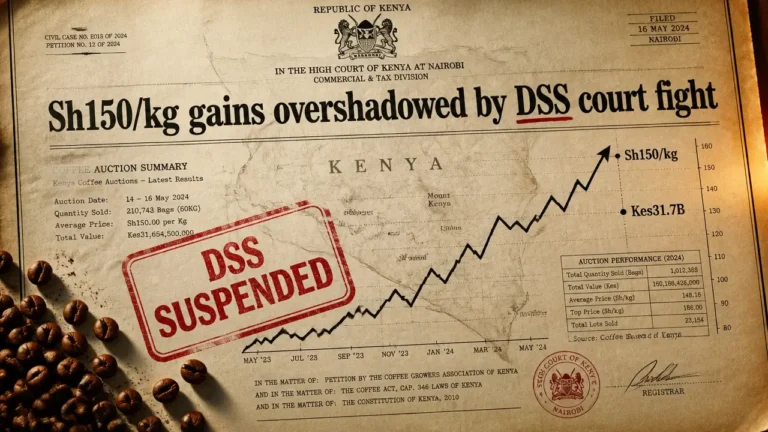

Kenya’s coffee farmers are seeing sharply higher payouts and more transparent auctions under a wave of reforms at the Nairobi Coffee Exchange (NCE), even as a High Court suspension of a new payment system exposes deep divisions over how those gains should reach growers.
According to Business Now, NCE Chief Executive Lisper Ndung’u says farmer returns have improved since the Capital Markets Authority (CMA) began regulating the exchange in 2020, licensing 19 brokers to participate in weekly trading. Backing that picture, MSME Africa reports that payments to farmers have risen from between Sh20 and Sh40 per kilogram of cherry to between Sh120 and Sh150, while The Star notes parchment prices climbing from about Sh50 per kilogram two years ago to as high as Sh158 per kilogram in some factories.
The reforms are being channeled through NCE’s 2026–2030 strategic plan, unveiled in February 2026. At the launch, covered by The Star, Co-operatives Cabinet Secretary Wycliffe Oparanya said, “For too long, our farmers have carried the heaviest burden while earning the smallest share of the final value,” framing the plan as beginning with “fair and competitive returns at the farm level.” NCE Chair Kenneth Gitonga told the same event that “the prosperity of the farmer is the prosperity of the Exchange,” highlighting a pledge to champion pricing that rewards quality and sustainability.
The strategic plan centres on digital transformation, market expansion and stakeholder value, according to The Star. NCE has already rolled out an online bidding system, digitised its auction and begun live streaming sessions, The Standard and MSME Africa report. NCE plans what it calls “radical transparency” with real-time market data and traceability “from farm to cup,” The Star adds.
This shift toward technology has coincided with robust auction performance. Between 1 October 2025 and 12 May 2026, NCE auctioned 602,973 bags worth Kes31.7 billion, with 44 dealers purchasing 591,695 bags, Food Business Middle East & Africa reported. The same source quotes Ndung’u saying “more farmers continued trading through the auction owing to the confidence based on high performance,” while noting that Alliance Berries Limited led brokerage volumes and Ibero Kenya accounted for 30.28% of total purchases.
Yet even as volumes and prices rise, the way money flows back to farmers is contested. The Direct Settlement System (DSS) – introduced by the government in August 2023 and developed by NCE, according to Kenyans.co.ke and Kenya News Agency – routes buyer payments into a single account that settles brokers and millers before sending the balance directly to farmers. By mid-2025, DSS had been integrated into the NCE trading platform, Food Business Middle East & Africa reports.
Farmers’ groups challenged the scheme in court, arguing it interfered with their savings arrangements and expressing a preference for receiving money through savings and credit cooperatives (SACCOs), according to Kenyans.co.ke. In November 2025, Kerugoya High Court Judge Edward Muriithi ordered the government to halt DSS implementation for six months and ensure proper public participation in 15 coffee-growing counties, Global Coffee Report and Kenyans.co.ke reported. The suspension runs until 20 May 2026, when the case is due back in court.
In his ruling, quoted by Global Coffee Report, Judge Muriithi said, “Public participation, both before and post formulation and gazettement, was violated” and that a key regulatory impact assessment and parliamentary committee process had not facilitated such participation. Kenyans.co.ke reports that coffee farmers welcomed the decision, quoting National Coffee Cooperative Union chairperson Felix Muriithi describing it as “a new dawn for coffee production in the country,” though that name differs from the union leadership cited by Kenya News Agency and is therefore marked [UNVERIFIED].
The legal pause came even as the government promoted DSS as a cornerstone of faster, fairer payments. At the launch of the National Coffee Revival Through Cooperative Societies Programme in June 2026, covered by The Star, President William Ruto said farmers would be paid within five days of delivering coffee under DSS and that at least 80% of sale proceeds would go directly to farmers, with service providers sharing the remaining 20%. “Timely payment is not a favour to the farmer; it is the farmer’s right,” Ruto told growers at Kianyaga Stadium.
Even with the court-ordered suspension, reform work is continuing on other fronts. A government Working Committee chaired by NCE’s Kenneth Gitonga has had its term extended until June 2027, with a mandate that includes reviewing NCE’s legal ownership, advising on asset and liability transfers, governance structures, licensing under CMA rules and related policy changes, Food Business Middle East & Africa reports. Outstanding tasks highlighted by the same source include converting NCE into a limited liability company with farmers as majority shareholders and finalising its governance framework.
The stakes extend beyond Kenya’s borders. Coffee value-chain expert Henry Kinyua told Food Business Middle East & Africa that most Kenyan coffee is exported through a direct-sales window to Belgium, France, Germany and the United States. At the NCE strategy launch, Ndung’u warned via The Star that buyers are demanding greater traceability and sustainability while producers seek fairer returns and more efficient systems, underscoring how Kenya’s push to digitise and rebalance farmer payments is playing out under close scrutiny from both local courts and global specialty buyers.