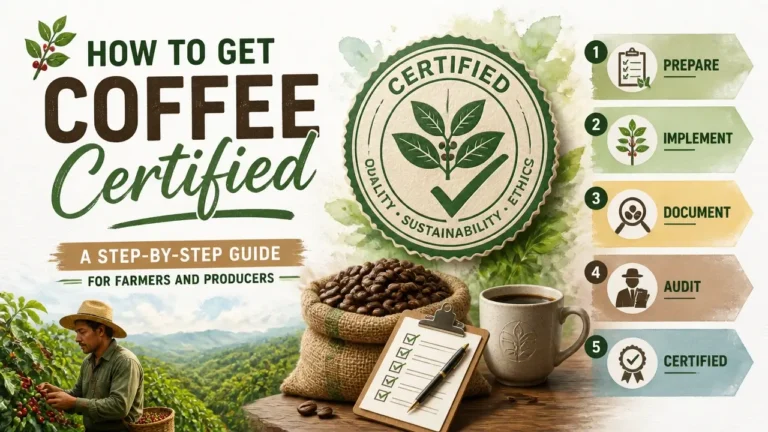

Getting coffee certified is one of the most financially consequential decisions a smallholder producer will make, yet nearly every guide on the subject is written for roasters and retailers, not the farmer footing the audit bill. Fair Trade, USDA Organic, and Rainforest Alliance all promise premium access – but the fee structures, documentation demands, and market realities look very different from the farm gate.
This guide is built for producers. It walks through every stage of the process in sequence: what you need before you apply, how to pick the right program, what an auditor actually checks, and how to calculate whether the premium you earn ever covers what the certificate costs you.
As you evaluate your options, it is also helpful to understand how Fair Trade and Direct Trade models compare in practice, ensuring you choose the right path for your farm’s economic goals.
To ensure your farm meets compliance requirements before applying, it is essential to thoroughly review the Rainforest Alliance certification standards so you can accurately assess your readiness for an audit.
This guide is built for producers, while consumers looking to understand these labels from the retail side can consult this certified coffee buying guide; it walks through every stage of the process in sequence: what you need before you apply, how to pick the right program, what an auditor actually checks, and how to calculate whether the premium you earn ever covers what the certificate costs you.
Key Takeaways on How to Get Coffee Certified
- Solo certification is financially impractical for smallholders; join a formally organized farmer group before beginning any application process.
- A gap analysis against the specific standard you are considering is the single most valuable step before spending money on registration or audit fees.
- Organic certification requires a verifiable three-year transition period that must have already started before you apply – not after.
- Rainforest Alliance’s shift to Improvement Pathways since 2020 means first-time audits are no longer strictly pass/fail, giving farms with capital constraints room to improve in stages.
- No major certification body publishes a clear farmer-facing fee schedule; always request one in writing before committing, and build a cost forecast before the application is filed.
- Treat certification as a price floor, not a revenue strategy – farms that stop investing in cup quality after certifying often lose access to higher-paying specialty buyers over time.
What You Need Before Starting: Prerequisites for Certification
Certification for a smallholder farmer almost never starts with a single farm. It starts with a group. Every major certification body – Fair Trade, Rainforest Alliance, USDA Organic – structures smallholder programs around collective membership, because the audit, administrative, and fee costs are simply too high for one farm to absorb alone. If you are farming independently and not affiliated with a cooperative or formally organized farmer group, that is the first thing to fix before you spend a day on paperwork.
Beyond group membership, there is a second structural requirement: your group needs an affiliated processor or exporter willing to act as the certificate holder. Certification bodies do not typically issue contracts directly to a collection of small farms. They issue them to a managing entity – the processor or exporter – who then operates an Internal Control System (ICS) to govern all member farms under that single certificate. If your cooperative does not yet have that relationship with a processor, building it is prerequisite work, not application work.
Training access matters too. Understanding what a standard requires – and what record-keeping looks like in practice – is not something most farmers absorb from reading a standards document. Access to an extension officer, NGO program, or cooperative training guide is what bridges the gap between a standard written in technical language and a farm that actually meets it.
Before a certification body schedules your first audit, it will expect the following to already exist:
- A functioning ICS with documented membership, internal inspection records, and a designated ICS manager
- Farm maps showing plot boundaries, buffer zones, and neighboring land use
- Production records covering harvest volumes, processing methods, and storage
- Input purchase and usage logs showing what has been applied to the soil and crop
- For organic certification specifically: verifiable evidence that no synthetic inputs have been used on the land for the prior three years (the transition period), including records from before you decided to certify
That last point catches many first-time applicants off guard. The organic transition period is not something you start when you apply. It started three years ago – or it didn’t, and you are not eligible yet. An auditor will verify this during the first inspection, and a missing or unverifiable transition record is grounds for rejection, not just a flag for follow-up.
For a broader picture of how these programs fit into the global supply chain, our complete guide to coffee certifications and standards covers the full landscape of what each certification body actually represents and who controls it.
These prerequisites are not aspirational benchmarks. They are the minimum entry gate. Meet them before you file a single form.
Step 1: Assess Your Farm’s Readiness and Gather Documentation
Farm readiness assessment is where most smallholders skip ahead too fast. They know roughly what a certification requires, assume their practices are close enough, and find out at the first audit that “close enough” costs them a corrective action deadline and a second audit fee. The way to avoid that is a gap analysis done before you ever contact a certification body.
A gap analysis is simple in structure: take the standard you are considering, work through its requirements point by point, and mark every place where your current practice falls short. You do not need a consultant to do this. Many certification bodies publish their standards publicly. Your cooperative officer can walk through it with you, or you can work through it as a peer group within your farmer organization.
The records a farmer must be able to produce at the first audit include:
- Proof of land ownership or tenure (title, lease agreement, or recognized community land documentation)
- Labor records showing who works the farm, under what terms, and that no child labor violations exist
- Input purchase and usage logs with dates, product names, quantities, and application areas
- Production volume records by harvest season
- Sales records showing where coffee was sold and to whom
- Environmental practices documentation covering buffer zones, water source protection, and waste management
Traceability is the requirement that trips up the most farms. Every certified lot must be physically and documentarily separable from non-certified coffee. That means your farm needs a system to segregate harvests from the moment of picking through delivery – separate containers, separate storage, separate invoicing. If certified and non-certified cherry mix at any point, that lot loses its certified status. There are no exceptions.
Walk your farm with the checklist in hand. Look at pesticide storage: is it locked, labeled, and away from food areas? Check worker safety gear availability. Verify that buffer zones along water sources are intact. Look for any inputs in storage that appear on your target certification’s prohibited list. Mark every gap you find.
Capture the results in a simple readiness scorecard – a one-page document that lists each requirement, your current status, and what action is needed. This becomes your pre-application work plan.
One practical tip for farmer groups: organize informal peer audits within the cooperative before the formal process begins. Pair farms together and have members walk each other’s land with the checklist. Farmers often spot issues on a neighbor’s farm they would miss on their own. It cuts costs, builds shared knowledge, and surfaces blind spots before they become audit findings.
Step 2: Choose the Right Certification Program for Your Farm
Certification program selection is the decision that shapes everything downstream: how much you spend, how long you wait, how much paperwork you carry, and what markets you can access. The three programs most smallholders consider are Fair Trade, USDA Certified Organic, and Rainforest Alliance. Each one makes a different promise to the farmer, and each one costs differently to maintain.
Certification Premiums, Market Returns, and Strategic Selection
The core promise of each program, in plain terms:
- Fair Trade Certified guarantees a minimum price floor so that even when commodity prices collapse, the farmer receives a viable base. It also delivers a social premium paid directly to the cooperative for community investment.
- USDA Certified Organic signals to buyers that no synthetic inputs were used, commanding a quality-linked price premium in health-conscious and specialty markets.
- Rainforest Alliance certification signals environmental and social stewardship, and is often a supply chain requirement for large commercial buyers rather than a consumer-facing premium driver.
The published premium structures for each look like this:
| Certification | Price Mechanism | Published Premium Range |
|---|---|---|
| Fair Trade | Minimum price floor + social premium | $1.80/lb floor + $0.20/lb social premium |
| Organic | Negotiated above-conventional premium | $0.20–$0.50/lb above conventional |
| Rainforest Alliance | Supply chain premium, buyer-negotiated | $0.03–$0.10/lb typical range |
Dual or triple certification is possible. An organic + Fair Trade combination, for example, stacks both premiums and can be attractive in specialty import markets. The tradeoff is that the administrative load multiplies proportionally. Each standard requires its own documentation stream, its own audit cycle, and its own fee payment.
One honest piece of guidance: if your farm already sells to a specialty buyer and commands a quality premium for cup profile, adding organic certification may deliver little net gain. The question is not which certification sounds most prestigious. It is which certification opens a market door you do not already have access to.
Here is where the information available to farmers breaks down. Across publicly accessible sources, no certification body publishes a clear, farmer-facing fee schedule showing actual audit costs, registration fees, or per-kilogram royalties. The premium numbers are well-publicized. The cost side is not. Before you commit to any program, request a detailed fee schedule in writing from the certification body or from your processor. If they cannot provide one, that is a signal worth taking seriously.
Documentation Burden, Timelines, and Audit Requirements
The paperwork and audit requirements differ substantially across the three programs.
Fair Trade requires a democratic cooperative structure with documented governance, compliance with labor standards (including freedom of association), and financial transparency in how the social premium is allocated and spent. The audit checks both farm-level practices and cooperative-level governance.
Organic certification carries the heaviest documentation burden of the three. Input records must be detailed and continuous. Composting regimes, soil amendment applications, and pest management approaches all require written logs. The 3-year transition period with zero synthetic inputs must be verifiable through records that predate your application. Annual inspections are mandatory, and any gap in the input record chain raises immediate questions.
Rainforest Alliance focuses on environmental protection and social improvement, requiring a farm management plan and a risk assessment covering areas like deforestation, water use, and worker welfare. Since 2020, Rainforest Alliance replaced its fixed pass/fail checklist with context-specific Improvement Pathways. Under the old system, a farm either met a requirement or it didn’t. Under the new system, a farm can demonstrate a credible trajectory of improvement against its own plan. For smallholders with limited capital who cannot fix every gap in one season, this structural change is significant. It means the first audit does not have to be a binary pass/fail event – it can be the start of a documented improvement cycle.
Realistic timelines: Organic transition takes three years from the last synthetic input application. Fair Trade and Rainforest Alliance can typically be achieved within one crop year after application, provided the farm meets baseline standards at the time of audit.
Step 3: Register and Submit Your Application
The certification application process converts your program choice into an official commitment, and the mechanics are more structured than most first-time applicants expect. For smallholders, the application almost never goes directly from farmer to certification body. It moves through the cooperative or farmer group, which routes it through the affiliated processor or exporter – the entity that will hold the certificate and bear legal responsibility for compliance.
The core application package typically includes:
- Completed registration form from the certification body
- Farmer group profile describing the cooperative’s structure, governance, and membership
- Member list with individual farm sizes and locations
- Map of all coffee plots within the group, with boundaries and buffer zones marked
- Proof of land tenure for each member farm
- ICS documentation showing the internal inspection system is operational
- Initial fee payment as required by the certification body
Get the fee schedule and contract terms in writing before you submit. Specifically: what is the first-year audit cost, what is the annual renewal fee, and does the certification body charge a per-kilogram royalty on certified sales? These figures directly affect your net return calculation. If the certification body cannot provide this breakdown clearly and in advance, you are entering a financial commitment without a budget – that is a risk worth naming.
Understanding the impact of certifications on farmers before you sign also gives you a realistic picture of what the process delivers in practice, not just in theory. And if you want the honest counterpoint, the documented criticisms of certification processes are worth reading before you commit.
Group certification under an ICS is the only financially viable route for most smallholders. Individual certification requires the farmer to absorb the full audit cost and administrative burden alone, which typically makes it economically irrational unless the farm is large enough to justify it. The ICS must be fully documented and operational before the application is submitted – not in progress, not planned.
Once the certification body accepts your application, they will schedule the first audit. Expect that within one to three months of acceptance. The farm and all ICS records must be audit-ready at that point, not still being assembled. Some certification bodies offer a pre-audit or mock audit service for an additional fee. For groups going through the process for the first time, it is often worth the cost: it surfaces the findings that would otherwise appear in the official report and gives you time to fix them before the real inspection.
Step 4: Prepare for and Pass the On-Farm Audit
The on-farm audit is the moment the entire preparation process has been building toward. An external inspector – typically from a third-party auditing firm contracted by the certification body – will arrive at the farm with a structured checklist tied to the specific standard you applied under. They will walk the land, review physical infrastructure, examine records, interview workers, and check storage and processing areas.
Here is what that day actually looks like, and what the auditor is specifically looking for:
- Record review: All production logs, input records, labor records, and ICS documents will be checked for completeness, accuracy, and signature. Missing dates, unsigned entries, or gaps in the sequence are the most common minor non-conformances.
- Physical farm inspection: Buffer zones along water sources, pesticide storage conditions, composting areas, and processing water management will all be physically verified.
- Worker interviews: The auditor will speak with farm workers directly – not just the cooperative manager – to verify that labor standards, safety practices, and worker rights information are understood and accessible.
- Input storage check: Any prohibited input found in storage is a major finding, regardless of whether it has been used recently.
- Traceability verification: The auditor will trace a sample lot from field to delivery point to confirm that certified and non-certified coffee are physically and documentarily separated.
Before the auditor arrives, run through this preparation checklist:
- Verify all records are current, complete, and signed by the responsible person
- Confirm that safety equipment and first-aid supplies are accessible and in usable condition
- Post worker rights information visibly in the processing area and in any communal space
- Physically segregate certified and non-certified coffee in storage, with clear labels
- Remove any prohibited inputs from storage entirely – do not leave them on-site and assume they won’t be noticed
- Prepare a clean, organized space where the auditor can sit and review documents without hunting through disorganized files
Assign one designated coordinator per farmer group to accompany the auditor throughout the entire inspection. This person answers questions, provides documents on request, and ensures the auditor’s findings are recorded accurately. When multiple people answer the auditor’s questions independently, contradictions emerge – even when everyone is telling the truth. A single point of contact prevents that.
The auditor’s job is not to fail the farm. It is to verify compliance. Many auditors working in smallholder contexts are trained to communicate findings constructively. A few minor non-conformances on the report do not automatically mean rejection – they mean you have a defined window to correct and document the fix. Major non-conformances are a different matter, and those are covered in the next step.
Step 5: Fix Non-Compliances and Take Corrective Action
Corrective action is not the end of the road. It is a defined stage in the certification process, and most first-time audits produce at least some findings. How you respond to them, and how fast, determines whether you receive your certificate on schedule.
After the audit, the certification body issues a formal report listing every non-conformance found. Each finding comes with a severity classification and a deadline for corrective action – typically 30 to 90 days, depending on the severity of the finding and the certification body’s procedures.
The distinction between minor and major non-conformances matters:
- Minor non-conformances are administrative or procedural gaps: a missing signature on a record, a buffer zone that is slightly narrow, a first-aid kit that is not fully stocked. These can typically be resolved with a documented fix submitted within the deadline.
- Major non-conformances are substantive violations: evidence of a prohibited pesticide application, a child labor finding, failure to maintain traceability of a certified lot, or a structural gap in the ICS. These may require a physical re-inspection before the certification decision moves forward, and in serious cases, they can result in disqualification from the current cycle.
When you submit a corrective action, do not just fix the problem and send a note saying it is done. Structure the response clearly:
- Describe the finding as the auditor documented it
- Identify the root cause – why did this gap exist?
- Document the action taken – specifically what changed
- Provide evidence – photos, updated records, a revised procedure
- Record the implementation date and the name of the person responsible
For group certification, the ICS manager must track corrective actions across all member farms simultaneously. A finding on one member’s farm requires a response from that member, but the ICS documentation must reflect the fix at the group level as well. Build a simple tracking sheet so the cooperative can see, at a glance, which members have submitted their corrective evidence and which have not.
If a major finding threatens to block certification and you believe the finding is incorrect or the timeline for correction is genuinely unworkable, most certification bodies have a formal appeals procedure. Request it in writing, understand the grounds on which an appeal can be filed, and use it if the situation warrants. Do not assume the initial decision is final without checking.
Once the certification body reviews and accepts the corrective action submissions, the certification decision is finalized and the certificate is issued.
Step 6: Receive Your Certificate and Start Selling as Certified
The certification certificate arrives as an official document with a defined validity period – almost always one year – a unique certification number, and the right to use the certification body’s logo on packaging, marketing materials, and sales documentation. That number is your proof of status. Buyers, importers, and roasters will verify it against the certification body’s public registry before signing a contract.
Here is how premiums actually move from buyer to farmer, because the mechanism is not automatic:
- For Fair Trade, the minimum price floor and the social premium are paid as separate line items by the buyer. The minimum price is paid to the cooperative for the coffee itself; the social premium goes into a communal fund governed by the cooperative’s members. Neither payment happens unless both amounts are explicitly written into the sales contract.
- For Organic and Rainforest Alliance, premiums are negotiated within the supply contract terms. There is no universal floor. The premium you receive is the premium you negotiate. Do not assume a certified lot automatically commands a higher price – confirm the figure in writing before you deliver.
On the first certified sale, work with your processor or exporter to ensure the following:
- The coffee is physically labeled as certified at every handoff point
- Traceability documentation – lot numbers, harvest dates, processing method, member farm origin – matches the information on the certificate
- Invoices separate certified from conventional lots as distinct line items with distinct prices
Certification opens access to buyers who require it as a procurement standard. Many specialty importers and commercial roasters will not engage with a supplier who cannot produce a recognized certification. Update your cooperative’s buyer outreach materials immediately to include the certification seal, certification number, and validity period.
One important caution: certification does not guarantee a buyer. Market demand for certified coffee fluctuates by origin, program, and buyer priorities. If possible, secure at least a letter of intent from a buyer before you commit your entire crop to a certified production model. Going fully certified without a confirmed buyer is a financial risk, not a marketing strategy.
Track every certification-related expense in a simple ledger alongside premium income: audit fees, travel costs, ICS management labor, documentation materials, and renewal fees. At the end of the first full certified season, run the calculation. The premium per pound multiplied by your certified volume, minus total certification costs, gives you the actual net gain. That number – not the published premium range – is the figure that tells you whether to renew.
Published field reports point to a structural risk worth naming: farms that rely solely on certification premiums without continuing to invest in cup quality sometimes find themselves locked out of higher-paying specialty markets. The minimum price floor that Fair Trade provides can, over time, become a ceiling for producers who stop pushing quality upward. Certification is a floor. The farmers who benefit most from it are the ones who treat it as the baseline, not the destination, and keep improving quality simultaneously.
Step 7: Stay Certified – Audits, Renewals, and Continuous Improvement
Certification renewal is not a separate project – it is the ongoing operating rhythm of a certified farm. Most certifications carry a one-year validity period, and the renewal process requires an annual surveillance audit, updated records, a new internal inspection cycle, and payment of annual fees. The surveillance audit is typically shorter than the initial audit, but it is not a formality. Auditors check for drift: practices that were compliant at the first audit and have quietly slipped since.
The renewal package looks similar to the original application: updated farmer group profile, current member list, refreshed farm maps if plot boundaries have changed, a full year of production and input records, and the internal inspection results from the ICS. No new transition period is needed as long as organic standards (or whichever standard applies) have been continuously maintained. If there is any gap in compliance – a prohibited input used during the year, a worker safety incident not documented – the renewal audit will surface it.
The ICS must operate year-round. This is where groups that were energized during the initial certification process often lose ground. Internal inspections need to happen on schedule, member training needs to be documented, and records need to be updated continuously – not reconstructed in a rush before the auditor arrives. A cooperative that treats the ICS as an annual audit preparation exercise rather than a permanent management system will eventually fail a renewal.
For Rainforest Alliance certified farms specifically, the standard requires a documented Improvement Plan with measurable targets set by the farm itself. Each annual audit checks progress against that plan. This means the auditor is not just comparing the farm to a fixed standard; they are comparing this year’s farm to the commitments made last year. If the plan called for expanding buffer zones by a specific area and that work did not happen, that is a finding – even if the farm meets every other baseline requirement.
The most common cause of renewal failure is documentation drift. Farmers who passed the initial audit and then let record-keeping slide for eight months face a genuine problem when the surveillance audit arrives. The practical fix is simple: designate one day per month as a documentation day for the entire cooperative group. Every member updates their input logs, labor records, and production notes together. Problems surface early, when they are cheap to fix, rather than at the audit, when they become findings.
If you want to add a second certification or transfer to a different certification body, do the planning well in advance. Understand the overlap in requirements – many standards share core principles, and documentation built for one often satisfies much of another. Time the transition to avoid any gap in coverage that would leave certified lots in an ambiguous status with buyers.
Troubleshooting: Overcoming the Most Common Certification Obstacles
Certification obstacles fall into two categories: financial and operational. Both are predictable. Neither is unique to your farm. The farmers who navigate them successfully are the ones who anticipated them before they became crises.
Financial and Market Obstacles
Challenge 1: Certification costs more than the premiums return.
This is the most common financial trap, and it is almost always avoidable with one tool: a cost forecast built before you apply. Take the fee schedule from the certification body (which you have requested in writing, as described in Step 2), add estimated audit travel costs, documentation labor, and any cooperative administrative time. Compare that total against the projected premium income: your expected certified volume multiplied by the premium per pound you have negotiated or can reasonably expect.
If that math is negative, you have three options before walking away entirely: explore cooperative cost-sharing where the audit and registration fees are divided across more member farms, pursue dual certification to stack premiums from two programs against a single audit cycle, or renegotiate the buyer contract to reflect the full certification cost.
Challenge 2: No buyer committed to purchasing the certified coffee.
Certification creates access. It does not create demand. Before the audit, secure at least a tentative buyer commitment – a letter of intent, a preliminary contract, a confirmed relationship with an importer who requires the certification you are pursuing. The assumption that “certified coffee sells itself” has cost cooperatives a full season’s premium income.
When not to certify:
If your farm already commands a quality premium through direct relationships with specialty buyers, and those buyers do not require a formal certification, the net gain from certification may be negative once costs are factored in. The administrative burden, the annual fees, and the documentation labor all have real costs. If the premium you already earn exceeds what certification would add, and no buyer is requiring the credential, the rational decision may be to skip it. That is not failure. That is sound business judgment.
Most public-facing content on coffee certification is written to persuade consumers and buyers, not to equip a producer with a cost analysis tool. Nearly every article in this space presents certification as an obvious good, without publishing the fee data or failure-rate information a farmer actually needs to make the decision. This guide is built to be the corrective: a producer-side framework that gives you the information to decide whether to certify, not just how.
Operational and Group Management Obstacles
Challenge 3: Paperwork overwhelms the group.
The volume of documentation required by any major certification standard is genuinely heavy for smallholder groups managing it manually. The practical solution is digitization – not sophisticated software, but a shared spreadsheet on a phone, a simple mobile app, or even a standardized paper form that gets photographed and stored. Assign a dedicated record-keeper role within the cooperative with a clear monthly task list. Audit records in small batches each month rather than attempting to reconstruct a year’s worth of documentation before the audit.
Challenge 4: The same non-conformances appear audit after audit.
Recurring findings are a management failure, not a knowledge gap. If the corrective action from last year’s audit addressed the symptom but not the cause, the finding will return. The fix is to treat every corrective action as a permanent update to your standard operating procedures. Write the new practice into the ICS manual. Train members on it. Check compliance during the monthly documentation day. A corrective action that exists only in the audit report and not in daily operations is not a corrective action – it is a deferred problem.
Challenge 5: Free-riding members threaten the group’s certificate.
In group certification, one member’s non-compliance can trigger a finding that affects the entire cooperative’s certificate. The ICS exists precisely to catch this before the external auditor does. Write group bylaws with explicit consequences for members who fail internal inspections and do not remediate. The ICS manager needs authority to flag problem members formally, document the finding, and escalate to cooperative leadership before the external audit. A member who repeatedly fails internal inspections and faces no consequence is a liability the entire group carries.
One final reality check on claims you will encounter in the broader certification literature: figures citing 20 to 30 percent income improvements from regenerative or certified farming practices circulate widely but consistently lack verifiable source data. Do not build your financial case on those numbers. Build it on your own farm’s net profit ledger after one complete certified season. That is the only data point that tells you whether certification was worth it for your specific farm, your specific market, and your specific cost structure.
Frequently Asked Questions About How to Get Coffee Certified
Can a single farmer get certified without joining a cooperative?
Technically yes, but it’s almost never financially viable. The audit, registration, and annual renewal fees spread across one farm rarely leave a positive net return. Group certification under a cooperative’s Internal Control System is the practical route for smallholders.
How long does the entire certification process take from start to certificate?
For Fair Trade and Rainforest Alliance, a well-prepared group can complete the process within one crop year after application. Organic certification requires a three-year transition period before the first audit, so the minimum timeline from decision to certificate is roughly three to four years.
What happens if my cooperative fails the first audit?
A failed initial audit usually means major non-conformances were found. The certification body will issue a report with a corrective action deadline. Fix the findings, submit documented evidence, and request re-inspection. It delays the certificate but doesn’t permanently disqualify the group unless the violations are severe enough to trigger a suspension.
Do I need to hire a consultant to prepare for certification?
No, but access to a trained cooperative officer or extension agent who knows the standard is valuable. Many NGOs and export processors offer technical assistance programs. A pre-audit mock inspection from the certification body itself is often more useful than a general consultant.
If I’m already certified, can I switch certification bodies?
Yes. Plan the transfer carefully so there’s no gap in coverage between the expiring certificate and the new one. Many standards share core requirements, so documentation built for one certification often satisfies much of another. Coordinate the timing with your buyer so they’re not left without a valid certificate on your account.
What is the difference between a minor and a major non-conformance?
A minor non-conformance is a procedural gap – a missing signature, an incomplete log entry – that can be fixed with documentation. A major non-conformance involves a substantive violation of the standard, like using a prohibited input or failing to maintain traceability of a certified lot. Major findings can require physical re-inspection and, in serious cases, disqualify the application for the current cycle.
Does holding a certification guarantee I can use the certification logo on my packaging?
The right to use the logo comes with the certificate, but each certification body has specific trademark rules governing how and where the logo can appear. Fair Trade, Rainforest Alliance, and USDA Organic all require separate licensing agreements for logo use. Confirm those terms before printing anything.
Is dual certification – like Organic plus Fair Trade – worth the extra cost?
Sometimes. Stacking premiums from two programs can improve net return, and some specialty buyers specifically seek dual-certified origins. The tradeoff is that the documentation burden and annual fees roughly double. Run the cost forecast for each combination before committing.
References
- Coffee Certifications and Standards: The Ultimate Guide to Ethical and Quality Coffee | coffeefactz.com
- The Impact of Coffee Certifications on Farmers and the Environment | coffeefactz.com
- Criticisms of Coffee Certifications: Are They Really Effective? | coffeefactz.com