
Genuinely certified coffee is one of the few things in a grocery store where the label actually has teeth – but only if you know which label to trust. Walk down any coffee aisle and you’ll find bags dressed in earthy tones, hand-drawn farmers, and words like “sustainably sourced,” most of which are marketing copy, not verified promises.
The seals that do mean something – USDA Organic, Fair Trade, Rainforest Alliance, Bird Friendly – each check a different part of the supply chain. A coffee farmer who earned Fair Trade premiums may have used synthetic pesticides. A Rainforest Alliance bag may contain mostly uncertified beans. Understanding the difference is the whole game.
While these programs aim to improve the supply chain, many industry experts point out label criticisms and limitations that every consumer should understand.
To better understand how different sourcing models impact coffee producers, it is helpful to examine the debate surrounding Fair Trade versus Direct Trade.
To fully understand how these standards impact your daily brew, it helps to take a closer look at organic versus conventional coffee labels and what they reveal about growing practices.
To dive deeper into the specifics of these programs, you can read our guide on Coffee Certifications Standards What Every coffee drinker should know before buying their next bag.
Key Takeaways on How to Choose Certified Coffee
- “Sustainably sourced” and “ethically grown” without a named certifying body’s seal are marketing claims, not verified commitments.
- Rainforest Alliance certified bags can legally contain as little as 30% certified beans unless the label explicitly states “100% Rainforest Alliance Certified.”
- Bird Friendly is the strictest environmental certification and includes mandatory USDA Organic status – you get both with one seal.
- Fair Trade premiums to farmers can be offset by certification costs; roasters who publish sourcing transparency reports signal deeper commitment than the seal alone.
- No reliable, comparable ranking of certifications by effectiveness exists – choosing based on your specific priority is the most defensible approach.
- A license or certification number on the bag can be verified directly on the certifying body’s website in under two minutes.
What “Certified Coffee” Actually Means
Certified coffee is coffee that passed a third-party organization’s verification of specific farming, labor, or environmental standards. That’s the plain definition. An independent body set a rulebook, audited the farm or supply chain against it, and issued a seal confirming the check happened.
What that seal does not verify, by default, is how the coffee tastes. Certification is about production practices – how the land was managed, whether a minimum price was paid, whether synthetic chemicals were used. Cup quality is a separate system entirely, and only a handful of programs address it directly.
The reason certifications exist in the first place is a trust gap. A coffee farmer in Ethiopia and a shopper in Chicago will never meet. The seal is shorthand for a promise that someone credible stood between them and confirmed something real.
Here’s the catch: not every claim on a bag is a certification. Phrases like “sustainably sourced,” “ethically grown,” or “responsibly farmed” carry no regulatory definition. No independent body checked them. They are positioning statements, not verified commitments. A genuine certification always comes with a recognizable seal from a named organization – not just words.
And even among real certifications, the differences run deep. Different programs have different scopes, different rigor, and different definitions of what “better” even means.
Statistical Data: Roughly one-third of global coffee production is now associated with at least one sustainability certification. – Source: MDPI Sustainability Journal
That’s a significant share of the market – but it tells you nothing about which third of production is actually better for the planet or for farmers. Coverage is not the same as impact.
According to Eric Lambin, environmental scientist at Stanford University and the Catholic University of Louvain, the data on which certifications genuinely improve outcomes for the environment or for farmers remains murky. Despite the proliferation of sustainability labels across the coffee industry, rigorous, comparable evidence that any single seal reliably delivers on its stated goals is still hard to find.
That’s not an argument against certifications. It’s an argument for knowing exactly what each one checks – which is precisely what the rest of this guide covers. For a broader look at how these programs fit into the full quality and ethics picture, our complete guide to coffee certifications and standards maps the entire landscape in one place.
The Major Coffee Certifications and What They Stand For
Core Coffee Certification Logos and Their Essential Promises
The seals a shopper will actually encounter on shelves break down into a short list. Each one checks something different, and the gap between the strictest and the most permissive is wider than most people realize.
Here’s what each major certification actually promises:
| Certification | Core Promise | Key Mechanism |
|---|---|---|
| USDA Organic | No synthetic pesticides or fertilizers; soil health standards | Government-regulated, third-party audited |
| Fair Trade International | Minimum price floor + social premiums for producer communities | Price guarantee, co-op structure |
| Fair Trade USA | Similar to FTI, but allows individual farmer certification (not co-op only) | Broader eligibility, different standards |
| Rainforest Alliance | Environmental and social farm-management standards | Allows blending; 30% certified content minimum for the seal |
| Bird Friendly (Smithsonian) | Strict shade-grown habitat rules; mandatory organic certification | Canopy height ≥12m, foliage cover ≥40%, ≥10 tree/shrub species |
| 4C (Common Code for the Coffee Community) | Baseline sustainability standard; excludes worst practices | Entry-level; widely used in commercial supply chains |
| SCA Specialty Grade | Coffee scoring 80+ on a 100-point quality scale | Sensory evaluation, not environmental or social standards |
| Starbucks C.A.F.E. Practices | Internal supply chain verification for Starbucks sourcing | Rarely appears on retail bags; not consumer-facing |
The number that changes how you read the Rainforest Alliance seal: a bag displaying the green frog can contain as little as 30% certified beans and still carry the logo unless the packaging explicitly states “100% Rainforest Alliance Certified.” That’s not fraud – it’s the program’s design, intended to bring more farms into the system gradually. But it’s a fact most buyers don’t know.
Bird Friendly sits at the opposite end. The Smithsonian Migratory Bird Center requires certified organic status first, then adds canopy height of at least 12 meters, foliage cover of 40% or more, and a minimum of 10 different tree or shrub species. There’s a structural logic to that organic requirement: shade trees drop leaves that naturally fertilize the soil, which reduces the need for synthetic inputs. Organic and shade-grown aren’t just compatible – they reinforce each other. When you buy Bird Friendly, you’re getting organic by default.
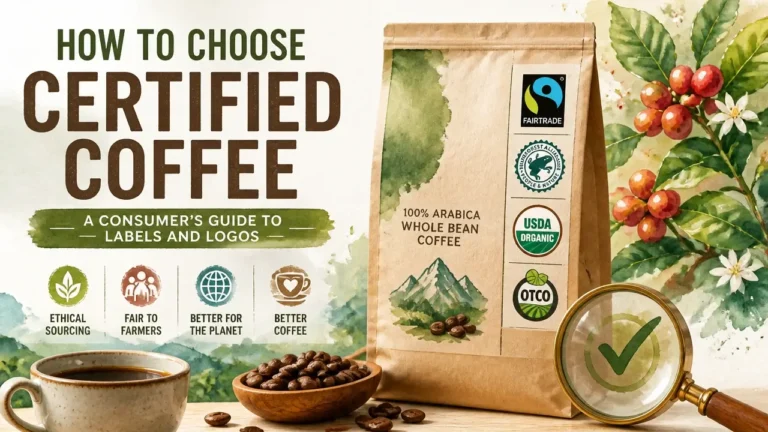
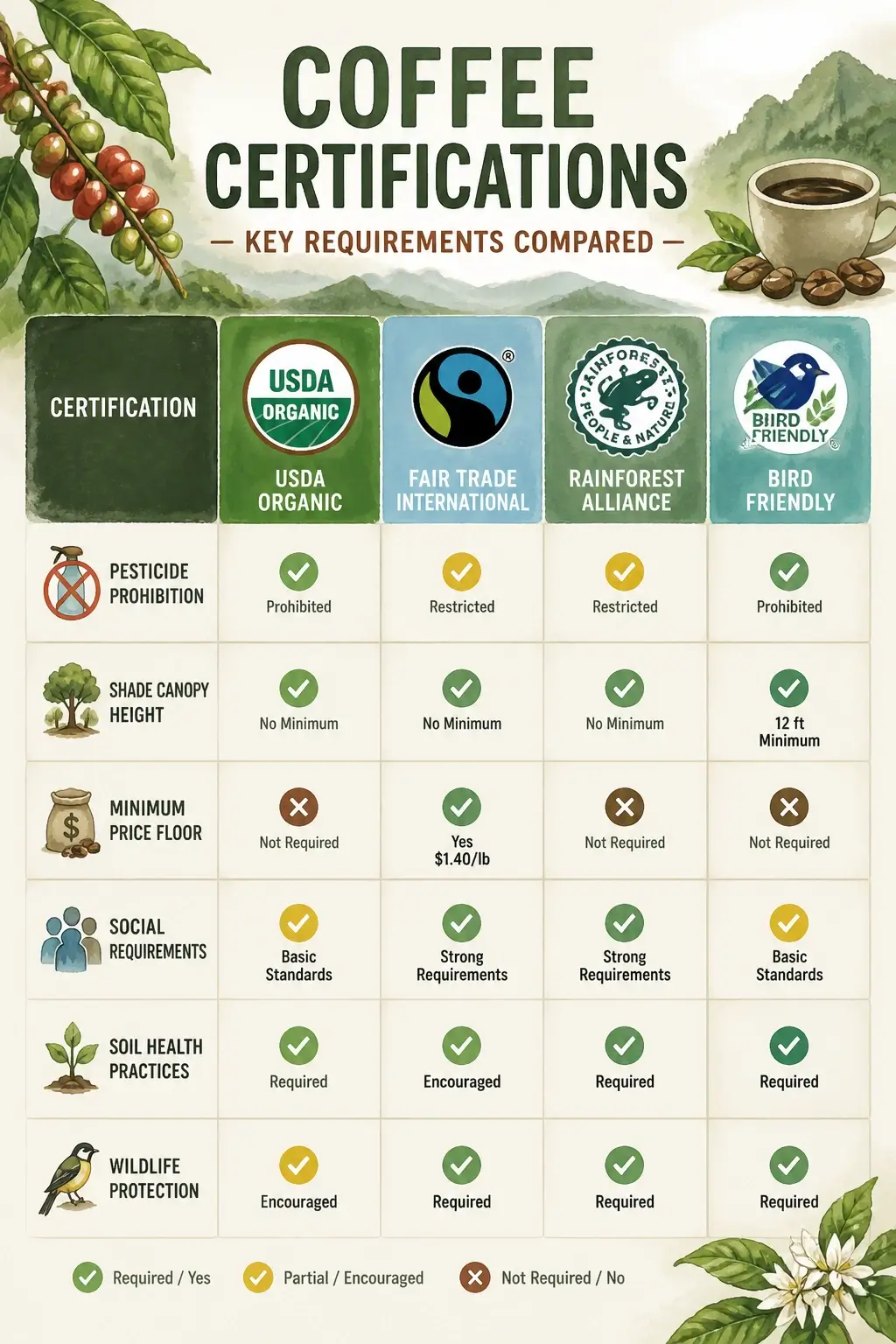
Here’s a visual breakdown of how the major certification logos compare:
One natural way to see these distinctions at a glance is to lay the logos side by side with their key requirements.
Nuances of Coffee Certification: Direct Trade, Blending Rules, and Multi-Certification
Direct Trade deserves a direct answer: it is a marketing term, not a formal certification. No independent body audits it. A roaster who claims “direct trade” may genuinely have deep relationships with specific farms, pay above-market prices, and visit producers annually – or they may have bought coffee through a broker once and liked the phrase. There’s no way to verify it from the bag alone.
Fair Trade International and Fair Trade USA both use the term but operate under different standards and have different eligibility rules. Fair Trade International requires farmers to be organized into cooperatives. Fair Trade USA extended certification to individual plantations and hired workers, which expanded reach but drew criticism for diluting the co-op model that was central to the original mission. The logos look similar; the underlying standards are not identical.
A bag carrying multiple certifications – say, both USDA Organic and Fair Trade – signals overlapping priorities, and that’s generally a good sign. But each certification must be verified separately. One seal doesn’t transfer the other’s promises. A coffee that’s organic and fair trade certified has passed two independent audits for two different things; it hasn’t passed a single combined audit for everything.
How to Read a Coffee Label and Spot a Genuine Certification
Reading a coffee label correctly takes about sixty seconds once you know what to look for. The skill is less about coffee knowledge and more about knowing the difference between a verified mark and a designed aesthetic.
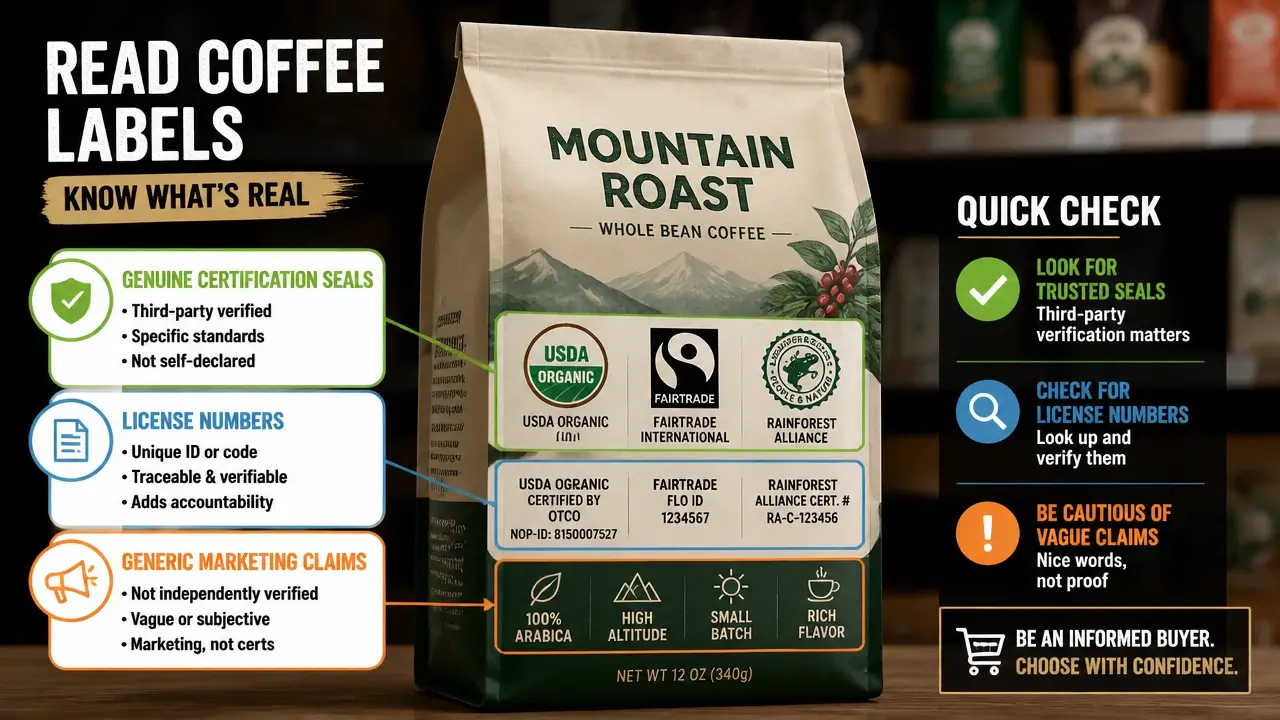
Start with the front panel. Genuine certification seals typically cluster near the bottom of the front label or appear grouped near the roaster’s branding. They look like structured logos with the certifying organization’s name embedded – not decorative illustrations.
Then flip the bag. The back label, near ingredient or producer information, often carries additional certification details, license numbers, or producer codes. A real seal includes the certifying body’s name and frequently a license or certification number. Phrases like “supports fair trade values” or “ethically sourced with care” without an accompanying logo are red flags – they’re claims the roaster made about themselves, not claims an independent body verified.
The verification step most people skip: certification numbers are checkable. The Rainforest Alliance, Fair Trade, and USDA Organic programs all maintain online databases where you can enter a license or producer code and confirm the certificate is current and valid. It takes two minutes and removes all ambiguity.
The Rainforest Alliance blending rule deserves a second mention here because it changes how you read the frog seal in practice. If the bag says “Rainforest Alliance Certified” without specifying “100%,” you’re looking at a product that met the 30% threshold. That’s still a meaningful commitment from the roaster – it means they sourced some certified beans and paid into the system. But it’s not the same as a fully certified supply chain.
Watch for packaging that mimics the feeling of certification without the substance. Images of lush forests, hand-drawn birds, or smiling farmers are design choices. Leaves and wildlife illustrations are not proof of anything. The only thing that counts is the third-party seal with a named organization behind it.
For coffees marketed on quality rather than sustainability, understanding what a score actually means is its own subject. The specialty coffee grade standards article breaks down the SCA scoring system and what separates an 80-point coffee from a 90-point one.
Here’s what a genuine certification looks like on a real bag versus generic claims:
Matching Certifications to Your Values: Environment, Social, or Quality?
Mapping Coffee Certifications to Environmental, Social, and Quality Priorities
Value-based certification selection starts with one honest question: what are you actually trying to protect? Most buyers have a vague sense that certified coffee is “better,” but better for whom depends entirely on what you prioritize. The certifications don’t overlap as much as the industry suggests.
Three core priorities cover most consumer motivations:
Protecting the environment – biodiversity, soil health, shade canopy, reduction of synthetic chemicals. Supporting farmer livelihoods – minimum price floors, social premiums, wage accountability. Seeking high cup quality – sensory rigor, production precision, specialty-grade scoring.
Here’s how the major certifications map to each:
| Priority | Best Match | Why |
|---|---|---|
| Environment (biodiversity) | Bird Friendly | Strictest shade and species requirements; organic mandatory |
| Environment (chemical reduction) | USDA Organic | Prohibits synthetic pesticides and fertilizers |
| Environment (broad farm management) | Rainforest Alliance | Covers more farms; less strict on biodiversity specifics |
| Farmer livelihood | Fair Trade International | Price floor and co-op premiums |
| Farmer livelihood (with caveat) | Direct Trade | Potentially higher pay, but no independent verification |
| Cup quality | SCA Specialty Grade | 80+ point score; sensory evaluation by trained cuppers |
| Baseline sustainability | 4C | Excludes worst practices; entry-level for commercial supply |
Academic Evidence: A peer-reviewed study on shade-grown coffee certification criteria found that rustic agroecosystems meeting the Smithsonian Migratory Bird Center’s standards contained significantly higher fruit-feeding butterfly diversity and an avifauna far more similar to forest reserves than other farming systems. The researchers noted that SMBC programs “use high standards that would exclude all but the most diverse commercial polyculture or rustic systems” – confirming that Bird Friendly certification selects for genuinely high-biodiversity environments. – From Ecological Applications: Linking Shade Coffee Certification to Biodiversity Conservation in Chiapas, Mexico
That finding matters because it connects a specific standard’s requirements directly to measurable ecological outcomes. The canopy height and species diversity thresholds aren’t arbitrary – they’re the conditions that actually support wildlife.
Now for the part no consumer guide will tell you: the cost side of the certification equation is almost never discussed. Every source promotes the premiums farmers supposedly receive. Almost none mention that getting certified costs money – inspection fees, compliance investments, lost operational flexibility. A Fair Trade premium of $0.10 per pound means something different if certification costs $0.15 per pound to maintain. This doesn’t make Fair Trade worthless. It means that if farmer wellbeing is your primary value, a certification seal alone isn’t enough evidence. Look for roasters who publish sourcing transparency reports alongside their certifications – those are the operations that treat the seal as a floor, not a ceiling.
There’s also a structural reality worth naming: no reliable, comparable ranking of certifications by effectiveness exists. The data on actual farmer outcomes, biodiversity impact, and long-term soil health across programs is fragmented and inconsistent. This isn’t a gap you can close by reading more guides. It’s a genuine limitation of the field.
Trade-Offs and Combining Certifications: What No Single Label Covers
No single certification covers everything. This is the central trade-off, and acknowledging it makes you a better buyer.
Organic doesn’t guarantee fair wages. A farm can be fully certified organic and pay its workers poverty wages – the standard simply doesn’t address labor economics. Fair Trade doesn’t require shade canopy or prohibit synthetic pesticides. A Fair Trade coffee can be grown in full sun with chemical inputs and still carry the seal. Rainforest Alliance is more accessible – more farms can meet its standards – but its flexibility on biodiversity requirements means it covers a broader range of farming practices, not all of them equally rigorous.
The practical solution is to look for coffees carrying multiple certifications. A bag with both USDA Organic and Fair Trade covers two independent pillars verified by two separate auditors. It won’t cover everything, but it covers more than either seal alone.
The budget reality is straightforward: the strictest certifications are the rarest. Bird Friendly certified coffees are harder to find and consistently priced higher than Rainforest Alliance or Fair Trade options, because fewer farms can meet the requirements. Aligning your values with your budget isn’t a compromise – it’s a realistic way to stay in the game long-term. Buying Rainforest Alliance consistently is more useful than buying Bird Friendly once.
Where to Buy Certified Coffee (and What to Expect to Pay)
Buying certified coffee doesn’t require a specialty shop or a subscription – but knowing which channel carries which certifications saves time and manages expectations.
Supermarkets are the easiest starting point for USDA Organic and Fair Trade options. Brands like Equal Exchange, Peet’s, and many store-brand lines carry certified options at competitive prices. Rainforest Alliance certified coffee has grown significantly in mainstream retail and now appears on mass-market bags from large commercial roasters.
Specialty coffee shops and roasters are the most reliable place to find Bird Friendly and single-origin certified coffees. Baristas at these shops typically know their sourcing and can answer specific questions about certification status. This is also where you’re most likely to find coffees carrying multiple certifications.
Online opens the full range. Direct-from-roaster websites often carry Bird Friendly and specialty-grade certified options that never reach supermarket shelves. Subscription services like Trade Coffee, Driftaway, and Mistobox let you filter by certification type, which removes the in-store guesswork entirely. Amazon carries a wide range, though verifying seal legitimacy requires the same label-reading skills covered earlier.
A realistic cost picture:
- Organic or Fair Trade certified bags typically run $1–$3 more per 12-ounce bag than comparable conventional coffee.
- Bird Friendly or single-origin specialty-certified coffees can run $4–$6 above the baseline, reflecting both the stricter standards and the smaller certified supply.
- Rainforest Alliance certified bags are often priced close to non-certified options in supermarkets, because the program’s broader adoption has reduced the premium over time.
Three budget-friendly strategies that actually work: buy in bulk when your preferred certified coffee goes on sale; use a subscription service that discounts per-bag cost on recurring orders; and consider that Rainforest Alliance certified coffee gives you a verified environmental and social baseline at near-conventional prices – which is a reasonable entry point if Bird Friendly is outside your regular budget.
Availability varies by region. In the U.S., Organic and Fair Trade are the easiest to find in any mid-size grocery store. Bird Friendly and high-scoring specialty-certified coffees are more consistently available online or at specialty retailers than on standard supermarket shelves.
Your Simple Guide to Choosing Your First Certified Coffee
Your first certified coffee purchase doesn’t need to be perfect. It needs to be informed enough that you’re not buying a label that only looks good.
Start here: pick one value that matters most to you right now. One. Trying to optimize for environment, farmer income, and cup quality simultaneously on your first purchase leads to paralysis. Pick the priority that resonates most and let the rest follow over time.
The starter cheat sheet:
- Want no synthetic pesticides and healthy soil? → USDA Organic. Widely available, well-regulated, and easy to verify.
- Want to protect birds and forests with the strictest rules? → Bird Friendly. Harder to find, costs more, but the organic requirement is built in.
- Want a safety net for farmer communities? → Fair Trade International. Look for the co-op model if farmer income is the core priority.
- Want an affordable, all-around environmental baseline? → Rainforest Alliance. Broadly available, competitively priced, and a genuine step above uncertified.
The one-minute in-store routine: flip the bag to the back label. Find a seal with a named organization. Look for a license or certification number. If those two things are there, you have a real certification. Buy it, taste it, and note whether you’d buy it again.
Your first certified coffee isn’t a permanent commitment. Use it to learn what you enjoy drinking, notice whether the origin or roast profile matters to you, and decide which certification priority feels most important in practice. The second purchase is always easier than the first.
For readers who want to go deeper on what “quality” means beyond the certification, the specialty coffee grade standards article breaks down SCA scoring and what a number on a scale actually tells you about what’s in the bag. For the full landscape of every certification framework – including how they interact with trade regulations and global supply chains – our complete guide to coffee certifications and standards covers it all.
One last thing worth knowing: every major certification system, whatever its blind spots, is built on four shared structural features. Farmers receive economic incentives. The production process gets certified, not just the product. An independent body does the verification. And participation is voluntary – which means the farms inside these systems chose to be there. That structure is real, verifiable, and meaningful. The gap in the research isn’t a reason to distrust certifications. It’s a reason to choose based on what you value most, with clear eyes about what each seal can and can’t promise. That’s the most informed purchase you can make.
Frequently Asked Questions About How to Choose Certified Coffee
What does “certified coffee” mean?
Certified coffee has passed an independent third-party organization’s audit of specific farming, labor, or environmental standards. The seal on the bag confirms that audit happened – it doesn’t automatically mean better taste or that every standard was met at the highest possible level.
Is Direct Trade better than Fair Trade?
Direct Trade relationships can result in higher payments to farmers and closer supply chain transparency, but Direct Trade has no independent verification. A roaster can call anything “direct trade.” Fair Trade, by contrast, requires a third-party audit. The terms aren’t comparable on the same scale.
Can a coffee bag carry more than one certification?
Yes, and it’s worth looking for. A bag with both USDA Organic and Fair Trade certifications has passed two separate audits covering soil practices and farmer economics respectively. Each certification is independent – one doesn’t transfer the other’s guarantees.
Why is Bird Friendly coffee so hard to find and more expensive?
The Smithsonian’s Bird Friendly standard requires certified organic status first, then adds strict canopy height, foliage cover, and tree species diversity requirements. Very few farms globally meet all of those criteria simultaneously, which limits supply and drives price up.
Does organic coffee taste better than non-organic?
Organic certification doesn’t address flavor. It verifies that no synthetic pesticides or fertilizers were used and that soil health standards were met. Whether that translates to cup quality depends on the variety, altitude, processing method, and roast – none of which organic certification controls.
What if a coffee bag has nature imagery but no certification seal?
Illustrations of forests, birds, or farmers are design choices, not proof of any verified standard. Rely only on a structured logo from a named certifying organization, ideally accompanied by a license or certification number you can look up.
How do I know if a certification on a bag is still current?
Most major certifiers – Rainforest Alliance, Fair Trade USA, and USDA Organic programs – maintain searchable online databases. Enter the license number or producer code from the bag to confirm the certificate is active and hasn’t expired.
Is Rainforest Alliance certification weaker than the others?
It’s more flexible, not necessarily weaker. Rainforest Alliance covers a broader range of farms by setting standards that more operations can realistically meet. That trade-off means wider adoption but less stringency on biodiversity specifics compared to Bird Friendly. Whether that’s acceptable depends on what you’re prioritizing.
References
- Sustainability Certifications in Coffee Production | mdpi.com
- A Blizzard of Sustainability Labels | dailycoffeenews.com
- Linking Shade Coffee Certification to Biodiversity Conservation: Butterflies and Birds in Chiapas, Mexico | esajournals.onlinelibrary.wiley.com