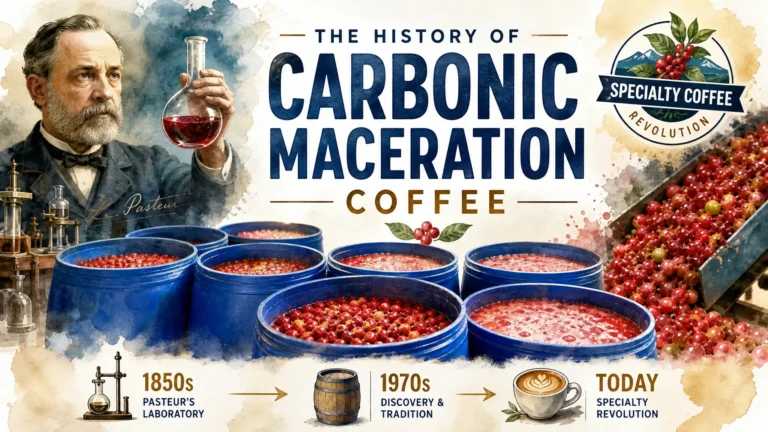

Surprisingly well-documented in wine and almost entirely undocumented in coffee, the history of carbonic maceration moves from Louis Pasteur’s anaerobic fermentation observations in 1872 through Michel Flanzy’s Beaujolais method to a sealed CO₂ tank on a competition stage in 2015. The paper trail is thin, the gaps are real, and the industry’s version of the story skips the hardest chapter entirely.
What makes this history worth reconstructing is not the innovation arc itself – it’s what the gaps reveal. The jump from Gamay grapes to coffee cherries required solving structural and biochemical problems that wine science never addressed, and the people who solved them left no public record. That missing chapter shapes what specialty coffee professionals still don’t know about the technique they’re using.
Louis Pasteur Saw It First, in 1872
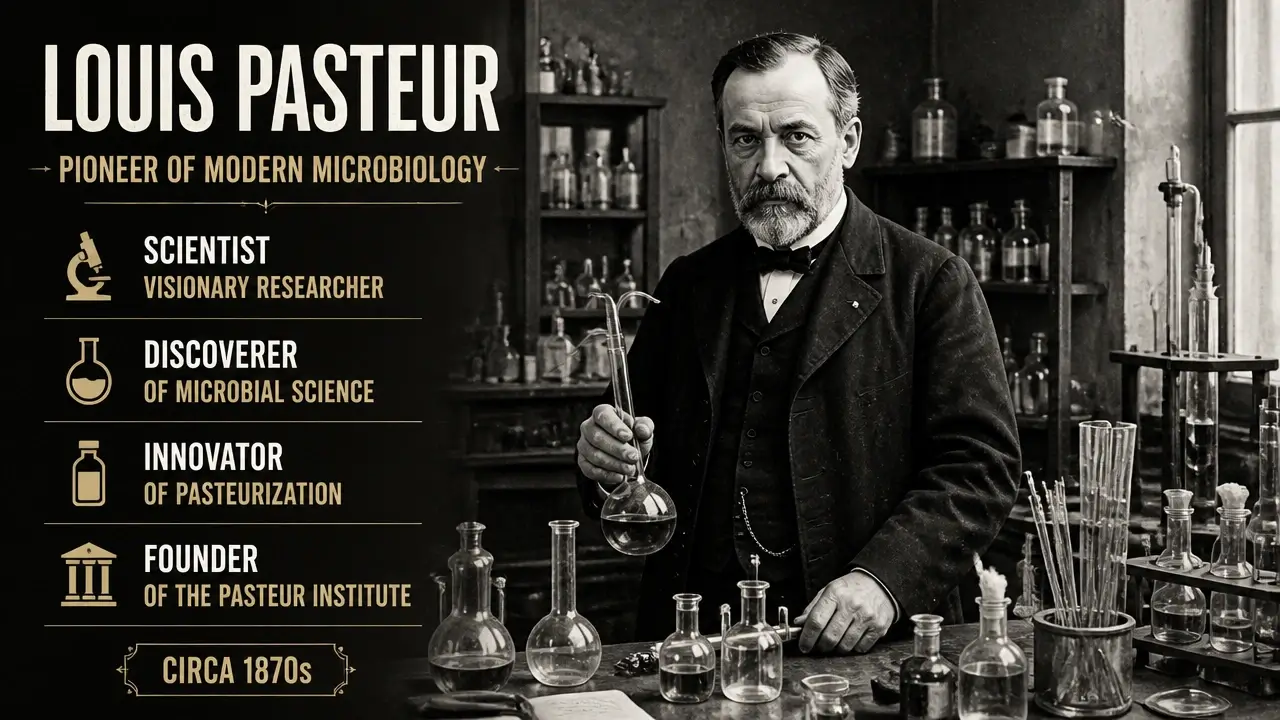
The history of carbonic maceration begins not in a Beaujolais cellar but in a French laboratory, where Louis Pasteur documented something that winemakers had likely stumbled across empirically for generations. In 1872, Pasteur observed that whole grapes stored in CO₂-rich environments fermented from the inside out – without oxygen, without crushed skins, and without the intervention of external yeast. The grapes were, in effect, doing something biochemically improbable: running fermentation entirely within their own cells.
What made this significant for the era was the explanatory framework Pasteur brought to it. His broader work on fermentation science – the demonstration that microbial activity, not spontaneous chemistry, drove the process – gave him the tools to describe what was happening inside those grapes with precision. Intracellular fermentation under anaerobic conditions was not folklore; it was a mechanism. Pasteur could name it, describe it, and situate it within the emerging science of microbiology.
What he did not do was turn it into a winemaking process. His contribution was foundational observation, not method engineering. He documented the CO₂ effect on whole-fruit fermentation; he did not design a sealed tank, write a production protocol, or test it across grape varieties. The gap between “observed phenomenon” and “usable technique” remained open for another six decades.
It’s worth noting that Pasteur wasn’t discovering something from nothing. Before his systematic study, Italian winemakers had practiced a technique called governo – a partial CO₂ exposure method that empirically exploited similar fermentation dynamics. These traditional practices suggest the CO₂ effect on fermentation was sensed long before it was explained. Pasteur was the first to document and articulate it scientifically, which is a different and more durable contribution.
This Pasteur origin is almost entirely absent from coffee-focused histories. The dominant narrative in specialty coffee media credits Michel Flanzy’s 1930s work as the singular origin point, erasing Pasteur’s 1872 documentation entirely. That pattern – a documented scientific foundation overwritten by a later, more commercially accessible story – is itself a historical phenomenon worth naming. Pasteur provided the observation; someone else would eventually build the manual. Coffee inherited the manual and forgot the observation.
Michel Flanzy Built the Operational Manual (1934)
Michel Flanzy was a French oenologist working in Beaujolais in the 1930s, and his problem was practical rather than theoretical. The region’s dominant grape, Gamay, produced wines that could be thin, astringent, and difficult to sell when processed through conventional winemaking. Flanzy needed a method that would coax something more appealing – softer tannins, brighter fruit – from a variety that conventional extraction punished.
What Flanzy engineered was the formalization of carbonic maceration as a controlled, repeatable winemaking process. Whole grape clusters, uncrushed, were loaded into sealed tanks flooded with carbon dioxide. With oxygen excluded, the grapes began the same intracellular fermentation Pasteur had described sixty years earlier – but now within a defined system, with predictable parameters and reproducible outcomes. The result was a wine with a distinctly fruit-forward, low-tannin profile that suited both the Gamay grape and the Beaujolais market.
The distinction between Flanzy and Pasteur matters precisely here. Pasteur observed a phenomenon; Flanzy engineered a production method with transferable outputs. The terminology itself reflects this: “carbonic maceration” as a named, documented winemaking technique originates with Flanzy’s work, which is why his name dominates the historical narrative even in coffee sources that haven’t traced the story back further.
That said, the evidentiary record has a real limitation. No coffee blog source provides a direct citation to Flanzy’s original 1934 work. The history has been transmitted through secondary wine literature and industry lore rather than primary documentation. The details of his method are widely accepted, but the paper trail in coffee literature is thin. Presenting Flanzy’s contribution as a well-sourced historical event would be misleading; the better framing is: this is what the secondary record consistently reports, and no primary source has emerged to contradict it.
The more useful framing for coffee professionals is this: Pasteur provided the scientific observation; Flanzy built the operational manual. Coffee would eventually take the manual – and forget the observation entirely.
How Beaujolais Nouveau Proved the Technique at Scale
Beaujolais Nouveau is the commercial proof point that carbonic maceration skeptics rarely have a clean answer for. By the 1960s and 1970s, the technique had escaped the laboratory and the regional cellar entirely, powering a globally distributed wine category built on one defining characteristic: fruit-forward, low-tannin wines released just weeks after harvest, designed for immediate consumption rather than cellaring.
The Beaujolais Nouveau phenomenon transformed carbonic maceration from a technical winemaking tool into a recognizable flavor identity. Consumers in Paris, London, and eventually Tokyo learned to associate the technique’s output – light body, bright berry fruit, minimal astringency – with a specific annual product. The marketing machinery was secondary; the technique’s consistency was the foundation. It delivered the same profile reliably, at scale, year after year.
By the time specialty coffee began its own processing experiments in the early 2000s, carbonic maceration had accumulated roughly four decades of commercial validation in wine. It was not experimental. It was not fringe. It was a proven, scalable flavor-engineering tool with international distribution history and a consumer base that understood what it produced.
This makes the lag in coffee adoption genuinely puzzling – and that puzzle is worth sitting with. The technique was available, proven, and widely understood in wine science. The question is not why it eventually reached coffee; the question is what made it so difficult to translate. The Beaujolais success story implicitly sharpens that problem: if carbonic maceration works this reliably for Gamay grapes, what exactly stood between 1960s Beaujolais and a sealed CO₂ tank at a coffee farm in 2012?
The Missing Chapter: Translating Carbonic Maceration to Coffee Cherries
The most significant structural blindspot in existing coffee literature is the chapter that doesn’t exist: the documented account of how carbonic maceration moved from wine grapes to coffee cherries. Every available source jumps from “carbonic maceration works in wine (1930s–1960s)” to “carbonic maceration works in coffee (2015)” as if the translation were obvious. It was not. The problems that had to be solved were real, specific, and largely unsolved in any public record.
Why Grapes and Coffee Cherries Are Structurally Incompatible Starting Points
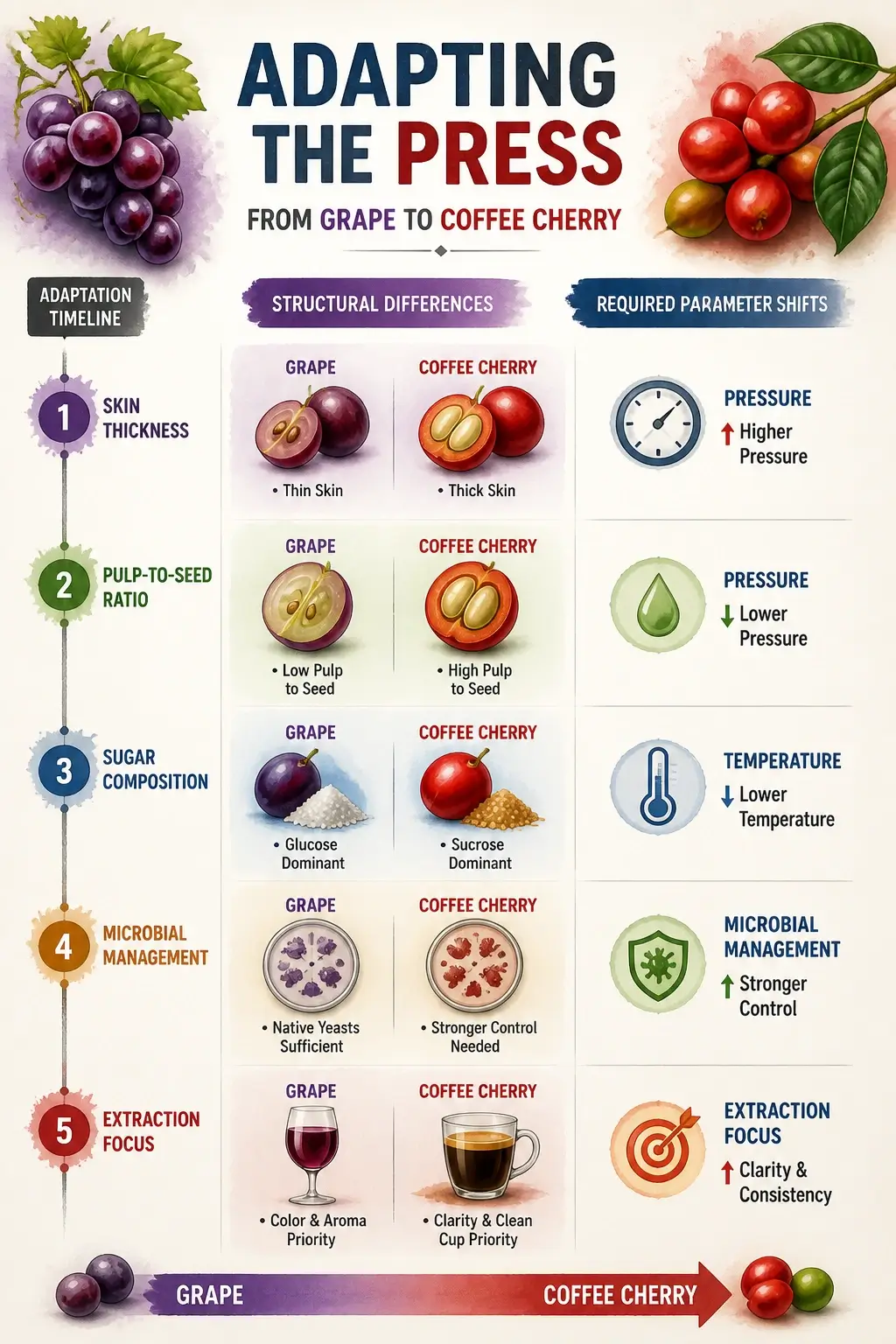
Coffee cherries and wine grapes share almost nothing structurally relevant to carbonic maceration beyond being fruit. Grapes are thin-skinned, high-moisture berries where the target product is the liquid pressed from the flesh. Coffee cherries are thick-walled fruits with a distinct mucilage layer, a parchment skin, and an internal seed – the coffee bean – that is the actual product. The flesh is discarded. The liquid is irrelevant.
This inversion creates a fundamental design problem. Carbonic maceration in wine is optimized for liquid extraction from whole fruit. In coffee, you’re running the same intracellular fermentation process inside a fruit whose liquid you don’t want, hoping that the metabolic activity inside the cherry will alter the chemistry of the seed without damaging the parchment layer protecting it. The CO₂ tank parameters that work for Gamay grapes – pressure profiles, temperature ranges, duration – were developed for a different respiration rate, a different sugar composition, and a different structural target.
The microbial management dimension adds another layer of complexity. Coffee cherries carry native yeasts and bacteria that differ substantially from those on wine grapes. The metabolic byproducts of intracellular fermentation in a coffee cherry – the compounds that will eventually define the cup – are produced by a different microbial community acting on different substrates. The “inside-out” fermentation mechanism is the same in principle; the specific chemistry it produces requires entirely different control strategies.
The Innovation Gap No One Has Documented
The experimental work that bridged 1960s Beaujolais and early 2010s coffee processing exists in lived experience, not written history. The producers, agronomists, and forward-thinking collaborators who ran the early trials – adjusting CO₂ concentrations, testing cherry integrity under pressure, managing fermentation duration to protect the parchment – left no public paper trail.
Cross-source analysis of available coffee literature confirms this gap consistently. Sources like Swings Coffee explicitly note the missing step; others present the timeline without the bridge; some ignore the history entirely. What none of them provide is an account of how the translation problems described above were actually solved. The specific experimental work that made carbonic maceration viable for coffee cherries – the pressure profiles, the duration parameters, the microbial management strategies that replaced wine precedent – remains undocumented in any public source.
This is not a minor omission. It means that the public historical record of carbonic maceration in coffee is built on a foundation with a deliberate gap where its most technically significant chapter should be. The knowledge almost certainly exists – in the hands of the producers who ran the early experiments – but it has not entered the documented record. What the history can offer is the known technical problems. The known solutions remain proprietary, informal, or simply unwritten.
Saša Šestić and the 2015 World Barista Championship Breakthrough
Saša Šestić did not invent carbonic maceration coffee. What he did in 2015 was prove publicly – at the highest competitive level in specialty coffee – that the technique could produce a cup profile that outscored everything else in the room. That distinction matters enormously for how the history should be read.
Šestić came to the 2015 World Barista Championship with a processing background that went beyond competition preparation. His work with origin partners had already engaged him with experimental post-harvest methods, and the coffee he presented had been processed using a carbonic maceration protocol – specifically, a 50% natural / 50% washed carbonic maceration blend that has since become the most-cited detail in the technique’s coffee history. He won.
What the win proved was not that carbonic maceration worked – that had been established in wine for decades. What it proved was that carbonic maceration coffee could score at the highest competitive level, that its defining flavor profile (high sweetness, bright fruit acidity, low astringency) had jury appeal, and that the technique was ready for the specialty coffee spotlight. The 2015 championship was the public validation event that catalyzed industry adoption. Before it, carbonic maceration coffee was experimental and largely invisible. After it, it was a recognized category.
For anyone wanting to understand the biochemical engine behind what Šestić presented on that stage, the scientific basis of intracellular fermentation explains the cellular mechanisms that produce the flavor compounds his competition coffee expressed.
The 50/50 natural-washed ratio is worth examining for what it represents in the historical record. It is the only specific process parameter consistently cited across blog sources covering the Šestić breakthrough. Every other variable – tank pressure, CO₂ concentration, fermentation duration, temperature profile – remains undocumented in public coffee literature. The most pivotal moment in carbonic maceration coffee history is built almost entirely on secondary reporting; no source provides a direct link to Šestić’s competition documentation, his process notes, or any first-person account of how the coffee was produced. The historical record here deserves epistemic humility: this is what was reported, not what was documented at source.
What 2015 represents is a catalyst year, not an origin year. The technique did not begin with Šestić. It arrived at its public breakthrough through him.
After 2015: What the Adoption Story Leaves Out
Carbonic maceration coffee expanded rapidly after 2015. It appeared on specialty roaster menus, in auction lots, and in competition routines globally. The flavor identity became codified: high sweetness, bright fruit acidity, low tannin, with descriptors like cotton candy, orange creamsicle, and red berry appearing consistently across tasting notes. Sealed, CO₂-flushed tanks became the recognizable production signature, and the “inside-out fermentation” framing became standard industry shorthand for a technique that most consumers encountered through its outputs rather than its mechanics.
The enthusiasm in the public record is genuine and not misplaced. The technique works. The flavor profiles it produces are real, reproducible under the right conditions, and commercially valuable at the specialty tier. For a complete picture of where the technique stands today – its process variables, its market positioning, and its applications across different origins – the complete guide to carbonic maceration coffee covers the production landscape in full.
What the public record does not contain is the harder data. No major coffee source provides quantitative figures on adoption rates, price premiums at auction, batch failure rates, or the capital investment required for sealed-tank infrastructure. The post-2015 narrative is anchored to sentiment – “still evolving,” “one of the most innovative frontiers” – not evidence. The enthusiasm is understandable; the absence of critical data is a structural problem in how the industry has documented its own technique.
The risks that exist are real and specific. A peer-reviewed study published in Heliyon examining the effect of processing method on heavy metal availability in specialty coffee found that cadmium levels were highest in Guatemalan green coffee processed via carbonic maceration, reaching 0.062 mg/kg – a statistically significant finding (p < 0.001) that the authors link directly to the post-harvest technique. Their conclusion is measured but clear: monitoring heavy metal concentrations matters when adopting emerging processing methods like carbonic maceration, and the interaction between fermentation conditions and mineral uptake into the seed is not yet fully characterized. No coffee blog source covering carbonic maceration addresses this finding.
Beyond heavy metal monitoring, the documented risks of spoilage from improper seal integrity, contamination from uncontrolled fermentation, and batch-to-batch consistency failures are entirely absent from the public coffee narrative. The record is systematically one-sided – not because producers are hiding failures, but because the industry media covering carbonic maceration has never been structured to report them.
The century-plus journey from Pasteur’s anaerobic observation to Šestić’s competition stage reveals something important: carbonic maceration succeeds under specific, repeatable conditions – anaerobic integrity, CO₂ saturation, and disciplined microbial management. Those conditions did not become easier to meet after 2015. The barriers that made the wine-to-coffee translation so difficult did not dissolve when the technique became fashionable. Understanding the actual history of carbonic maceration – including its gaps, its disputes, and its still-undocumented risks – is what separates professionals who use the technique from professionals who understand it.
Key Takeaways on the History of Carbonic Maceration Coffee
- Louis Pasteur documented intracellular anaerobic fermentation in 1872, but his observation was never developed into a winemaking protocol.
- Michel Flanzy’s 1934 work formalized carbonic maceration as a transferable technique; Pasteur observed the phenomenon, Flanzy engineered the method.
- The Beaujolais Nouveau era proved carbonic maceration was commercially scalable decades before coffee producers attempted the translation.
- The structural and biochemical differences between wine grapes and coffee cherries required solving translation problems that wine science never addressed – and that public coffee literature still hasn’t documented.
- Saša Šestić’s 2015 WBC win was a catalyst event, not an origin point; the 50/50 natural-washed blend remains the only publicly documented process parameter from that breakthrough.
- The post-2015 adoption narrative omits failure rates, capital barriers, and documented risks including heavy metal concentration effects confirmed by peer-reviewed research.
Frequently Asked Questions About the History of Carbonic Maceration Coffee
Did Pasteur actually intend his 1872 observations to apply to winemaking?
No – Pasteur’s documentation of intracellular fermentation was a scientific observation within his broader microbiology research, not a winemaking proposal. The application to controlled wine production came sixty years later through Flanzy’s independent engineering work.
Why does coffee literature almost never mention Pasteur in the carbonic maceration origin story?
Because the coffee industry inherited the technique through wine practitioners and secondary sources that already centered Flanzy as the origin point. Pasteur’s foundational observation had been filtered out of the transmission chain long before coffee writers picked up the story.
What specifically makes carbonic maceration harder to run on coffee cherries than on wine grapes?
Coffee cherries have thicker skins, a mucilage layer, and a parchment-protected seed that is the actual target product – not the fruit’s liquid. Running intracellular fermentation inside a fruit you intend to discard, in order to alter the chemistry of the seed inside it, requires entirely different pressure profiles, duration parameters, and microbial management strategies than wine production demands.
Is the 50/50 natural-washed ratio Šestić used in 2015 a recommended starting point for producers?
It’s the only publicly documented parameter from his competition routine, but it reflects a specific coffee, origin, and competition context. Treating it as a universal protocol would be a misreading of the historical record – it’s a data point, not a formula.
How long did it take for carbonic maceration to move from wine to specialty coffee after Flanzy’s 1934 work?
Roughly eight decades. Flanzy formalized the technique in 1934; Beaujolais Nouveau validated it commercially in the 1960s–70s; Šestić’s 2015 WBC win catalyzed its recognition in specialty coffee. The gap reflects real structural translation barriers, not slow awareness.
Are there documented risks to carbonic maceration that producers should know about before adopting the technique?
Yes. Peer-reviewed research has found statistically significant differences in heavy metal concentrations – specifically cadmium – in green coffee processed via carbonic maceration compared to other methods. Spoilage from seal failure and batch inconsistency are also known risks, though they remain largely absent from public coffee media coverage.
Why is the experimental work that bridged wine carbonic maceration to coffee processing undocumented?
It was almost certainly conducted by individual producers and agronomists working outside academic or media documentation – through trial-and-error at origin, informal knowledge exchange, and proprietary process development. That kind of knowledge rarely enters the written record until it’s already been commercialized.
Does understanding carbonic maceration’s history actually change how you should use it?
It should. Knowing that the technique’s translation from wine to coffee involved unsolved structural problems – and that the public record still lacks failure data, economic benchmarks, and full process parameters – means approaching it as applied biochemistry with known gaps, not as a proven plug-and-play method.
References
- Effect of processing method (natural, washed, honey, fermentation, maceration) on the availability of heavy metals in specialty coffee | pmc.ncbi.nlm.nih.gov
- The Science Behind Carbonic Maceration: Intracellular Fermentation Explained | coffeefactz.com
- The Complete Guide to Carbonic Maceration Coffee: Process, Science, and Market | coffeefactz.com