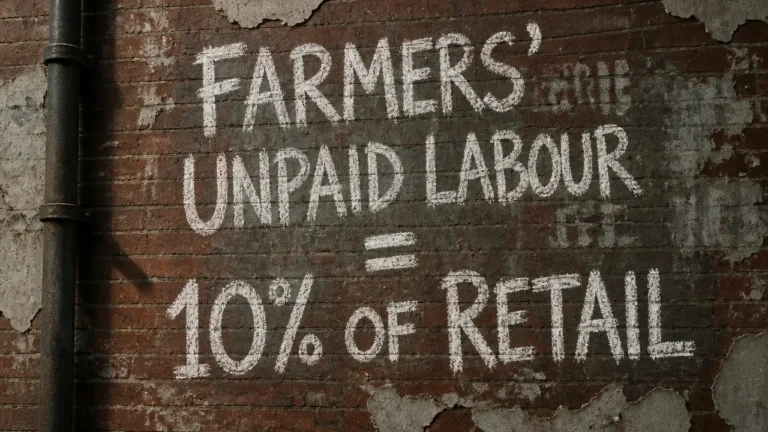

Unpaid family labour is effectively underwriting the global coffee trade, the new Coffee Barometer 2026 warns, with farmers’ households shouldering around 10% of the retail cost of a pack of coffee while producer incomes remain below living income benchmarks. The 20-year edition of the report was officially launched on June 10, 2026, in Milan, Italy, at a Comunicaffe event, according to Solidaridad Network and Comunicaffe.
The Coffee Barometer 2026, produced by a consortium including Conservation International, Ethos Agriculture, Solidaridad Network, and VOCAL Network and supported by the German Federal Ministry for Economic Cooperation and Development, estimates there are approximately 12.5 million smallholder farming households in coffee, most cultivating less than two hectares, as reported by Fresh Cup and the report itself. In their introduction to the Barometer, lead author Sjoerd Panhuysen and co-author Frederik de Vries state that producer incomes still fall below living income benchmarks, labour is poorly rewarded, climate vulnerability is deepening, and most value is captured downstream rather than in producing countries, according to Comunicaffe’s summary of the report.
Solidaridad Network reports that unpaid labour by farmers’ families effectively subsidizes 10% of the retail price of coffee, and describes the global coffee trade as being characterized by short-term transactions, volatile prices, and risk concentrated at origin. The Barometer’s authors argue in the report that the current value chain denies farmers the stability required to plan, invest, and withstand future shocks, according to the Coffee Barometer 2026 PDF.
Price movements over the past two years have added to that instability. The Coffee Barometer notes that the International Coffee Price Index (I-CIP) fell to 273.70 cents per pound in early to mid‑2026, more than 22% below previous highs, following a sharp correction from historic highs reached during the 2025 price cycle, according to the report PDF. Even during that record price cycle, higher market prices translated unevenly into farmgate incomes while input costs continued to rise, the Barometer states, as summarized by Comunicaffe.
Over the two decades since the first Coffee Barometer, the structural conditions shaping the sector have remained largely unchanged, Panhuysen and de Vries write in the 2026 edition, cited by Comunicaffe. They conclude that sustainability commitments have multiplied during this period without being matched by systemic reform, and that the sector has repeatedly treated structural problems as technical fixes and market failures as issues to be solved at farm level, according to Fresh Cup’s coverage of the report.
One area of focus in the 2026 Barometer is how major companies approach sustainability claims. Fresh Cup reports that 15 of the biggest coffee companies were asked to share information on sourcing, living income targets, and sustainability investments, with the authors finding what they describe as a stark lack of transparency. The same article notes that voluntary sustainability programmes have improved some conditions at farm level but have failed at scale, and that certification results are characterized as “mixed” by Panhuysen and de Vries.
Against this backdrop, Fresh Cup reports that many large companies have introduced in‑house sustainability programmes they view as more efficient, adaptable, and easier to control than third‑party alternatives. Starbucks, for example, reports that 99.75% of its coffee is ethically sourced through its own C.A.F.E. Practices programme, according to the same Fresh Cup article.
Panhuysen and de Vries argue in the Barometer’s conclusion that the choice facing the sector “is not between sustainability and profitability,” but between models that merely manage the appearance of progress and those that accept the redistribution of value they say a resilient coffee future requires, as quoted by Fresh Cup. In the report’s launch communication, Solidaridad Network highlights the authors’ central conclusion that “sustainability cannot be built on permanently cheap coffee.”