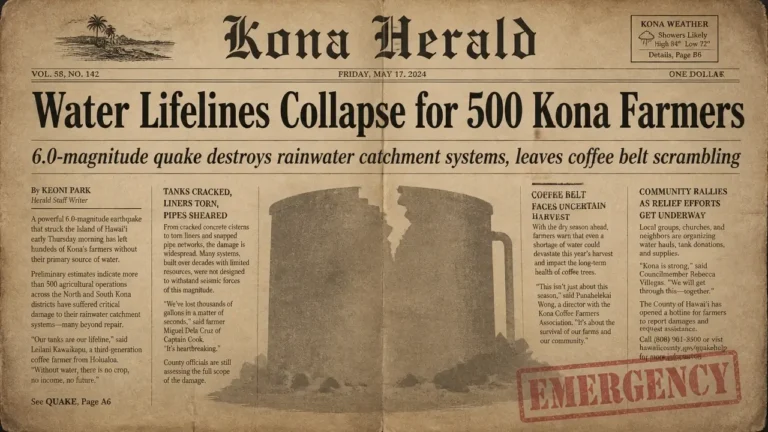

A late-night earthquake in South Kona on Hawaiʻi Island has left the heart of the Kona coffee belt scrambling for water, after a 6.0-magnitude quake on May 22 destroyed rainwater catchment systems and cut primary water access for up to 500 farmers and residents, according to reports from Civil Beat and Readers ID.
The quake struck shortly before 10 p.m. local time, with an epicenter about eight miles south of Hōnaunau-Nāpoʻopoʻo on the west flank of Mauna Loa at a depth of 14 miles, according to coverage from Daily Coffee News and Sprudge. The Hawaii County Civil Defense Agency told Daily Coffee News it had logged 207 damage reports concentrated in the rural districts of Kaʻū, North Kona, and South Kona, while Hawaii News Now later cited 463 reports, with 18 homes destroyed and 60 suffering major damage.
For many Kona coffee growers living uphill from the coastal highway, rainwater catchment tanks are the only running water source for homes and farms. Civil Beat and Readers ID reported that up to 500 people lost this lifeline when liners ripped, concrete rings failed, and entire tanks collapsed under the shaking. South Kona farmer Linda Grimes told Daily Coffee News that the cement rim around her tank “exploded, punctured the liner and flooded everything,” costing her more than 9,000 gallons of stored water in an instant.
Corey Yeaton, owner of catchment supplier Pacific Blue Catchment, described to Hawaii News Now one failure where a 25,000–30,000 gallon tank “created literally an Amazonian river” when it let go all at once. In another case he cited, a rusty tank released about 20,000 gallons underground when the liner failed. Hawaii News Now reported that Yeaton’s company received more than 150 calls after the quake, with 80 customers already queued for new liners or tanks, while Readers ID noted that two main catchment sellers in the area had about 200 calls each, with one company flying workers from the island of Oʻahu to keep up.
Kanalani Ohana Farm coffee grower Colehour Bondera told Daily Coffee News that his family now has to rebuild a roof over their surviving tank but “do not have the money to invest in making that happen.” Speaking to Readers ID, he said neighbor farms “are doing the same or worse,” with many losing liners or complete tanks and not enough labor available to restore systems quickly. He added that, from his view, county and state authorities were “not helping with immediate labor needs to get operations back to pre-earthquake capacity.”
Accessing replacement water has become a daily burden for older farmers on fixed incomes. Hawaii Public Radio and Civil Beat reported that 71-year-old coffee farmer KayLynne Santana and her 80-year-old husband now drive several miles to fill a 275-gallon plastic tote, a supply that lasts only three days at their Hōnaunau farm. Hawaii Public Radio said Santana expects to pay between $40,000 and $50,000 to rebuild a damaged retaining rock wall on the property.
County officials have set up limited stopgaps. Hawaii News Now reported that Hawaii County dispatched a 2,000-gallon water tanker to the coastal village of Miloliʻi, while Readers ID noted that public spigots at Hōnaunau Rodeo Arena have been opened daily from 7 a.m. to 1 p.m. for residents hauling water by truck and container. At the same time, Hawaii News Now reported that the county may not meet the federal threshold needed for a major disaster declaration, prompting Mayor Kimo Alameda to tell Readers ID that the county is acting as a “middle person” and is “exploring opportunities for funding” with the state.
The financial strain comes on top of other recent shocks. Daily Coffee News reported that so-called “Kona low” storms in March caused an estimated $40 million in damage to Hawaiʻi agricultural lands before the quake hit. The same report noted that Big Island coffee farmers are already contending with coffee leaf rust, coffee berry borer, and rising production costs, while many older producers lack earthquake insurance coverage.
Emergency cost-share support through the United States Department of Agriculture’s Emergency Conservation Program, which can cover up to 75% of allowable conservation structure costs (or 90% for limited-resource producers), had not yet opened for earthquake-related losses as of early June, according to Hawaii Public Radio. Acting Farm Service Agency director Keadin Fujii told the station he expected approval “in the next few weeks,” while Daily Coffee News reported that local coffee associations have begun circulating links to county damage-report forms and federal aid resources to affected growers.