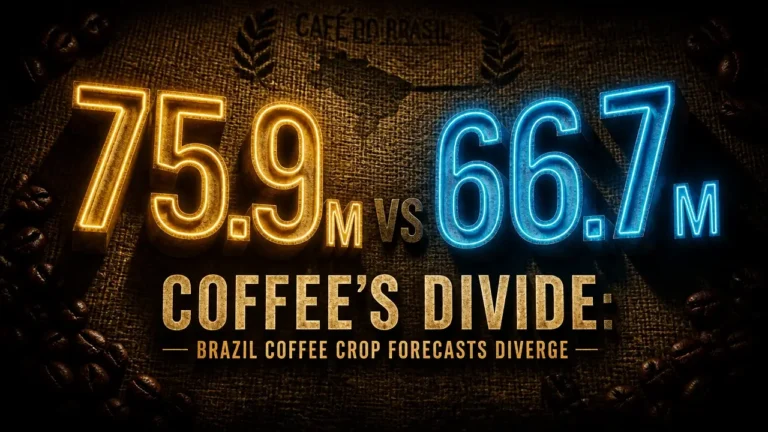

Competing forecasts for Brazil’s 2026/27 coffee crop are widening, with estimates for the world’s largest producer ranging from 66.7 million to 75.9 million 60‑kg bags just as global futures prices hit multi‑month lows. The divergence is sharpening debate over how large a surplus the market will face in the next cycle.
On April 29, Coffee Trading Academy (CTA) released a farmer‑based survey suggesting Brazil’s 2026/27 crop will reach a record 71.4 million bags, an 11.5% year‑on‑year increase, according to a report from KELO-AM. CTA’s survey of 758 farmers across all producing regions projected arabica output at 47.9 million bags, up 13.5% from the previous season, and robusta at 23.5 million bags, up 7.6%.
The CTA survey also captured on‑farm conditions behind those figures. KELO-AM reported that 63.5% of Brazilian farmers surveyed said off‑season rain had a major positive impact on their crops, and that fertilizer application rose 5.4% compared with the previous season. Total coffee acreage was estimated to have expanded 2.97% year on year, with arabica area up 2.7% and robusta up 3.6%.
Official Brazilian agency CONAB has issued a lower figure. In late May, CONAB’s crop monitoring manager Fabiano Vasconcellos placed Brazil’s 2026 coffee crop at 66.7 million bags, 18% higher than the previous year, according to Global Coffee Report. CONAB’s breakdown pointed to 45.8 million bags of arabica, a 28% year‑on‑year increase, and 20.9 million bags of robusta, up 0.8%.
International agencies and trading houses are generally more bullish than CONAB. On June 3, the United States Department of Agriculture’s Foreign Agricultural Service (USDA FAS) forecast Brazil’s 2026/27 crop at 71.9 million bags, a 14% year‑on‑year rise, Barchart reported. Earlier private‑sector estimates cited by Barchart were higher still: Marex Group at 75.9 million bags, Sucafina at 75.4 million bags (a 15.5% increase from the previous season), and StoneX at 75.3 million bags.
The scale of these records is also disputed by Brazilian producers. In a June 2 article from Fresh Cup, Juliana Paulino, president of the Coffee Growers Association in Southwestern Minas Gerais, said “the harvest will be good but will not exceed the historic 2020 harvest” when responding to record crop forecasts. Fresh Cup noted that the C price had hit record highs in 2025 due to climate extremes, tariffs, and geopolitical factors, and that futures had been falling for months.
At the global level, surplus projections have increased alongside the higher Brazilian numbers. Barchart reported that Rabobank now anticipates a 9.5‑million‑bag arabica surplus in 2026/27, raising its estimate from 7.0 million bags, while StoneX has forecast a 10‑million‑bag global coffee surplus in 2026, described as the largest in six years.
Despite expectations of greater supply, inventory data and agency commentary point to ongoing tightness. Barchart noted that certified stocks on the ICE exchange fell to 3.75‑month lows for arabica at 427,840 bags on June 3 and to two‑year lows for robusta at 3,631 lots on May 15. Global Coffee Report cited CONAB as saying that no significant price reductions are expected, referring to low stocks and projecting global coffee demand growth of 1.3% to 173.9 million bags.
Price moves on futures markets have nonetheless been sharply lower. Barchart reported that on July 3, July arabica futures (KCN26) closed down 2.35% at a 1.5‑year nearest‑futures low, while July robusta (RMN26) fell 2.63% to a seven‑week low, and stated that “Coffee prices have ratcheted lower over the past six weeks.” Vietnam.vn said that in the week ending June 5, arabica prices fell 7.2% to 246.5 US cents per pound, a 19‑month low, and robusta dropped 4.6% to $3,316 per ton.
In Vietnam, the world’s second‑largest producer, the combination of ample supply and weaker international prices has filtered into domestic markets. Vietnam.vn reported that coffee exports in the first eight months of the 2025/26 crop year were about 25% higher year on year, and that the Vietnam Statistics Office expects 2025/26 production to rise 6% to 1.76 million metric tons, equivalent to 29.4 million bags, according to Barchart. Vietnam.vn added that bulk green bean prices around June 8 were approximately 85,500 Vietnamese dong per kilogram, down 2,000 dong week on week, with trading described as quiet as farmers held back stock.
Even with these developments, USDA FAS figures compiled by Barchart show that global coffee production for 2025/26 is projected at a record 178.848 million bags, while ending stocks are forecast to decline 5.4% to 20.148 million bags, underscoring that the balance between rising output and available inventories remains finely measured.