

Famous literary cafes didn’t just serve coffee, they fostered entire intellectual movements. From the smoke‑hazed velvet booths of Les Deux Magots, where Sartre and de Beauvoir rewrote Western thought between espressos, to the gilded excess of Budapest’s New York Café, where novelists wrote under chandeliers because they couldn’t afford heat at home, these spaces were something rarer than restaurants.
They were pressure chambers. The right marble table, the right ambient noise, the right sense of being among people who also refused ordinary lives — and the page stopped being blank.
The Writer’s Office: How Cafés Became Creative Sanctuaries
Famous literary cafés didn’t become legendary by accident, they solved a specific, grinding problem that writers faced every day. The café stepped in as the one place that offered warmth, light, a flat surface, and no landlord standing over your shoulder, turning an ordinary table into the most productive workspace a writer on a tight budget could find.
To understand why, you have to picture where most writers actually lived.
The Cramped Reality Behind the Romantic Myth
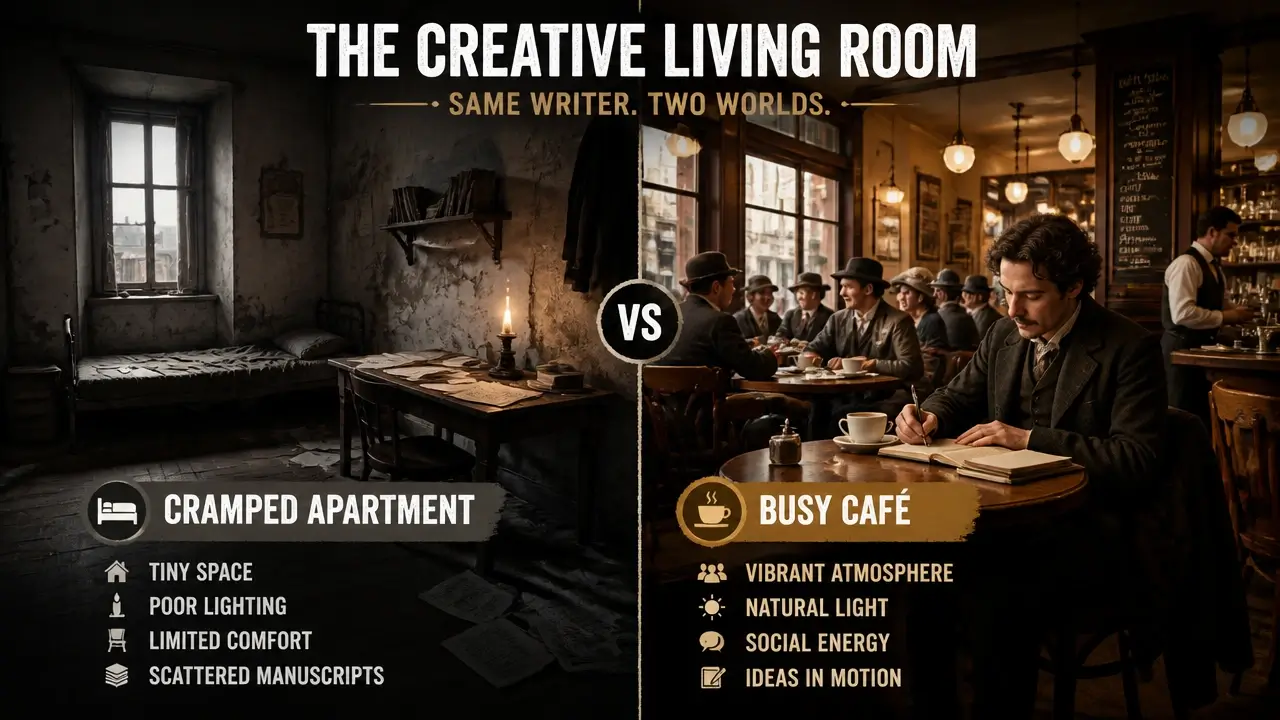
In 19th‑ and early‑20th‑century Paris, Vienna, or Budapest, a writer’s apartment was rarely the candlelit study we picture. It was more likely a single rented room — poorly heated, dimly lit by a small window, and shared with enough furniture to make pacing impossible. There was no space to spread out manuscripts, no way to receive a colleague, and in winter, no reliable warmth. The idea of sitting down and thinking clearly in that environment wasn’t romantic. It was genuinely difficult.
The café solved every one of those problems in a single step. One coin bought you a coffee, and that coffee bought you the table — the heat from the stove, the gas lamps overhead, and as many hours as you needed. No lease. No landlord. No cold.
The Intellectual Equalizer at the Corner Table
What made the café more than just a warm room was who else was sitting in it. These weren’t curated salons with velvet ropes and invitation lists. An exiled political journalist, a local poet, a celebrated novelist, and a philosophy student could end up at neighboring tables on the same Tuesday afternoon — and frequently did.
That accidental proximity mattered. Ideas cross‑pollinated not through formal debate but through overheard arguments, borrowed newspapers, and the slow drift of conversation from one table to the next. The café was an intellectual equalizer in the most literal sense: the price of admission was the same for everyone, and the conversation didn’t care about your credentials.
The Surrealists understood this. They didn’t draft their manifestos in isolation — they hammered them out over espresso, in public, with the noise of the room pressing in on all sides. The friction of other people’s thinking sharpened their own.
Ernest Hemingway captured the texture of this workspace better than any historian could. In his posthumously published memoir A Moveable Feast (1964), he wrote:
“It was a pleasant cafe, warm and clean and friendly, and I hung my old raincoat on the hanger to dry and put my worn felt hat on the rack above the bench and ordered a cafe au lait. The waiter brought it and I took out a notebook from the pocket of my coat and a pencil and started to write.”
Notice what he doesn’t describe: silence, solitude, or a room cleared for concentration. The café worked because of its texture, not in spite of it. The warmth, the ritual of ordering, the ambient hum — all of it signaled to the brain that it was time to work.
Why the Hum Helped More Than the Quiet
Here’s where the popular travel‑guide version of this story quietly gets it wrong. The image it sells — the solitary genius hunched over a notebook in atmospheric silence — is a myth assembled after the fact to make the pilgrimage feel more poetic.
The historical record says something different. The best work happened in the hum. Conversation wasn’t a distraction from the creative process; it was part of the raw material. Writers weren’t hiding from the world in these cafés. They were plugging directly into it.
That distinction matters because it reframes what made certain cafés genuinely special. It wasn’t the quality of the coffee or the beauty of the interior. It was the specific density and chemistry of the people who kept coming back — the regulars who turned a public room into something that functioned like a shared creative office.
This pattern wasn’t a Parisian quirk. From Vienna to Rome to Buenos Aires, wherever writers clustered in cities, a café eventually became their unofficial headquarters. The conditions that created it were the same everywhere: cheap rent on a table, heat, light, and the right crowd. What separated the legendary ones from the merely convenient — that’s where the story gets interesting.
What Makes a Literary Café Different
A literary café is a coffeehouse that functions as a cultural salon — a public space where intellectuals, writers, and artists gather not just to drink but to debate, share unfinished work, and argue ideas into existence. That definition sounds simple, but the mechanics behind it are surprisingly specific.
Think of it less like a coffee shop and more like a living room that nobody owns. The best ones shared a tight cluster of traits: a central, walkable location that made dropping in frictionless; prices low enough that a writer could nurse a single cup for three hours without guilt; and an unspoken house rule that lingering was not just tolerated but expected. That combination — affordable access plus time — is the actual engine. It let a critical mass of creative regulars build up over months and years until the café itself became a reason to show up, independent of any single person.
Once that mass forms, the space starts doing three distinct things at once.
| Role | Primary Purpose | Typical Regulars | Historical Outcome | Representative Cafés |
|---|---|---|---|---|
| Creative Living Room | A third place for long, informal, repeat gatherings where people can work, talk, and belong outside home and office | Writers, artists, editors, students, musicians | Enduring literary communities, collaborations, essays, poems, and manifestos shaped by sustained conversation | Café de Flore, Les Deux Magots, Café Central |
| Birthplace of “‑isms” | A site where new schools of thought, styles, and movements are argued into existence | Avant‑garde writers, philosophers, artists, critics, radicals | Named movements and manifestos — Surrealism, Existentialism, Dada — associated with modern intellectual life | Café de Flore, Café Procope, Café Central |
| Intellectual Equalizer | A public space where rank softens and people of different classes debate as near‑equals | Writers, journalists, merchants, politicians, students, reformers | Cross‑class debate normalized, public opinion sharpened, civic networks generated | Café Procope, Café Central, Café de Flore |
The most powerful famous literary cafés pulled off all three simultaneously. A writer could sit next to a philosopher, argue with a painter, and leave with a manifesto half‑drafted on a napkin — and nobody checked credentials at the door.
Some of these spaces eventually stopped leaving their identity to chance. Certain cafés formalized their literary culture by establishing prizes, hosting regular readings, or sponsoring events — a signal that what looked like a happy accident was, at some point, a deliberate institutional choice. The café wasn’t just a backdrop. It was an active participant in the culture it hosted.
UNESCO captured this quality precisely when it registered Viennese Coffee House Culture on its Intangible Cultural Heritage List in 2011, describing these spaces as:
“characterized by a very special atmosphere… where time and space are consumed, but only the coffee is found on the bill”
That phrase — time and space are consumed — is the whole point. The intellectual and coffee culture of these places gave writers something money couldn’t easily buy elsewhere: unstructured, unhurried hours in a room full of people who took ideas seriously.
Here’s the honest caveat, though. The label “literary café” has never been backed by anything resembling an objective standard. Travel guides and cultural lists built the entire canon on famous‑name association — Hemingway sat here, Sartre wrote there — without any real proof that those venues contributed more to literature than dozens of forgotten establishments that served the same coffee to the same kind of people. What we have is a curated set of legends, not a historically rigorous ranking.
That’s not a reason to dismiss them. It’s a reason to visit them differently — not as verified monuments to documented genius, but as invitations into a story. The imaginative connection is the real thing on offer, and that turns out to be worth quite a lot.
Paris’s Left Bank Duel: Les Deux Magots vs. Café de Flore
Two famous literary cafés sit directly across from each other on Boulevard Saint‑Germain — and between them, they hosted the intellectual engine of the 20th century. Les Deux Magots and Café de Flore weren’t just places writers happened to drink coffee. They were the offices, the debating halls, and the living rooms where Existentialism got argued into existence, one espresso at a time.
Les Deux Magots: The Open Terrace
Step inside Les Deux Magots and the first things you notice are the two wooden Chinese mandarin statues mounted high on the interior columns — the “deux magots” the café is named for, staring down at the room with the detached calm of figures who’ve heard everything. The wide terrace spills onto the boulevard, open to the morning light and the foot traffic of Saint‑Germain‑des‑Prés. It has the feel of a brasserie built for watching: broad, warm, a little theatrical. Ernest Hemingway understood this instinctively. He’d arrive early, order a café crème, and sit with the steam rising off the cup while Paris walked past him — not hiding from the world, but reading it like a manuscript.
Café de Flore’s Red‑Booth Office
Cross the street and the atmosphere shifts. Café de Flore has art deco lines, tighter proportions, and those iconic red booths that turn the interior into something closer to a private club. It’s the kind of room that makes you want to stay. Jean‑Paul Sartre and Simone de Beauvoir didn’t just want to stay — they effectively moved in.
Jean‑Paul Sartre, the Nobel Prize‑winning French philosopher, playwright, and leader of the existentialist movement, described his daily life at Flore with a precision that makes it sound less like a café habit and more like a structured work arrangement:
“We were completely settled there: from nine o’clock in the morning until noon, we wrote, then we went to lunch, at two o’clock we came back and talked with friends we met until eight o’clock… After dinner, we received people we had made appointments with. It may seem strange to you, but we were at home in the Flore.”
That’s not a romantic exaggeration — that’s a schedule. Sartre and de Beauvoir were writing Being and Nothingness, drafting plays, and building the philosophical architecture of Existentialism from a corner booth. The university lecture hall had nothing to do with it.
James Baldwin and the Weight of Sanctuary
The Left Bank’s pull wasn’t only philosophical. For James Baldwin, arriving in postwar Paris, Les Deux Magots and Café de Flore offered something America hadn’t: the basic dignity of being left alone to think. The racial violence and social suffocation he’d experienced in the United States had no equivalent in Saint‑Germain’s café culture. He could sit, write, and be seen as a writer first. That kind of sanctuary has its own creative physics — when the ambient pressure drops, the work comes out differently.
What Existentialism Actually Owes to Coffee
It’s worth pausing on what was really happening at these tables. Existentialism — the philosophical tradition that reshaped how the 20th century understood freedom, responsibility, and the self — didn’t emerge from isolated scholars working in quiet studies. It was a conversational philosophy, built through argument, pushback, and revision in real time. The café provided the friction. You couldn’t write a chapter, close the notebook, and disappear. Your interlocutors were three feet away. De Beauvoir would challenge a premise before the ink dried. That productive pressure is baked into the work itself.
The Prix des Deux Magots, a literary prize awarded annually since 1933, is the most concrete evidence that the café’s relationship with literature was never just atmosphere. The prize is still given today, voted on by a jury that meets — where else — at the café. The institution outlasted the movement it helped incubate.
Video: Walkthrough of Les Deux Magots and Café de Flore in Paris
Vienna’s Café Central and the World of Ideas
Café Central didn’t just host great minds — it was their office, their postal address, and in some cases, their only reliable shelter from the cold. In the late 19th and early 20th centuries, this single vaulted hall in the heart of Vienna became a pressure cooker where psychoanalysis, revolutionary politics, and literary modernism all simmered at neighboring tables.
Walk in today and the room stops you. Soaring Gothic arches, polished marble columns, and chandeliers that throw a warm amber light across the stone floor — it looks more like a cathedral than a coffeehouse. That’s not an accident. As architectural historians at De Gruyter’s study of Viennese modernism document, Café Central’s cathedral‑like interior was precisely what enabled those interdisciplinary collisions — the space itself communicated that what happened here mattered. You didn’t come to grab a coffee and leave. You came to think, to argue, to belong.
And belonging was the whole point. Stefan Zweig, the Austrian novelist who watched this world from inside it, described what the Viennese coffeehouse actually was:
“The Viennese coffeehouse is a particular institution which is not comparable to any other in the world… It is actually a democratic club, open to everyone for the price of a cheap cup of coffee, where every guest can sit for hours with this little offering, to talk, write, play cards, receive post, and above all consume an unlimited number of newspapers and journals.”
That last detail matters more than it sounds. Unlimited newspapers. In an era before broadcast media, the coffeehouse was where you learned what the world was thinking — and then immediately argued about it with the person across the table.
Peter Altenberg’s Permanent Table
No one took the “second living room” idea more literally than Peter Altenberg, the Viennese poet and sketch writer who had his mail delivered directly to Café Central. Not to his apartment. To the café. His small bronze statue still greets visitors near the entrance today — a quiet joke and a genuine tribute, because Altenberg treated the marble‑topped tables as his desk, his parlor, and his anchor to the world. He wrote in compressed, almost aphoristic bursts, and the café’s ambient noise, the rustle of newspapers, the low murmur of argument, seemed to be the exact conditions his mind needed.
Trotsky’s Chessboard, Freud’s Table
The same room held very different kinds of work. Leon Trotsky used Café Central as his Vienna headquarters during his years in exile, hunched over a chessboard between sessions of writing revolutionary pamphlets. The De Gruyter volume on Viennese modernism documents his presence here as more than casual — the café functioned as his operational base, where chess and politics blurred into the same analytical exercise.
Sigmund Freud was a regular presence in the broader Viennese coffeehouse circuit, and Alfred Adler — whose split with Freud would reshape the trajectory of psychology — held court at Café Central itself, working through ideas about individual psychology in exactly the kind of open, argumentative environment the space invited. The cross‑pollination wasn’t metaphorical. These people were physically within earshot of each other.
Franz Kafka arrived quieter than all of them. Where Trotsky projected and Altenberg performed, Kafka read his fragile, unsettling drafts in corners, never the loudest voice in the room. He wouldn’t be, for decades after his death, the most recognized name either — and yet the one that would echo longest.
Myth, Marble, and What’s Actually True
Here’s where honesty serves the experience better than romance. Many of the precise anecdotes attached to Café Central — the specific corner where Kafka drafted a particular story, the exact table where Freud first articulated a concept — appear across guidebooks without a single primary citation. The claim that Kafka drafted The Metamorphosis at a particular spot is a good example: it’s everywhere, and sourced nowhere.
This isn’t unique to Vienna. It’s a pattern across famous literary cafés worldwide — stories repeated so many times they calcify into atmosphere. The myth becomes part of the walls. Recognizing that doesn’t flatten the experience; if anything, it sharpens it. You’re not just visiting a place where history happened. You’re visiting a place where a story about history was constructed and maintained, generation after generation. That’s its own kind of cultural artifact.
What is documented — the UNESCO recognition of Viennese coffeehouse culture as intangible heritage, the architectural record of the space, the verified presence of Trotsky, Adler, and the Young Vienna literary circle — is remarkable enough without the embellishments.
The famous literary cafés that endure longest aren’t the ones with the most verified anecdotes. They’re the ones whose atmosphere makes you want to invent new ones. Café Central is that kind of place. The marble still reflects the light the same way. The coffee still arrives on a small silver tray. And somewhere between the vaulted ceiling and the scratch of your pen on a notebook, you understand exactly why people never wanted to leave.
Italy’s Legendary Cafés and the Romantic Imagination
Famous literary cafés found their most sun‑drenched expression in Italy, where Caffè Greco in Rome and Caffè Gambrinus in Naples became essential ports of call for every Romantic poet, composer, and novelist making the Grand Tour. These weren’t accidental pilgrimages. The cafés offered something specific: a warm, civilized room where a foreign artist could sit for hours, order one coffee, fill a notebook, and feel, for a moment, like they belonged to something larger than themselves.
Caffè Greco’s Walls and the Grand Tour
Caffè Greco opened in 1760, tucked into a narrow street just off Rome’s Spanish Steps, and it has barely changed its face since. The red velvet banquettes still line the walls. Oil paintings hang in dense clusters, frame touching frame, the way a collector hangs things when the collection outgrows the space. Dark marble tables absorb the candlelight the way old stone absorbs heat — slowly, completely.
For a century and a half, this room was a mandatory stop on the Grand Tour. Lord Byron passed through. Percy Bysshe Shelley lingered over coffee while Rome hummed outside. John Keats, who died just a short walk away on the Piazza di Spagna, was a regular presence in these rooms during his final months in the city. Hans Christian Andersen was perhaps the most devoted of the lot — a gawky, enthusiastic figure filling notebooks in a corner, returning again and again as though the café were a well he needed to keep drawing from.
Nikolai Gogol, the Russian novelist who wrote large portions of Dead Souls while living in Rome, put it plainly in his personal letters:
“I can write only in Rome… My thoughts are clearer, and the air of Rome inspires me.”
Gogol wasn’t being poetic for its own sake. He was describing a real cognitive shift — what happens when a writer leaves the noise of their ordinary life and lands somewhere that asks nothing of them except to observe and think. Caffè Greco was where that shift became a daily practice.
When you visit today, look for the small brass plaques on certain tables marking a poet’s preferred seat. They’re easy to miss, but they’re there — a quiet way the café acknowledges that some guests left more than a tip behind.
Caffè Gambrinus and Naples’ Belle Époque Fire
Naples runs hotter than Rome, in every sense, and Caffè Gambrinus matches the city’s register perfectly. Founded in 1860 and expanded into its current Belle Époque form in the 1890s, it sits at the foot of the Piazza del Plebiscito, steps from the Royal Palace, with frescoed ceilings, gilded stucco work, and chandeliers that make ordering a mid‑morning espresso feel vaguely theatrical.
Franz Liszt was its most celebrated regular — a composer who understood spectacle and found the café’s grandeur entirely appropriate. Oscar Wilde came through. Gabriele D’Annunzio, the Italian poet and provocateur who treated public life as performance art, made Gambrinus part of his personal stage.
What made these two cafés genuinely extraordinary wasn’t just the famous names. It was the density of languages and cultures colliding inside them on any given evening. At the height of the Grand Tour, a typical night at Caffè Greco or Caffè Gambrinus might carry four to six languages across the room — Italian, French, English, German, Russian, etc. That kind of cross‑cultural friction is exactly where ideas mutate and sharpen. A Russian novelist overhears a French poet’s argument. A German composer watches an English lord hold court. Everyone is slightly outside their native context, which means everyone is paying closer attention than usual.
One practical note worth knowing before you visit either place: in Italy, the price of your coffee depends on where your body is. Drinking your espresso standing at the bar costs a fraction of the price of sitting at a table. At Gambrinus especially, the sit‑down experience carries a premium — but you’re paying for the ceiling as much as the coffee, and that ceiling has been inspiring people for over a century.
From Budapest to Buenos Aires: The Global Reach of Literary Café Culture
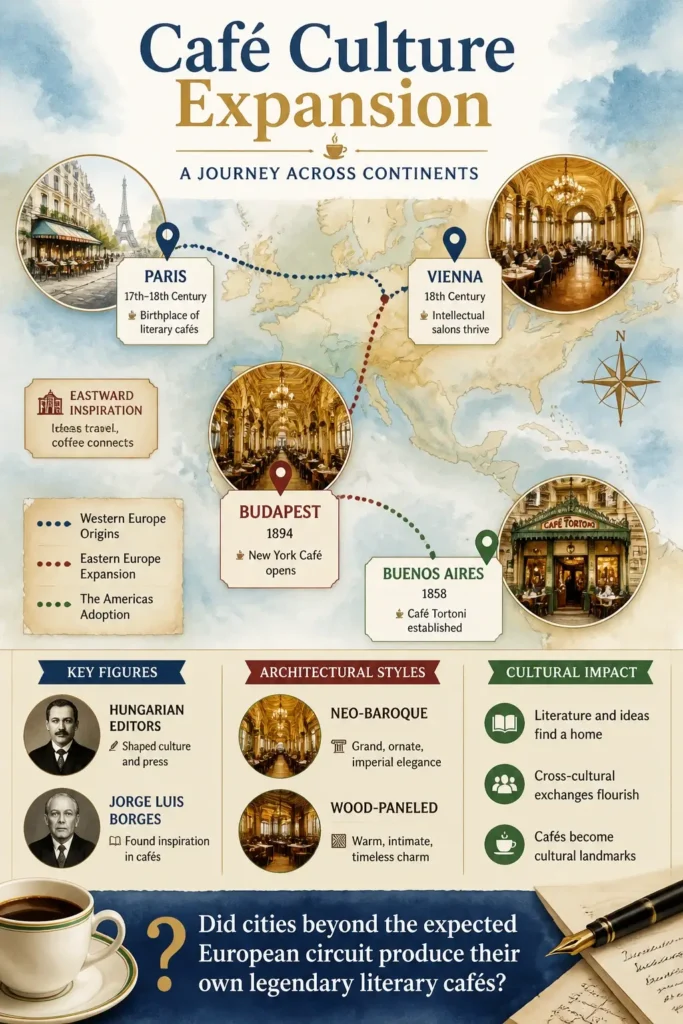
Famous literary cafés didn’t stop at the Seine or the Ringstraße. The same engine that made Paris and Vienna legendary — cheap rent on a marble table, a community of restless minds, and an atmosphere that treated ideas as currency — traveled east to Budapest and all the way across the Atlantic to Buenos Aires, where it took root in entirely different soil and grew into something distinctly its own.
The infographic below maps how that invisible logic spread:
New York Café and Budapest’s Literary Identity
Budapest’s New York Café, opened in 1894, is the kind of place that makes you stop walking and just stare. Neo‑baroque stucco climbs every wall. Crystal chandeliers hang from ceilings covered in painted frescoes. The whole room feels less like a coffeehouse and more like a gilded theatre where the performance never quite ended — because for Hungarian editors, poets, and novelists in the early twentieth century, it didn’t.
This was the room where modern Hungarian literature was argued into shape. Writers came not just to drink coffee but to exist as writers. The café gave them an address, a community, and a stage. The table was the desk. The conversation was the manuscript in progress.
That dynamic was something more than social. A peer‑reviewed analysis published in MDPI Religions on early‑20th‑century Budapest Jewish literature captures the mechanism precisely:
“Secular Jewish writers in Budapest went there for escaping economic reality while creating a virtual reality. Their identity as writers existed precisely because they went to the coffeehouse, where they wrote about the coffeehouse and formed a presence in the crowd and as writers.”
The café wasn’t just where they worked. It was what made them writers in the first place. The New York Café didn’t host a literary scene — it constituted one.
Café Tortoni and Borges’s Buenos Aires
Café Tortoni tells a different story with the same bones. Founded in 1858, it arrived in Buenos Aires wearing an Italianate coat — wood‑paneled walls, stained‑glass windows, deep leather armchairs worn smooth by generations of elbows. The architecture spoke European, but the soul that filled it was unmistakably Argentine: tango musicians, political debates that spilled past midnight, and writers who understood that a café table was the most democratic institution in the city.
The name most permanently woven into Tortoni’s identity is Jorge Luis Borges. The blind maestro of Latin American letters held court here regularly, his presence so consistent and so charged that the café absorbed it the way old wood absorbs smoke. You don’t visit Tortoni simply for the coffee. You visit because Borges sat in this room and built his labyrinths here, and something of that remains in the air — or at least, that’s what every reader who has fallen in love with his work comes hoping to find.
What links Budapest and Buenos Aires isn’t just the architectural grandeur, though both cafés wear it well. It’s the way a Viennese‑style coffeehouse became a Budapest landmark by filling its gilded frame with Hungarian literary identity, and the way an Italianate café became a Buenos Aires institution by letting Argentine culture reshape everything inside it. The European template traveled. What grew from it belonged entirely to where it landed.
Are These Cafés Still Writers’ Havens?
Famous literary cafés today occupy an honest paradox: they are living museums that charge museum prices, yet the pull they exert on a receptive visitor is not entirely manufactured. A simple espresso at Café de Flore or Caffè Greco can run three to five times the neighborhood average. On any given morning, more cameras come through the door than notebooks. That’s the reality, and there’s no point dressing it up.
But dismissing these spaces as overpriced tourist traps misses something real.
When you settle into a banquette at Les Deux Magots and a brass plaque tells you Sartre sat in this exact corner, something happens that isn’t purely sentimental. You are occupying the same physical coordinates as a person who changed how the world thinks. The room looks the way it did then. The light falls the same way. That kind of continuity has weight — not because the genius is contagious, but because the physical reminder collapses time and makes the act of writing feel less lonely and more possible.
The practical side of a visit is worth knowing before you go. In France and Italy, sitting at a table rather than standing at the bar can double the price of your coffee — that’s the cost of the chair, the view, and the unhurried hour. It’s worth paying once. Seek out the brass plaques that mark famous seats; not every café advertises them loudly, but they’re there. And check the calendar. The Prix des Deux Magots — a French literary prize awarded annually since 1933 — is still handed out at the café itself, proof that a thin but unbroken thread of intellectual life still runs through these walls. Similar events appear at other historic cafés throughout the year, and attending one shifts the experience entirely from tourist stop to living tradition.
What these spaces can no longer do is incubate the next movement. That work has decentralized. In Lisbon, Mexico City, and Chiang Mai, independent coffeehouses are running poetry readings, philosophy discussion groups, and writer residencies right now — no plaques on the walls yet, but the same essential transaction happening: people gathering with intention around a cup of coffee and an open mind. The spirit that made Café Central or Café Tortoni legendary wasn’t unique to those addresses. It was the combination of affordability, community, and the unspoken agreement that ideas were worth taking seriously.
Visiting the great literary cafés, then, is less about chasing a ghost and more about being reminded that the ghost was never really tied to the room. Creativity found its sanctuary in these places because people chose to show up and do the work. That choice is still available — in the gilded originals, yes, but equally in any quiet corner where a writer sits down, orders something warm, and starts.
Key Takeaways on Famous Literary Cafes
- Literary cafes thrived because they solved a practical problem: writers needed affordable warmth, light, and community, not just coffee.
- The most productive literary cafes were intellectual equalizers where rank softened and ideas cross-pollinated across classes and disciplines.
- The romantic image of the solitary writer in a cafe is largely a myth; collaboration and ambient noise were the real catalysts.
- Today’s historic literary cafes are beautifully preserved time capsules, but the living creative energy has moved to cheaper, less polished neighborhoods.
- The true legacy of these cafes is not the buildings but the model: any affordable, welcoming space can become a creative sanctuary.
Frequently Asked Questions About Famous Literary Cafes
Q: How did historic literary cafes stay in business if writers only bought one coffee?
A: They relied on other customers, food sales, and sometimes patronage. The writers were part of the draw; their presence attracted tourists and locals who spent more. Owners tolerated the lingering because it created the intellectual atmosphere that defined the brand.
Q: Why are there so few famous women writers associated with these cafes?
A: Social norms often excluded women from public spaces alone, and their literary contributions were historically undervalued. While some women like Simone de Beauvoir were central, the cafe culture was predominantly male-dominated, reflecting broader societal barriers rather than a lack of female talent.
Q: What ended the golden age of literary cafes?
A: World War II disrupted communities, and post-war economic shifts made real estate too valuable for lingering. Television and later the internet replaced the cafe as the primary social hub. Gentrification priced out the bohemians who once filled these rooms.
Q: How can I find a modern cafe with a similar creative community?
A: Look for independent coffeehouses in up-and-coming neighborhoods, not city centers. Check for event calendars: poetry readings, philosophy groups, or writer residencies. The key signs are affordable prices, communal tables, and a lack of pressure to leave.
Q: Did any famous writers dislike working in cafes?
A: Yes. Some, like Marcel Proust, famously wrote in bed in a cork-lined room to avoid noise. Others found cafes distracting. The myth that all great writers thrived in cafes ignores the many who needed solitude and silence to produce work.
Q: What’s the most exaggerated myth about a literary cafe?
A: The claim that Kafka wrote The Metamorphosis at a specific Cafe Central table is widely repeated but unsourced. Many such anecdotes were invented by cafe owners or guidebooks to attract tourists, blending fact with fiction to enhance the allure.
References
- Viennese Coffee House Culture – ich.unesco.org
- Viennese Modernism study – degruyterbrill.com
- The World of Yesterday – worldcat.org
- Jean-Paul Sartre – britannica.com
- Nikolai Gogol – en.wikipedia.org
- Poetry and Literature at the Gambrinus – grancaffegambrinus.com
- MDPI Religions article on Budapest Jewish literature – mdpi.com