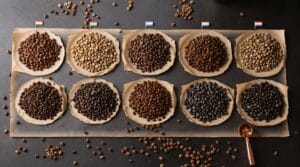

Brazil’s next coffee harvest is shaping up to be the most hotly debated crop in years, as official and private forecasts for the 2026/27 season span nearly 10 million 60‑kg bags and local growers strike a more cautious tone.
In April, the Coffee Trading Academy (CTA) projected Brazil’s 2026/27 crop at 71.4 million bags, an 11.5% increase from the previous season and a record, based on a survey of 758 farmers across all producing regions, according to Reuters reporter Marcelo Teixeira. CTA’s breakdown points to 47.9 million bags of arabica, up 13.5% year-on-year, and 23.5 million bags of robusta, a 7.6% rise.
Brazil’s government forecast is more conservative. The National Supply Company (CONAB) pegs the 2026/27 crop at 66.7 million bags in its second official estimate, an 18% year-on-year increase and itself an all-time high, according to Comunicaffe. CONAB’s figures include 45.8 million bags of arabica, up 28%, and 20.9 million bags of robusta (also known as Conilon), up 0.8%, as reported by Global Coffee Report.
International institutions are generally closer to the higher end. The US Department of Agriculture (USDA) estimates Brazil’s 2026/27 output at 71.9 million bags, including 47.5 million bags of arabica, a 25% increase, Comunicaffe reported. Risk manager Hedgepoint Global Markets goes further, projecting 75.8 million bags – 50.2 million arabica and 25.6 million robusta – citing “favorable weather throughout the crop development” and “increased area and investments in management” that “resulted in coffee plantations in excellent condition and supported the revision of production figures for the 26/27 season,” according to analyst Laleska Moda in Revista Cultivar. Rabobank adds yet another number, at 73.3 million bags, Fresh Cup reported.
Within Brazil, CONAB says total coffee area has increased 3.9% to 2.34 million hectares and that productivity is expected to reach a record 34.4 bags per hectare, according to Comunicaffe. CTA’s survey-based work similarly found total acreage up 2.97% year-on-year, with arabica area rising 2.7% and robusta 3.6%, Teixeira reported.
The CTA survey also highlights how growers themselves describe conditions. According to Teixeira, 63.5% of farmers said off-season rain had a major positive impact on their crops, and fertilizer application rose 5.4% from the prior season. These responses underpin CTA’s record forecast even as its earlier projections shifted from 73.7 million bags in July 2025 to 69 million bags in November 2025, before the April revision to 71.4 million bags.
Local voices on the ground, however, do not all echo the most optimistic figures. “The crop is in very good condition. The weather was favorable, with regular rainfall,” said Fabiano Tristão of the Capixaba Institute for Research, Technical Assistance and Rural Extension, speaking to Fresh Cup. In the same report, Juliana Paulino, president of the Coffee Growers Association in Southwestern Minas Gerais, offered a different perspective: “The harvest will be good. It will not be bigger than in 2020, but it will be good.”
The disagreement over crop size extends into expectations for the balance of the world market. Commodity brokerage StoneX projects a global surplus of 10 million bags for 2026/27, the largest in six years, according to the May 2026 Coffee Monthly Report compiled by CropGPT. At the same time, USDA’s Foreign Agricultural Service forecasts 2025/26 world coffee production at 178.848 million bags and global ending stocks falling 5.4% to 20.148 million bags, the same report noted.
While forecasts diverge, prices have already reacted to expectations of a large Brazilian crop. The Coffee Monthly Report shows ICE Arabica July futures dropping from above 306 cents per pound in late April to a 1.5‑year low near 267 cents by mid‑May, before recovering toward 272 cents by the end of the month. In Brazil, arabica farmgate prices fell to around 1,670 reais per 60‑kg bag and Conilon prices slid to 880 reais from 1,700 reais a year earlier, according to the same source.
Despite these moves, CONAB told Global Coffee Report that it does not expect significant price reductions, citing low remaining stocks and USDA’s projection of 1.3% growth in world demand to 173.9 million bags.