
Brazil’s next coffee harvest is shaping up to be one of the largest on record, with forecasts clustered around or above 70 million 60‑kilogram bags, even as arabica futures on ICE have slipped to their lowest levels since late 2024.
On April 29, a farmer survey from the Coffee Trading Academy (CTA) projected Brazil’s 2026/27 crop at 71.4 million bags, an 11.5% increase and a record, based on responses from 758 growers, according to a report from kelo.com. The same survey estimated arabica production at 47.9 million bags and robusta at 23.5 million bags, with total coffee acreage up 2.97% year‑on‑year.
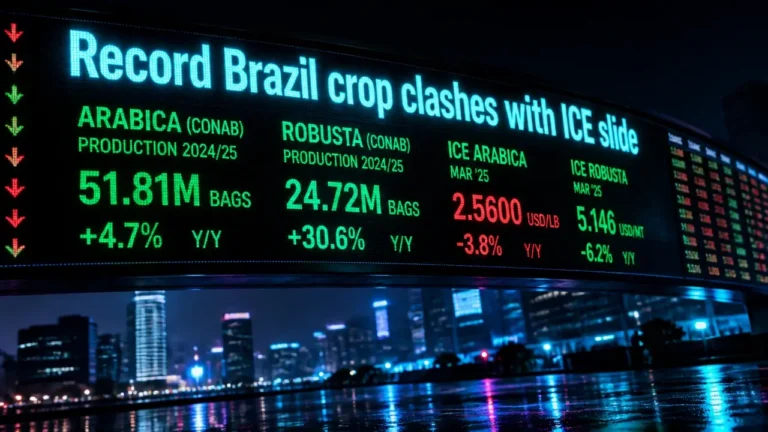
CTA’s figure sits near the middle of an unusually wide range of estimates. Brazil’s government agency CONAB raised its official forecast to 66.7 million bags in May, still below its February projection of 66.2 million, according to GCR Magazine and Comunicaffe. In contrast, Hedgepoint Global Markets expects 75.8 million bags (50.2 million arabica and 25.6 million robusta), citing “favorable weather” and increased area and management investments, Market Intelligence Analyst Laleska Moda told Revista Cultivar.
Other private forecasters cluster near Hedgepoint’s high end. Market analysts Safras & Mercado and StoneX both place Brazil’s 2026/27 output between 75.3 and 75.8 million bags, according to Valor International. Rabobank projects 73.3 million bags, reported by Fresh Cup, while the US Department of Agriculture (USDA) puts the crop at 71.9 million bags, according to a Reuters dispatch carried by MarketScreener India.
Despite the spread between public and private forecasts, several agronomists and grower representatives describe field conditions as unusually strong. Sérgio Mário Regina of Minas Gerais extension agency Emater‑MG said, “I have never seen the crop in such good condition. The beans are developing well and have good size,” in comments to Valor International, adding that the harvest could be “really strong” if frost is avoided. In Espírito Santo, Fabiano Tristão of the Capixaba Institute Incaper told Fresh Cup that “the crop is in very good condition” with regular rainfall.
The CTA survey points to similar drivers on a national scale. According to kelo.com’s report on the study, 63.5% of surveyed farmers said off‑season rain had a major positive impact on their 2026/27 crop, while fertilizer application rose 5.4%, aided by high coffee prices in prior cycles. Arabica and robusta acreage each expanded by more than 2.5% year‑on‑year.
At the global level, these expectations translate into a significant surplus. Rabobank told Business Recorder it sees a 9.5 million‑bag coffee surplus in 2026/27, up from 1.2 million bags in 2025/26, largely reflecting higher Brazilian output. Separately, GCR Magazine reported that CONAB projects world coffee demand at 173.9 million bags, with 1.3% growth, and that the agency does not expect significant price reductions because of low remaining stocks from the previous cycle.
Futures markets are reacting nonetheless. Reuters reported via Business Recorder that ICE arabica coffee futures hit a fresh one‑and‑a‑half‑year low of USD 2.5600 per pound on June 3, settling at USD 2.5740, down 0.7% on the day, while robusta futures fell 1.4% to USD 3,417 per ton. On June 3, the S&P GSCI Coffee Index stood at 194.92 points, down 27.37% since the start of the year, according to MarketScreener India.
Physical inventories remain comparatively tight even as paper prices soften. Business Recorder, citing ICE data, reported that certified arabica stocks stood at 432,781 bags as of June 2, roughly half their level a year earlier. The same article, referencing the European Coffee Federation via CTA, noted that non‑certified green coffee stocks in Europe fell 3.6% year‑on‑year in April to 6.82 million bags.
CONAB’s assessment, reported by GCR Magazine, is that low stocks from the previous cycle will limit major price reductions despite the larger 2026/27 crop, while Valor International has reported that some less‑capitalized Brazilian growers began harvesting early in April and May to capture current price levels ahead of the main July start to the national harvest.