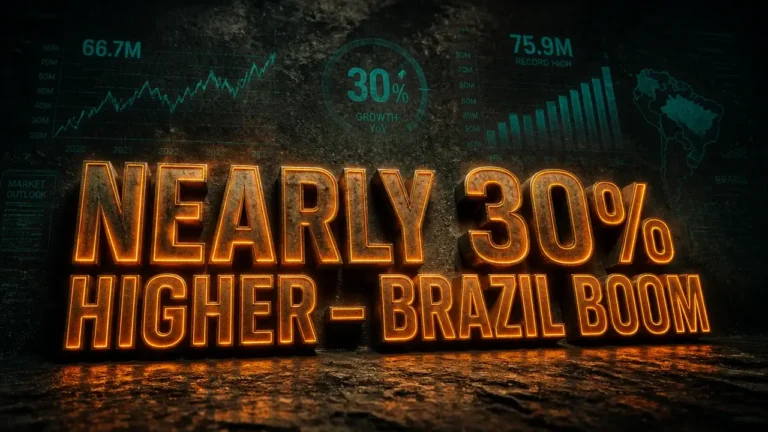

Global coffee buyers are facing an unusual combination of nearly 30% higher prices and forecasts for a record Brazilian harvest, as competing outlooks for Brazil and Vietnam cloud the supply picture for the 2025/26 and 2026/27 seasons.
International Coffee Organization data cited by Mwakilishi show global coffee prices have risen nearly 30% over the past year, with consumers in some markets paying as much as £5 for a latte, even as the United States Department of Agriculture’s Foreign Agricultural Service (USDA FAS) projects record world 2025/26 production of 178.848 million bags and ending stocks falling 5.4% to 20.148 million bags, according to a December report summarized by Barchart.
The tension is most visible in Brazil, where six major forecasts for the 2026/27 crop span nearly 10 million bags. A survey by Coffee Trading Academy (CTA) pegs the 2026/27 crop at 71.4 million bags, with 47.9 million bags of arabica and 23.5 million of robusta, and notes acreage expanded 2.97% year-on-year; 63.5% of farmers cited off-season rain as positive, according to CTA figures reported by KELO-AM. In contrast, Brazil’s national supply agency CONAB estimates the 2026 harvest at 66.7M vs 75.9M bags, with 45.8 million arabica and 20.9 million robusta, as detailed by Global Coffee Report.
Private analysts are even more bullish. Market intelligence firm Hedgepoint Global Markets forecasts Brazil’s 2026/27 crop at 75.8 million bags (50.2 million arabica, 25.6 million robusta), with analyst Laleska Moda telling Cultivar Magazine that “favorable weather throughout the crop development, combined with the increased area and investments in management, resulted in coffee plantations in excellent condition and supported the revision of production figures for the 26/27 season.” Trading house StoneX projects a record 75.3 million bags and a global coffee surplus of 10 million bags in 2026, up from 1.8 million in 2025, while Marex Group forecasts 75.9 million bags and Sucafina 75.4 million bags, all cited by Barchart.
Recent production setbacks help explain why prices remain elevated despite those larger harvest expectations. Mwakilishi, citing the Brazilian Institute of Geography and Statistics, reports that Brazil’s coffee production fell 14% in 2025 compared with the previous year, while Vietnam’s output declined 10% in 2025, according to Vietnam’s Ministry of Agriculture and Rural Development. Over the same period, global coffee consumption grew by 3%, Mwakilishi notes, adding pressure to limited inventories.
Vietnam is now forecast to rebound, particularly in robusta. A report from Perfect Daily Grind states that market forecasts indicate Vietnam’s 2025/26 coffee harvest is projected to increase by 9%, with the USDA later pegging the crop at 31.7 million bags, up from a previous USDA FAS projection of 30.8 million bags summarized by Barchart. Another Barchart report places Vietnam’s 2025/26 production at 29.4 million bags, a 6% year-on-year increase and a four-year high. Perfect Daily Grind, citing the USDA, adds that robusta is expected to account for 30.5 million bags, with exports forecast at 28.5 million bags.
Higher flows from Vietnam are already apparent in trade data. Vietnam’s coffee exports between January and April 2026 rose 15.8% year-on-year to 810,000 metric tons, after full-year 2025 exports increased 17.5% to 1.58 million metric tons, according to figures from the Vietnam National Statistics Office quoted by Barchart. On the futures side, Perfect Daily Grind reports that July ICE robusta contracts closed up 1.68% on 26 May 2026 on concerns about dry conditions in Vietnam’s Central Highlands.
Short-term weather disruptions have also kept markets on edge in Brazil. Barchart notes that coffee prices rallied to two-week highs on 28 May 2026 as heavy rains delayed the Brazilian harvest and threatened supplies. At the same time, Barchart reports that the US National Oceanic and Atmospheric Administration (NOAA) estimates an 82% probability of El Niño conditions between May and July 2026 and a 67% chance of a “Super El Niño,” circumstances described as threatening Brazil’s coffee crop.
Industry leaders link these swings to broader instability. “The impact on global supply chains is profound,” International Coffee Organization Executive Director Vanusia Nogueira said of poor harvests in Brazil and Vietnam, according to Mwakilishi. In the same outlet, German Federal Minister of Food and Agriculture Jens Spahn stated, “The effects of climate change are becoming increasingly evident, and they pose a significant threat to agricultural stability worldwide.”
Despite that backdrop, several sources see supply growth outpacing demand in the near term. CONAB, citing USDA figures, reports that global coffee demand in 2025/26 is expected to grow 1.3% to 173.9 million bags, while StoneX, as reported by Barchart, projects the global coffee surplus will expand to 10 million bags in 2026, from 1.8 million bags in 2025.