
Concentrated espresso is not simply strong coffee poured into a smaller cup. It’s a specific preparation method where hot water is forced under mechanical pressure through a compact, finely ground puck, producing a chemically distinct liquid that no other brew method replicates.
Understanding why espresso works the way it does, from the fluid dynamics inside a coffee puck to the cultural economics that created the espresso bar, gives you something no recipe chart can: the ability to diagnose your own shots and fix them on the fly.
Key Takeaways on Espresso
- Espresso’s intensity is a property of concentration per milliliter, not total caffeine; a double shot typically contains less caffeine than a standard drip coffee.
- The espresso bar emerged from a specific economic problem: urban Italian cafes needed fast, made-to-order coffee at scale, and steam pressure was the engineering solution.
- Every generation of machine design solved one specific extraction problem, from temperature control to pressure consistency to pre-infusion, each translating directly into a more repeatable cup.
- Espresso parameters (dose, grind, yield, time, temperature, pressure, water quality) form an integrated system; changing one variable shifts the conditions for every other.
- Sour shots point to under-extraction, bitter shots to over-extraction, and weak shots to dose or ratio errors, but channeling can mimic all three simultaneously and must be ruled out first.
- A grinder, a 0.1 g scale, fresh beans, disciplined puck prep, and a shot log deliver more extraction control than any machine upgrade.
Espresso Defined: Concentration, Caffeine, and the Mental Jam
Espresso is hot water forced through a compact, finely ground coffee puck under mechanical pressure, typically around 9 bar, producing a small, highly concentrated liquid. That’s the technical side of espresso. But the mental jam most people carry into their first espresso conversation is this: small and intense must mean more caffeine. It doesn’t, and that confusion shapes almost every beginner mistake.
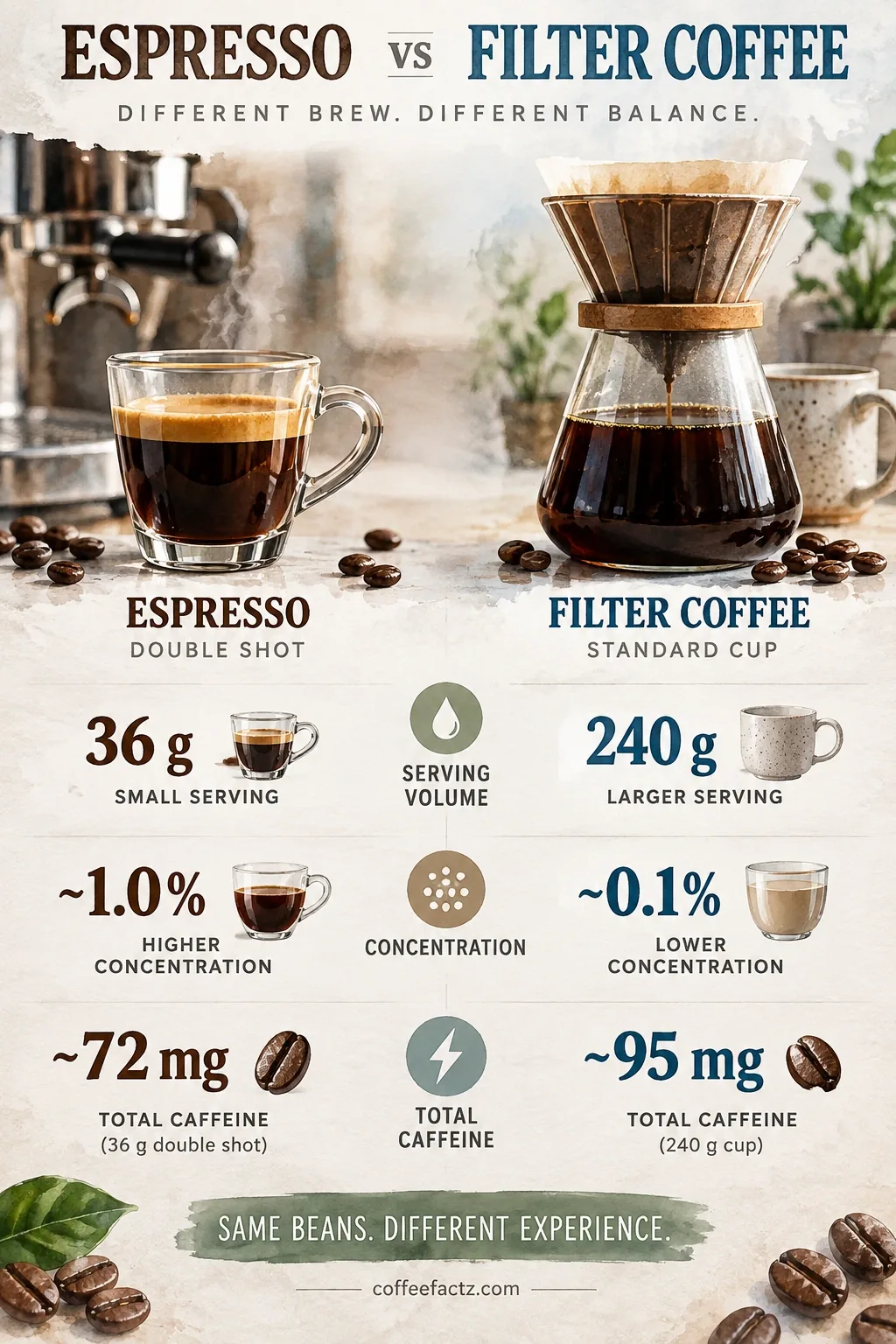
Concentration and total caffeine are separate measurements. A standard double espresso shot pulls roughly 36 grams of liquid from 18-20 grams of ground coffee. That shot contains approximately 63 milligrams of caffeine. A 240 ml (8 oz) drip coffee, brewed at a far lower concentration, can contain anywhere from 95 to 165 milligrams of caffeine depending on the beans and brew ratio. Espresso is more concentrated per milliliter, yes. But the small serving size means total caffeine per cup is often lower than what’s in a standard filter coffee.
The distinction matters practically. When you’re calibrating a dose or explaining a drink to a customer, conflating concentration with caffeine load leads to wrong decisions. Espresso’s intensity is a sensory property of extraction density, not a measure of stimulant volume.
Culturally, espresso operates on a second level entirely. In Italy, the espresso bar was never just a place to get coffee. It was a social checkpoint, a brief ritual between obligations, an affordable daily luxury. That cultural architecture spread globally and now defines the baseline expectation of a cafe. Espresso is both an extraction method and a social institution, and understanding both layers is what separates someone who makes shots from someone who understands the drink.
Here’s a visual breakdown of how espresso and filter coffee actually compare on concentration versus total caffeine:
The Beginnings: Steam, Speed, and Urban Italian Cafe Economics
Espresso’s origins sit inside a specific economic problem. Late 19th-century Italian cities were growing fast, and urban cafes were filling with workers who needed coffee quickly. The existing methods, batch brewing large pots or preparing individual cups slowly over heat, couldn’t keep pace. A cafe with a line of customers at a counter needed a machine that could produce a single cup in seconds, on demand.
The answer was steam pressure. Early Italian inventors, including Angelo Moriondo, who received a patent in Turin in 1884 for a large steam-driven machine, and later Luigi Bezzera, who patented individual-serving improvements in 1901, were solving a throughput problem. Pressure cut brew time dramatically. What once took minutes now took seconds.
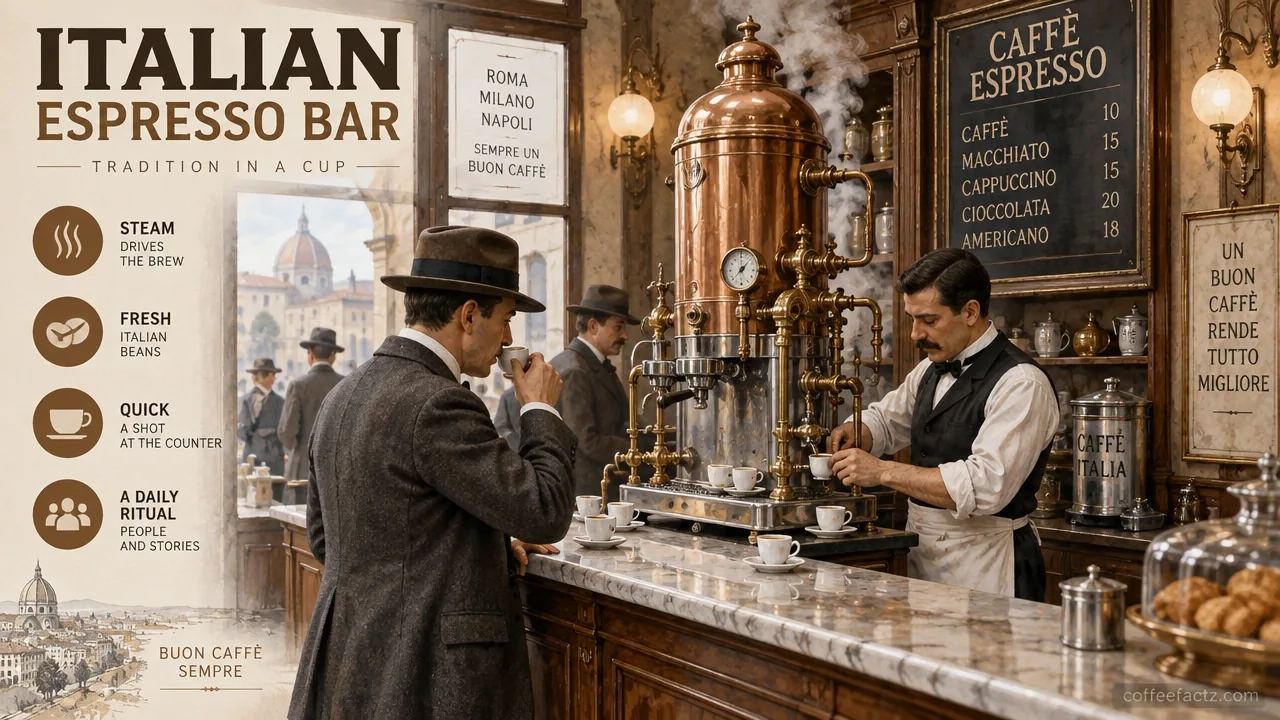
Desiderio Pavoni bought Bezzera’s patent in 1903 and began commercial production, and the La Pavoni machines that followed became fixtures in Italian cafes by the 1910s. These early steam-driven machines operated at around 1.5 to 2 bar of pressure, far below the 9 bar standard that defines modern espresso. The coffee they produced was fast, but the high steam temperature often scorched the grounds.
Jonathan Morris, Professor of Modern European History at the University of Hertfordshire and author of Coffee: A Global History, describes what those early machines actually produced: the result would have tasted like a slightly concentrated version of filter coffee by today’s standards, and that was really the first iteration of espresso.
The espresso bar as a social institution emerged from this mechanical foundation. The counter format, the standing customer, the brief transaction: all of it was shaped by what the machine made possible. Speed created a ritual. The ritual became a culture. That culture then traveled with Italian immigrants and trade networks across Europe, the Americas, and eventually the world.
What drove adoption wasn’t flavor science. It was economics and social habit. The espresso bar offered an affordable, consistent, quick experience that fit the rhythm of working-class urban life. That’s the root cause behind why this particular method, and not some other fast-brew invention, became the global cafe standard.
Innovations and Improvements: From Manual Levers to Modern Pump Pressure
Historical Machine Milestones
The steam-driven machines of the early 1900s had a fundamental flaw beyond scorching: the barista had no real control over pressure or temperature. Both were byproducts of steam generation, not engineered parameters.
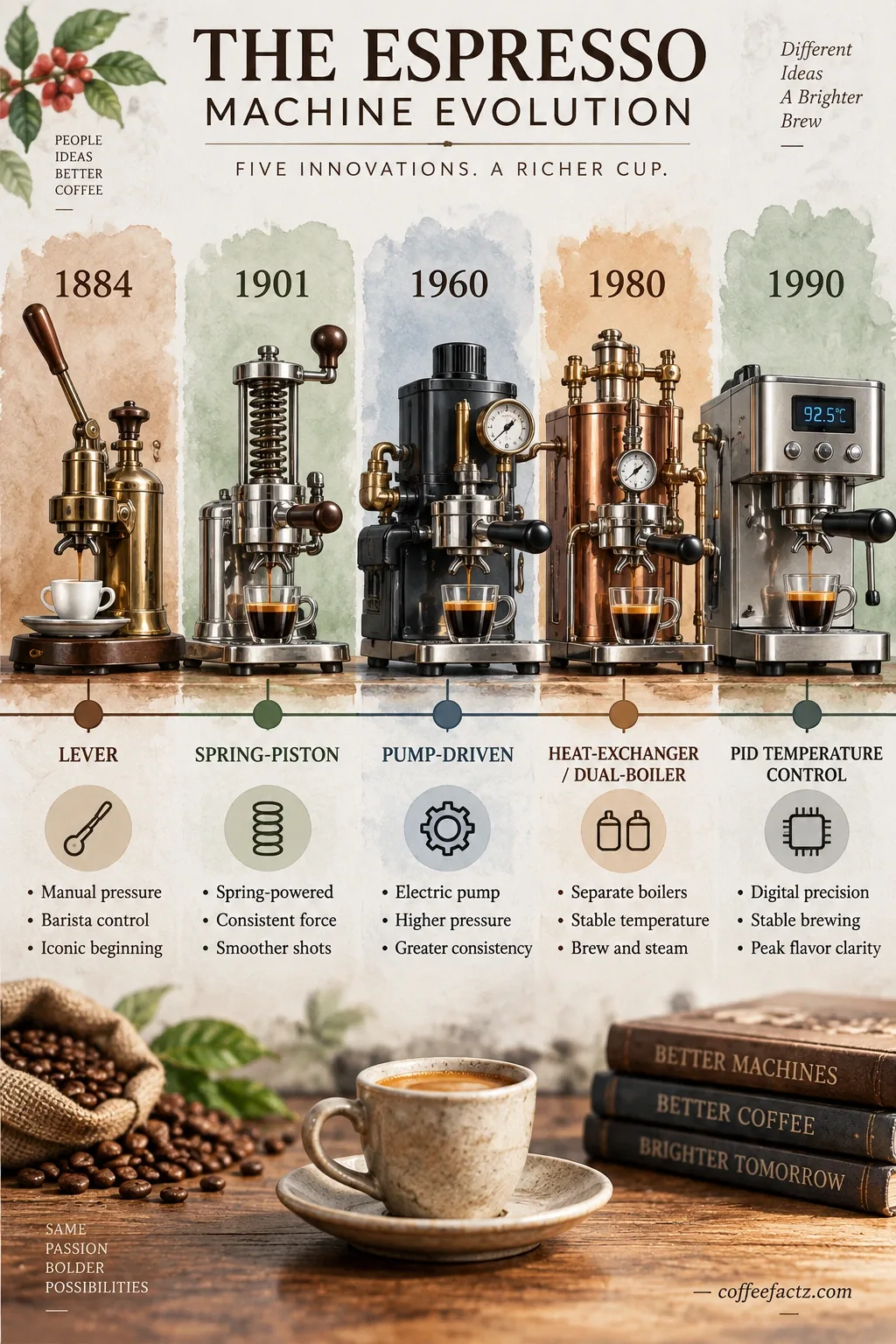
The first major engineering leap came in 1945, when Achille Gaggia introduced the lever-piston machine. Instead of steam pressure alone, a spring-loaded lever allowed the barista to generate water pressure mechanically by pulling a handle down and releasing it. This spring-lever system produced pressures approaching 8 to 9 bar, the range where water extracts coffee differently than at lower pressures, and where crema, the emulsified layer of CO₂ and oils, first appeared consistently. Customers initially called it “caffe crema,” unsure what the foam was.
Kent Bakke, former CEO of La Marzocco and founder of the Bakke Coffee Museum, points to another critical development that often goes unmentioned: the heat exchanger. Early gas-powered machines had no temperature controls at all, making the heat exchanger a pivotal step toward repeatable extraction.
In 1961, Faema released the E61, the machine that established the modern template. It used a motorized pump to generate consistent 9 bar pressure independent of the barista’s physical force, and its heat exchanger allowed a single boiler to supply both brewing water and steam without the temperature swings that plagued earlier designs. The E61’s group head design, with its continuous water circulation, became an industry reference that manufacturers still copy today.
Dual-boiler machines followed, separating brewing and steaming into independent systems with independent temperature control. Then came PID controllers (proportional-integral-derivative temperature regulators), which allowed baristas to set brew temperature to within fractions of a degree. What was once a matter of mechanical luck became an engineered parameter.
Extraction Stability Engineering
Each of these mechanical developments solved a specific extraction problem. Pressure consistency meant the water moved through the puck the same way on every shot. Temperature stability meant soluble compounds dissolved at a predictable rate rather than varying with ambient conditions or machine warm-up state.
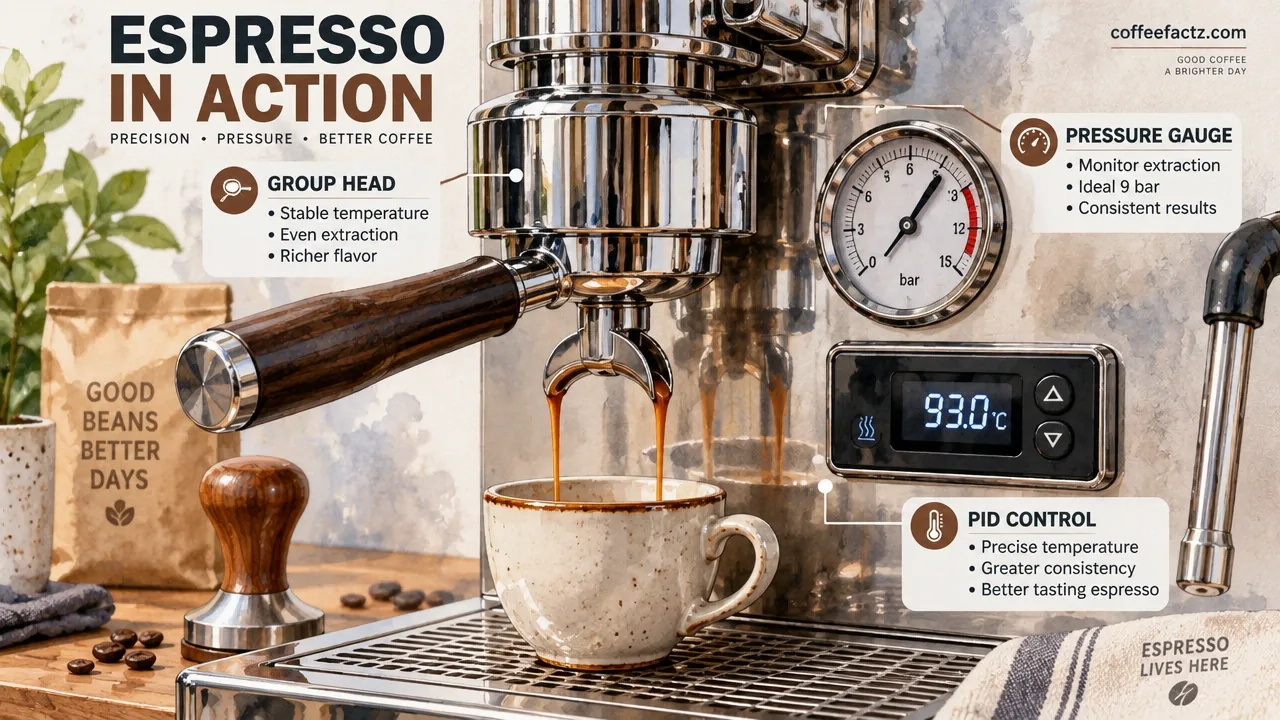
Pre-infusion, the practice of wetting the puck at low pressure before ramping to full extraction pressure, emerged as machines became capable of pressure profiling. It saturates the grounds evenly before the full 9 bar hits, reducing channeling and improving extraction uniformity. This wasn’t a marketing feature added to sell machines. It was an engineering response to a documented flow problem.
The trajectory of machine design is a trajectory of parameter control. Every generation of hardware gave baristas one more variable they could hold steady, and each stable variable translated directly into a more repeatable cup.
The Manual Trend: Why Lever and Handcrafted Espresso Culture Returned
Fully automatic machines can now grind, dose, tamp, brew, and steam milk without any barista input. So why are lever machines, hand grinders, and manual tamping more popular today than at any point since the 1970s?
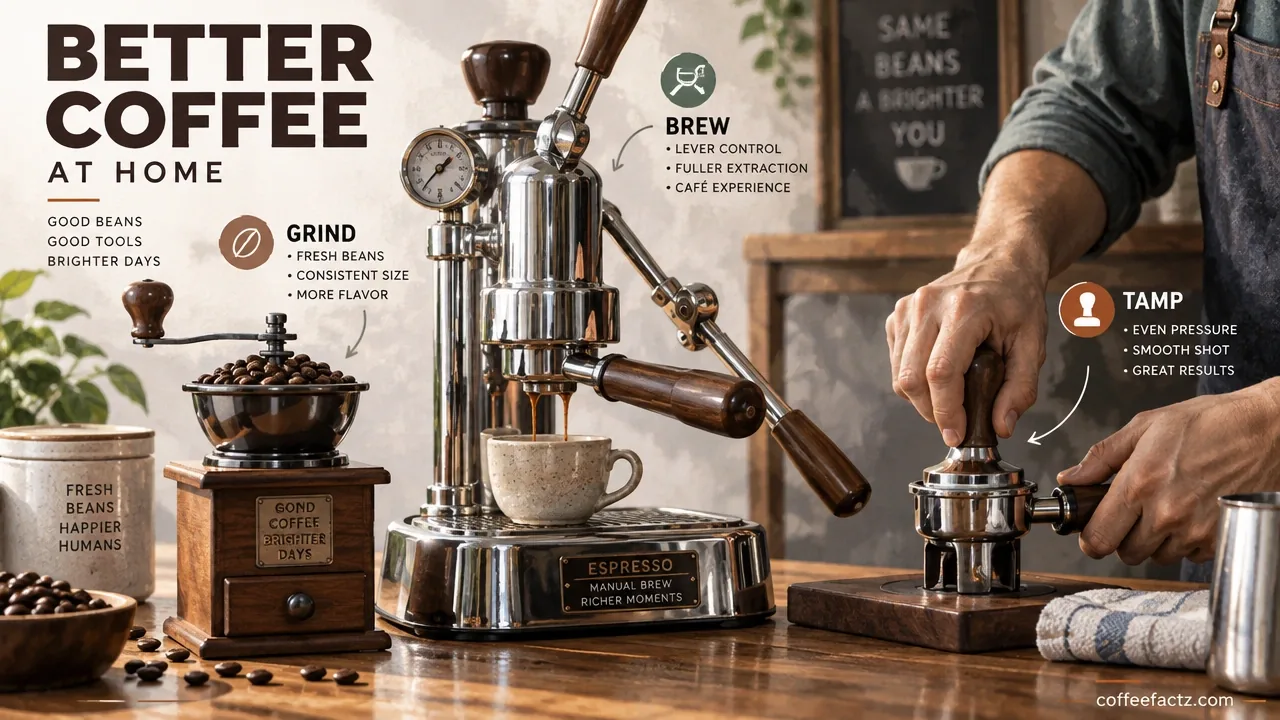
The answer isn’t nostalgia. It’s a reaction to what automation removes. When a super-automatic machine handles every variable, the output is consistent but the process is opaque. The barista, or home enthusiast, has no felt connection to what’s happening inside the puck. Manual espresso returns tactile feedback to the operator. A lever machine tells you, through resistance and flow, whether your grind was right. A hand grinder makes you aware of particle size in a way a motorized grinder doesn’t.
This matters to a specific kind of coffee drinker: someone who wants to understand the system, not just consume the output. The home-barista community that emerged through the 2010s and 2020s, accelerated by specialty coffee culture and online knowledge-sharing, created demand for gear that teaches rather than hides.
There’s also an aesthetic dimension. A lever machine pulling a shot at a cafe counter is cafe theater. It signals craft. Customers read it as evidence of attention and intention, even if they can’t articulate why. Cafes in the specialty sector use manual elements partly because the visual communicates quality before the first sip.
The distinction between manual and automatic isn’t about which produces better espresso. It’s about what the operator controls versus what the machine controls. A skilled barista on a manual lever can produce exceptional espresso. An unskilled barista on the same machine can produce undrinkable espresso. Automation narrows that gap. Manual widens it, in both directions.
Key Elements to Make Espresso: The Integrated Control Model
Espresso variables don’t operate independently. Every parameter you adjust changes the conditions for every other parameter. That’s the core insight most guides miss, because they present dose, grind, time, and temperature as a checklist rather than as an integrated system.
Jonathan Morris frames this precisely: espresso is best understood as neither a type of coffee nor a beverage category, but as the outcome of a preparation process in which the machine, grind, blend, and barista act together to produce the result. None of the four elements works without the others.
Parameter Targets and Standards
The accepted control set for espresso covers dose, grind size, distribution, tamp, yield, brew time, brew ratio, water temperature, pressure, water quality, and bean freshness. Here’s what executable standards look like for each:
| Parameter | Target / Standard |
|---|---|
| Dose | 18–20 g (double shot) |
| Brew ratio | 1:2 (dose to yield) |
| Yield | 36–40 g liquid |
| Brew time | 25–35 seconds |
| Water temperature | 90–96°C (194–205°F) |
| Pressure | ~9 bar |
| Grind tool | Burr grinder (flat or conical) |
| Scale precision | 0.1 g minimum |
| Bean freshness | Specialty-grade, freshly roasted |
What’s worth noting: most consumer espresso guides present these parameters in fragments. One source covers dose and ratio but omits temperature. Another gives temperature but skips pressure. Very few integrate the full set into a single working model. When parameters are missing from your mental model, you can’t diagnose a bad shot accurately because you don’t know which variable you’re not controlling.
Dialing Workflow and Reliability
Dialing in is the process of adjusting your parameters until the shot tastes right, then locking them in for repeatability. The rule that makes this tractable is simple: change one variable at a time, taste the result, then decide whether to move further in that direction or try a different variable.
A practical sequence for dialing in from scratch:
- Set dose to 18 g, target yield 36 g, target time 25-35 seconds.
- Pull a shot. Note actual yield and time.
- If it runs too fast (under 25 seconds), grind finer. If too slow (over 35 seconds), grind coarser.
- Once time is in range, taste. Sour → adjust finer or raise temperature. Bitter → adjust coarser or lower temperature.
- Log every parameter and the taste result.
That last step is where most home baristas skip out. Logging isn’t obsessive. It’s the only way to know what you changed and whether it helped. A notebook with dose, yield, grind setting, time, and a one-word taste note is enough. Without it, you’re re-dialing from scratch every session.
For cafe apprentices specifically: repeatability and reliability matter more than technical sophistication. A cafe doesn’t need you to explain extraction kinetics. It needs you to pull the same shot at 7am, 11am, and 3pm with the same result. That comes from logging and discipline, not from expensive gear.
Extraction Mechanics: Fluid Dynamics, Puck Resistance, Channeling, and Crema
Grind Geometry and Pressure Profiling
Water is lazy. It finds the weakest spot in your puck and punches straight through. Understanding why requires thinking about the puck as a hydraulic resistor, not just a bed of coffee.
When you grind finer, you increase the surface area of each particle and reduce the gaps between particles. Water moving through that bed encounters more hydraulic resistance, slows down, and spends more time in contact with the grounds. Coarser grinding does the opposite: larger gaps, lower resistance, faster flow. This is why grind size is the primary lever for controlling brew time.
Basket geometry compounds this. A wider, shallower basket spreads the same dose across a larger surface area, reducing bed depth and therefore resistance. A narrower, deeper basket concentrates the same dose into a taller column with higher resistance. Two shots with identical grind settings but different baskets will extract differently.
Pressure profiling, available on higher-end machines, allows the barista to vary pressure during extraction rather than holding it constant at 9 bar. A low-pressure pre-infusion phase (2-4 bar) wets the puck gently before ramping up. This reduces the initial hydraulic shock that can crack a dry puck and create uneven flow paths. It’s not a luxury feature. It’s an engineering solution to a documented puck-integrity problem.
Soluble Compound Kinetics and Bean Density
Water doesn’t dissolve all coffee compounds at the same rate. Early in extraction, it picks up the most soluble compounds first: acids, some sugars, lighter aromatic molecules. Later in extraction, it reaches less soluble compounds: heavier bitter molecules, certain phenols. This is why brew time directly influences flavor balance. Cut the shot short and you get predominantly early-extraction compounds, which taste sour and sharp. Run it too long and the late-extraction compounds dominate, which taste bitter and dry.
A peer-reviewed extraction kinetics study published in the Journal of Mathematics in Industry modeled this process in detail, finding that coffee extraction proceeds through two distinct phases: rapid dissolution of solubles from grain surfaces and broken cell walls, followed by slower diffusion through intact intragranular cell structures. The model, validated experimentally, also showed that finer grinds increase initial extraction yield by raising surface area while simultaneously increasing hydraulic resistance and brew pressure. This confirms what baristas observe empirically: finer grinds extract faster at first but create more resistance overall.
Bean density adds another layer. Lighter roasts are denser, with more intact cellular structure, and resist water penetration more than darker roasts. This is why light roasts often need finer grinds or higher temperatures to achieve the same extraction yield as a darker roast. Freshness matters here too. Freshly roasted beans contain CO₂ trapped inside cellular structures. That gas creates resistance and contributes to crema. Stale beans have off-gassed, their cellular structure has partially collapsed, and they extract unevenly, producing thin shots with little crema and inconsistent flow.
Uneven Flow Paths and Emulsified Oils
Channeling is the most common cause of an unexplainably bad shot. When the coffee bed isn’t uniformly distributed or the tamp isn’t level, water finds the path of least resistance through the puck and rushes through a narrow channel rather than flowing evenly across the entire bed. The grounds in the channel are over-extracted. The grounds around it are under-extracted. The shot coming out of the spout is a mix of both, which produces a confused, flat, often sour-and-bitter-simultaneously flavor.
You can often diagnose channeling by watching the spout. If liquid appears from one side before the other, or if you see a thin, fast stream alongside a slower drip, the puck is channeling. The fix is upstream: distribution and tamping, not pressure adjustment.
Crema is the foam layer sitting on a well-pulled shot. It forms through the emulsification of CO₂ and natural oils under pressure. As pressurized water passes through the grounds, it dissolves CO₂ from the bean cells and carries oils into suspension. When pressure drops at the spout exit, CO₂ comes out of solution and creates the fine bubble structure visible as crema. Two things drive crema: bean freshness (CO₂ content) and extraction pressure (emulsification force). A dark, oily crema that collapses quickly often indicates stale beans or over-extraction. A thin, pale crema typically means under-pressure or old coffee. Crema is a diagnostic signal, not just an aesthetic feature.
Edge Cases and Diagnostics: Troubleshooting Taste, Flow, and Water
Taste Fault Correction
Most espresso taste problems trace back to one of three root causes: under-extraction, over-extraction, or dose/ratio error. The difficulty is that the same symptom can come from multiple causes, and fixing the wrong variable wastes time and coffee.
Sour, sharp, or thin shots point to under-extraction. Water didn’t spend enough time in contact with the grounds, or the temperature was too low, and you pulled mostly early-extraction compounds. The directional fix: grind finer to slow flow, or raise brew temperature toward 96°C. But also check dose and distribution. A low dose creates a thin puck with low resistance that extracts too fast regardless of grind setting. Uneven distribution creates partial channeling that mimics under-extraction in taste even if brew time looks normal.
Bitter, dry, or astringent shots point to over-extraction. You’ve pulled too many late-extraction compounds. The directional fix: grind coarser to speed flow, or lower temperature. Check yield and time: if your shot ran 45 seconds when you expected 30, the grind is too fine. If yield is correct but the taste is still bitter, try a slightly lower dose.
Weak or watery shots are a different category. The espresso isn’t over- or under-extracted in the classic sense; it’s simply under-strength. Common causes: dose too low for the basket, brew ratio too high (too much water for the coffee), stale beans with collapsed cell structure that can’t provide resistance, or genuine channeling that bypassed most of the puck.
The important caveat: these diagnostic maps are directional. They tell you which variable to move, but not by how much. And they don’t account for interactions. A shot can be simultaneously under-extracted in one part of the puck and over-extracted in another if channeling is present. Fixing grind alone won’t resolve that. You have to fix distribution and tamp first, then re-evaluate taste.
Flow Failure Troubleshooting and Maintenance
Flow problems are mechanical, not flavor-based, but they produce bad flavor as a consequence.
No flow after 8-10 seconds: The puck is too dense. Grind coarser, or check that you’re not over-dosing for your basket size. A 20 g dose in a basket rated for 18 g will compress into a puck that the machine can’t push water through.
Pours too fast (under 20 seconds for a double): The puck offers too little resistance. Grind finer. If you’re already at a fine setting, check tamp pressure. A light or uneven tamp reduces effective resistance.
Uneven spout flow: Distribution or tamping is the culprit in most cases. Use a distribution tool or WDT (Weiss Distribution Technique) to break up clumps before tamping. Tamp level, applying even pressure across the full puck surface.
Maintenance is not optional. Rancid coffee oils accumulate in the group head, portafilter basket, and shower screen with every shot. Those oils go rancid within days and contaminate the flavor of every subsequent shot. Backflush with a cleaning agent like Urnex every few days for a machine in regular daily use, at most weekly for lighter use. When soaking the drip tray and basket, 15 minutes in a half-tablespoon of Urnex solution is sufficient. Wipe the group head gasket and shower screen with a damp microfiber cloth after every session. These steps cost two minutes. Skipping them costs flavor quality and eventually machine function.
Mineral Composition and Setting Adjustment
Water is 98% of a standard drip coffee and over 95% of an espresso shot by volume. Treating it as an afterthought is the single most common gap in home espresso setups.
The basic recommendation is filtered water, but that’s underspecified. Filtration removes chlorine and large particulates, which is necessary. But the mineral profile of your water after filtration still determines extraction behavior. Magnesium promotes extraction of aromatic compounds. Calcium contributes to hardness and affects scale buildup in the boiler. Alkalinity (carbonate hardness) acts as a buffer that can mute acidity in the cup and affect how the machine reads temperature.
Most consumer guidance stops at “use filtered water” or specifies total dissolved solids (TDS) in the range of 200-300 mg/L, as De’Longhi does in its machine documentation. What that guidance doesn’t provide: target pH, alkalinity, chloride levels, or a complete mineral profile. ZeroWater filtration removes almost all dissolved minerals, which sounds good but produces water that’s too pure for extraction and can actually be corrosive to machine components. Brita reduces hardness but leaves significant mineral content.
The honest position: water chemistry for espresso is not a solved checkbox. It’s an active variable that affects taste, machine longevity, and extraction in ways that simple TDS readings don’t fully capture. For home use, a filtered water source with moderate mineral content (not zero, not very hard) is a reasonable starting point. Log your results and treat water as one more parameter to revisit if your shots plateau.
Benefits and the Barista’s Verdict: What Espresso Rewards and What It Demands
Espresso rewards different people for different reasons, and being clear about which category you’re in saves time, money, and frustration.
For coffee drinkers, the core benefits are sensory and cultural. A well-pulled espresso concentrates aroma, sweetness, and complexity into a small volume that no other method replicates. The crema carries volatile aromatics that disperse immediately on first sip. The ritual of a short, intentional coffee pause has genuine cultural weight, and that context is part of the experience. Caffeine intensity is not the primary benefit; the flavor density is.
For home baristas, espresso offers something different: a controllable craft with a measurable feedback loop. Every variable is adjustable. Every adjustment produces a detectable result. The skill progression is real and visible. You can track it. Gear literacy develops naturally through use, and the knowledge transfers across machines and methods. The investment isn’t just in equipment; it’s in a framework for understanding extraction that applies to every other coffee method you’ll ever try.
For cafe apprentices, the calculus is different again. Cafes don’t hire for pre-existing technical sophistication. They hire for reliability, composure under service pressure, and the ability to take direction. Most specialty cafes train their own baristas from scratch on their specific equipment and workflow. What matters in an interview or first shift is that you can work cleanly, communicate clearly, and stay consistent when the line is long. The technical knowledge in this guide gives you vocabulary and a diagnostic framework, but it doesn’t replace the repetition required to build muscle memory and speed.
The final verdict on espresso as a discipline: start with the grinder, a 0.1 g scale, fresh specialty beans, clean puck prep, and a log. Those five elements give you more control than any machine upgrade. An expensive machine running stale beans through a sloppy puck prep produces worse espresso than a modest machine running fresh beans through a disciplined process.
What makes espresso espresso is the historical pressure method applied through a controlled, integrated extraction system. The benefits come from mastering that system, not from owning any particular piece of it.
Frequently Asked Questions About Espresso
Why does espresso taste so much stronger than drip coffee if it doesn’t always have more caffeine?
Strength and caffeine content are separate things. Espresso is more concentrated per milliliter, so the flavor compounds, acids, and oils hit your palate with more intensity, but the total caffeine in a small shot is often lower than what’s in a full mug of drip coffee.
What actually causes crema, and does thick crema mean better coffee?
Crema forms when CO₂ and natural oils emulsify under 9 bar of pressure. Freshness drives CO₂ content, and pressure drives emulsification. Thick crema signals fresh beans and correct pressure, but it’s a process indicator, not a quality guarantee; the flavor underneath matters more.
How does pre-infusion actually improve a shot?
Pre-infusion wets the puck at low pressure (around 2-4 bar) before ramping to full extraction pressure. This saturates the grounds evenly and reduces the hydraulic shock that can crack a dry puck and create channels, producing a more uniform flow path across the full shot.
Why do lighter roast beans need different settings than darker roasts?
Lighter roasts are physically denser with more intact cell structure. Water has more difficulty penetrating them, so they often need a finer grind or higher temperature to achieve the same extraction yield. Darker roasts are more porous and extract more easily, sometimes requiring a coarser grind to avoid over-extraction.
Is a lever machine actually harder to use, or is that a myth?
A lever machine is harder to use consistently because the barista generates pressure manually, which means slight variations in pull force and timing affect the shot. The skill ceiling is higher, but so is the feedback: you feel resistance changes in real time, which makes the machine a better teacher than an automatic pump system.
How often should I clean my espresso machine, and what happens if I skip it?
Backflush with a cleaning agent every few days for daily use, at most weekly for lighter use. Rancid coffee oils accumulate in the group head and basket within days and contaminate every subsequent shot’s flavor. Skipping cleaning also accelerates wear on seals and group head components.
Can water quality really change how my espresso tastes, or is that overstated?
Water makes up over 95% of an espresso shot by volume, so its mineral profile directly affects extraction and flavor. Too-pure water (like ZeroWater output) can actually be corrosive and extracts poorly; very hard water mutes acidity and scales the boiler. Filtered water with moderate mineral content is the practical baseline, but it remains an active variable worth logging.
Why do some well-dialed shots still taste flat or inconsistent across days?
Bean freshness degrades continuously after roasting. If your parameters are locked in but taste shifts day to day, the beans are likely past their peak CO₂ window, which affects both crema formation and extraction behavior. Ambient humidity changes can also shift grind particle size on some burr grinders, requiring small adjustments even without changing settings.
References
- Jonathan Morris on early espresso flavor and iteration | hub.jhu.edu
- Jonathan Morris: Espresso as a preparation process, the four Ms | uhra.herts.ac.uk
- Kent Bakke on heat exchangers and espresso machine evolution | perfectdailygrind.com
- Journal of Mathematics in Industry: Coffee extraction kinetics in a well mixed system | link.springer.com