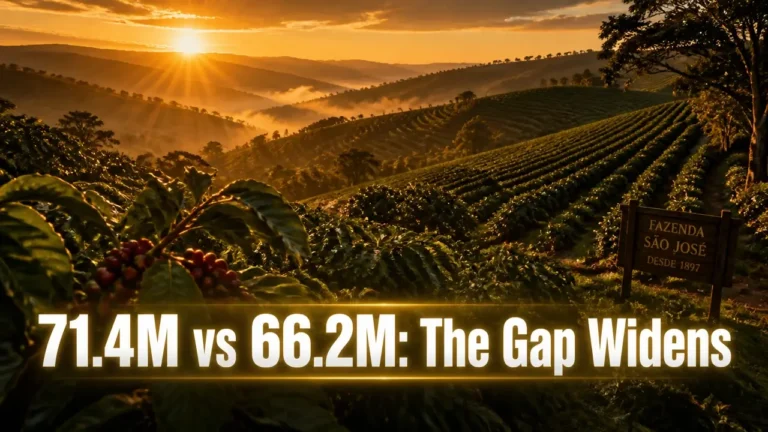

Brazil’s 2026/27 coffee crop has become the focus of a widening forecasting gap, as a new farmer survey from Coffee Trading Academy (CTA) released on 29 April set production at 71.4 million 60‑kg bags, between a lower government estimate and more bullish private-sector views. The survey-based projection underscores how much uncertainty still surrounds the size of the upcoming harvest in the world’s largest coffee producer and exporter.
The third edition of CTA’s Brazil Coffee Farmer Survey, covering 758 growers across all producing regions, points to an 11.5% increase versus the previous season and what CTA describes as a record crop, according to Reuters. The breakdown in the same report puts arabica output at 47.9 million bags, up 13.5% year on year, and robusta at 23.5 million bags, up 7.6%. CTA also found that Brazil’s total coffee area expanded 2.97% over the past year, with arabica area up 2.7% and robusta up 3.6%.
CTA’s new figure adds another reference point to an already crowded field of Brazil crop estimates. Brazil’s government supply agency Conab set its first official 2026/27 forecast at 66.2 million bags on 5 February, up 17.1% year on year but well below the latest CTA number, according to structured content derived from Conab data. On the higher side, brokerage StoneX raised its estimate to 75.3 million bags in March, while Marex Group projected 75.9 million bags and trader Sucafina saw 75.4 million bags, all cited in aggregated structured content.
The new CTA survey also marks an evolution in its own outlook. Reuters reports that the 71.4 million bag figure is the third in the series, coming in above CTA’s November 2025 estimate of 69 million bags but below its initial July 2025 projection of 73.7 million. In a February 2026 blog post, CTA stated that it was “less optimistic than the prevailing consensus” after revising its estimate down from 73.7 million to 69 million bags due to dry spells, though it did not publish a specific number in that update that matched the April survey result.
On-farm conditions reported in the latest survey help explain why most institutional forecasts cluster in a relatively high range, even if they differ on the exact total. Reuters notes that 63.5% of farmers told CTA that off-season rainfall had a major positive impact on their crops. In the same coverage, CTA analysts reported that fertilizer application rose 5.4% from the prior season, and linked that increase to elevated coffee prices allowing adequate use of inputs.
The debate over Brazil’s harvest is central to expectations for the global balance. Structured content based on Rabobank analysis projects world coffee production at 180 million bags in 2026/27, roughly 8 million bags above the prior season, while StoneX expects a 2026 global surplus of 10 million bags, up from 1.8 million in 2025 and described as the largest surplus in six years. CTA’s February blog similarly referred to a transition from years of tight balances to a more comfortable supply environment, while also pointing out that ICE-certified stocks were well under 1 million bags at around 430,000 bags at that time.
Market reaction to the latest survey was muted on the day of its release. Comunicaffe reported that ICE arabica futures for July delivery closed unchanged at 290.70 cents per pound on 29 April, with other arabica contracts edging lower, while July ICE robusta fell 1.1% to finish at $3,442. The same report attributed the slight downward move in coffee futures that day in part to a recovering U.S. dollar and noted that macro-driven logistical challenges continued to support supply-side constraints.
Despite the differing Brazil crop numbers, structured content summarizing these forecasts indicates broad agreement that Brazil will harvest a historically large coffee crop in 2026/27, even if analysts and agencies remain several million bags apart on how large it will ultimately be.