Dubai’s role in the global coffee trade is moving beyond local café culture to large-scale logistics, with new analysis and infrastructure data positioning the emirate as a major re-export hub between producing countries and the wider Middle East. The latest report from
Authority.Coffee and an expansion at the
DMCC Coffee Centre in Jebel Ali together underline how quickly that role is scaling.According to author Robert Jones on
Authority.Coffee, UAE coffee imports exceeded
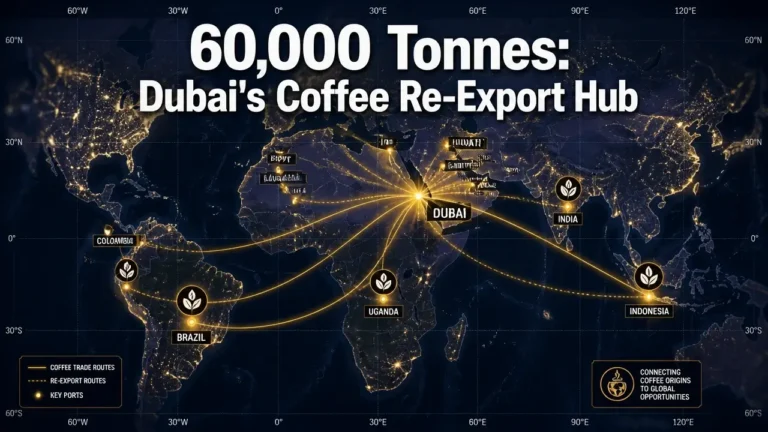
120,000 tonnes in 2025, with an estimated value of USD 450–500 million. He states that approximately 40,000–50,000 tonnes were consumed domestically, while the remaining 60,000–80,000 tonnes were re-exported, and that the UAE’s re-export trade is overwhelmingly in green (unroasted) coffee.The scale of those re-exports is echoed by Dubai-based company Scarab Coffee, which said via a
press release that green coffee re-exports through the UAE exceeded AED 3.5 billion in 2024. Jones notes that more than 200 coffee trading companies are registered within the Dubai Multi Commodities Centre (DMCC) free zone adjacent to Jebel Ali, which he describes as home to the DMCC Coffee Centre.The physical backbone of this trade has been built out rapidly. A Jafza insight article cited by
Jafza and
DMCC records that the DMCC Coffee Centre, established in 2019, offers a 15,000 m² temperature‑controlled facility with capacity to process 20,000 tonnes of green coffee per year. In September 2025, DMCC announced the launch of a new 500 m² mezzanine level at the centre, adding 16 private offices, flexible hot‑desking and a members‑only espresso bar.Explaining the rationale for this expansion, Mike Butler, Associate Director – Coffee at DMCC, said in the DMCC press release that “this report envisages a future that is both complex and full of opportunity. Our role is to support DMCC Coffee Centre members through warehousing, logistics, roasting services and member-to-member trade. Our newly fitted-out mezzanine level is a physical expression of that commitment – part of our broader strategy to support our coffee ecosystem and Dubai as a global coffee hub.”Global context helps show where Dubai now fits. The DMCC
Future of Trade report, cited in the same
announcement, puts global coffee trade at over USD 26 billion and the global retail coffee market well above USD 200 billion. In that release, DMCC Executive Chairman and CEO Ahmed Bin Sulayem added that coffee is “a cornerstone of the global economy, with a retail market well above US$200 billion and around two billion cups enjoyed every day,” and noted that more than 25 million farmers, mostly smallholders, depend on coffee.Regional demand is one of the drivers of flows through the UAE, according to several sources. Jones estimates on
Authority.Coffee that the UAE coffee market was valued at approximately USD 3.4–3.5 billion in 2026, up from USD 3.2 billion in 2025, with an annual growth rate of 8–9% and a cited compound annual growth rate of 10.6%. He also estimates that the combined coffee market of the Gulf Cooperation Council (GCC) is worth USD 9.5–10.5 billion in 2026, and identifies Saudi Arabia as the largest single market by value.Consumption and café density figures suggest this demand is both broad and out‑of‑home focused. Scarab Coffee’s
statement says 93% of coffee consumption in the UAE occurs outside the home. In his
UAE Coffee Market Observation Report 2025, consultant André Eiermann writes that Dubai alone is home to over 4,800 coffee shops, and estimates this as roughly one coffee shop for every 750 people in the city.Eiermann adds that “Dubai has firmly established itself as the coffee capital of the Middle East, influencing trends across the region,” and cites an unnamed industry expert who told him that “Dubai is where coffee brands come to prove themselves before expanding across the region.” According to Jones on
Authority.Coffee, more than 9,000 cafés and coffee shops now operate across the UAE.Dubai’s role as a stage for specialty coffee is also reflected in events. In the 2025 DMCC announcement, Ahmed Bin Sulayem noted that World of Coffee Dubai 2025 drew over 17,000 visitors and set record auction prices for rare lots, which he said underscored market depth in a Middle East and North Africa coffee market projected at roughly US$11.5 billion.Several logistics and policy details cited by Jones help explain why traders are routing coffee through the UAE. His
analysis highlights that the Jebel Ali Port is the world’s 9th largest container port, connecting to more than 180 ports and handling 15 million TEU annually, with transit times of 12–18 days from major coffee origins such as Brazil, Vietnam, Ethiopia, Colombia and India. He also notes that the DMCC free zone offers zero import duty and corporate tax, while Eiermann points to UAE government support via zero import duties on green coffee and VAT reductions for food and beverage businesses.Trade statistics indicate that this connectivity translates into significant sourcing from major origins. World Bank WITS data on green coffee exports to the UAE in 2024, cited in the Authority.Coffee analysis, shows Brazil at USD 77,065.13K (190,314,000 kg), India at USD 62,168.48K (13,879,800 kg), Uganda at USD 19,996.39K (6,069,990 kg), Indonesia at USD 16,982.28K (3,211,720 kg) and Colombia at USD 14,019.49K (2,354,300 kg).Re-export activity is not limited to green coffee alone. World Bank WITS figures for roasted coffee exports from the UAE in 2023, again cited in the Authority.Coffee analysis, indicate shipments worth USD 56,362.63K, with a quantity of 6,205,840 kg. The same dataset lists Kuwait, Saudi Arabia, Bahrain, Qatar and Egypt as top destinations for UAE roasted coffee that year, with Kuwait at USD 15 million, Saudi Arabia at USD 11.2 million, Bahrain at USD 6.27 million, Qatar at USD 4.5 million and Egypt at USD 4.12 million.For DMCC, the coffee story sits alongside an established position in tea. The Jafza insight article notes that external coffee trade has generated over AED 3.5 billion during the last decade, and adds that the UAE is one of the largest re-exporters of tea worldwide, with a global share of approximately 60%. In that piece, DMCC states that “the DMCC Tea and Coffee Centres are always on the lookout to open doors to new trading opportunities by liaising with Dubai Customs to give members access to the latest data and analytics.”Across the various sources, Dubai’s current coffee role is framed within a changing global map described in the DMCC
Future of Trade report, which says that climate threats, shifting consumer preferences and new power dynamics in the value chain are redrawing the global coffee map, and points to tools such as AI‑enabled traceability and tokenisation of real‑world assets as emerging features of how coffee is traded and financed.

 By | May 22, 2026