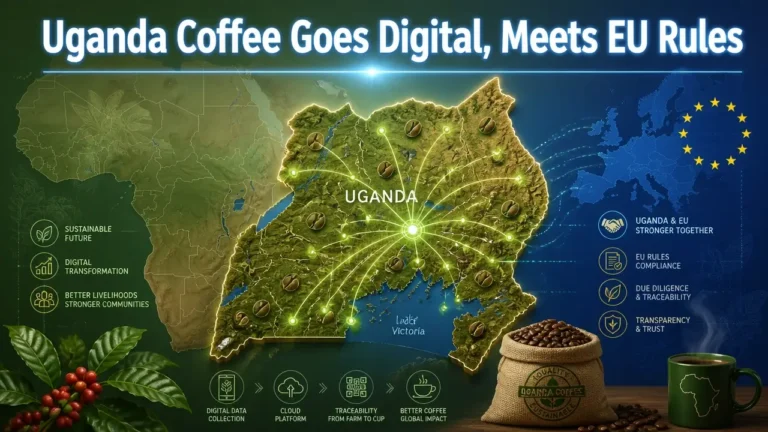
Uganda has launched a national digital coffee‑traceability platform that links every lot to individual farms while embedding strong data‑privacy protections, aiming to meet the European Union’s Deforestation Regulation (EUDR) requirements for exports to Europe. The system, unveiled on 10 April 2026 in Kampala by the
Uganda Coffee Farmers Alliance (UCFA) and the National Coffee Research Institute (NaCORI), is designed to keep Ugandan coffee verifiably deforestation‑free for EU buyers, according to
The Cooperator News.The stakes are high: “Coffee is a critical livelihood for over 35 % of Uganda’s rural population,”
Tridge Insights reported on 8 May 2026. The same report stated that the new platform “enables real‑time monitoring, strict traceability and data protection, allowing every coffee lot to be traced from farm to final buyer.”Under the EUDR, Uganda’s coffee “must be verifiably free from deforestation and traceable to individual farms,” according to
The Cooperator News. The outlet also noted that “several African countries failed to comply with the initial December 31 2025 deadline for the EU Deforestation Regulation,” and that “previous challenges with smallholder farmer data delayed compliance with earlier EU deadlines” in Uganda’s case.The digital system is intended to address those bottlenecks by systematizing data collection from smallholder producers while aligning with national and European privacy rules. A March 2026 article from Uganda’s National Agricultural Research Organization (
NARO) said “the platform aligns with Uganda’s Data Protection and Privacy Act of 2019,” which, in the words of UCFA managing director Antony Mugoya, “aligns closely with the European General Data Protection Regulation in safeguarding personal information.”Describing the philosophy behind the system, Mugoya stated, “We must be mindful of the farmer and their rights. Privacy is a key consideration,” according to NARO. The same source reported that “the law mandates farmers must be fully informed before data collection and have the right to access, correct or delete their information.” It added that “farmers can restrict access to their data or transfer it between buyers, keeping profiles portable within the supply chain.”In addition to compliance objectives, the traceability rollout sits within the EU’s broader sustainability agenda. Tridge Insights wrote that “the initiative supports the EU’s broader strategy to reduce global deforestation and promote sustainable agricultural value chains,” and noted that “transitional disruptions to production and supply chains are anticipated” as the system continues to expand across Uganda’s smallholder coffee sector.Tridge Insights reported that the continued rollout of the digital platform across smallholder farms is underway, though it did not specify a completion date.

 By | May 23, 2026