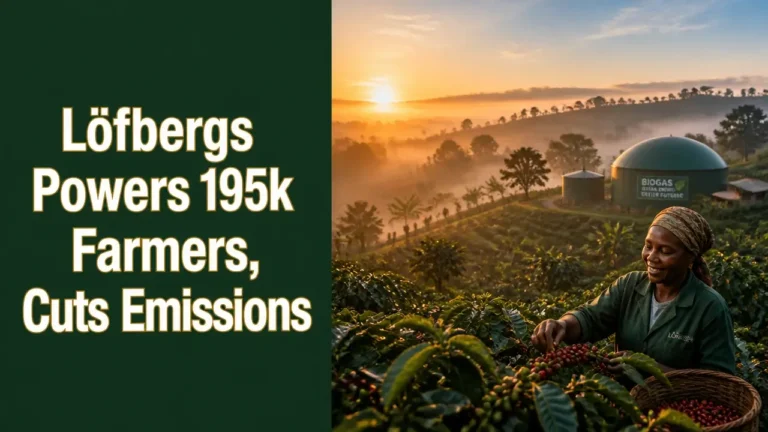

Löfbergs has reported that its sustainability work in 2025 reached more than 195,000 smallholder coffee farmers and delivered sharp emissions cuts across its operations, even as the company describes the year as one of high green coffee prices and climate‑related uncertainty for the global coffee sector. The Sweden‑based roaster published its latest sustainability results on 5 May from Karlstad, outlining farmer support, fossil‑free logistics and packaging changes.
In its official press release, Löfbergs stated that “2025 was another challenging year for the coffee industry. High green coffee prices, extreme weather and uncertain harvests put pressure on the entire value chain,” but said it continued long‑term investments “despite challenging conditions.” According to the same release, the company’s development projects “reached more than 195,000 smallholder coffee farmers,” and generated SEK 42 million (US$4.5 million) in additional Fairtrade premiums to farmers and cooperatives.
Global Coffee Report also reported that Löfbergs contributed SEK 42 million (US$4.5 million) in Fairtrade premiums during the reporting period, repeating the figure given by the company. In that article, Löfbergs CEO Anders Fredriksson is quoted as saying: “For us, quality, business and sustainability go hand in hand, and this year’s report shows that we continue to invest in the future of coffee.” He added that “when the world around us is uncertain, it becomes even more important to stay the course with long‑term efforts.”
On the environmental side, Löfbergs reports several operational changes with quantifiable results. In its press announcement, the company highlights that all of its sea freight was “100% fossil‑free,” which it says reduced emissions by 1,400 tonnes of CO₂. At its roasteries in Karlstad, Sweden, Löfbergs states that returning to fossil‑free biogas cut Scope 1 emissions from its own operations by 43% compared with previous levels.
Waste and packaging were another focus. Löfbergs’ sustainability report notes that waste from its own production fell to 0.28%, and that this waste is now used to produce soil from coffee by‑products. The company also reports that it has “transitioned its entire range of whole‑bean products to mono‑material packaging designed for recycling,” which it links to its broader ambition, reported by Global Coffee Report, to move toward 100% circular and renewable packaging.
Traceability and certification play a central role in the company’s strategy. Löfbergs states in its press release that it now sources “100% traceable coffee.” The same document describes the roaster as “one of the first European companies to purchase coffee certified under Regenerative Organic Certified (ROC),” a label that combines organic, social and soil‑health criteria. Global Coffee Report writes that Löfbergs’ head of sustainability likened this ROC milestone to the introduction of organic coffee to Sweden three decades ago.
The shift toward regenerative organic coffee followed direct engagement with producers, according to Löfbergs. In an earlier report on the company’s ROC purchase, Global Coffee Report quotes Johnny England, Löfbergs’ Green Coffee Trading & Blending Manager, describing how “having seen firsthand the positive feedback from producers adopting regenerative organic agricultural practices on a recent trip to Peru, we took the decision to purchase our first container of ROC coffee earlier this year from SACACLI cooperative in Jinotega, Nicaragua.”
Across these initiatives, both Löfbergs’ own report and Global Coffee Report frame climate change as a major driver of risk. The press release states that climate change is causing “extreme weather, volatile harvests, and soaring green coffee prices that pressure the coffee value chain,” while Global Coffee Report notes that the company views climate change as “the greatest threat to the supply chain” and is targeting farmer resilience through ongoing development projects.