
Volatility in anaerobic coffee market trends often stems from valuing branding over the microbial mechanics that ensure flavor consistency. This mental jam obscures how anaerobic fermentation fundamentally alters mucilage breakdown to create the flavor compounds consumers actually pay for. When you treat market growth as a variable dependent on microbial activity rather than mere hype: the ROI calculation shifts from speculation to biological certainty. Without this link, farmer livelihood remains vulnerable to market fluctuations disguised as stability.
This analysis dissects the systemic logic behind the premium. You will understand the underlying physics of production costs and risk exposure, allowing you to derive profit strategies based on measurable input variables rather than following generic industry instructions. True profitability comes from mastering the process, not just chasing price points.
Why are consumers willing to pay $20‑30 for an anaerobic coffee cup in 2026?
Anaerobic coffee production leverages sealed-tank fermentation metabolites to generate unique flavor profiles that directly justify $20-30 retail price points in the 2026 specialty market. These controlled environments cultivate specific organic acids and esters unavailable in open-air washing, creating a sensory scarcity that buyers actively seek. Market consumption data confirms this chemical differentiation sustains the premium margin without relying on brand hype alone.
You see this play out when customers stop asking about the farm story and start asking about the processing method. They know the tank creates the taste, not just the terrain. The price tag sticks because the cup delivers a consistent intensity that washed coffees struggle to match batch after batch.
- Ester Density: Sealed tanks increase fruity aromatic compounds by limiting oxygen exposure during peak fermentation.
- Acid Modulation: Producers manipulate pH levels to stabilize bright citric notes rather than harsh acetic spikes.
- Sensory Consistency: Controlled variables reduce lot-to-date variation, ensuring the flavor matches the marketing claim.
This shift moves the value proposition from rarity to reliability. A buyer pays the premium knowing the specific flavor notes listed on the bag will appear in the brew. That predictability reduces risk for the café owner and builds trust with the end drinker.
The mechanics behind the cost involve more than just sealing a drum. It requires monitoring temperature curves and gas exchange rates to prevent spoilage while maximizing flavor development. When the process holds steady, the resulting liquid carries a complexity that supports the higher shelf price naturally.
Consumers recognize this difference immediately on the palate. They accept the cost because the sensory return exceeds the baseline expectation of standard specialty coffee. The market rewards the technical precision required to maintain that quality scale.
Anaerobic Process Mechanics: From Sealed Tanks to Co‑Fermentation
Anaerobic fermentation mechanics generate premium flavor profiles by strictly controlling oxygen exposure during bean processing. This sealed environment forces specific biological shifts that unlock exotic taste notes consumers willingly pay extra to experience. Many producers get stuck on the hardware hype, believing the tank itself creates the value, but the real leverage lies in managing the microscopic biology inside. When you understand the root causality, you see that anaerobic fermentation transforms bean flavor through mucilage, origin yeast, and biological filter interactions. The process works because excluding oxygen changes which bacteria survive, shifting the metabolic output from standard acetic acids to complex lactic and carboxylic acids. This biochemical switch is what justifies the price premium, not merely the use of a sealed container.
Anaerobic Fermentation Definition and Parameters
Defining anaerobic coffee starts with the vessel: beans ferment in sealed, oxygen-free containers to dictate microbial activity. Success depends on hitting precise parameters rather than guessing, as slight deviations alter the final cup score significantly. The Mucilage coats the bean surface, providing the sugar substrate that bacteria consume during this oxygen-limited phase. To steer this consumption, Origin yeast drives the conversion of sugars into specific flavor compounds, such as the tropical esters found in high-scoring lots. The sealed Fermenter enables the exclusion of oxygen, creating the necessary pressure and environment for these specific strains to dominate over wild bacteria.
Typical fermentation parameters vary by region, but most premium producers target a duration between 12-72 hours at temperatures around 15-25°C. Altitude also plays a role, with the sweet spot often falling between 1,500-2,200 meters where cooler ambient temperatures assist in slowing down microbial metabolism for cleaner scores. For instance, Lactobacillus plantarum thrives in these oxygen-limited environments at controlled temperatures around 20°C, producing the lactic acid responsible for creamy mouthfeels.
| Coffee Origin | Duration (h) | Temperature (°C) | Altitude (m) | Yeast / Bacterial Strain* |
|---|---|---|---|---|
| Colombia | 24-48 | 18-22 | 1,600-2,200 | Single-origin Champagne yeast |
| Ethiopia | 12-36 | 15-20 | 1,500-2,000 | Lactobacillus plantarum |
| Brazil | 36-72 | 20-25 | 1,600-2,100 | Single-origin Champagne yeast |
| Kenya | 12-24 | 16-21 | 1,500-2,000 | Lactobacillus plantarum |
\*Values are typical ranges; actual parameters may be adjusted based on desired flavor outcomes.
Industry leaders emphasize that removing oxygen is the critical first step to enabling these specific bacterial strains. Felipe Sardi, CEO of La Palma y El Tucán explains the mechanical necessity of this exclusion:
“After depulping the cherries, the coffee is sealed in tanks to remove (or significantly decrease) the presence of oxygen during the fermentation process. This allows facultative anaerobic lactic acid bacteria like Lactobacillus plantarum to thrive.”
This observation by Sardi confirms why maintaining the sealed environment is essential for directing the microbial population toward lactic acid production rather than spoilage.
Anaerobic Co‑Fermentation, Standardization, and Up‑Cycling Innovations
Producers are now layering exotic flavors by adding fruit skins, spices, or hops during the anaerobic stage, a trend known as co-fermentation. Colombian producers lead this shift, using the sealed environment to infuse beans with external aromatics without risking mold growth. Alongside flavor innovation, the industry moves toward standardization using stirred-tank reactors (STR) and starter cultures. This technology ensures traceable data for pH, temperature, and duration, meeting strict sourcing requirements from international buyers. Additionally, producers up-cycle under-ripe coffee cherries during this phase, turning potential waste into yield and adding unique sweetness to the profile.
In this advanced stage, the Biological filter removes unwanted volatile compounds that typically cause defects in open fermentation systems. The modern Fermenter optimizes the infusion process by maintaining consistent pressure and temperature while external ingredients break down. You can see this mechanical process in action below, where producers demonstrate adding external ingredients directly into the sealed environment:
This field-level demonstration shows how physical addition of ingredients combines with biological control to create repeatable, marketable flavor profiles.
What Drives Anaerobic Coffee Production Costs?
A Specialty roaster optimizes profitability by recognizing that sealed-tank infrastructure dwarfs raw material expenses. Most folks assume the green price sets the ceiling, but the machinery required to keep oxygen out dictates the floor. This misconception creates a mental jam where producers underestimate the capital needed to stabilize Flavor development before Sensory calibration even begins.
Research confirms this biochemical reaction requires heavy hardware investment compared to traditional methods.
Data Point: Proportion of total production cost attributable to equipment in anaerobic coffee processing
According to a critical techno-economic analysis of coffee processing utilizing modern fermentation systems, equipment (primarily bioreactors and associated airtight tanks) accounts for roughly 73 % of the total production cost in anaerobic coffee processing. This high share reflects the capital-intensive nature of sealed-tank infrastructure, air-locks, and control systems required for field-level co-fermentation.
To build a realistic budget, you need to break down the specific mechanical and operational drivers behind that 73% figure.
- Raw Materials: The process sources high-quality Bean lots alongside specific yeast cultures and co-fermentation additives like fruit skins or spices.
- Equipment: Stainless-steel sealed tanks often cost $5,000-$20,000 per unit for small-scale operations, requiring additional investment in stirred-tank reactors and pH monitoring sensors.
- Labor: Continuous monitoring of fermentation parameters and tank cleaning drives manpower needs, especially since failure rates can exceed 20% in early trials.
- Operational Risk: High capital requirements and the potential for entire-crop loss demand small-batch experimentation, starting with 2-3 experimental lots of roughly 10 kg each.
While Roasting style enhances the final cup profile, it cannot fix fermentation errors made during these costly stages. The financial exposure here is significant because the system relies on precise biological control rather than passive drying.
Coffee processing expert Bram highlights the human element required to manage this technology.
“It has a steep learning curve, and any mistake can ruin a batch of coffee. Moreover, anaerobic fermentation is more expensive than the more traditional types of coffee processing (natural, washed, and honey). Anaerobic fermentation requires special sealed tanks to be used during the fermentation; these must then be regularly monitored for accurate control of the processed batches, so it requires additional manpower.”
This observation confirms why labor intensity and risk management must be calculated into the cost per pound before you scale. Without accounting for the 20% failure rate and the specialized manpower, the ROI calculation will fail to reflect the true cost of goods sold.
The ROI Equation: Calculating the margins of a $30 Anaerobic Coffee cup
To secure the $20-30 cup price, producers must subtract total production costs from retail revenue while accounting for yield loss. Farmer livelihood grows when Price influences net income and the caffeine Stimulant boosts demand enough to fund Community investment. Most operators skip this math because no quantitative ROI analysis exists for anaerobic coffee projects, leaving producers without a reliable financial-planning framework. Real profit comes from managing variable yield losses between 10-30% rather than chasing perfect sensory scores alone.
Build your financial model by summing every expense before comparing it against income. You need to track specific cost drivers that change with every batch.
- Raw Costs: Sum materials, equipment, labor, and overhead before subtracting from revenue.
- Yield Loss: Account for variable losses between 10-30% during fermentation and drying.
- Market Volatility: Factor in fluctuations in green bean premiums against fixed costs.
Translate the cup price to per-kilogram revenue to see the real scale. A typical 8-oz cup uses ~18-22 g of beans. Yielding roughly $20-30 per cup equals approximately $900-$1,650 per kilogram at retail. Note that cup yield math adjusts for standard SCA brew ratios (1:16-1:18 coffee-to-water). High-end pricing supports $50-150/kg green premiums but not consistently $1,650/kg retail equivalent after markups.
Prioritize profitability over pure quality. Modest quality improvements can still yield high margins if costs stay controlled. The industry often confuses cup score with business viability. A higher score does not guarantee a higher return if the process costs exceed the premium gained.
Consider a 10 kg batch to visualize the break-even point. Assuming 20% loss, break-even occurs at ~150 premium cups. This volume covers the risk of fermentation failure and drying time. Any cups sold beyond this threshold contribute directly to the profit margin.
Peer-reviewed modeling validates these financial risks and capital requirements.
Evidence: The study presents a detailed financial framework for anaerobic coffee processing, quantifying a total capital investment of roughly US $1.4 million for a 45-ton farm equipped with stirred-tank bioreactors. It breaks down cost components, showing equipment costs represent 73 % of total equipment spend and that production costs rise by about $0.74 /kg, with starter cultures accounting for 88 % of this increase. The model links these costs to premium pricing, indicating high-scoring beans (sensory scores 85.5–91.5) can command $15.50–$40.92 /kg (over sixteen times commodity prices) and demonstrates ROI sensitivity, with profit ranging from $0.04 /kg (pessimistic) to $25.32 /kg (optimistic).
Anaerobic Coffee Sustainability Risks Impact Farmer Livelihood
Anaerobic coffee sustainability risks impact farmer livelihood because the Farmer livelihood endures pressure from hidden energy costs and new environmental laws. While Community investment mitigates some social friction, the Stimulant market demand affects production speed, often forcing shortcuts that compromise the Biological filter of the land. You just saw how the ROI looks on paper, but these environmental variables can erase that margin faster than a bad harvest.
Most buyers assume a higher price tag automatically covers sustainable practices. That is a dangerous mental jam. The sealed tanks that create those premium flavors require constant temperature control and monitoring, shifting the burden from water waste to electricity consumption.
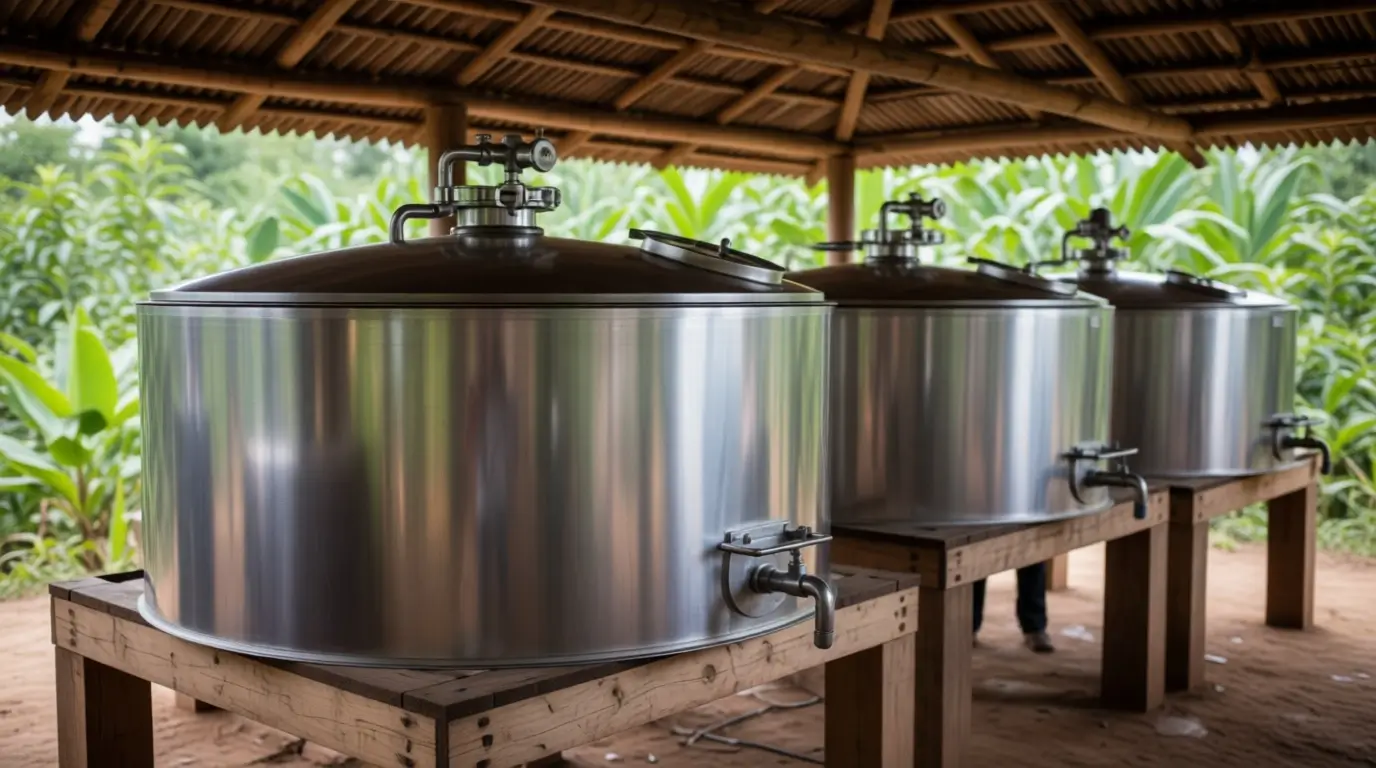
The equipment above illustrates the industrial scale required to maintain anaerobic conditions, driving the energy metrics we need to examine.
- Energy vs. Water Trade-off: Limited studies indicate anaerobic methods can reduce water use by 50-70% but increase energy by 20-40%. The sealed tanks require cooling systems and power for pumps, creating a carbon footprint from equipment manufacturing and transport that washed processes avoid.
- Regulatory Exposure: Sustainability is becoming a brand-risk factor as regulations like the EU deforestation law tighten. Producers facing compliance costs without clear documentation risk losing access to premium markets, directly threatening the profitability model we just calculated.
- Capital and Flavor Risk: High capital investment locks producers into specific outcomes, while the possibility of flavor overload can affect consumer perception. If the fermentation goes too far, the coffee becomes unsellable, turning expensive equipment into stranded assets.
- The Industry Blind Spot: Limited sources address the environmental sustainability of anaerobic processing, a gap that could become a regulatory or brand-risk factor. Competitors overlook this vulnerability now, but future audits will likely expose these missing data points.
- Up-Cycling Potential: One mechanical advantage exists in the up-cycling of under-ripe coffee cherries. Using fruit that would otherwise rot adds value without expanding land use, offering a tangible sustainability benefit to balance the energy ledger.
These hidden costs do not just affect the environment; they rewrite the risk profile of your investment. Understanding this exposure is the only way to build a brand that survives the next regulatory shift.
Building Market Trust: Community Investment, Social Proof, and Sensory Calibration
Consumer demand drives market stability when buyers see tangible value beyond the cup. Community investment enhances brand narrative by linking profit to producer welfare, while Social proof validates the premium price point through external verification. Flavor alone rarely justifies a $30 tag; skepticism dies only when the buyer trusts the system behind the bean.
Many producers assume exceptional cup scores automatically secure loyalty. This overlooks the psychological friction high prices create. A customer paying $20 for a bag of coffee isn’t just buying caffeine; they are buying insurance against disappointment. Trust lowers the perceived risk of purchase. When you remove the fear of inconsistency, the price barrier dissolves.
The workflow below maps how these invisible levers reinforce pricing power.
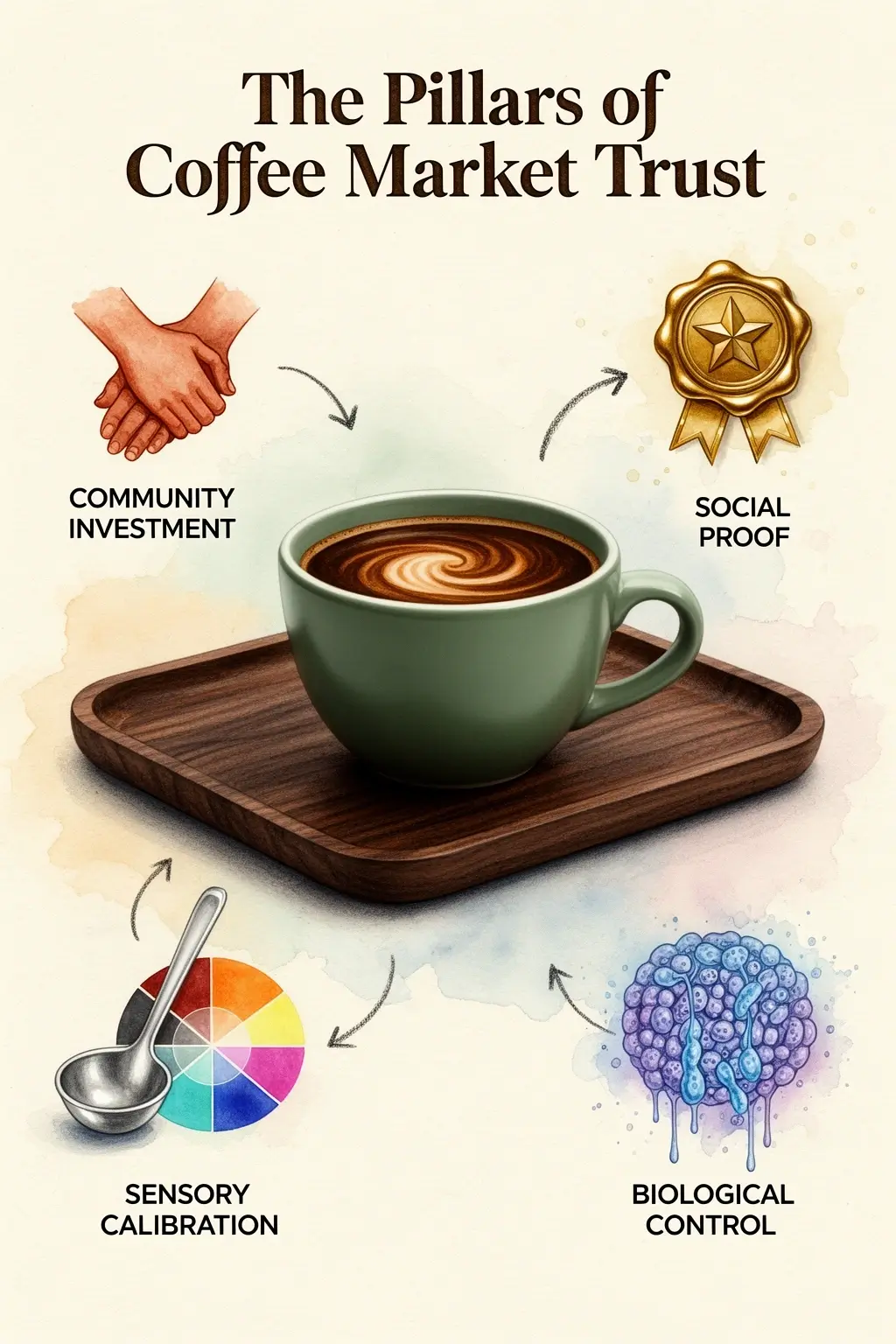
- Community Investment Models: Direct partnerships with local farms and co-ops transform transactions into relationships. Shared-profit models ensure producers see direct returns from premium pricing, which stabilizes supply chains. When buyers know their money supports specific families or regions, Community investment enhances the emotional weight of the purchase, making the cost feel like a contribution rather than an expense.
- Social Proof Mechanisms: Third-party verification removes the burden of self-promotion. Influencer endorsements, transparent consumer reviews, and recognized certifications act as objective anchors. Social proof validates the quality claims you make on packaging. A high score means little if nobody believes it; independent voices confirm the experience matches the marketing, reducing hesitation at the point of sale.
- Sensory Calibration Protocols: Consistency requires rigid measurement standards, not just palates. Implementing standardized cupping protocols, such as SCA protocols, ensures every batch meets the same flavor profile benchmarks. This removes subjective variance between buyers and roasters. When a customer knows the “Anaerobic Blueberry” profile tastes the same in February as it did in June, reliability becomes a sellable asset.
- Biological Filter Control: Flavor consistency starts at the microbial level. Biological filters control microbial activity during fermentation, preventing rogue bacteria from altering the taste profile. This technical guardrail ensures the chemistry inside the tank matches the chemistry in the cup. Without this control, natural variation creates batch inconsistency, which erodes trust faster than any marketing campaign can rebuild it.
- Actionable Implementation Steps: Roasters and green buyers must audit their supply chains for transparency gaps. Start by mapping the profit share visible to the end consumer. Next, aggregate verified reviews and certification data into a single trust dashboard. Finally, mandate biological filtration data in purchase contracts to guarantee flavor stability. These steps convert abstract trust into measurable business logic.
Strategic Outlook: Scaling, Innovation, and the Path to Sustainable Profit
You cannot scale biology without controlling the variables that define it. Anaerobic fermentation propels commercial growth only when you treat the process as a managed system rather than a lucky accident. This distinction matters because mucilage shapes the substrate availability while origin yeast drives the metabolic output inside every sealed fermenter.
Most producers hit a wall here because they assume what works in a five-kilo bucket works in a five-ton tank. That assumption ignores the heat buildup and pressure changes that spoil flavor profiles at scale. You need a roadmap that respects both the biology and the balance sheet.
- 2026 Market Trends: Steady evolution favors co-fermentation with native fruits and up-cycling under-ripe cherries to maximize yield. Standardization via starter cultures and controlled STR methods ensures batch consistency without sacrificing complexity.
- Scaling Friction Points: Equipment costs rise sharply when moving from plastic bags to stainless steel tanks. Risk of batch loss increases without precise temperature-time control protocols to manage exothermic reactions.
To move from experimentation to production, validate your process at a pilot scale before committing capital. Staged investment reduces exposure if a specific flavor profile fails to resonate with buyers. You must align product development with consumer demand for exotic notes while managing operational risks.
The $20-30 premium remains justified, but only with a measurable ROI framework. Controlled process variables and trust-building levers confirm the business case, provided you validate costs site-specifically. This approach secures the margin while protecting the brand from the volatility of uncontrolled biological systems.
Real Talk: What Most People Miss About Anaerobic Coffee
Q: Why does anaerobic fermentation fail 20% of the time even with fancy tanks?
A: It fails because tiny shifts in temperature or pH let rogue bacteria take over the mucilage breakdown, turning your premium batch into undrinkable sludge. The root fix is constant monitoring with sensors, not just buying the hardware–start small with 10kg lots to nail the parameters before scaling, or you’re burning cash on spoiled beans.
Q: What if your co-fermentation with fruit skins goes wrong in a sealed tank?
A: It backfires when added sugars spike fermentation too fast, creating off-flavors like harsh alcohols instead of tropical esters. Control it by dosing ingredients precisely and stirring regularly to distribute evenly; test pilot batches first since high pressure builds heat that kills consistency without active management.
Q: How come high cup scores don’t guarantee you’ll hit that $20-30 cup price?
A: Scores measure flavor peaks but ignore your 73% equipment costs and 20% failure risks eating margins. You’re profitable only if yield losses stay under 15% and buyers trust your consistency–focus on repeatable biology over chasing 90+ scores that don’t pay bills.
Q: What kills farmer profits when anaerobic coffee tanks boost energy bills?
A: Hidden electricity for cooling those sealed tanks offsets water savings, jacking costs 20-40% while new EU regs demand proof you’re not deforestation-linked. Balance it by up-cycling under-ripe cherries to cut waste, but skip scaling without site-specific energy audits or you’ll erode livelihoods.
Q: Why doesn’t scaling from 5kg buckets to 5-ton tanks work like you think?
A: Heat buildup and pressure shifts in big fermenters speed up unwanted reactions, spoiling origin yeast balance and flavor profiles. Fix it with stirred-tank reactors and starter cultures for data-tracked control; validate at pilot scale first or your ‘scaled success’ becomes total crop loss.
Q: How does ignoring biological filters tank your anaerobic flavor consistency?
A: Without them, wild microbes slip in during sealing, degrading mucilage into acrid acids instead of lactic smoothness. They act as your quality gate by filtering defects pre-dry; mandate strain-specific data in contracts to force suppliers to prove control, or every batch varies wildly.