
Espresso grinder longevity splits into four distinct failure categories, and most of the published guidance only measures one of them. Burr wear gets all the attention. The drivetrain, the alignment geometry, and the contamination path get almost none.
What follows is a component-level audit. We work through torque loading, gear material trade-offs, carrier runout, fines migration, and maintenance triggers, then close with a ranked failure hierarchy and a decision rule you can actually apply to your own machine.
Key Takeaways on Espresso Grinder Longevity
- Espresso grinder longevity splits into four failure categories; mainstream guides measure only burr wear, leaving drivetrain failure unaudited.
- Light-roast espresso grinding imposes the highest sustained torque demand because denser beans resist fracture in a narrower shear zone at fine settings.
- Polymer reduction gears fail by tooth shear under sudden overload or by age-hardening after years of thermal cycling, not by gradual wear.
- Burr-carrier misalignment presents as a “can’t dial in” problem and is almost universally misattributed to burr wear; replacing burrs in a tilted carrier changes nothing.
- Fines migration into motor bearings first appears as a grind-quality complaint, not mechanical noise; by the time you hear rumble, the bearing is at end-of-life.
- The only reliable longevity evidence for your specific machine is your own throughput log, service history, and burr wear patterns.
What Actually Fails: Redefining the Espresso Grinder Lifespan Question
Espresso grinder longevity means four different things depending on which component you’re asking about, and the standard discourse conflates all of them into one burr-wear estimate. When someone says their grinder “died,” something specific stopped working. Knowing which category that failure belongs to tells you whether to order a part, call a technician, or buy a new grinder.
The lifespan numbers you’ll find quoted for burr grinders describe burr wear and build class, not the drivetrain that actually stops the machine. That gap is the central problem with every generic longevity guide in this category.
Component Outage Categories and Triage Signals
Four failure categories cover every grinder death, and each one has a diagnostic signature:
- Consumable wear (burr set dulling): rising grind setting for the same recipe, widening particle distribution, longer shot times at a fixed dose. Expected. Budgetable.
- Drive-assembly failure (motor, reduction gear set, bearings, coupling or belt, burr carrier): mechanical noise, intermittent speed, total seizure. Repairable or fatal depending on parts availability.
- Electrical or electronic failure (switch, capacitor, control board, thermal cutout): won’t start, trips mid-grind, runs intermittently without load change.
- Behavioural end-of-life: the grinder functions correctly and is sold, shelved, or traded because the owner upgraded.
The triage framework that follows this taxonomy is simple. Won’t run points to electrical or motor. Runs but drifts points to alignment or gear backlash. Runs but sounds wrong points to bearing or gear. Runs fine but was replaced is behavioural. Each branch implies a different repair decision, which is why the taxonomy matters before you touch anything.
Drive-assembly and mechanical failure lifespan is the single most-requested and least-answered question in practitioner communities. Forums ask it constantly. Mainstream longevity guides skip it entirely.
The behavioural category is also worth naming honestly. A Mazzer Super Jolly reportedly changed hands after roughly three years of ownership, sold near its original purchase price, while the seller framed the transaction as an upgrade rather than a failure. “Upgradeitis” is a real end-of-life mechanism, and it is resale-market dependent, not engineering dependent.
Published Durability Ranges and Evidence Gaps
The baseline the reader already half-knows: commonly cited burr-grinder expectations cluster in a 5 to 7 year band, with well-built commercial units quoted across a far wider 5 to 30 year span. Both figures describe burr sets and construction quality. Neither describes drivetrain service life, because no one has measured drivetrain service life at a population level.
No independent failure statistics or teardown datasets exist for home-class grinders. Any lifespan claim in this category is an estimate built on consensus and anecdote. That includes the figures above, the forum posts you’ve read, and the vendor copy on the product page. The honest answer to “how long does it last?” depends on which component you’re asking about, and the only reliable evidence is your own throughput log.
The Torque Budget: Duty Cycle, Bean Density, and the Light-Roast Penalty
Every spec sheet leads with motor wattage, but wattage tells you almost nothing once the burr is buried in a dense light-roast espresso load. Torque delivery and duty-cycle margin are the numbers that matter, and neither appears on the box.
Load Modeling and Material Resistance
Torque demand is a composite, not a single number. Five variables determine how hard the motor is working at any given moment: bean hardness and density, burr geometry and cutting-edge condition, spindle RPM, dose mass, and grind fineness.
Light roasts carry a specific penalty here. They are denser and structurally more resistant to fracture than dark roasts, which have undergone cell-wall breakdown during extended roasting. At espresso-fine settings, the motor delivers the same energy into a narrower shear zone per unit of throughput. The result is a sustained torque demand that sits higher than the same grinder would see pulling a coarser, darker grind.
The infographic below maps how these load variables interact across a typical espresso session.
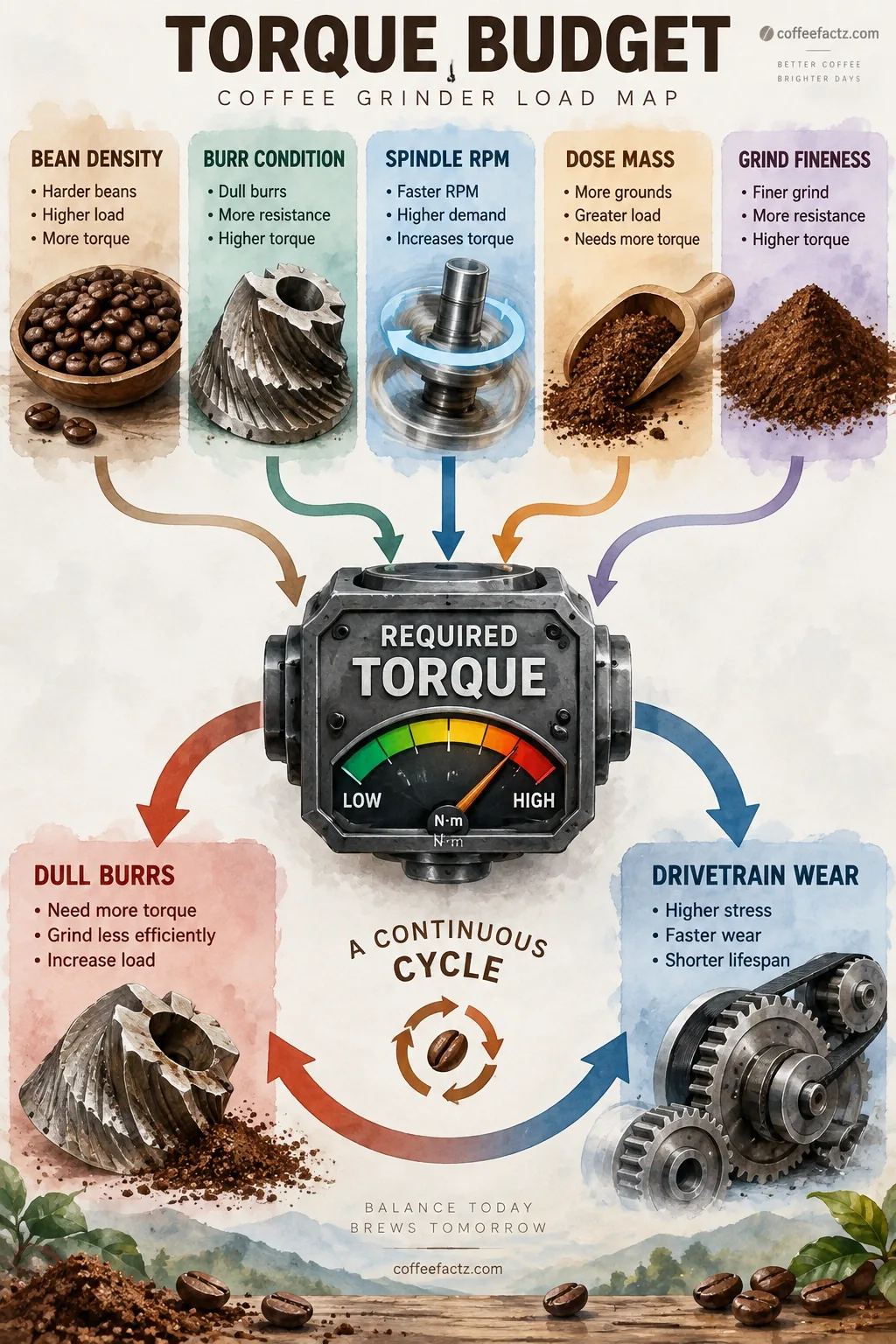
There is also a feedback loop that most longevity guides treat as two separate problems. Dulled or poorly seasoned burrs require more torque to produce the same grind output. That increased torque demand accelerates wear on the drive assembly. The consumable failure category and the mechanical failure category are not independent: burr condition directly loads the drivetrain, and letting burrs run past their service point is a drivetrain maintenance decision as much as a grind-quality one.
Diego Salvatori, PhD researcher at the University of Modena and Reggio Emilia, describes the initial wear phase of burr sets as a period in which the wear rate varies rapidly before stabilizing. He identifies that stabilized period as the functional service life of the burr.
The practical implication: a burr set that has not yet stabilized through its running-in phase, or one that has passed its stable plateau, is generating elevated torque demand at both ends of its life. The drivetrain absorbs that demand silently until it doesn’t.
Operational Thermal Stress and Used-Market History
Duty cycle has a precise technical meaning: grind duration, rest interval, winding and housing thermal soak, and start-up inrush current on each power cycle. The café pattern, continuous multi-pound throughput across a shift, differs fundamentally from the home espresso pattern, which is many short, fine-grind, high-stall-risk pulses across a working day.
The home pattern is not necessarily gentler. Short pulses generate inrush current on every start. Fine settings create high stall risk. Frequent setting changes mean the burr is often grinding outside its optimized shear zone. The motor may never reach the thermal equilibrium that continuous café grinding achieves, but it may accumulate more stall events per pound of coffee ground.
Stall and thermal events are cumulative damage, not isolated incidents. A bog-down at fine settings, a thermal cutout trip, a hot-windings smell, and a stall-and-recover cycle each stress gears, couplings, and windings. None of them produces an obvious single failure. The machine keeps running. The damage accumulates in the reduction stage, the coupling, and the winding insulation, and the failure arrives later with no apparent cause.
This has direct implications for used-market purchases. A prosumer or commercial-grade grinder that looks clean inherits its accumulated duty-cycle history. Cosmetic condition tells you nothing about how many stall events the gearbox absorbed, how many times the thermal cutout tripped, or how much winding insulation degraded. The theoretical reconciliation for why a prosumer unit “shouldn’t” fail in five or six years is duty-cycle margin: café-grade motors and gearboxes are engineered for pounds-per-day throughput while home users grind a fraction of that. But this remains an experimental inference. No expert teardown data confirms it at a population level.
The belief that a prosumer grinder “shouldn’t” fail in five to six years, and that grinder and machine prices should match as a durability signal, are social expectations rather than engineering findings. Durability is settled by load and duty cycle.
Reduction Gears: Nylon vs. Metal and the Overload Failure Chain
Most owners know their grinder has a gearbox. Almost none can name what the gears are made of, and that material choice is where the first hard failure typically originates.
Polymer and Alloy Drive Components
The reduction stage does one thing: it steps a high-RPM, low-torque motor output down to a burr-appropriate RPM while multiplying torque. The drive path in most conical and flat espresso architectures runs from the motor pinion through one or more intermediate stages to the output carrier that seats the burr. The reduction stage sits directly adjacent to the burr chamber, which matters for contamination reasons addressed in a later section.
The photo below shows a typical reduction gearbox layout with both polymer and alloy components visible.
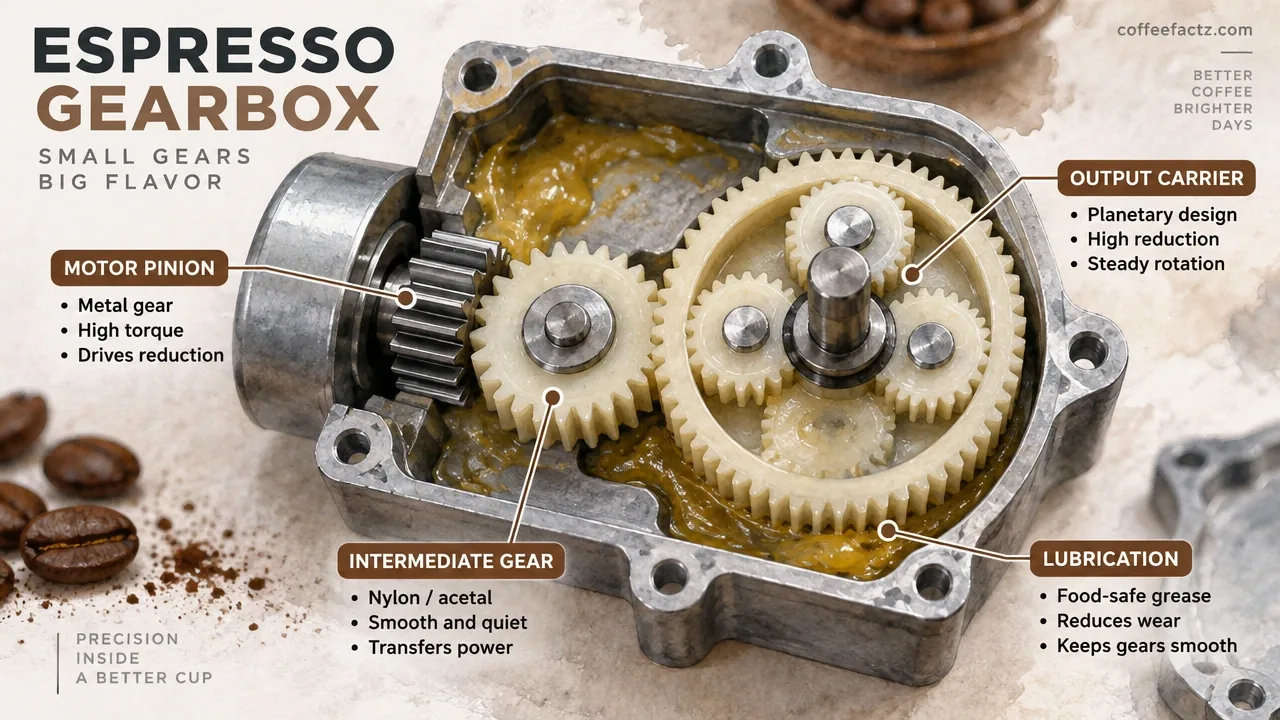
Nylon and acetal gears are an engineering trade-off, not a cost-cutting shortcut. Polymer gears run quiet, absorb shock loads that would crack a metal tooth, are partially self-lubricating, and do not score their mating metal surfaces. They fail by tooth shear under sudden overload or by creep and age-hardening under sustained thermal exposure. Age-hardened nylon loses its shock-absorption property and becomes brittle, so a gear that survived five years of normal use may shear on the first stall event in year six.
Metal gears tolerate sustained heat and load better, do not creep, and maintain dimensional stability across a wider temperature range. The trade-offs are real: they are louder, depend on correct lubrication to prevent scoring, wear their mating surfaces over time, and transfer shock directly into the motor shaft and bearings rather than absorbing it. A metal gear train in a machine with a worn motor bearing will accelerate bearing damage faster than a polymer train would.
Naoaki Oka and Seiichiro Katsura at Keio University examined grinder speed control precision and found that servo-based speed control produced smaller speed error and reduced variance in particle size distribution compared to conventional full-wave rectified DC motor control. The improvement in speed stability translated directly into more consistent grind output.
The engineering point here is that speed stability at the output carrier, whether maintained by the motor control system or by a tight, well-lubricated reduction stage, determines grind consistency. Gear wear and backlash growth degrade that stability from the mechanical side, independent of whatever the motor control circuit is doing.
Tooth Shear and Lubrication Diagnostics
The failure chain from overload to secondary damage follows a predictable sequence. An overload event, a hard stall on a dense light-roast espresso dose being the most common in home use, either shears a tooth outright (sudden, total failure) or initiates progressive backlash growth as tooth faces deform. Backlash growth causes burr-speed variation, grind-setting drift, chatter at the carrier, and increased radial load on the carrier bearing. That secondary radial load accelerates misalignment damage, which is addressed in the next section.
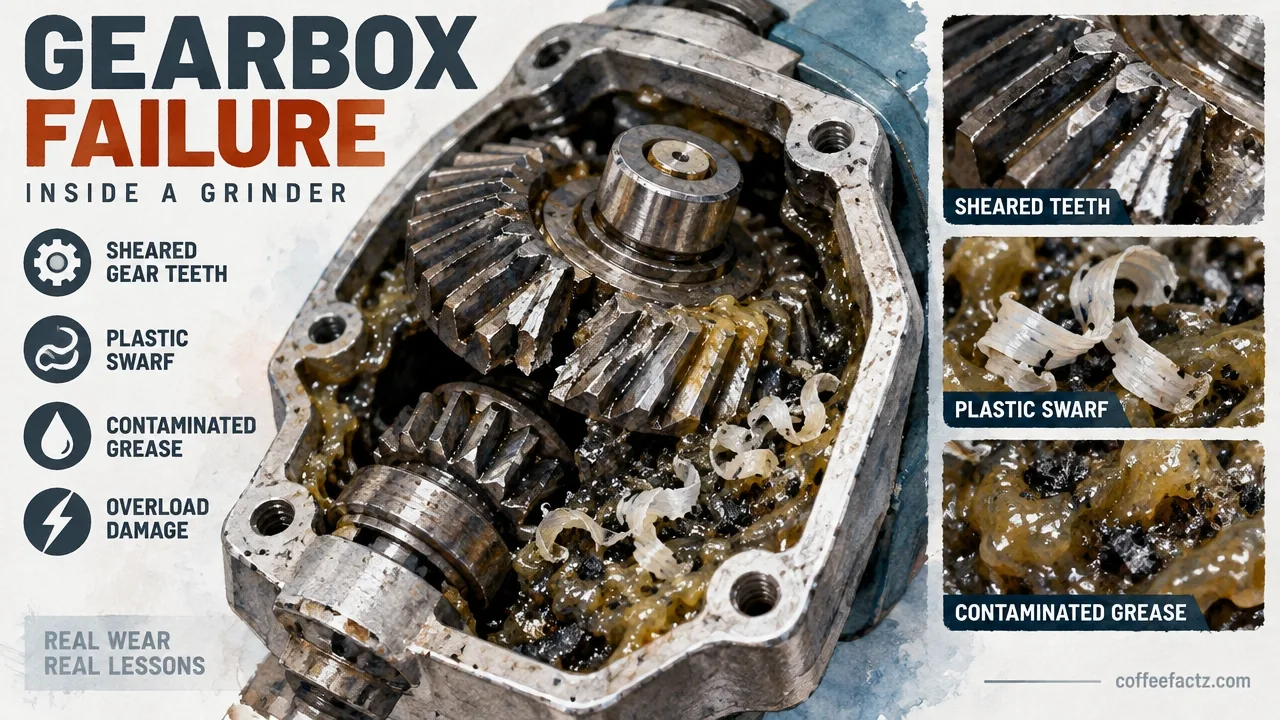
Lubrication is its own failure variable, independent of gear material. Over-greasing traps fines and forms an abrasive paste. Under-greasing allows metal-to-metal contact on the tooth flanks. Grease migration away from the mesh point, which happens in high-cycle applications as centrifugal force slings lubricant to the gear periphery, leaves the contact zone dry. Contamination ingress from the burr chamber introduces coffee fines and oils into the grease matrix, which changes its viscosity and abrasive properties. Each condition produces a different failure signature.
The observable diagnostics that signal gear problems, in order of increasing severity:
- Plastic swarf in the burr chamber or chute (polymer tooth material migrating upstream)
- Metallic or hot-winding smell during or after grinding
- Audible pitch change or whine under load that was not present when the machine was new
- Intermittent consistency at a fixed grind setting with no recipe change
- Hand-rotation backlash check with the machine unplugged: grip the top burr carrier and rotate it gently in both directions; perceptible free play before the motor shaft engages indicates backlash in the reduction stage
Zedong Mao at the University of Warwick found that gear wear is sensitive to yaw and pitch misalignments, which degrade conjugate contact action, but insensitive to radial and axial misalignments. Yaw misalignment produces characteristic scoop wear marks near tooth pitch points, while pitch misalignment causes superimposed palisade wear marks and micro-cracks near tooth roots.
In a grinder context, this means burr-carrier misalignment, the subject of the next section, feeds back into gear wear through altered tooth contact geometry. The two failure modes are not sequential; they compound each other.
Carrier Misalignment and Thermal Expansion: The Micron Drift Problem
Burr-carrier alignment is not a factory condition that holds indefinitely. It is a live variable that degrades with gear wear, thermal cycling, and mechanical shock, and its degradation appears in the cup years before it appears on a parts list.
Concentricity and Runout Geometry
Alignment has two components that are easy to conflate. Static alignment is the geometric relationship between the burr carrier and the motor shaft when the machine is cold and at rest. Dynamic runout is the deviation of the carrier’s rotational axis from the true center line during operation, which includes contributions from bearing play, shaft flex, and gear backlash.
The infographic below illustrates how these two conditions produce different gap geometries at the burr face.
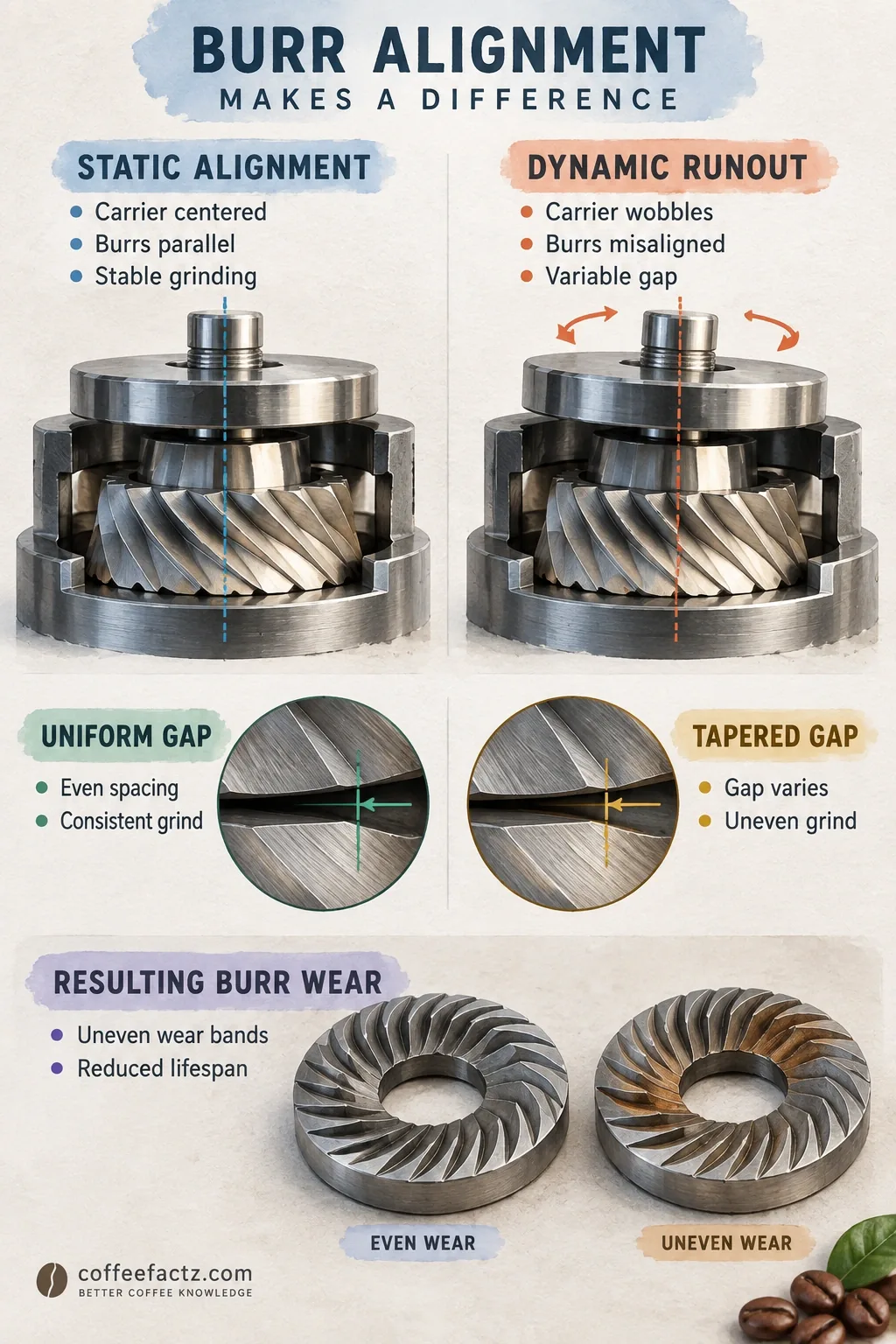
A uniform circumferential burr gap means every point on the burr face is equidistant from its opposing surface throughout the rotation. A tilted or eccentric carrier produces a gap that varies around the circumference: one arc of the burr face is grinding finer than the opposite arc on every revolution. The particle-size distribution that results is not a single peak; it is a composite of two overlapping populations.
Maxwell Colonna-Dashwood, Q-grader and shop owner, notes that burr alignment can be assessed audibly by closing the burr aperture with the grinder running and listening to the chirp. A deeper chirp indicates more contact area between the burrs and therefore better alignment.
Downstream, misalignment produces: wider particle-size distribution, session-to-session shot-time inconsistency at a fixed recipe, and channeling that appears only at fine settings where the gap variation represents a larger fraction of the total gap. Diagnostically, uneven burr wear bands visible when the burr set is removed for replacement are direct physical evidence of a carrier that has been running tilted. The wear band is narrow on the side where the gap was wider and deep on the side where the gap was tighter.
Alignment degradation is the most misattributed failure mode in home espresso. It presents as a “grinder can’t dial in” problem, and the standard answer is burr replacement. A new burr set in a tilted carrier produces the same distribution problem within a few sessions. The carrier geometry is the actual variable.
Heat-Induced Gap Changes and Measurement
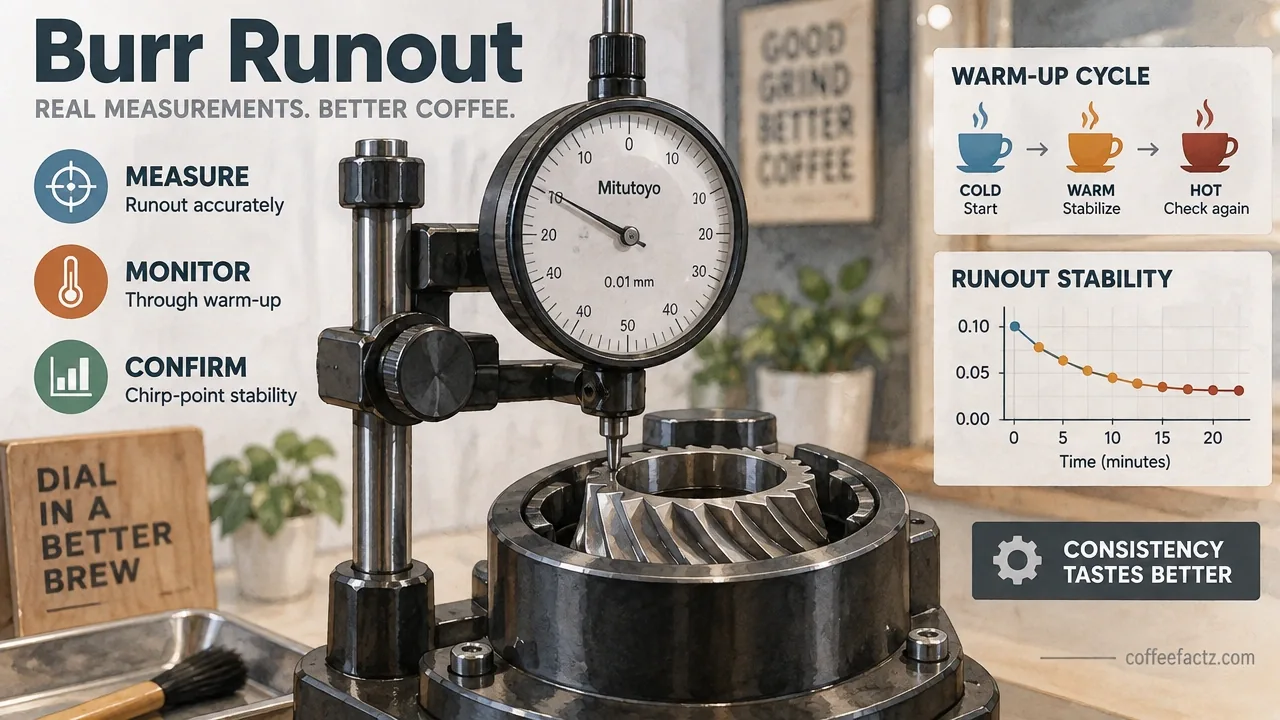
Thermal expansion adds a second layer of alignment variability that operates independently of static misalignment. The burr carrier, the burrs themselves, and the grinder housing are made of different materials with different coefficients of thermal expansion. As grinding heat and motor soak accumulate across a session, each component expands at a different rate. The effective burr gap changes. An alignment that is correct when the machine is cold is not necessarily correct after twenty minutes of continuous use.
At coarse settings, this effect is negligible relative to the gap size. At espresso-fine settings, where the gap may be measured in tens of microns, a small dimensional change converts directly into visible grind drift and shot-time variation. This is the mechanism behind the common observation that the first shot of a session pulls differently from the third or fourth.
The inspection protocol for alignment issues:
- Hand-rotation feel (machine unplugged): rotate the top burr carrier slowly through a full revolution and feel for tight spots, resistance variation, or lateral wobble. Any of these indicate runout or bearing play.
- Dial indicator measurement: where housing geometry allows access, a dial indicator against the burr face or carrier OD across a full rotation quantifies runout directly.
- Chirp-point stability test across a warm-up cycle: note the chirp point cold, then recheck after five and ten minutes of operation. A chirp point that migrates indicates thermal gap change.
- Wear-pattern reading at burr replacement: examine the wear band width and depth around the full circumference of the removed burr. Uneven wear is the historical record of carrier misalignment during that burr’s service life.
Model-level alignment data for specific platforms, such as the Eureka Atom or similar prosumer units, is not published anywhere in the practitioner literature. You will not find it. The inspection protocol above is how you generate that data for your own machine and log it against your service history.
Fines Migration into Motor Bearings: The Contamination Path
Fines migration is the mechanism that connects grinding-media degradation to drivetrain destruction, and it operates through pathways that are invisible during normal use. The earliest warning is acoustic, not visual.
The migration path starts at the burr chamber. Fines escape through chute gaps, vent openings, and the clearances around the burr carrier shaft. Cooling airflow drawn past the burr carrier by the motor fan actively transports particles toward the motor. Static-driven adhesion deposits fines on chamber walls, where they accumulate until a vibration or airflow event dislodges them further into the machine. Darker or flavored roasts add oil to this process: oil-coated fines form a paste that travels further and adheres to surfaces that dry particles would not reach.
Single-dosing and retention workflows each carry a specific risk. High-retention grinders leave resident fines in the burr chamber between sessions; those fines migrate on subsequent grinds. Single-dosing workflows that involve frequent bean changes and setting adjustments maximize the number of migration events per session, since each change involves a purge that moves fines through the system.
Once fines reach a motor bearing, they act on the bearing grease in two ways simultaneously. Hard particles embed in the grease matrix and function as an abrasive. Finer particles and oil act as a wick, drawing lubricant out of the bearing race and into the surrounding cavity. The result is lubricant starvation at the contact surface.
A peer-reviewed experimental study in Tribology in Industry tested grease-lubricated ball bearings contaminated with solid particles and found that hard contaminants such as silica and iron sand induced two-body and three-body abrasive wear, producing scuffing, dents, and material removal. Soft contaminants altered grease lubricating properties and triggered starvation through lack of lubricant. In both cases, solid particles accumulated in the inlet contact area, producing high friction and elevated bearing temperature.
Coffee fines span both categories: silica-bearing cell-wall fragments behave as hard abrasives, while oils and soft organic matter alter grease viscosity and promote starvation. The bearing damage mechanism is not theoretical.
The sequence of bearing degradation presents as a grind-quality complaint first, not a mechanical complaint. Increased radial play from a worn bearing changes the dynamic runout of the burr carrier, which produces the same downstream effects as static misalignment: wider particle distribution, shot-time inconsistency, channeling at fine settings. The owner replaces burrs. The problem continues. Eventually the bearing noise becomes audible: a low rumble on spin-down, or a roughness felt through the housing. By that point, the bearing is not recoverable by cleaning.
Espresso work concentrates this risk specifically. Fine grind settings generate the highest proportion of sub-100-micron fines inside the smallest practical chamber volume. High duty density, many short grinds with frequent bean and setting changes, maximizes migration opportunity per session compared to any other brewing method.
The prevention set is straightforward:
- Minimize resident chamber volume through single-dosing practice and end-of-session purges
- Purge the chute between setting changes, not just between sessions
- Service or replace vent filters where the design allows access
- Avoid running a clogged chute: backpressure redirects fines into the machine rather than out through the spout
- Do not over-grease a serviceable gearbox: excess grease migrates, traps fines, and becomes the contamination vector rather than the lubricant
- Listen for rumble at every cleaning session, not only when a grind complaint emerges
A bearing that is already rumbling is not recoverable by cleaning. The intervention at that point is bearing replacement or professional service. The acoustic early-warning habit matters more than any cleaning product because it moves the intervention point from replacement to prevention.
Preventative Maintenance Cycles: Auditing Before Failure
Preventative maintenance for an espresso grinder is not a cleaning schedule. Cleaning is one component. The maintenance cycle is a mechanical audit that uses load-based triggers rather than calendar intervals, because load is what actually determines component wear.
Replace Calendar Thinking with Throughput Thinking
Log grams per day. Convert to accumulated throughput over time. Use that figure to trigger burr replacement. The widely cited 1,000 lb heuristic for burr replacement is a load trigger for the consumable, not a machine-life estimate. A grinder used for two shots daily accumulates throughput at a very different rate than one used for twenty. Calendar intervals, whether monthly or annual, are a proxy for throughput that breaks down the moment usage patterns change.
The same throughput logic applies to the drive assembly. A machine that has ground 800 lb of light-roast espresso at fine settings has a different accumulated torque and thermal history than one that has ground 800 lb of medium-roast filter coffee. The throughput log is the only evidence base you have for component-level decisions.
Hygiene Cadence
- End of day: empty the hopper and purge the chamber to prevent stale resident grounds from migrating overnight
- Every two weeks: burr-chamber cleaning using the manufacturer’s approved method and cleaning media; reduce to weekly if you grind daily, use oily or dark roasts, or run a high-retention grinder
- Between setting changes: chute purge to clear resident fines before they migrate on the next session
Do not substitute improvised abrasive purges for the manufacturer’s approved cleaning media. Abrasive particles that are not matched to the burr geometry and chamber materials become fines-migration feedstock.
Mechanical Inspection Cadence
This is a distinct activity from cleaning and should be logged separately:
- Hand-rotation feel (unplugged): check for tight spots, lateral wobble, and backlash at the carrier
- Carrier runout where access permits: use a dial indicator or the chirp-point stability test described in the alignment section
- Burr retaining-screw torque: loose screws allow the burr to shift on the carrier, generating both alignment error and vibration damage
- Gearbox grease condition on serviceable units: check for migration, contamination, and quantity at the service interval
- Bearing noise on spin-down: listen for rumble or roughness as the burrs coast to a stop after power-off
- Vent filter condition: replace or clean per the manufacturer’s interval; a clogged filter redirects fines into the machine
- Thermal-cutout behaviour: a cutout that trips more frequently than it used to indicates either increased load (burr wear, gear wear, bearing drag) or degraded winding insulation
The video below demonstrates a full cleaning and inspection cycle on a single-dose commercial grinder, including the disassembly steps that expose the gearbox and bearing access points.
Early-Warning Action List
Map symptoms to mechanisms, not to cleaning tasks:
| Symptom | Mechanism | Action |
|---|---|---|
| Intra-session shot-time drift | Thermal expansion or alignment drift | Chirp-point test across warm-up cycle; carrier runout check |
| Rising grind setting for the same recipe | Burr wear or torque increase from gear backlash | Log throughput; assess burr and backlash together |
| New rumble on spin-down | Fines contamination in bearing | Listen at next session; if persistent, schedule bearing service |
| Pitch change under load | Gear wear or bearing drag | Hand-rotation backlash check; inspect gearbox if serviceable |
| Visible swarf in chute or chamber | Tooth shear in polymer gear | Disassemble and inspect reduction stage before next use |
| Thermal cutout tripping | Increased load or winding degradation | Identify load source before assuming electrical failure |
Service-History Log
Record date, accumulated throughput since last service, part replaced, and observed condition at each intervention. This converts repair-versus-replace decisions from memory-based guesses into evidence-based judgments. A log that shows three burr replacements, two gearbox grease services, and one bearing replacement across a known throughput figure tells you exactly where the machine sits in its component life. Brand-level claims tell you nothing about your specific machine’s history.
The Longevity Verdict: Building a Realistic Failure Hierarchy
After auditing load, gears, alignment, contamination, and maintenance, the single lifespan number you started searching for resolves into a ranked failure hierarchy rather than one figure. Here is that hierarchy in order of practical incidence for home espresso use.
First: burr sets. The designed consumable. Replacement is load-triggered at roughly 1,000 lb of accumulated throughput, though the actual figure varies with roast density, grind fineness, and burr material. Predictable, budgetable, and the only failure mode that the mainstream longevity literature actually describes with any accuracy.
Second: drive assembly. Reduction gears, motor, and bearings under sustained torque and thermal duty. This is the failure mode that the lifespan discourse does not measure. Polymer gears fail by tooth shear or age-hardening. Metal gears wear their mating surfaces. Motors accumulate winding insulation degradation from thermal cycling and inrush current. The timeline is load-dependent, not calendar-dependent, and it is not separable from burr condition because the two categories are mechanically coupled.
Third: bearing contamination via fines migration. Presents as a grind-quality complaint first. By the time it presents as mechanical noise, the bearing is already at end-of-life. The intervention window is the acoustic early-warning period, and missing it converts a bearing replacement into a motor replacement or a chassis write-off.
Fourth: alignment and thermal drift. Degrades the cup years before it destroys parts. Misattributed to burr wear almost universally. Corrected at the carrier level, not the burr level.
Fifth: behavioural end-of-life. Functional hardware sold or shelved because the owner upgraded. Not a mechanical event. Call it what it is.
The Honest Lifespan Answer
Category figures, burr-grinder expectations in a mid-single-digit-year band and well-built units across multi-decade spans, describe burr life and build class. They are not measured drivetrain service life, and they cannot be, because no independent failure statistics or teardown datasets exist for home-class grinders. Any MTBF-style number attached to a specific grinder model is an inference, not a measurement. That includes every claim in this audit.
The only reliable evidence is your own throughput log, service history, and burr wear patterns. A logbook built from your own machine beats any brand-level claim because it is actual evidence about the specific chassis, duty cycle, and load history you are asking about.
The Decision Rule
Identify which category failed. If it is a consumable, replace and continue. If it is a serviceable drive component, price the part against the machine’s remaining value and the availability of a parts path. If the failure is a non-serviceable bearing or seized gearbox in a chassis with no parts supply, the machine is at end-of-life regardless of how the rest of it looks. If the machine is functional and the impulse is an upgrade, call it behavioural end-of-life and make the decision on those terms rather than manufacturing a mechanical justification.
Grinder longevity is not a brand property or a spec-sheet figure. It is a load and duty-cycle outcome, and every lifespan claim you have ever read is a description of that outcome, usually with the mechanism left out.
Frequently Asked Questions About Espresso Grinder Longevity
What is the average lifespan of a burr grinder?
Commonly cited figures cluster in a 5 to 7 year band for consumer units, with well-built commercial-grade machines quoted across a far wider range. These figures describe burr wear and construction quality, not drivetrain service life, and no independent failure dataset exists to validate them as population averages.
What is the lifespan of a grinder’s burr set specifically?
The widely used heuristic is roughly 1,000 lb of accumulated throughput, but the real trigger is grind quality, not a calendar date. Roast density, grind fineness, and burr material all shift that figure, and a throughput log is the only way to apply it accurately to your machine.
How do I know if my grinder’s gearbox is failing rather than the burrs?
Check for plastic swarf in the burr chamber or chute, an audible pitch change or whine under load, intermittent grind consistency at a fixed setting, and perceptible free play in the carrier when you rotate it by hand with the machine unplugged. Burr dulling produces rising grind settings and wider shot times; gear failure produces noise, swarf, and mechanical inconsistency.
Does buying a prosumer or commercial-grade grinder guarantee longer drivetrain life?
Not automatically. Commercial-grade motors and gearboxes are engineered for pounds-per-day throughput, which gives them substantial duty-cycle margin at home use levels. But a used commercial unit inherits its accumulated duty-cycle history, and cosmetic condition tells you nothing about stall events, thermal cutout trips, or winding degradation that occurred under previous ownership.
Why does my shot time drift across a session even when I haven’t changed anything?
Thermal expansion is the primary mechanical cause. The burr carrier, burrs, and housing expand at different rates as grinding heat accumulates, changing the effective burr gap across a session. At espresso-fine settings, that small dimensional change converts directly into visible grind drift. A chirp-point stability test run cold and then again after ten minutes of operation will tell you how large the gap change is on your specific machine.
What is the best long-lasting coffee grinder?
Longevity is a load and duty-cycle outcome, not a brand property. A well-built grinder run at appropriate duty, with timely burr replacement and regular mechanical inspection, will outlast a nominally superior machine that is stalled repeatedly on dense light-roast doses. The maintenance log matters more than the badge on the hopper.
Can I recover a bearing that has started to rumble by cleaning or re-greasing it?
No. A bearing that is producing audible rumble has already undergone abrasive wear at the contact surfaces. Cleaning removes contaminated grease but does not restore the bearing geometry. Re-greasing delays further damage briefly. The correct intervention is bearing replacement or professional service, which is why catching the acoustic warning before it becomes rumble is the only effective strategy.
How does single-dosing affect grinder longevity compared to hopper feeding?
Single-dosing reduces resident fines in the burr chamber between sessions, which lowers fines migration into the motor bearing. It also involves more frequent bean and setting changes, which increases the number of purge events and migration opportunities per session. The net effect depends on workflow discipline: a single-doser who purges the chute between changes and cleans weekly is reducing contamination risk; one who skips purges is increasing it.
References
- Tesi di Dottorato definitiva Diego Salvatori – Running-in and Burr Wear | iris.unimore.it
- Naoaki Oka and Seiichiro Katsura – Coffee Grinder Speed Control and Particle Size Distribution | exa.ai
- Zedong Mao – Investigation of Misalignment Effects on Gear Wear, University of Warwick | wrap.warwick.ac.uk
- Maxwell Colonna-Dashwood – Burr Alignment and Chirp Assessment | pmc.ncbi.nlm.nih.gov
- Tribology in Industry – Wear Patterns on Ball Bearings Lubricated by Grease Contaminated with Several Large Solid Particles | tribology.rs