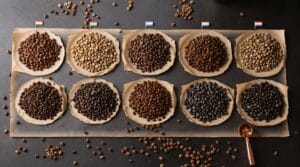

Arabica coffee earns its specialty premium not from a single decision but from a chain of interdependent ones, each stage either protecting or squandering what the previous stage built. The flavor in your cup was fixed months or years before the roaster touched the drum.
Understanding that chain, from the genetics locked in a nursery seedling through the microbial activity inside a fermentation tank to the soluble transfer happening in your brew vessel, is what separates a buyer who reads a cupping score from one who can actually evaluate a lot. This manual covers every link.
Key Takeaways on Arabica Coffee
- Coffea arabica is a tetraploid hybrid of C. canephora and C. eugenioides, which explains both its flavor complexity and its narrow genetic base that makes it vulnerable to rust and climate shifts.
- Flavor precursors, primarily sucrose, amino acids, and organic acids, are built during cherry development at altitude and accumulate faster where diurnal temperature swings are wider.
- Nursery propagation method determines cultivar identity; when a nursery cannot state its propagation route, lot traceability effectively does not exist upstream of the mill.
- Fermentation is a microbial and enzymatic process governed by temperature, pH, duration, and inoculum, not a passive waiting period, and over-fermentation produces defects that no roast profile can correct.
- Green coffee moisture content between 10-12% is a stability threshold: above it, mold risk rises; below it, beans fracture during hulling and grind unevenly in the drum.
- A finished espresso represents approximately 2% of the original cherry biomass, which means every stage in the chain is an irreversible quality decision, not a reversible one.
The Species Blueprint: What Coffea arabica Is and Why Its Biology Sets the Ceiling
Coffea arabica is a specific biological entity with a narrow genetic base, not a marketing category. When you buy arabica, you’re buying the output of a plant with defined biochemical limits, specific climatic tolerances, and structural vulnerabilities that no processing method or roast profile can override. Every quality ceiling in specialty coffee is set here, before the seed leaves the nursery.
Taxonomic Position and Biochemical Differentiation
Coffea arabica sits in the Rubiaceae family as an understory evergreen native to the Ethiopian highlands, now cultivated across the equatorial belt between the Tropics of Cancer and Capricorn. Against Coffea canephora (robusta), the differences aren’t just marketing copy. They’re measurable and consequential.
Arabica carries roughly 1.2-1.5% caffeine by dry weight, against robusta’s 2.7%. It holds higher lipid and sucrose concentrations, which directly support the brighter perceived acidity, more complex aroma, and heavier mouthfeel that specialty buyers pay differentials for. Its bean structure is thinner and denser at altitude, and it’s self-pollinating, which makes it genetically stable but also narrows its gene pool. That narrow base is exactly why arabica is so susceptible to leaf rust (Hemileia vastatrix) and why rust outbreaks move through monoculture farms with so little resistance.
Here’s the part most origin stories omit: Coffea arabica is itself a hybrid. It originated from a natural cross between C. canephora and C. eugenioides, which is why it carries a doubled chromosome set (tetraploid, 2n=44) while most other Coffea species are diploid. That hybrid origin explains both its flavor complexity and its structural vulnerability. The genetic base is narrow because the founding cross was narrow. Rust, climate shifts, and disease pressure all exploit the same bottleneck.
Working Vocabulary and Commercial Supply Context
The vocabulary matters because every section of this manual depends on it. A coffee cherry is a botanical fruit. Inside it, surrounding the seeds, is the mucilage, a pectin-rich, sticky fruit layer that is central to fermentation. Around each seed sits the parchment, the hard endocarp shell. Strip that away after drying and you have green coffee, which is a dried, hulled seed. The thing everyone calls a “coffee bean” is a seed inside a fruit, not a nut, not a legume.
At commercial scale, coffee is one of the most heavily traded agricultural commodities on earth. Dozens of producing origins operate distinct harvest calendars, which means origin is a buying variable independent of species. A Colombian lot and an Ethiopian lot are both arabica, but they arrive at different times of year, carry different flavor profiles, and sit on different contract timelines.
Of roughly 130 identified Coffea species, only two support meaningful cultivation and trade. C. arabica accounts for approximately 60% of global production and C. canephora for approximately 40%. The supply base behind that 60% is fragmented: roughly 25 million smallholder farmers manage approximately 60% of coffee farms worldwide. Supply risk in arabica is therefore relational and localized. When a farm fails, there’s no industrial backup lot sitting in a warehouse. That reality makes origin relationships a supply-chain mechanism, not a values statement.
Nursery, Germination, and Propagation: From Hypogeal Seed to the Epigeal Soldier Seedling
Coffee propagation begins with a decision that locks in genetics for the life of the farm. Whether you’re sourcing seedlings or advising a producer, understanding what happens in the nursery window explains why traceability either starts here or doesn’t exist at all.
Clonal and Open-Pollinated Multiplication Routes
Two propagation routes exist, and they produce fundamentally different outcomes. Seed propagation from selected mother trees works for open-pollinated cultivars, where natural genetic variation is acceptable or even desirable. The mother tree selection matters: seeds from a high-yielding, disease-resistant tree with a documented cup profile carry those traits into the next generation, probabilistically.
Vegetative propagation by cuttings or grafting produces clonal copies of a specific plant. This is the only reliable route for F1 hybrid cultivars, which cannot be seed-propagated true to type. When you plant F1 hybrid seeds, you get a genetically mixed population. When you plant F1 cuttings, you get the parent. Grafting adds a further variable: rootstock selection for disease resistance or soil adaptation, with the scion providing the cup genetics.
The nursery hygiene piece gets underweighted in most cultivation guides. Damping-off fungi, nematodes, and bacterial blights spread through contaminated propagation media and shared trays. A disease pressure event in the nursery isn’t a housekeeping failure. It’s a yield decision that plays out three to five years later when the affected seedlings underperform in the field.
For buyers: when a nursery source cannot state its propagation method, it cannot state what cultivar is being delivered. Lot traceability starts at the nursery bench, not at the wet mill.
The total elapsed time from seed to first meaningful crop runs to 3-5 years when you add the nursery window of 6-9 months to field establishment and early bearing. “Plant to cup” is measured in years. That timeline is why forward contracts and producer relationships carry weight that spot buying cannot replicate.
Sprouting Morphology and Early-Stage Husbandry
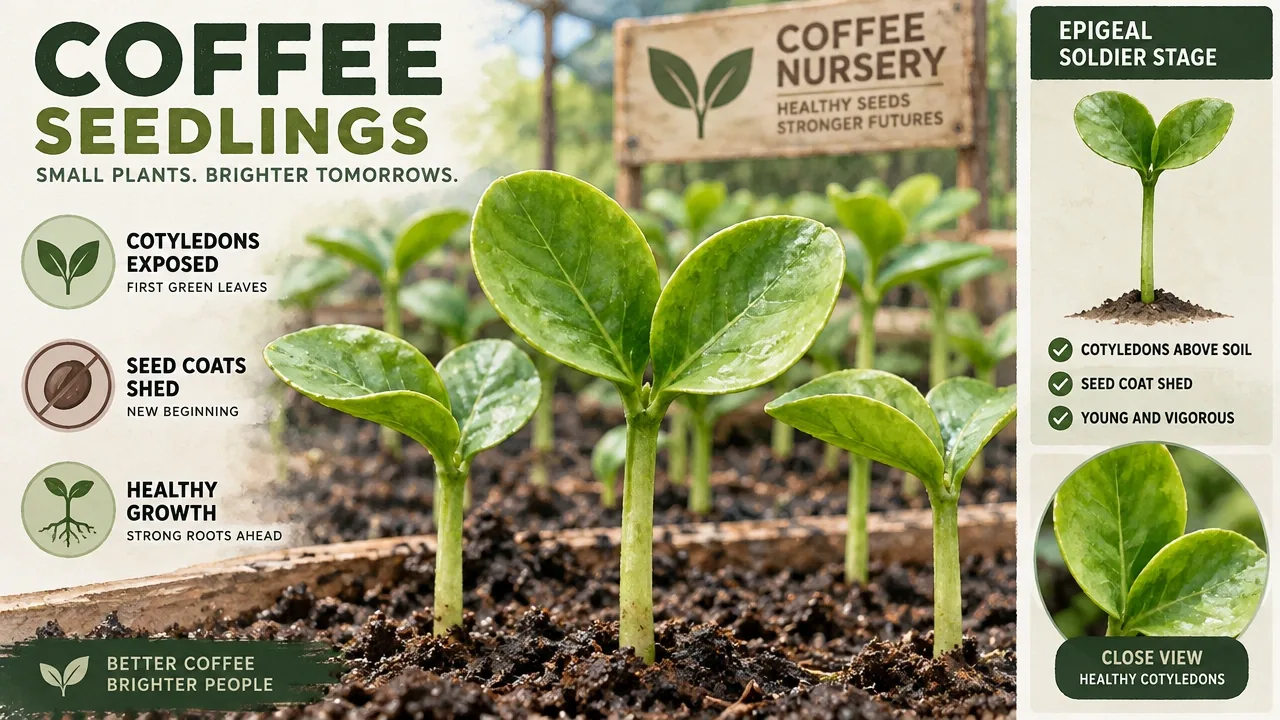
Coffee germinates hypogeal: the cotyledons stay below the soil surface while the hypocotyl arches upward in a characteristic hook shape. This is the stage growers call the “matchstick.” When the seedling straightens and sheds its seed coat, the cotyledons emerge above ground. This is the epigeal “soldier” stage, named for the upright posture the seedling holds with its two rounded cotyledons exposed. It’s a reliable visual checkpoint for nursery timing.
The nursery management window runs 6-9 months. Sowing should be timed so seedlings reach transplant readiness at the onset of the rainy season, giving the young root system the moisture it needs to establish without supplemental irrigation. Staged shade, typically 50-70% at sowing, reducing as the seedling develops, buffers light and temperature extremes. Irrigation frequency tracks soil moisture, not a fixed schedule. Hardening off before transplant, a progressive reduction in shade and irrigation over several weeks, conditions the seedling for field conditions and reduces transplant shock.
At out-planting, root system handling is the critical variable. J-rooting (where the taproot bends back on itself in a too-small hole) produces a structurally compromised tree that never achieves full productivity.
One fact that surprises most people outside commercial propagation: seed coffee is held at roughly 22-25% moisture to maintain viability. Green coffee destined for roasting is dried below about 11% moisture. Roasted beans are drier still. This is why you will never germinate a roasted bean or a properly dried green coffee. The moisture that makes a seed viable is the same moisture that makes a roasted bean go stale.
Agro-Ecological Conditions and the Maturation Clock: Elevation, Shade, Soil, and the 3-5 Year Wait
Agro-ecological conditions are where the flavor precursors get built. Not at the roaster, not in the tank. Here, at the root zone, in the diurnal temperature swing, in the soil chemistry. The roaster works with what the farm deposited.
Microclimate and Root-Zone Requirements
The cultivation envelope for arabica runs roughly 1,000-2,200 m elevation, with the most consistently high-quality production generally concentrated in the 1,200-1,800 m band. Published temperature optima range from 15-24°C depending on the reference, and that disagreement is itself instructive.
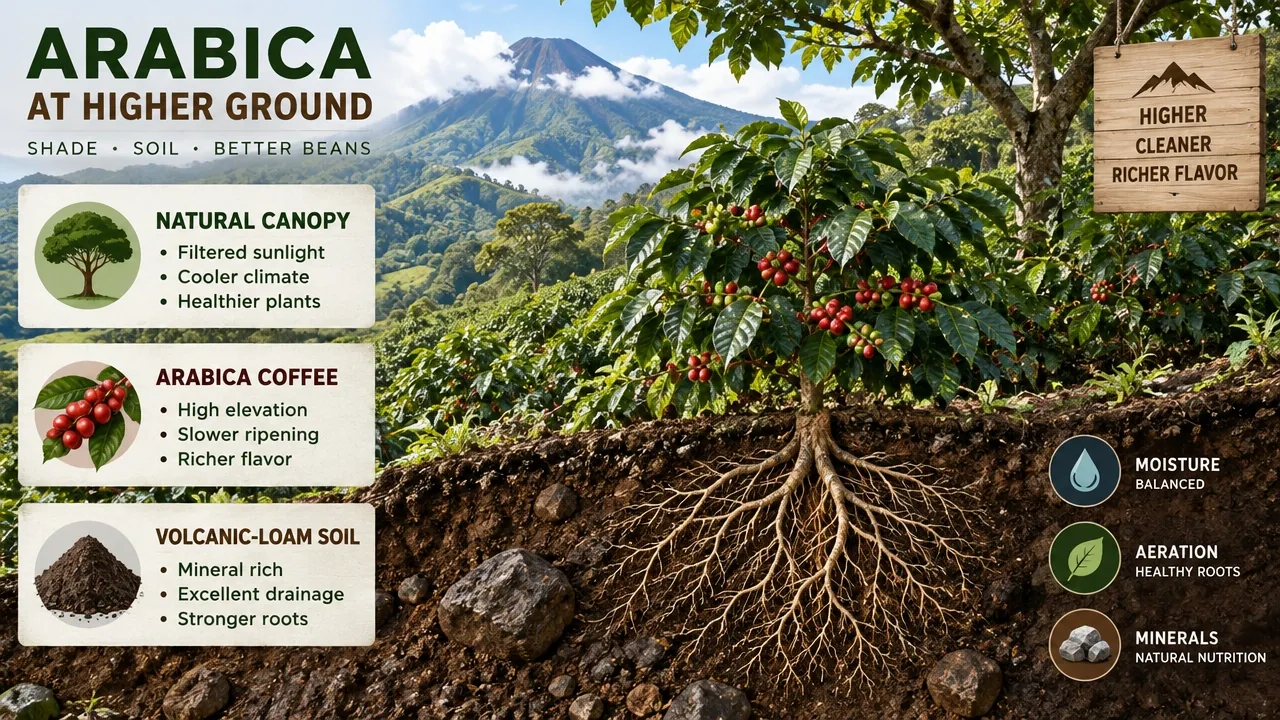
Bukomansimbi District Local Government’s Arabic Coffee Handbook makes the quality mechanism explicit: elevation between 1,200 m and 2,500 m is ideal for arabica, with areas between 1,500 m and 2,500 m producing demonstrably superior cup quality. The reason is the delay in cherry ripening caused by cooler temperatures at altitude, which allows acidity, aroma, and bean density to fully develop before harvest.
The mechanism behind that finding is the diurnal temperature swing. Warm days drive photosynthesis and sugar production. Cool nights slow cellular respiration, so the sugars the plant built during the day aren’t burned off overnight. They accumulate in the cherry. That’s the sucrose and organic acid reservoir that fermentation and roasting will later act on. A farm at 900 m with minimal diurnal swing produces a cherry that matures fast and thin. A farm at 1,800 m with a 10-15°C overnight drop produces a cherry that matures slowly and dense.
The headline altitude number is a shortcut. Judge a farm on its diurnal swing, shade load, and rainfall pattern. Two farms at identical elevation can produce radically different cup profiles if one sits in a wind-exposed ridge and the other in a sheltered valley with high humidity.
Shade canopy management buffers both light intensity and temperature extremes. Permanent shade trees reduce maximum leaf temperature and slow soil moisture loss. They also contribute organic matter as leaf litter and host the microbiome that feeds soil health. The trade-off is yield: full sun cultivation produces more cherries per tree but accelerates maturation, compressing the development window that altitude is supposed to extend.
Soil requirements center on drainage, depth, and organic matter. Well-drained loamy and volcanic soils with a pH of roughly 6.0-6.5 and significant organic matter allow the root system to reach the depth it needs for water and nutrient access. Compacted or waterlogged soils force shallow root systems, making trees drought-sensitive and nutrient-deficient regardless of the rainfall totals above ground.
The FAO’s crop ecology guidelines quantify the rainfall requirement: arabica needs approximately 1,500-3,000 mm annually, with the pattern of wet and dry periods mattering as much as the total. A dry spell is not a threat to be eliminated. It’s the trigger that breaks bud dormancy. When the first rains arrive after a defined dry period, arabica trees flower synchronously. That synchrony is what makes a defined harvest calendar possible.
Fruit Development and Bearing Schedules
After transplant, the clock runs as follows. Field establishment takes the first year. First meaningful crop arrives at 3-5 years, depending on cultivar and management. Full economic production follows a few seasons after that and can persist for 20-30 years with proper pruning and soil management.
Cherry development from fruit set to full ripeness spans 6-9 months in most arabica-growing origins. The color progression from green through yellow to red (or yellow in some cultivars) is visible. What’s happening internally during that window is the simultaneous formation of the mucilage and parchment layers around the seed, and the progressive Brix accumulation in the fruit pulp. Brix is a proxy for dissolved solids, primarily sugars. A cherry at 13-15° Brix has built the fermentation substrate and the flavor precursor reservoir. A cherry at 8° Brix has not, regardless of what color it is.
Most origins deliver one main harvest per year, structured around a defined wet and dry cycle. Parts of Colombia are the notable exception, where two distinct flowering events produce a main crop and a smaller secondary crop called the mitaca. That second flowering shifts the harvest calendar and the contract timing built around it. Buyers sourcing from Colombian producers need to know which crop they’re contracting.
Bearing age figures in the literature vary: some sources cite first crop at 2-3 years, others at 3-5 years. Treat it as cultivar-and-management-dependent. A well-managed Castillo plant on good soil at appropriate elevation will bear sooner and more consistently than a neglected Typica on degraded land at any altitude.
Selective Harvesting and the Brix Decision: Why Ripe Cherry Is the Highest-Leverage Variable
Selective harvesting is where the flavor potential built over years either gets protected or immediately compromised. Every decision made at the tree has a downstream chemical consequence that no processing step can reverse.
Maturity Assessment and Picking Protocols
Ripe cherry identification in the field uses three cues. Color is the most visible: red in most varieties, yellow in Amarillo and some Ethiopian landraces. But color can be misleading in variable light or mixed-variety plots. Firmness is more reliable: a ripe cherry yields slightly to thumb pressure without being mushy. Detachment resistance is the most objective field measure: a ripe cherry releases from the branch at roughly 8-10 Newtons of applied force. An unripe cherry resists. An overripe cherry releases with almost no force.
Selective hand picking across multiple passes through the same trees captures only ripe fruit at each visit. It’s labor-intensive, typically requiring 3-5 passes through a plot during a single harvest season. Strip picking, where all fruit on a branch is removed in a single pass regardless of ripeness stage, is faster but delivers a mixed-maturity lot that no amount of post-picking sorting fully corrects.
The labor economics explain why selective picking is concentrated in specialty programs. The cost per pound of green coffee is higher. That cost is what a quality differential is partly paying for.
A refractometer reading taken from cherry juice gives a Brix measurement of dissolved solids. At 13-15° Brix, the cherry has accumulated sufficient sucrose to serve as the fermentation substrate the wet mill will act on. Below that range, the sugar loading is thin. Above it, the cherry may be moving toward overripeness. Brix reads a snapshot and must be paired with visual and tactile assessment, not used as a standalone metric. A cherry can read 14° Brix while already beginning internal decomposition if holding conditions were poor.
The resource math behind selective picking is worth understanding as a yield translation. Supporting one cup of coffee per day requires roughly six coffee trees. That figure reflects the combination of cherry yield per tree, processing losses through pulping and fermentation, and the fraction of green coffee that survives milling and sorting. Selective harvesting adds labor cost at the front of that chain, but it also reduces the defect losses that compound through every subsequent stage.
Post-Picking Sorting and Fruit Handling
What happens to unripe and overripe cherry downstream is specific and damaging. Green cherry carries high concentrations of chlorogenic acids and undeveloped pectin. In processing, it contributes grassy, astringent notes and, in some East African origins, potato defect, caused by pyrazine compounds associated with bacterial infection of damaged immature fruit. Raisined and overripe cherry has already begun internal fermentation. When mixed into a lot, it creates localized fermentation hot spots that produce inconsistent, phenolic, and ferment-forward notes that read as processing defects on the cupping table.
Lot blending of ripeness stages doesn’t average out. It creates variance. A lot with 5% overripe cherry and 95% perfectly ripe cherry doesn’t cup like a slightly ripe lot. It cups like a lot with defects.
Harvest logistics follow from this. Picking into shallow crates rather than deep sacks reduces compression damage to the bottom layers of fruit. Same-day delivery to the mill is the target, because holding time and ambient temperature accelerate the very fermentation the mill is supposed to control. A cherry sitting in a sack in afternoon heat for 18 hours before depulping has already begun microbial activity that the processor didn’t choose and can’t fully see.
For buyers: a producer’s picking protocol is a legitimate sourcing question. Brix-based harvesting with multiple selective passes is one of the clearest cost drivers in a differential price. When you’re evaluating whether a differential is justified, the picking protocol is part of the evidence.
Processing Biochemistry: Washed, Natural, and Honey as Controlled Fermentation Systems
Coffee processing is not a flavor-addition step. It’s a controlled degradation and drying sequence that either preserves the precursor compounds built at the farm or introduces new ones through microbial activity. The method determines which pathway dominates.
Shared Mechanical Spine and Aqueous Mucilage Removal
Every processing method shares a mechanical spine. Cherry intake is followed by flotation sorting, where cherries are floated in water to separate underdeveloped, overripe, and defective fruit by density. Denser, denser-fleshed ripe cherries sink. Light, hollow, or damaged ones float. This is the first physical quality gate after the picker.
From flotation, the routes diverge, but all converge again at drying, moisture monitoring, parchment resting, and hulling to green coffee before sorting and grading.
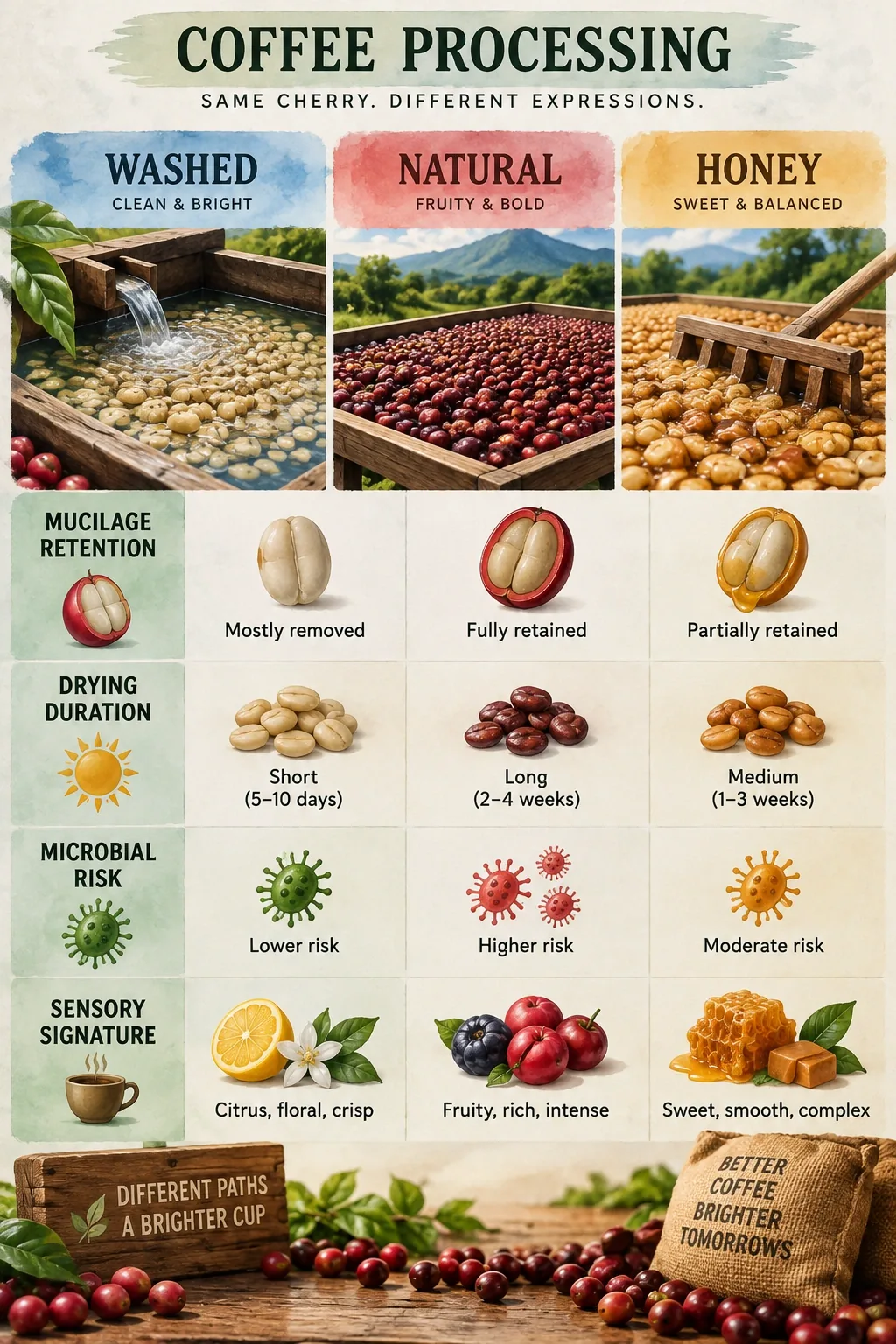
Washed processing (also called wet processing) removes the mucilage before drying. After flotation, cherries are depulped: a mechanical depulper strips the outer skin and most of the fruit flesh, leaving the seed encased in parchment with a thin mucilage layer attached. The depulped coffee then enters fermentation tanks, where it rests for up to 48 hours.
Neil Rotta’s UC Davis thesis on postharvest coffee processing_1.pdf) documents this stage precisely: microorganisms naturally present in the fermentation environment both degrade the mucilage and cause measurable changes to the chemical composition of the green beans, ultimately altering the sensory profile of the finished cup.
The mechanism behind that finding is enzymatic and microbial. Pectinase enzymes, produced by bacteria and yeasts colonizing the tank, hydrolyze the pectin chains in the mucilage into simpler sugars and organic acids. Temperature, pH, duration, and the microbial population present all govern which metabolic products dominate. A well-managed fermentation at controlled temperature produces a clean, predictable acid profile. A tank that runs hot or long shifts toward acetic acid production and phenolic off-notes.
The quantitative basis for pectinase activity in fermentation systems is well-established in enzyme kinetics research. A peer-reviewed fermentation study published in BMC Biotechnology reports pectinase kinetic values including a Vmax of 32.7 U/mL and Km of 0.3 mg/mL, with maximum enzyme activity of 24 U/mL at 50°C and pH 5.0. The study links pectinase activity directly to the hydrolysis of pectin-based plant biomass into galacturonic acid and oligogalacturonic products, which are the acid and sugar end-products that determine fermentation flavor outcomes.
After fermentation, the coffee is washed in channels where water flow separates remaining mucilage and grades beans by density. An optional soak follows in some protocols. Then drying, on raised beds or patios, to a target moisture of 10-12%. The sensory signature of washed coffee is cleaner acidity and higher origin transparency, because the mucilage that would otherwise contribute fruit ester character has been removed before drying.
The risk profile centers on over-fermentation: a tank that runs beyond the optimal window produces acetic acid, butyric acid, and phenolic compounds that read as vinegary, putrid, or barnyard notes on the cupping table. These are not stylistic choices. They’re process failures.
Fruit-Contact Drying, Mucilage Retention, and Parchment Hulling
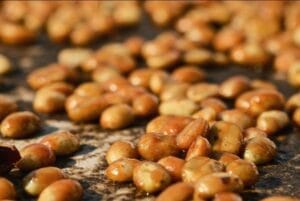
Natural processing skips depulping entirely. The whole cherry, skin and all, goes directly onto drying beds or patios. Over two to four weeks, the cherry dries intact, with the fruit and mucilage in prolonged contact with the seed. Regular turning prevents mold formation and ensures even drying.
The sensory signature of natural-processed coffee is heavier body and pronounced fruit-forward ester character: blueberry, strawberry, and tropical fruit notes that washed processing cannot produce. The mechanism is ester migration. Fruit esters present in the pulp and mucilage migrate through the parchment into the seed, where they associate with lipid and protein fractions that survive into roasting. Under slow or uneven drying, mold and phenol risk rises significantly. A natural lot dried too thick on a patio in humid conditions can produce a cup that reads as fermented, musty, or rotten rather than fruity.
Honey processing occupies the middle ground. After depulping, the mucilage is deliberately retained at defined levels rather than fermented away. The classification by color (yellow honey, red honey, black honey) roughly corresponds to the percentage of mucilage retained and the frequency of turning during drying. More mucilage retained, less frequently turned, produces a darker honey designation and a more fruit-forward, syrupy cup profile. Less mucilage, more frequent turning, produces a cup closer to washed.
The sensory signature of honey processing sits between washed and natural: more sweetness and body than washed, more clarity and structure than natural. The trade-off is precision. Mucilage retention percentages are difficult to standardize across lots, and the profile can shift significantly based on drying conditions.
After all three methods, the coffee enters parchment resting, a period of weeks to months in which internal moisture equilibrates across the seed before hulling. Skipping or shortening this rest produces uneven moisture distribution that causes cracking during hulling and uneven roast development later. After resting, hulling removes the parchment to reveal green coffee, which then passes through density sorting, screen sorting, and color sorting to establish the grade that goes to market.
The Green Coffee Handoff: What Buyers Actually Verify Before a Lot Earns a Contract
Green coffee evaluation is not a cupping exercise with a price attached. It’s a full production chain audit compressed into a set of physical and sensory measurements. The cupping score is the last number you look at, not the first.
The evaluation lens starts at terroir and works forward: elevation and microclimate, cultivar and propagation method, processing method and mill hygiene, drying conditions and storage history. A lot with a clean 84-point cup that arrived from a mill with documented moisture control and a transparent producer relationship is a different risk than an 85-point lot from an unknown origin with no pre-shipment sample history.
The SCA score of 80 or above is the specialty threshold. The cupping protocol behind it is standardized: specific water temperature, coffee-to-water ratio, grind size, steeping time, and a 10-attribute scoring system covering fragrance, aroma, flavor, aftertaste, acidity, body, balance, uniformity, clean cup, and sweetness. The pre-shipment sample (PSS) is the reference standard that the physical lot must match. Contract language should tie every shipment to the approved PSS. When the landed lot diverges from the PSS on moisture, defects, or cup profile, the buyer has a documented basis for recourse.
Physical verification at intake covers four numbers. Moisture content should be within roughly 10-12%, with trade tolerances generally inside 10-12.5% at receipt. Above that range, the lot is vulnerable to mold growth and mycotoxin development during storage. Below it, the beans are brittle and prone to fracture during hulling and grinding. Primary and secondary defect counts follow the SCA green analysis protocol, with primary defects (full blacks, fulls sours, pods, large stones) weighted more heavily than secondary ones. Screen size distribution indicates bean development and predicts roast uniformity: a lot with high screen-size variance will roast unevenly, with smaller beans developing faster than larger ones in the same drum load. Density separation predicts roast behavior more directly than screen size: denser beans carry more cellular material, require more heat energy to develop, and produce more soluble compounds per gram.
Contract mechanics in specialty coffee run on the C market (the commodity benchmark price for arabica, traded on the ICE Futures exchange) plus a differential that reflects quality, origin, relationship, and lot size. A Colombian microlot from a high-elevation farm with documented selective harvesting and washed processing might carry a differential of $1.50-$3.00 per pound over the C price. A commercial-grade washed Colombian traded through a commodity importer might carry a differential of $0.10-$0.30.
Spot buying from importers provides immediate inventory access and reduces logistics complexity, but it limits control over lot selection and typically offers no relationship with the producer. Forward contracts allow a roaster to secure a named lot before harvest, locking in price and quality at the cost of capital tied up before delivery. FOB pricing (Free on Board) applies when importing directly: the buyer assumes responsibility and risk from the moment the container is loaded at the origin port.
The relationship layer is not a values exercise. In a supply base dominated by smallholder farmers, communication between roaster and producer is the mechanism by which quality information travels back to the farm. A roaster who provides specific, harvest-by-harvest feedback on cup profile, defect counts, and moisture gives the producer data they can act on. A roaster who sends a wire transfer and nothing else gives the producer nothing to optimize. Supply stability in arabica depends on that feedback loop.
Roasting Thermodynamics: Drying, Maillard, Caramelization, and First Crack
Coffee roasting is a translation process, not a creation process. The flavor compounds that emerge from the drum were not manufactured by heat. They were assembled from precursors, the sugars, amino acids, lipids, and organic acids built during cherry development, fermentation, and drying, and heat triggered the reactions that converted them into volatile aroma compounds. The roaster’s job is to run those reactions without burning the evidence.
Thermal Phase Chemistry
The roast begins at charge: green coffee loaded into a preheated drum. The bean probe and environmental probe readings diverge immediately, with the environmental probe dropping as the cold beans absorb heat. The turning point, where the bean probe stops dropping and begins rising, typically occurs within the first 60-90 seconds. From the turning point through roughly 160°C, the primary event is drying: water retained in the bean (that 10-12% moisture from intake) leaves as steam. Airflow carries that vapor out of the drum. A stalled drying phase, caused by insufficient airflow or too low a charge temperature, flattens the flavor development that follows because the bean surface enters Maillard reactions while still carrying excess moisture.
The Maillard reaction begins in earnest around 160°C. Reducing sugars react with amino acids to form melanoidins (the brown pigments responsible for roasted color and body) and hundreds of aroma-active volatile compounds. Strecker degradation, a subset of the Maillard pathway, produces aldehydes and pyrazines that contribute nutty, caramel, and toasty notes. Simultaneously, the bean’s sucrose content undergoes caramelization as heat climbs, producing caramel and butterscotch-adjacent flavor compounds alongside CO2.
First crack arrives at roughly 196-205°C. Internal steam pressure and CO2 buildup fracture the cellulose matrix of the bean, producing an audible cracking sound similar to popcorn. This is the structural event that marks the transition from a dense, raw seed to a porous, brittle roasted bean. Development time after first crack, the interval between the first audible crack and the roaster’s drop decision, is the primary control variable for the cup. More development time drives more caramelization, reduces perceived acidity, and increases body. Less development time preserves more of the organic acids and sucrose-derived brightness while leaving the bean less soluble.
The precursor reservoir built during the growing and processing stages determines the ceiling for every Maillard and caramelization reaction in the drum. A cherry picked at 8° Brix, processed without adequate fermentation control, and dried too fast arrived with a thin amino acid and sugar profile. No roast profile recovers what wasn’t there.
The “caffeol” shorthand, which implies that roasted coffee aroma comes from a single fragrant oil, is a historical artifact. Modern flavor chemistry identifies hundreds of volatile compounds generated through Maillard and caramelization pathways, including pyrazines, furans, aldehydes, ketones, and thiols. A roaster optimizing for one compound is not optimizing for the cup.
Profile Engineering and Shelf-Life Stability
A roast profile is an engineered curve, not a temperature target. The variables are rate of rise (how fast the bean temperature climbs through each phase), charge weight, drum speed, gas input, airflow, and drop temperature. Changes to any one variable shift the others. Increasing gas input without increasing airflow raises drum temperature but also raises humidity inside the drum, slowing drying. Increasing airflow without adjusting gas input can drop the rate of rise below the level needed to sustain Maillard activity.
The light-to-dark continuum is a trade-off curve, not a quality gradient. Light roasts preserve more organic acids, sucrose-derived sweetness, and origin character. They also require higher bean solubility to extract evenly, which means grind and water chemistry tolerance is narrower. Dark roasts drive more caramelization and produce more melanoidins, increasing body and reducing acidity, but they also degrade the volatile aroma compounds that distinguish a high-quality origin from a commodity lot. At a certain roast level, origin character disappears entirely into roast character.
After the drop, roasted coffee begins degassing: releasing CO2 absorbed during roasting. The degassing curve is steep in the first 24-48 hours and continues for days to weeks depending on roast level and particle size. One-way valve packaging allows CO2 to escape without admitting oxygen, extending shelf life. A roast date printed on the bag is the buyer’s reference for where the coffee sits on that degassing curve.
Profile decisions should be matched to the lot’s processing method and density. A dense, high-elevation washed lot with a clean acid profile benefits from a longer development time that fully converts its sucrose. A natural-processed lot with high ester character may need a faster profile that preserves the fruit volatiles without driving them off through extended caramelization. A universal roast curve applied across different origins and processing methods is not precision roasting.
Grinding, Water Chemistry, and Extraction Physics: Why the Cup Is the Last Two Percent
Coffee extraction is where everything the chain built either survives into the cup or gets discarded. The physics are simple. The margins are not.
Particle Size and Aqueous Solvent Conditions
Grind particle size distribution determines two things simultaneously: surface area exposed to water and flow resistance through the bed. A finer grind creates more surface area, which accelerates soluble transfer, and more resistance, which slows water flow. A coarser grind creates less surface area and less resistance.
Burr grinders cut coffee between two abrasive surfaces, producing a relatively consistent particle size distribution. Blade grinders chop randomly, producing a wide distribution of fines (very small particles that over-extract quickly) and boulders (large particles that under-extract). The cup result of a blade grind is a mixture of over-extracted and under-extracted compounds in the same brew, which is why the flavor profile is simultaneously bitter and hollow.
Grind freshness matters independently of grind geometry. Ground coffee begins staling within minutes of grinding as volatile aroma compounds oxidize and CO2 escapes. Static causes fine particles to clump and distribute unevenly across the brew bed. Clumping creates channeling: water finds the path of least resistance through a loose clump and bypasses the surrounding coffee, under-extracting the bypassed material while over-extracting the channel.
Water chemistry is the solvent specification for extraction. Total dissolved solids (TDS) in the range of 75-150 ppm (as calcium carbonate) provide the mineral content that facilitates soluble transfer without competing with coffee compounds. Hardness (primarily calcium and magnesium ions) drives extraction efficiency: magnesium in particular has a documented affinity for coffee aroma compounds. Alkalinity is the buffer system: high alkalinity (above roughly 40 ppm as CaCO3) neutralizes the organic acids that give specialty coffee its brightness, producing a flat, dull cup regardless of roast quality. pH of the brew water should be close to neutral (6.5-7.5). Acidic water under-extracts. Alkaline water over-buffers.
The practical water specifications published by the SCA target roughly 150 ppm TDS, 68 ppm hardness, 40 ppm alkalinity, and pH 7.0. A roaster with a technically precise profile and a high-quality lot will produce a flat, mineral-tasting cup if the water running through their espresso machine carries 300 ppm alkalinity. The water is the solvent. Its chemistry is not a preference.
Soluble Transfer and Yield Verification
Extraction is a mass transfer event. Soluble compounds migrate from the ground coffee into the water phase. The variables governing the rate and completeness of that transfer are temperature, turbulence, contact time, and in espresso, pressure.
Water temperature for most brew methods targets 90-96°C. Below that range, solubility decreases and the most polar, easily-dissolved compounds (acids, lighter aromatics) extract while the heavier, more complex ones do not. Above it, degradation of heat-sensitive volatile compounds accelerates. Turbulence from pouring, agitation, or pressure promotes even extraction by disrupting the saturated boundary layer that forms around each particle. Contact time is the dial that, combined with grind size, controls how much of the available soluble material actually transfers.
Espresso adds pressure, typically 9 bars, which forces water through a compacted puck at a rate that would be impossible under gravity alone. The high pressure drives rapid extraction of compounds that require significant solvent force to release, producing the concentrated, syrupy texture characteristic of the format.
Extraction yield is the percentage of the ground coffee’s dry mass that dissolved into the brew. The specialty target range is typically 18-22%. Below 18%, the cup is under-extracted: sour, hollow, and thin, because the first compounds to extract are the easily-soluble organic acids, and the more complex, balancing compounds never made it into the water. Above 22%, the cup is over-extracted: bitter, drying, and harsh, because the later-extracting compounds include astringent phenolics and degraded melanoidins.
Refractometry measures the refractive index of the brewed coffee and converts it to TDS in the cup, from which extraction yield can be calculated using the brew ratio (coffee dose to water mass). It’s the fastest objective verification tool available at the bar.
The mass-balance figure that closes the chain: a finished espresso represents approximately 2% of the original biomass of the cherry it came from. The rest was discarded as skin, pulp, mucilage, parchment, chaff, roasting loss, and spent grounds. Every stage in the chain from nursery to cup is a sequence of irreversible material losses. The only question at each stage is whether the quality built in the previous stage survived the transition.
That’s the whole chain. Arabica coffee isn’t a product. It’s the surviving fraction of a years-long biological and chemical process in which every decision either protects or destroys what came before it.
Frequently Asked Questions About Arabica Coffee
How many coffee plants does it take to make a cup of coffee?
Supporting a daily coffee habit of one cup requires roughly six arabica trees, a figure that reflects cherry yield per tree, pulping and fermentation losses, and the fraction of green coffee that survives milling and sorting to reach the grinder.
What is so special about arabica coffee compared to robusta?
Arabica carries lower caffeine (roughly 1.2-1.5% versus robusta’s 2.7%), higher sucrose and lipid concentrations, and a brighter organic acid profile, all of which support the flavor complexity specialty buyers pay differentials for. The trade-off is narrower climatic tolerance and much higher susceptibility to leaf rust.
How long does it take to get coffee from a coffee plant?
Add the nursery window of 6-9 months to field establishment and early bearing: the first meaningful crop arrives at 3-5 years after the seed is sown, with full economic production following a few seasons after that.
How do you propagate arabica coffee without losing genetics or vigor?
Open-pollinated cultivars can be seed-propagated from selected mother trees. F1 hybrids must be clonally propagated by cuttings or grafting because seed propagation scrambles the parent genetics. Nursery hygiene is a yield decision: damping-off and nematode pressure in the propagation bed show up as underperforming trees three to five years later.
Why does processing method change the flavor of arabica coffee?
Washed processing removes the mucilage before drying, producing cleaner acidity and more origin transparency. Natural processing leaves the whole cherry intact during drying, allowing fruit esters to migrate into the seed and produce heavier body and fruit-forward character. Honey processing retains varying amounts of mucilage, landing somewhere between the two. The method determines which microbial and enzymatic pathways act on the seed and which flavor precursors survive into green coffee.
What does “diurnal temperature swing” actually do to coffee quality?
Warm days drive photosynthesis and sugar production in the cherry. Cool nights slow cellular respiration, so those sugars don’t get burned overnight. They accumulate. A farm with a 10-15°C diurnal swing produces denser, sweeter cherries than a farm at the same elevation with minimal overnight temperature drop.
Why can’t you germinate a roasted coffee bean?
Seed coffee is held at roughly 22-25% moisture to maintain viability. Green coffee is dried to below 11% for stability during storage and shipment. Roasted coffee is drier still. The moisture level that allows germination is eliminated during the drying and roasting process, which is why the two uses, propagation and consumption, require fundamentally different post-harvest handling.
What does extraction yield actually measure, and why does it matter?
Extraction yield is the percentage of the ground coffee’s dry mass that dissolved into the brew, with the specialty target range at 18-22%. Below 18%, only the easily-soluble organic acids extracted, producing a sour, hollow cup. Above 22%, astringent phenolics and degraded melanoidins dominate, producing bitterness and a drying finish. Refractometry gives you the number in under a minute.
References
- Arabic Coffee Handbook | bukomansimbi.go.ug
- FAO Crop Ecology and Physiology: Coffee | fao.org
- Acclimatization of Coffee Seedlings Obtained via Tissue Culture | alice.cnptia.embrapa.br
- Neil Rotta Thesis: Postharvest Processing of Coffee | iad.ucdavis.edu
- Statistical Optimization of Pectinases from Thermophilic Aspergillus fumigatus BT-4 | bmcbiotechnol.biomedcentral.com