Yemen coffee history separates cleanly into two chapters that most people collapse into one: where the plant came from, and where the drink was born. Wild Coffea arabica grew in Ethiopian highland forests long before anyone brewed it. But it was 15th-century Yemen – its Sufi orders, its mountain terraces, and its Red Sea port – that turned a forest shrub into the world’s first globally traded beverage.
That distinction matters more than most origin debates. Yemen didn’t just adopt coffee. It cultivated it, monopolized it, and enforced that monopoly with a biological weapon: a scalding process that killed every seed before it left the port. Understanding how that system worked – and why it eventually failed – is the real story behind every cup of specialty coffee in the world today.
Key Takeaways on Yemen Coffee History
- Wild Coffea arabica originated in Ethiopia, but coffee as a roasted, brewed, and traded beverage was invented in 15th-century Yemen – these are two separate historical events.
- The Shadhiliyya Sufi order under Sheikh Muhammad al-Dhabhani first decocted Qahwa to sustain wakefulness during nocturnal Dhikr vigils, creating the world’s first intentional coffee preparation.
- Yemen enforced its global monopoly by killing every exported seed through scalding or boiling – the first commodity monopoly to weaponize germination itself.
- Three smuggling missions – Baba Budan’s 1670 pilgrimage, the Dutch VOC’s 1696 Java transplantation, and de Clieu’s Caribbean crossing – collapsed Yemen’s exclusive supplier status within decades.
- Yemen’s mountain terroir at 2,000 to 2,500 meters, combined with rooftop dry-natural fermentation, produces a wine-like, chocolate-cardamom flavor profile that no other major origin replicates.
- The 2020 discovery of the New-Yemen genetic cluster – a distinct mother group of Coffea arabica found nowhere else on Earth – makes Yemen’s smallholder farming system a living reservoir for global coffee’s climate-resilience future.
Did Coffee Originate in Yemen or Ethiopia? The Shared-Heritage Baseline
The Ethiopia-versus-Yemen debate dissolves the moment you separate botanical origin from beverage civilization. Wild Coffea arabica is native to the highland forests of southwestern Ethiopia – it still grows there without human cultivation. But coffee as a roasted, brewed, and deliberately consumed drink emerged in 15th-century Yemen. These are two different events, separated by geography and centuries. Conflating them is what keeps the debate alive.
Think of it like wheat and bread. Wheat grew wild across the Fertile Crescent long before any civilization baked a loaf. Ethiopia is the wheat field. Yemen is the bakery. Neither claim erases the other.
Botanical versus Beverage Origin
Wild Coffea arabica has its evolutionary home in the moist, shaded forests of southwestern Ethiopia, at elevations between 1,500 and 2,000 meters. Genetic evidence confirms this. The plant was almost certainly carried across the Red Sea – through Somali and Ethiopian trading networks – into the Arabian Peninsula before Yemen’s cultivators took over.
What Yemen did with it was entirely different. Yemeni farmers didn’t simply harvest a wild plant. They domesticated it: selecting varieties, building terraced stone farms on near-vertical mountain slopes, and developing the roasting and brewing processes that transformed a bitter forest seed into Qahwa. The article’s arc follows that transformation – from the Sufi genesis of brewing, through the Mokha monopoly and its biological enforcement, to the espionage missions that broke it, and finally to the modern genetic discoveries that proved Yemen’s coffee lineage is unlike anything else on Earth.
Nancy Um, author of The Merchant Houses of Mocha, frames this precisely: Yemen is the home not only of the social habit of drinking coffee as we know it today, but of large-scale coffee cultivation and the first purveyor of coffee to the world.
That framing – cultivation, socialization, and global distribution – is what distinguishes Yemen’s role from Ethiopia’s. Ethiopia gave the world the species. Yemen gave the world the habit.
Documentary Evidence and Attribution Legends
The stories most people know – Kaldi the Ethiopian goat herder who noticed his animals dancing after eating red berries, and Sheikh Omar who survived exile by brewing wild coffee cherries – are cultural memory, not documentary proof. They function as attribution legends: narratives that communities use to claim or explain an origin. Neither appears in contemporaneous written records with verifiable dates.
What the documentary record does show: cultivation evidence from 12th-century Yemen, and a reference placing the plant in Mecca by 1414. These are the anchors. The legends are context, not confirmation.
Before we go further into how Yemen turned this plant into a global commodity, this short documentary captures what that journey looks like on the ground today – the farmers, the terraces, and the processing methods that have changed surprisingly little in six centuries.
The Sufi Genesis: Qahwa, Sheikh Muhammad al-Dhabhani, and the Shadhiliyya Night Vigils
Coffee became a brewed drink because a religious order needed to stay awake. That’s the functional answer. The Sufi mystics of 15th-century Yemen weren’t searching for a new beverage – they were solving a physiological problem: how do you sustain concentration and wakefulness through hours of nocturnal prayer without losing mental clarity? The coffee bean, once roasted and decocted, was their solution.
Mystical Brewing and Visual Record
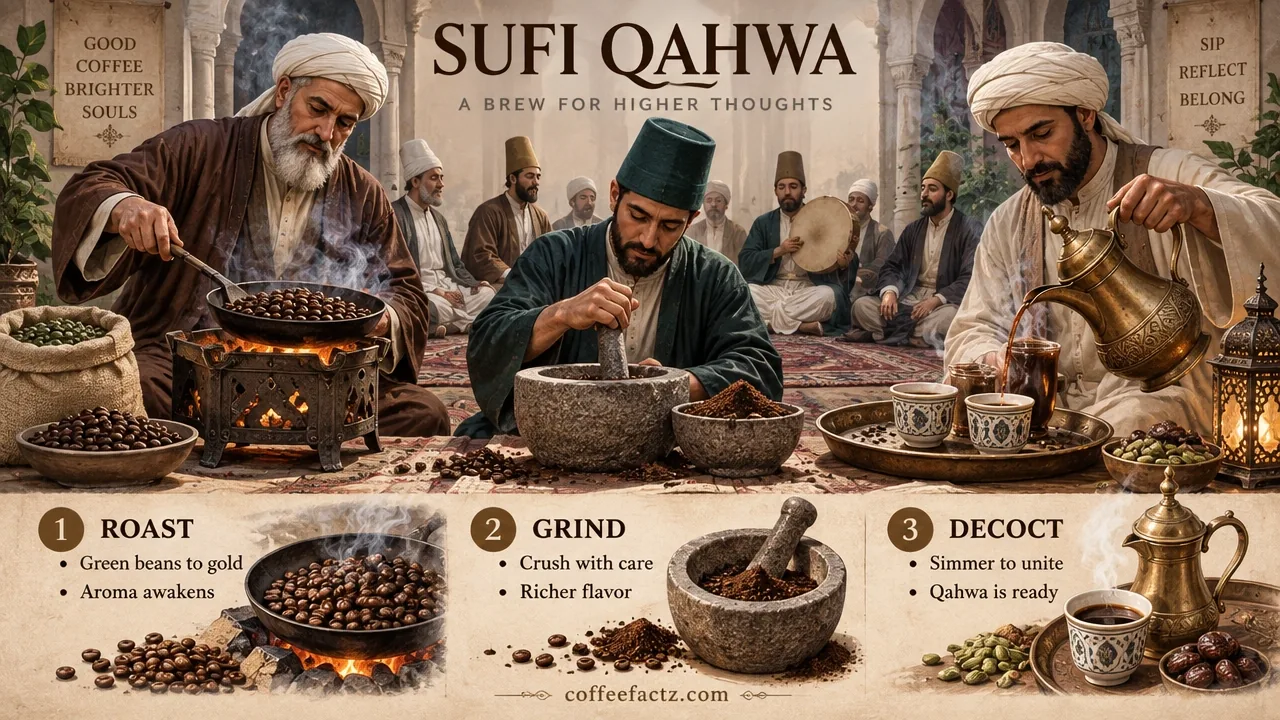
Sheikh Muhammad al-Dhabhani and the Shadhiliyya Sufi order are the earliest documented agents of coffee’s transformation from raw seed to brewed beverage. They roasted the beans, ground them, and boiled the grounds into Qahwa – a dark, bitter decoction designed not for pleasure but for devotional endurance.
Muslim Heritage, in its research publication on coffee’s origins, identifies a clear consensus among early sources: the first users of coffee were the Sufis, who consumed it as a stimulus to remain awake during late-night Dhikr – the meditative remembrance of God.
The process they used wasn’t casual. Roasting beans over an open fire, grinding them by hand, and simmering the grounds into a concentrated decoction required knowledge, equipment, and intentionality. This was a crafted preparation, not a foraged snack. That craft is what separated Yemeni coffee culture from anything that came before it.
Nocturnal Devotion and Urban Diffusion
Qahwa served a specific function inside the Sufi lodge: it kept the body alert while the mind turned inward during Dhikr vigils that ran through the night. Coffee wasn’t a social luxury in this context – it was a devotional technology, as purposeful as a prayer mat or a candle.
But devotional technologies rarely stay inside the monastery. As the Shadhiliyya order spread, so did Qahwa. The drink moved from Sufi lodges into the broader fabric of Islamic urban life, and the coffee house emerged as its secular vessel. By 1554, coffee houses were operating in Cairo, Syria, Aleppo, and Constantinople – each coffee house was a direct descendant of the Yemeni Sufi lodge, stripped of its religious purpose but retaining its social architecture: a place where people gathered, talked, and stayed alert together.
There is also a less-examined transmission layer worth noting. Several 15th and 16th-century Yemeni manuscripts suggest that brewing knowledge may have arrived in Yemen from Zeila – a port city on the Somali coast – carried by trade networks that also spiced and traded coffee. This is a revisionist perspective, not settled consensus, and the manuscripts require careful attribution. But it adds texture to the origin story: Yemen may have been the civilization that perfected and exported coffee, while the Horn of Africa provided both the plant and early brewing knowledge through Red Sea trade.
What is settled: the diffusion was rapid and permanent. The Ottoman Empire adopted coffee culture with institutional speed, and the coffee house became one of the defining social spaces of the Islamic world within a century of the Sufi genesis.

Port of Mokha and the Germination Embargo: Yemen’s First Global Coffee Monopoly
Yemen controlled the world’s coffee supply for roughly two centuries. That’s not a loose historical claim – it’s a documented economic fact. And the mechanism that enforced it was more sophisticated than most modern trade protections: Yemen didn’t just guard its ports. It killed the seed.
Red Sea Gateway and Export Control
Al-Makha – the ancient Red Sea port known in European trade records as Mokha or Mocha – was the single point of exit for all Yemeni coffee exports from the 15th through the late 17th century. Every sack of beans that reached Cairo, Constantinople, Venice, or Amsterdam passed through this port. That geographic chokepoint gave Yemen something most commodity producers never achieve: total supply-chain control from farm to ship.

The port’s position on the Red Sea was not accidental. Al-Makha sat at the natural convergence of Indian Ocean trade routes, making it the logical hub for any commodity moving between the Arabian Peninsula, East Africa, and the Mediterranean. Yemen’s governors – first under their own authority, then under Ottoman administration – understood what they had and protected it accordingly.
Exclusive Supplier Status and Embryo Sterilization
From the 15th through the late 17th century, Yemen held exclusive global supplier status for coffee. No other country grew it commercially. No other port shipped it. And Yemeni and Ottoman governors intended to keep it that way through a measure that was, by any modern standard, a form of biological intellectual-property enforcement.
Every bean exported through Al-Makha was first scalded, parched, or boiled in water hot enough to kill the embryo inside. The target wasn’t the bean’s flavor or appearance – it was its reproductive capacity. A dead embryo cannot germinate. A non-germinating bean cannot be planted. Yemen was not merely selling coffee; it was selling a sterile copy of itself, engineered to go no further.
Attempting to smuggle viable seeds or live plants out of Yemen carried the death penalty. The embargo operated on two levels simultaneously: biological, through embryo destruction, and legal, through lethal deterrence. Together, they created what may be history’s first commodity monopoly enforced at the cellular level.
The FAO’s assessment of Yemen’s coffee value chain confirms that coffee cultivation in Yemen dates to its introduction into an arid mountain climate, where farmers developed terraced farming systems that have persisted for centuries – the same agricultural infrastructure that supported the monopoly’s production base.
The genius of the system was its simplicity. Yemen didn’t need a navy to patrol every coastline or an intelligence network to track every merchant. It just needed to make sure that nothing leaving Al-Makha could ever be planted somewhere else. For two centuries, that was enough.
Espionage, Seeds, and Seedlings: How Baba Budan, the Dutch VOC, and Gabriel de Clieu Broke the Monopoly
The germination embargo held until human ingenuity – and human greed – found ways around it. Three separate breaches, spanning roughly five decades, dismantled the most effective agricultural monopoly in history. Each one used a different method. Together, they rewrote the global food economy.
Smuggling Missions and Transplantation Routes
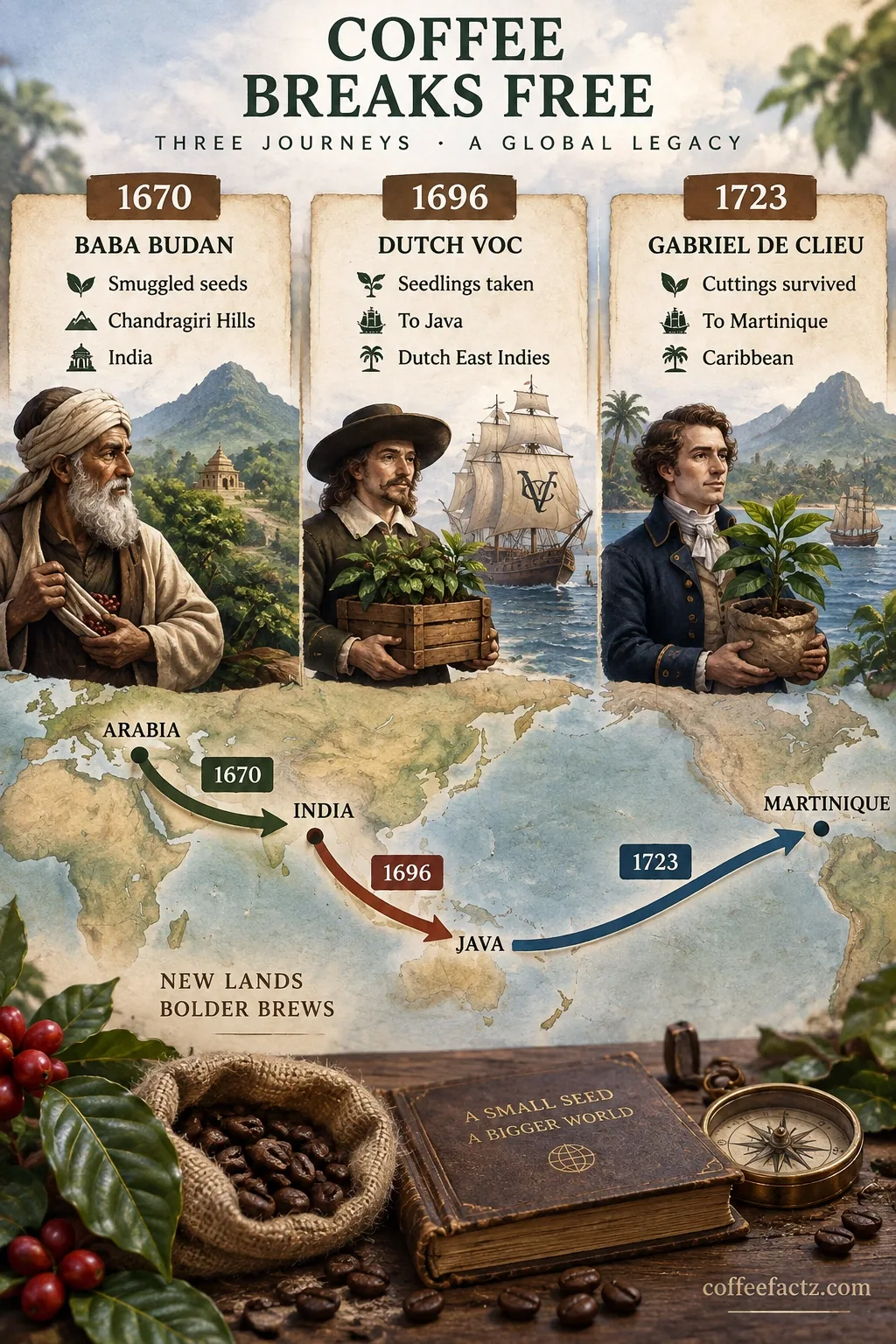
The first documented breach came not from a European trading company but from a Sufi pilgrim. In 1670, an Indian mystic named Baba Budan completed the Hajj in Mecca and returned home to the Chandragiri Hills of southern India – with seven fertile coffee seeds strapped to his abdomen. Seven seeds. The number is specific in the historical record, and it matters: Baba Budan wasn’t running a commercial operation. He was making a devotional gesture, planting the sacred drink of Sufi practice in his homeland. The plants took root. India’s coffee cultivation traces directly to that pilgrimage.
The Dutch VOC operated with considerably less poetry. In 1696, VOC merchants smuggled live coffee seedlings out of Yemen and transported them to Java. This was a corporate espionage mission with full institutional backing – the Dutch East India Company understood that whoever broke Yemen’s monopoly would control the next phase of global coffee supply. The Java plants survived and thrived.
Gabriel de Clieu carried the breach further west. A French naval officer, de Clieu transported coffee cuttings to Martinique – sources give both 1720 and 1723 as the date, and the uncertainty is genuine enough to note rather than paper over. What is not disputed: the Martinique plants survived a sea crossing during which, by de Clieu’s own account, he shared his water ration with the seedlings during a drought at sea. Those cuttings became the parent stock for much of the Caribbean’s coffee cultivation.
Market Collapse and Production Reordering
The consequences of these three breaches compounded across the following century with a speed that Yemen’s governors could not have anticipated. Java became a viable coffee producer within decades of the VOC transplantation. The Caribbean followed. And then Brazil absorbed everything.
By 1788, the French colony of Saint-Domingue – modern Haiti – was supplying roughly half the world’s coffee. By 1852, Brazil had become the largest coffee producer on Earth, a position it still holds. By 1999, Vietnam had claimed second place, primarily through Coffea canephora (Robusta) cultivation.
By 1800, Yemen’s share of world coffee production had fallen to 6 percent. Today, it is less than 0.1 percent – a collapse documented by GQ Middle East in its coverage of Yemen’s modern coffee renaissance.
Yemen went from sole global supplier to statistical rounding error in under 200 years. That’s what three smuggling missions, two centuries of colonial agriculture, and a continent-scale Brazilian plantation economy can accomplish.
[Photo]: https://coffeefactz.com/wp-content/uploads/2024/05/yemen-coffee-journey-map.jpg
Terraced Mountains, Rooftop Drying, and Qishr: Yemen’s Extreme Terroir and Architectural Heritage
Yemeni coffee tastes different because it is different – grown under conditions that no other major coffee-producing country replicates. The combination of extreme altitude, arid heat, ancient stone terraces, and a rooftop drying method that predates modern processing science produces a flavor profile that is genuinely distinct. This isn’t marketing language. It’s agronomy.
Altitude Microclimates and Stone Agriculture
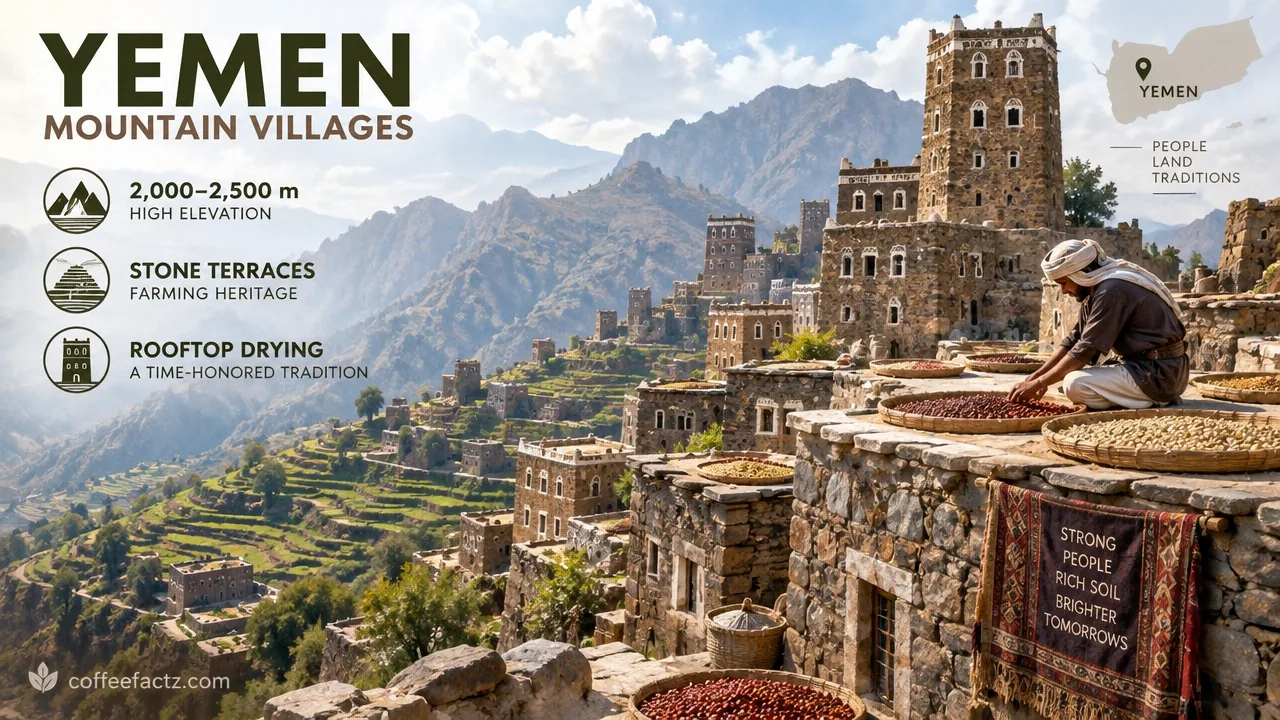
The mountain ranges of Haraz, Bani Matar, and Hayma form the backbone of Yemen’s coffee-growing regions. Farms sit at 2,000 to 2,500 meters above sea level – altitudes that slow the cherry’s maturation, concentrate sugars, and develop the complex acid structures that specialty roasters prize. At these elevations, the air is thin, the sun is harsh, and rainfall is scarce. The plants stress. Stress, in coffee, is often flavor.
The terraced stone farming that covers these slopes is not a modern agricultural technique adopted for efficiency. It’s an ancient engineering solution to an impossible landscape: near-vertical mountain faces converted into productive farmland through centuries of manual labor, one stone wall at a time. These terraces retain water, prevent erosion, and create the microclimates that differentiate Haraz beans from Bani Matar beans even when they grow within kilometers of each other.
After harvest, whole coffee cherries are spread across the flat stone roofs of centuries-old tower houses – the architectural signature of Yemen’s highland villages – and left to dry under the arid mountain sun. This is dry-natural fermentation: the cherry’s fruit pulp decomposes slowly around the bean, infusing it with sugars, acids, and fermentation compounds that wet-processed coffees never develop. The tower house roof is the processing facility. The sun and the mountain air are the equipment.
[Photo]: https://coffeefactz.com/wp-content/uploads/2024/05/yemen-coffee-monopoly-village.webp
Flavor Profiles and Husk-Based Beverages
The flavor that emerges from this process is deep, wine-like, and layered with chocolate and cardamom – a profile that experienced tasters identify immediately and that no other major origin replicates consistently. The fermentation from rooftop drying adds a fruited complexity. The altitude adds brightness and acidity. The arid stress adds concentration. These factors don’t add up linearly; they compound.
There is an irony embedded in Yemen’s coffee culture that most outsiders miss. The farmers who grew and processed some of the world’s most valuable coffee beans historically did not drink it. The green beans were too valuable to keep. They were exported. What Yemeni households brewed instead was Qishr: dried coffee cherry husks – the discarded outer skin of the processed cherry – simmered with ginger and cinnamon into a spiced, amber-colored infusion. Qishr is lighter than brewed coffee, mildly caffeinated, and deeply warming. It remains a daily ritual across Yemen today.
This tells you something important about Yemen’s relationship to its own product. For centuries, the beverage that Yemeni farmers drank every morning was made from what the export market threw away. The world got the bean. Yemen kept the husk.
Yemenia, the Extinction Crisis, and the Modern Renaissance: What Yemeni Coffee Means Today
Yemeni coffee is not a historical artifact. It is a living genetic system – and one that a 2020 genomic study revealed to be more distinct, and more scientifically significant, than anyone had previously understood. The question of Yemen’s coffee future is not sentimental. It is a question about the genetic resilience of the global coffee supply.
Genomic Discovery and Lineage Recognition
In 2020, a team of researchers published a genomic analysis of 137 Coffea arabica samples using SSR (Simple Sequence Repeat) markers, mapping the genetic structure of cultivated Arabica across its major populations. The study identified five distinct genetic clusters. One of them – named the New-Yemen cluster – was unlike anything previously catalogued.
[Photo]: https://coffeefactz.com/wp-content/uploads/2024/05/Yemen-Ethiopian-Coffee-Genetic-Diversity.png
The New-Yemen cluster contained only Yemeni samples. It was not related to any known cultivated variety, and it showed no connection to any known Ethiopian accession. Discriminant analysis confirmed the statistical separation with a Wilks lambda of P < 0.0001, and cross-validation classified 100% of New-Yemen samples correctly - the highest possible confidence level in this kind of cluster analysis.
The peer-reviewed study published in Genetic Resources and Crop Evolution (Springer Nature) identified the New-Yemen cluster as a distinct Yemeni mother group, separate from both the Bourbon-Typica lineage and Ethiopian landraces – and noted that Yemen’s centuries of cultivation under extreme climate conditions may have produced genes relevant to coffee’s adaptation to rising temperatures globally.
This is Yemenia: a newly recognized mother group of Coffea arabica, carrying genetic material that spent centuries adapting to heat, drought, and altitude stress. For a global coffee industry facing accelerating climate disruption, that gene pool is not a curiosity. It is a resource. Varieties adapted to extreme conditions through natural selection are exactly what plant breeders need to develop heat-tolerant and drought-resistant cultivars for the coming decades.
Scarcity Economics and Conflict Pressures
Authentic specialty Yemeni coffee sells for $80 to $150 per pound on the specialty market today. That price is not a marketing premium. It reflects the actual cost of production under conditions that would have shut down most agricultural systems entirely.
[Photo]: https://coffeefactz.com/wp-content/uploads/2024/05/yemen-coffee-collapse.jpg
Yemen’s coffee farmers operate under a layered set of pressures that compound each other. Water scarcity is severe – Yemen is one of the most water-stressed countries on Earth, and coffee cultivation competes directly with domestic consumption. Qat, the mildly narcotic shrub that Yemeni farmers can sell locally for immediate cash, competes with coffee for the same mountain farmland and draws farmers away from the longer, more labor-intensive coffee harvest cycle. The 2015 civil war disrupted supply chains, displaced farming communities, and severed export routes. Logistical blockades have made even getting harvested coffee to port a significant operational challenge.
By 1800, Yemen’s share of world coffee production had dropped to 6 percent; today it represents less than 0.1 percent of global supply – a contraction documented by GQ Middle East in its analysis of Yemen’s modern coffee sector.
Against that backdrop, organizations like Qima Coffee have built direct-trade networks connecting over 2,600 farmers across 53 communities to specialty buyers willing to pay prices that make coffee economically competitive with Qat. The model requires buyers who understand what they’re paying for – and why the price reflects something beyond rarity.
Living Heritage and Genetic Reservoir
Yemen’s coffee heritage is not a story that ended when the monopoly broke. The terraces are still farmed. The rooftop drying still happens. The Qishr is still brewed. And the genetic diversity that six centuries of mountain cultivation produced still lives in the beans.
[Photo]: https://coffeefactz.com/wp-content/uploads/2024/05/yemen-coffee-legacy.jpg
What the 2020 genomic study made undeniable is that Yemen’s coffee is not merely old – it is different at the molecular level. The New-Yemen cluster carries genetic information that no other population of Coffea arabica has preserved. Lose Yemen’s smallholder farming system to war, water collapse, or Qat displacement, and that genetic information disappears permanently. There is no backup copy in Java or Brazil or Ethiopia. The plant that adapted to Yemen’s specific extreme conditions exists only where those conditions shaped it.
That makes Yemen’s coffee survival not just a cultural question but a scientific one. The country that gave the world its first brewed beverage, its first coffee monopoly, and its first globally traded commodity now sits at the center of a different kind of stakes: the genetic future of coffee itself.
Frequently Asked Questions About Yemen Coffee History
Did coffee actually originate in Yemen?
Coffee as a brewed beverage originated in 15th-century Yemen, where Sufi mystics first roasted and decocted the beans into Qahwa. The wild plant itself is native to Ethiopian forests – Yemen civilized the drink, not the species.
Why does Yemeni coffee taste so different from other origins?
The combination of 2,000 to 2,500 meter altitude, arid mountain microclimates, and rooftop dry-natural fermentation creates a flavor profile – deep, wine-like, with chocolate and cardamom – that wet-processed or lower-altitude coffees don’t develop.
How did Yemen control all the world’s coffee for so long?
Every bean exported through the Port of Mokha was scalded, parched, or boiled before shipment to kill the embryo inside. A sterile seed can’t be planted. Yemen didn’t guard its borders – it made its product biologically impossible to reproduce abroad.
What is Qishr, and why did Yemenis drink it instead of coffee?
Qishr is a spiced infusion brewed from dried coffee cherry husks – the outer skin discarded after processing – simmered with ginger and cinnamon. Yemeni farmers historically exported the valuable green beans and kept the husks for their own daily drink.
What is Yemenia, and why does it matter to coffee’s future?
Yemenia is a newly identified genetic cluster of Coffea arabica, confirmed by a 2020 genomic study, that exists only in Yemeni samples and is unrelated to any known cultivated variety or Ethiopian accession. Its centuries of adaptation to extreme heat and drought conditions make it a potential source of climate-resilient coffee genetics.
How expensive is authentic Yemeni coffee, and why?
Specialty Yemeni coffee sells for $80 to $150 per pound, reflecting genuine production costs: extreme water scarcity, competition with Qat for farmland, ongoing civil conflict since 2015, and logistical blockades that make export difficult even after harvest.
How completely did Yemen lose its coffee monopoly?
Almost entirely. Yemen held exclusive global supply through the late 17th century. By 1800, its market share had fallen to 6 percent. Today it accounts for less than 0.1 percent of world coffee production, with Brazil, Vietnam, and Colombia dominating the global market.
Is there any connection between the Sufi origins of coffee and the coffee house as a social institution?
Yes, directly. The Sufi lodge – where Qahwa was first consumed communally during night vigils – established the social architecture of the coffee house: a shared space for alertness, conversation, and congregation. By 1554, secular coffee houses operating in Cairo, Aleppo, and Constantinople were structurally identical to their Sufi predecessors, minus the prayers.
References
- Why Mokha, the historic port that shaped the coffee trade, is a prize in Yemen’s war | omanobserver.om
- Coffee: A Historical and Cultural Overview | muslimheritage.com
- FAO Yemen Assessment Report: Coffee Value Chain in Yemen | yemen.un.org
- Unveiling a unique genetic diversity of cultivated Coffea arabica L. in its main domestication center: Yemen | link.springer.com
- Yemen Gave Coffee to the World. Now It’s Brewing an Almighty Renaissance | gqmiddleeast.com