

Cold brew coffee and iced coffee share a menu board and a glass of ice, but they are built on completely different physics. One uses heat and speed; the other uses cold water and time, and that single difference changes the acid chemistry, the flavor compounds, and the shelf life of everything in the cup.
The four reasons baristas reach for cold brew, lower acidity, smoother taste, caffeine control, and multi-day stability, each trace back to that same root. Once you understand the mechanism, the preference stops being a matter of opinion and starts being a matter of chemistry.
Key Takeaways on Cold Brew Coffee
- Cold brew and iced coffee use fundamentally different brewing physics; heat is what separates them, not temperature at serving.
- Chlorogenic acids degrade into quinic acid when heat and cooling are applied, which is the named mechanism behind iced coffee’s sharper, more astringent edge.
- Cold brew’s natural sweetness comes from slow polysaccharide diffusion, not added sugar; the bitter fraction largely stays in the grounds.
- Caffeine content is a function of brew ratio and dilution, not the method label; “twice as caffeinated” is recipe-dependent, not a universal fact.
- Refrigerated cold brew holds stable for up to 14 days under clean handling conditions; iced coffee degrades within hours due to lipid oxidation and ice dilution.
- Over-steeping cold brew past its target window produces the exact bitterness and astringency the method is supposed to avoid; steep time is an ingredient you taste, not just clock.
What Baristas Mean When They Say “Cold Brew” (And Why Iced Coffee Isn’t It)
Cold brew and iced coffee are not the same drink brewed twice. The confusion is understandable because both end up cold and both taste like coffee, but the production method is entirely different, and that difference is what drives every flavor, acidity, and stability claim you’ll read about either one.
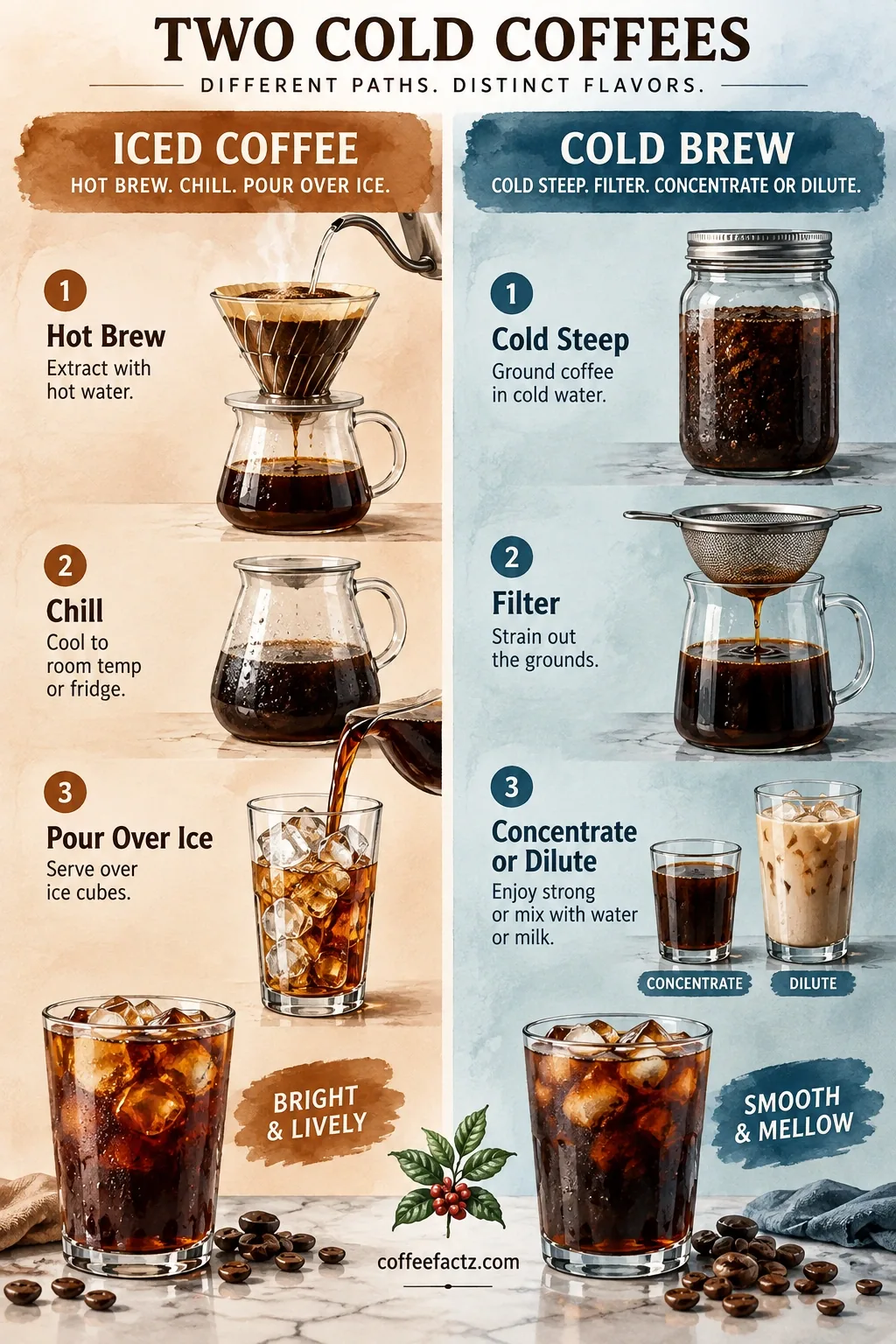
Iced coffee is hot-brewed coffee, typically brewed at double strength so melting ice doesn’t water it down, then chilled and poured over ice. The heat step is not optional. It’s what shapes the acid profile, the aromatic top notes, and the final flavor of the drink. Remove the heat and you don’t have iced coffee anymore.
Cold brew is coarse-ground coffee steeped in cool or room-temperature filtered water for 12 to 24 hours, then filtered and served. No heat enters the process at any point. What you get after filtering is either a ready-to-drink cold brew, which is already at drinking strength, or a concentrate, which is intentionally strong and designed to be diluted with water or milk before serving. Treating undiluted concentrate as a finished drink is one of the most common reasons someone walks away thinking cold brew is too intense or too bitter.
Three beginner myths are worth clearing up before going further. First, cold brew is not iced coffee with the ice strained out. The brewing method itself is different. Second, cold brew does not have to be brewed in the refrigerator. Room-temperature steeping is a legitimate method that simply runs faster, which is why steep time and temperature must always be read together. Third, cold brew is not automatically stronger than iced coffee. Strength depends entirely on your brew ratio and how much you dilute before serving.
The four reasons baristas prefer cold brew come with conditions attached. Lower acidity, smoother taste, higher caffeine potential, and better flavor stability are all real, but each one depends on how the coffee was made and how it’s served. This article tests each claim against the actual chemistry.
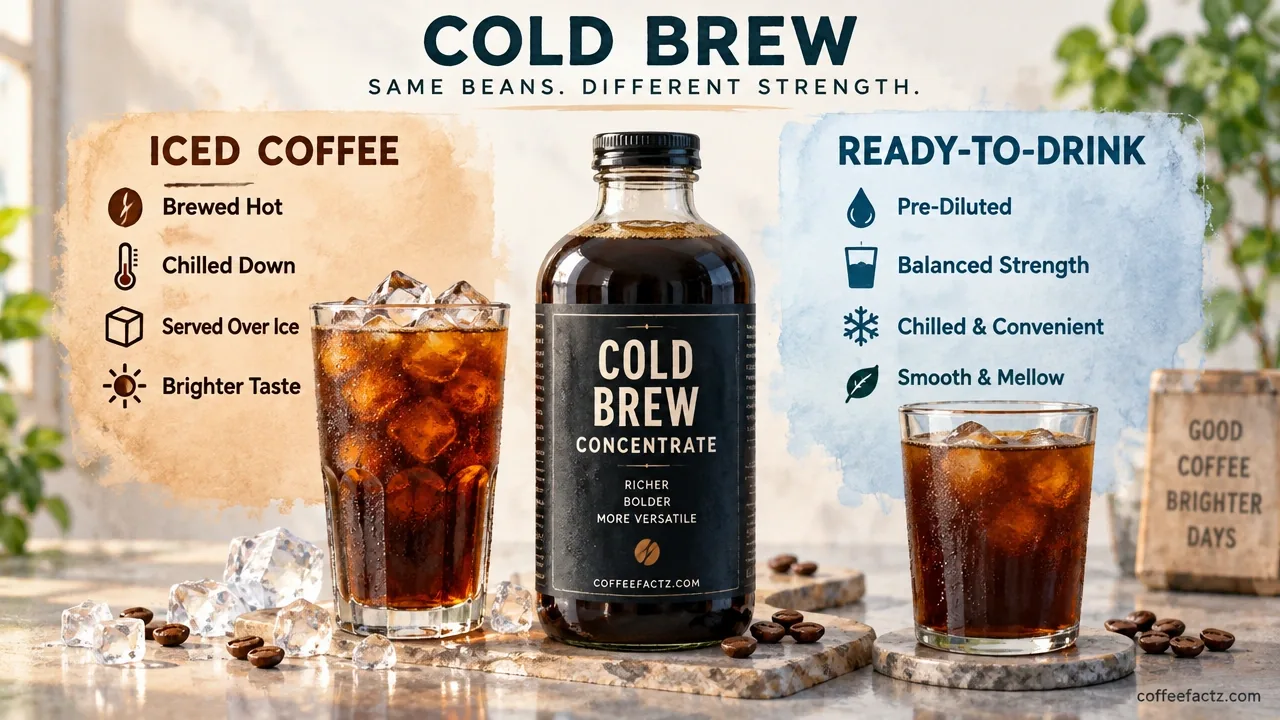
The Specialty Coffee Association draws the line clearly: while iced coffee and espresso drinks are brewed hot and then chilled, cold brew is a long, slow, typically immersion-style steep in room-temperature or chilled water lasting anywhere from 4 to 24 hours.
That definitional boundary isn’t pedantic. It’s the foundation for everything that follows.
Cold Water Is a Slow Solvent: How Time Replaces Heat
Cold water extracts coffee compounds less efficiently than hot water, which is the first thing anyone learns about cold brew. What almost no guide explains is that the same slow extraction also changes which compounds actually make it into the cup. That’s the difference you taste.
Extraction Physics and Particle Size
Heat accelerates solubilization. Hot water dissolves coffee compounds in minutes because elevated temperature gives molecules the energy to break free from the grounds and move into solution. Cold water is a far slower solvent, so cold brew compensates by substituting hours of contact time for the energy that heat would have supplied.
Grind size has to be coarse for this method to work. A fine grind with a long steep is a recipe for over-extraction because the increased surface area accelerates compound release past the point where the cup is still pleasant, and fine particles clog filtration. A coarse grind slows the extraction rate, keeps it even, and gives you a forgiving window to work within.
The two causal chains look like this side by side: coarse grind + cold water + long steep produces a time-based extraction that yields a lower-acid, smooth, sweet-leaning cup. Hot brew poured over ice produces a fast, heat-driven extraction followed by chilling and dilution, which results in a brighter, lighter, faster-fading drink.
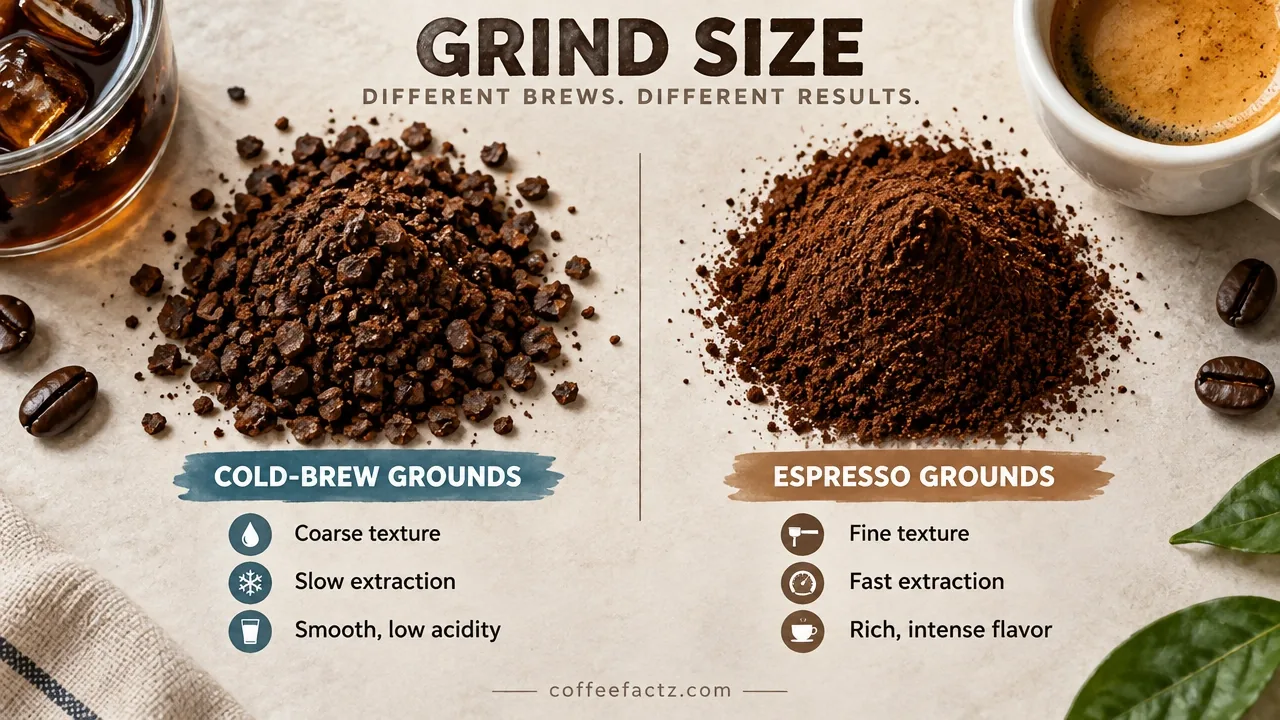
Steeping Variables and Structural Contrast
A standard starting ratio is 100 g of coffee to 1 liter of water, a 1:10 ratio. That produces a strong base, not a finished drink. It is the starting point from which dilution and serving decisions are made.
Temperature during steeping is a real variable, not a fixed rule. Refrigerator steeping runs slower, produces a cleaner cup, and is more forgiving if you lose track of time. Room-temperature steeping runs faster because even modest ambient warmth accelerates extraction. Neither method is wrong. The “cold brew must go in the fridge” rule is a forum assumption with no chemical basis. What matters is that you adjust your steep time to match whichever temperature you choose.
The structural difference that governs everything in this article is simple: iced coffee is brewed hot and then chilled. Cold brew is brewed cold from start to finish. That distinction isn’t about preference. It’s about which compounds get extracted, how much, and in what form.
Reason One: Lower Acidity and the Cooling Step
Iced coffee can genuinely irritate a sensitive stomach in a way that cold brew often doesn’t. The reason isn’t vague. It has a name and a mechanism, and it starts with a specific compound in the bean.
Heat-Sensitive Compound Degradation
Chlorogenic acids are among the dominant acid compounds in coffee, and they are heat-sensitive. During hot brewing, elevated temperature breaks them down. The breakdown products include quinic acid and a family of related compounds called chlorogenic acid lactones. Quinic acid reads on the palate as a sharper, more astringent edge, and research published in European Food Research and Technology confirms that roasting drives chlorogenic acid isomers toward quinic acid and its epimers through thermal degradation. The same pathway accelerates during hot brewing and again during the subsequent cooling step that iced coffee requires.
Cold brew never runs that heat-plus-cooling sequence. Cold water also extracts less of the acid fraction to begin with, because many of these compounds require heat to fully solubilize. The result is a cup with a lower perceived acid load, not because acid is absent, but because the specific compounds that register as sharp or biting are present in smaller quantities and in less degraded forms.
The circulating figure that cold brew is “over 60% less acidic than hot coffee” is methodologically hollow. It ships without specifying pH measurement, titratable acidity, brew ratio, roast level, or measurement conditions. It cannot be reproduced or compared across sources. Treat it as a directional signal, not a spec.
Digestive Comfort and Health Positioning
The outcome for the drinker is straightforward: cold brew tends to be gentler on the stomach for acid-sensitive people, those with reflux, and anyone whose digestive system objects to hot coffee poured over ice. That said, cold brew is not acid-free. The gentleness is real, but it is relative.
The “is cold brew healthier than iced coffee?” question has a conditional answer. For most people, it is the easier option on the stomach. Whether it’s healthier in a broader sense still depends on what you add to it and how much you drink.
Because the acidity claims in the category are largely unverifiable without knowing the production parameters, the more useful approach is to control the four levers that actually decide the acid character of your cup: roast level (darker roasts have already degraded more chlorogenic acid during roasting, so they tend to taste less acidic), brew ratio and dilution (more water softens perceived acidity), steep duration (longer steep extracts more total compounds), and serving temperature (colder temperatures suppress perceived acidity). Change one variable at a time with the same beans, and the acidity difference stops being a slogan and becomes something you can taste and adjust.
Reason Two: Smooth and Naturally Sweet
The sweetness question catches people off guard because there’s no sugar involved. The answer is in the bean itself, and in what cold water does and doesn’t pull out of it.
Carbohydrate Extraction Mechanics
Coffee beans contain carbohydrates and polysaccharides that carry natural sweetness. These compounds diffuse into water slowly and gradually. A long cold steep suits them well because extraction happens at a pace that allows these heavier molecules to move into solution without the aggressive thermal forcing that hot water applies.
Heat doesn’t just speed extraction up. It also aggressively pulls bitter and astringent compounds that cold water largely leaves in the grounds. Roast-driven bitterness, in particular, requires heat to fully solubilize. In a cold steep, those compounds stay largely locked in the coffee particle, which means the sweet, rounded notes in the cup aren’t competing with a wall of roast bitterness.
The result: cold brew’s sweetness is generated by extraction, not added. An unsweetened cold brew made from the same beans as an unsweetened iced coffee will taste noticeably sweeter, not because of anything added, but because the extraction method selectively emphasized the sweet fraction and left much of the bitter fraction behind.
Sensory Vocabulary and Flavor Tradeoffs
“Smooth” is a vague word. Here’s what it actually means in the cup: low bitterness means you don’t get the sharp, drying finish that roast-driven compounds create. Low astringency means the drink doesn’t leave your mouth feeling chalky or dry. Fuller body means more dissolved solids are present, giving the liquid a slightly heavier, more coating texture. Clean finish means the aftertaste resolves quickly and pleasantly rather than lingering with harshness.
The honest tradeoff is that the same gentleness mutes bright, fruit-forward, aromatic top notes. Smoothness is not complexity. A cold brew made from a naturally processed Ethiopian bean will taste rounder and sweeter than its hot-brewed counterpart, but it will also lose some of the vivid, floral, high-register notes that make that bean interesting in a pour-over. Choose what you actually want.
Most drinkers misjudge cold brew’s sweetness because of how they serve it. Concentrate is designed to be diluted, roughly 1:1 with water or milk as a common starting point. Taste it straight from the jar and you’re evaluating a base ingredient, not the finished drink. Before pouring over ice, taste the diluted version first. Account for ice melt by either chilling your glass beforehand, using less ice, or freezing coffee into cubes so dilution doesn’t quietly thin the drink while you’re drinking it. The perception of sweetness peaks when the drink is neither over-diluted nor over-steeped; those two failures are the most common reason a home batch tastes thin or dull despite a solid recipe.
Reason Three: Caffeine and the Honest Math Behind “Cold Brew Is Stronger”
The claim that cold brew has more caffeine is repeated constantly and verified almost never. Here’s what the numbers actually say and what they depend on.
Dose Ranges and Method Variance
Commonly cited ranges put an 8 oz serving of iced coffee at around 80 to 120 mg of caffeine, while 8 oz of undiluted cold brew concentrate lands around 150 to 200 mg. Those figures describe specific serving conventions, not a universal truth about the methods. The word “undiluted” is doing a lot of work in that second number.
The “twice as caffeinated” claim is unreliable because dilution, brew ratio, roast level, bean origin, and serving size each move the caffeine number more than the method label does. A cold brew made at a 1:10 ratio and diluted 1:1 before serving sits at a different caffeine level than one made at 1:5 and served straight. The category as a whole publishes either a bare number with no parameters, an unquantified “more caffeine” assertion, or nothing at all. Any figure you read is a function of someone else’s specific recipe, not a property of cold brew as a method.
Recipe Levers and Intake Moderation
If you want to control your caffeine dose, the actual levers are starting coffee weight and final dilution, not the label on the cup. More coffee relative to water, and less dilution at serving, produces a higher caffeine dose. That’s the whole equation.
The moderation point is worth taking seriously. Because cold brew can be dosed high without tasting harsh, it’s genuinely easy to overshoot your usual intake without noticing. The smoothness masks the dose. Know your target before you drink, not after.
To reproduce your own answer rather than borrowing someone else’s, track these parameters: bean weight, water weight (ratio), grind size, steep time, whether you’re making concentrate or ready-to-drink, and final serving dilution. The most direct way to settle the caffeine and smoothness argument for yourself is a controlled side-by-side: same beans, same ratio, one batch hot-brewed and chilled, one cold-steeped, served at identical volume and dilution. Everything else is theory. That experiment is your evidence.
Reason Four: Flavor Stability and the 14-Day Fridge Window
Iced coffee tastes noticeably worse by mid-afternoon. Cold brew poured from the same fridge on day seven tastes essentially the same as day one. That gap has a chemical explanation.
Oil Degradation and Shelf Life
Lipid oxidation is the mechanism. Coffee oils react with oxygen, and that reaction accelerates with heat and exposure to air and light. The compounds produced by oxidizing lipids read as stale, cardboardy, or in advanced cases, rancid. Every cup of coffee begins this process from the moment brewing is complete.
Iced coffee punishes time because it’s hot-brewed, cooled rapidly, and then continuously diluted by melting ice. The aromatic compounds that make it bright and interesting are volatile and degrade over hours. By mid-afternoon, the drink is both more diluted and more oxidized than it was at 9 a.m. Baristas don’t batch iced coffee because there’s no point; the cup you’d pour at 3 p.m. wouldn’t be worth drinking.
Cold brew’s advantage is that the cold environment slows oxidation, and the absence of heat means fewer volatile aromatics were created in the first place, so fewer volatile aromatics are lost. Refrigerated cold brew holds its character for up to 14 days, giving a barista one batch to pour from all week without the flavor profile shifting cup to cup. That stability is the practical reason cold brew dominates café batch programs.
One important framing note: because cold brew sits at the smooth, low-acid end of the flavor spectrum, mishandling is harder to detect by taste alone. A slightly oxidized cold brew may not taste obviously wrong the way a stale iced coffee does. That’s precisely why the handling rules, not the flavor, are the actual safety mechanism.
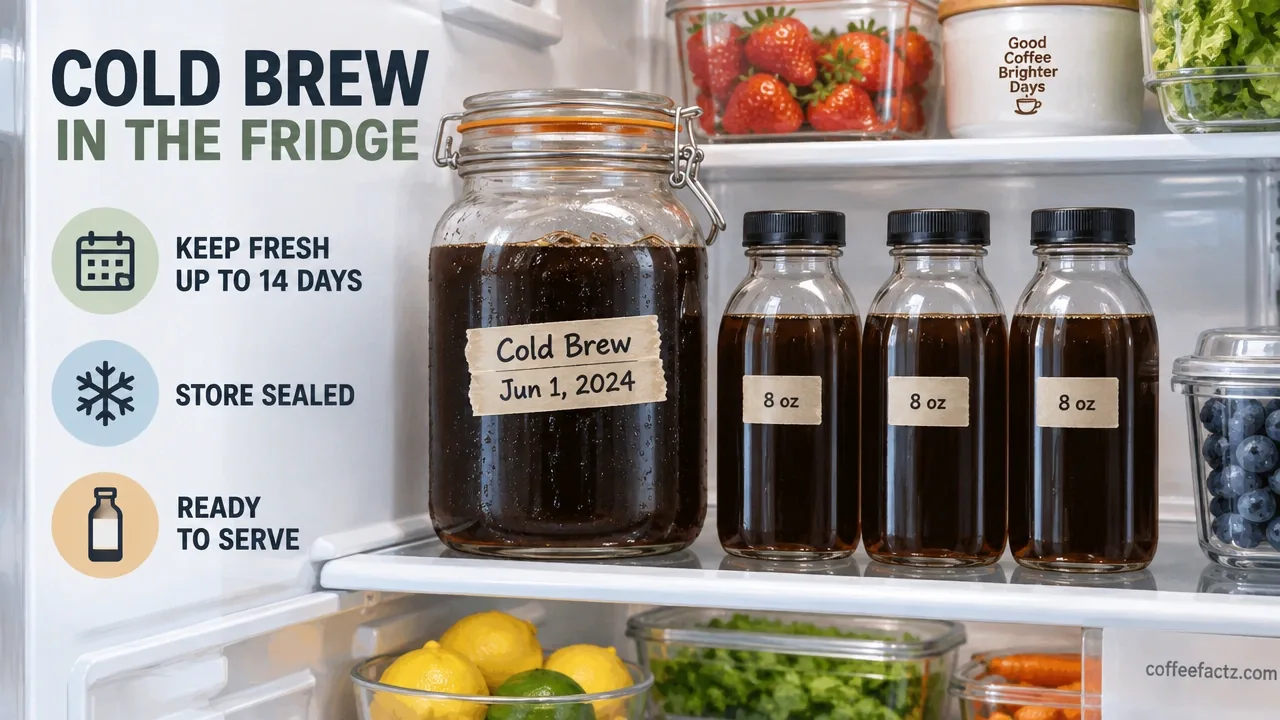
Storage Variables and Batch Assessment
The 14-day figure comes with conditions. It assumes consistent refrigeration and clean handling throughout the storage period. Anything added to the batch, milk, syrups, cream, shortens the practical window because dairy and sugar introduce their own spoilage timelines. “Keeps for 14 days” is not the same as “never spoils.”
Storage guidance across the cold brew category is genuinely inconsistent. Some sources state 14 days, others omit storage guidance entirely, and forum advice ranges from “it never goes off” to strict food-safety warnings. Nobody defines the conditions clearly: dairy addition thresholds, room-temperature holding limits, or microbial risk. Treat 14 days as a guideline, not a guarantee.
Judge a batch by aroma and taste, not by color or by how long it’s been sitting. A batch that smells flat, sour, or off is done regardless of the calendar. Conservative handling fills the gap the category leaves open: keep the batch sealed and refrigerated, don’t leave it at room temperature for extended periods, add milk only at serving time, and discard anything showing off-aromas or a surface film.
When Cold Brew Turns on You: Over-Steeping and the Honest Downsides
If cold brew is supposed to be smooth and gentle, why do some home batches come out bitter and drying? Because extraction doesn’t stop when you want it to. It stops when you filter.
Astringency Onset and Contact Duration
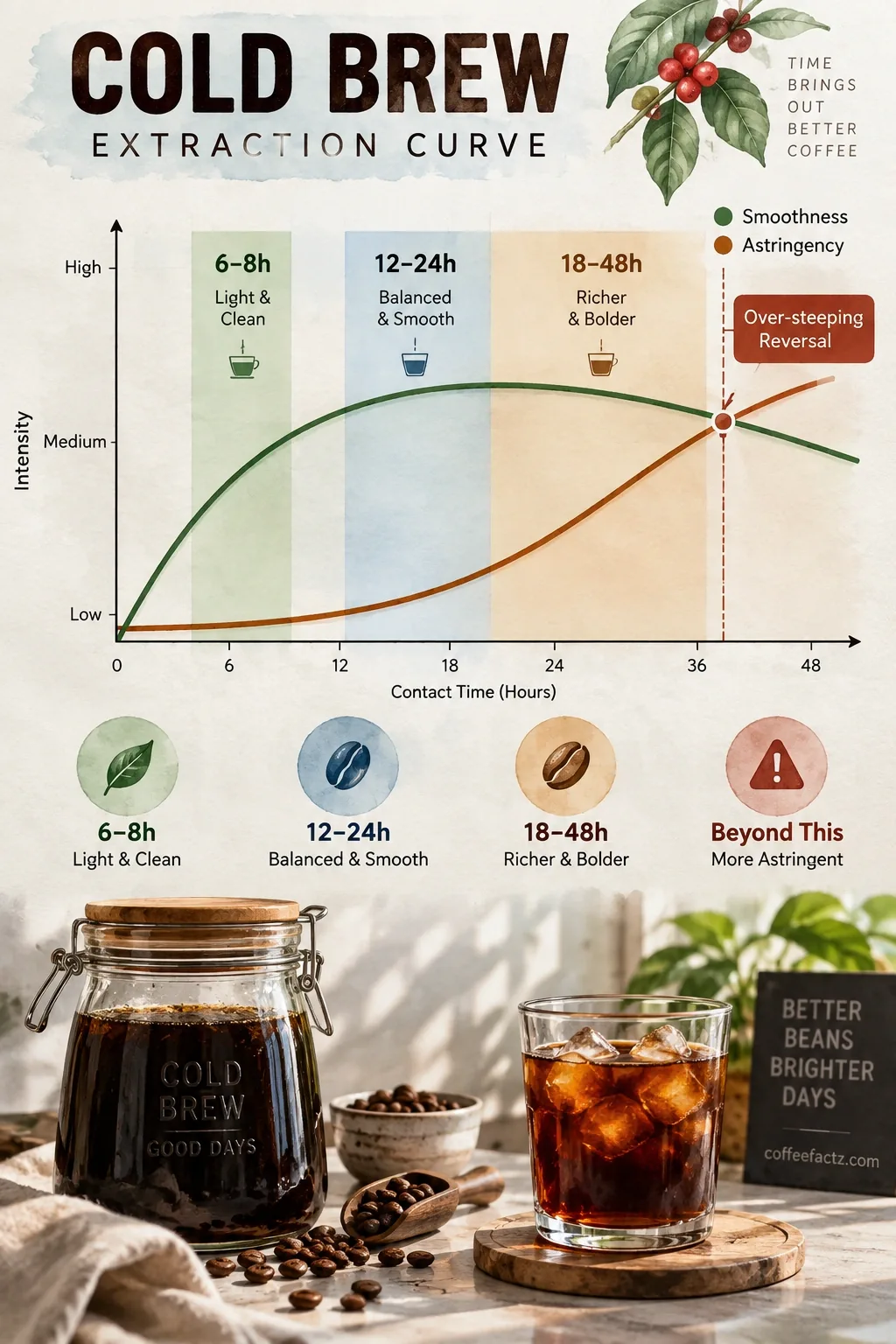
Extraction continues as long as grounds sit in water. Past the intended window, the water keeps pulling bitter and astringent compounds that it was too slow to reach in the early hours of the steep. Cold brew’s signature smoothness collapses into the exact harshness it was supposed to avoid. The reversal is real and almost entirely absent from blog-level guides, which is why so many home brewers conclude cold brew is overrated.
The working windows depend on what you’re making: roughly 6 to 8 hours for a lighter, ready-to-drink style; 12 to 24 hours for a standard batch; and 18 to 48 hours for a concentrate. Longer is not better. Longer is stronger, and only useful if concentrate is what you actually wanted.
The common failure modes are: steeping at room temperature and forgetting about it, using a fine grind with a long steep, leaving the grounds in contact after the steep because you didn’t filter immediately, or extending the steep to “get more out of” the coffee. Published brew windows across the category swing wildly, from 6 hours to 48 hours, with no consistent guidance on grind, ratio, or temperature. Over-steeped cold brew can taste sharper than a well-made iced coffee, the exact opposite of the claim that drew the reader in.
Operational Drawbacks and Diagnostic Control
The honest downside list for cold brew: you must plan at least a day ahead, you spend more grounds per finished cup than hot brewing requires, aromatic top notes are muted by design, dilution takes practice to calibrate, and the caffeine ceiling is easy to hit by accident because the smoothness doesn’t signal the dose.
These are control failures, not method failures. Every one of them is addressable with a small amount of deliberate attention.
The control method is straightforward: mark your steep start time, taste at the short end of your target window before you pull the grounds, and stop when the cup tastes right rather than when the clock says so. Extraction is a curve, not a switch. Time is an ingredient you taste your way through.
Diagnose by symptom: harsh and drying means over-steeped or too finely ground. Thin and hollow means over-diluted or under-steeped. Two symptoms. Two dials. Adjust one at a time.
The Barista’s Choice, Reproduced at Home
Baristas choose cold brew because it is reproducible, forgiving, batchable, and stable, not because hot-brewed coffee is inferior. Iced coffee still wins on brightness, aroma, speed, and single-cup variety. Both methods have a legitimate place. The preference is a control decision, not a taste verdict.
The decision rule is simple. Choose cold brew when you want a smooth, low-acid, sweet-leaning cup you can pour from for days. Choose iced coffee when you want aromatic, bright coffee right now, without a day of planning.
Here’s one repeatable starting protocol: coarse grind, 1:10 coffee to water, cold or room-temperature water, 12 to 24 hours, filter completely, refrigerate immediately, dilute before serving, and taste before adding ice. That sequence covers every variable that matters for a first batch.
The three adjustment dials, and what each one changes:
| Dial | Adjust This Way | What Changes |
|---|---|---|
| Grind | Finer | Faster, stronger extraction; higher risk of harshness |
| Time | Longer | Stronger up to a point, then bitter and astringent |
| Dilution | More water or milk | Softer flavor, lower caffeine per serving |
Change one dial per batch. Log your bean, grind setting, ratio, steep hours, and dilution for each attempt. You will converge on a house recipe faster than any published recipe can hand you one.
The category’s central failure is that nearly every source answers “what’s the difference” while drinkers actually want operational control: the exact caffeine gap under controlled parameters, optimal brew time for their specific grind and ratio, and real food-safety limits. Those questions remain genuinely unanswered at the category level. The protocol above is built as three adjustable dials rather than a fixed recipe because the numbers are starting points, not laws.
Know your beans and roast level. A light roast from Ethiopia and a dark roast from Brazil will produce completely different cold brews from the same 1:10 ratio and 18-hour steep. Serve at the dilution and temperature you genuinely enjoy rather than what a label recommends. And treat caffeine as a dose you choose rather than a side effect you absorb.
The only way to settle the taste argument for yourself is the controlled side-by-side: same beans, same ratio, one hot-brewed and chilled, one cold-steeped, served identically. Everything in this article is a mechanism. That experiment is your evidence.
Frequently Asked Questions About Cold Brew Coffee
Is cold brew stronger than iced coffee?
It depends entirely on the brew ratio and how much you dilute it before serving. Undiluted cold brew concentrate can contain significantly more caffeine per ounce, but a properly diluted serving made at a standard 1:10 ratio may land close to a double-strength iced coffee.
What is healthier, iced coffee or cold brew?
Cold brew is generally gentler on the stomach because it contains less degraded chlorogenic acid and fewer bitter compounds. Whether it’s “healthier” in a broader sense depends on what you add to it and how much caffeine you’re actually consuming per serving.
What are the disadvantages of cold brew coffee?
You need at least 12 hours of lead time, you use more coffee grounds per finished cup, bright and aromatic top notes are muted by design, dilution requires calibration, and the smooth taste can mask a high caffeine dose that’s easy to overshoot.
Is cold brew the healthiest coffee?
No single brewing method earns that title cleanly. Cold brew’s lower perceived acidity and gentler extraction make it a reasonable choice for acid-sensitive drinkers, but the health picture shifts the moment you add milk, sugar, or flavored syrups.
Why does my cold brew taste bitter if it’s supposed to be smooth?
Almost certainly over-steeping. Extraction continues as long as grounds sit in water, and past your target window the water pulls the same bitter and astringent compounds that cold brew is supposed to leave behind. Filter at the short end of your window and taste before the clock runs out.
Can I brew cold brew at room temperature instead of in the fridge?
Yes. Room-temperature steeping works and simply runs faster than refrigerator steeping. The “fridge-only” rule has no chemical basis; what matters is adjusting your steep time downward to account for the warmer ambient temperature.
Does cold brew lose quality after a week in the fridge?
Under clean handling conditions with no dairy added, it typically holds well for up to 14 days. Judge by aroma and taste rather than by the calendar. Anything smelling flat, sour, or off should be discarded regardless of how long it’s been stored.
Why does cold brew taste sweeter than iced coffee made from the same beans?
Cold water extracts carbohydrates and polysaccharides slowly and gently while leaving most of the roast-driven bitter compounds locked in the grounds. Hot water pulls both the sweet and the bitter fractions aggressively, so in iced coffee the bitterness competes with and partially buries the sweetness that’s present.
References
- Cold vs. Iced: Using Sensory Analysis to Test the Claim That Cold Brew Is Sweeter and Less Acidic | sca.coffee
- Transformation of Chlorogenic Acids During the Coffee Beans Roasting Process | link.springer.com