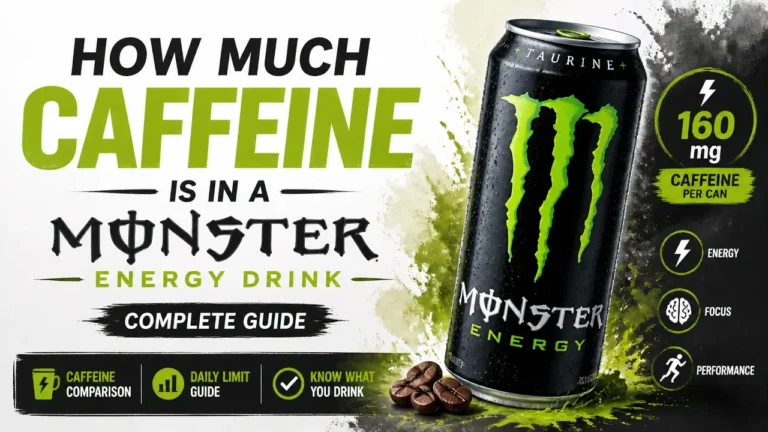

Original Monster Energy delivers 160 mg of caffeine in a standard 16 oz can, exactly 10 mg per fluid ounce. That’s roughly comparable to a strong brewed coffee, but the experience hits differently: sugar, taurine, and B-vitamins accelerate absorption and amplify the effect.
The FDA caps safe daily caffeine at 400 mg, which means one can sits well within limits (two starts pushing boundaries). Go for the Mega Monster 240 and your math changes fast. Know what’s in the can before the can makes decisions for you.
How Much Caffeine Is in a Monster Energy Drink?
Monster Energy Drink’s standard 16-oz green-claw can delivers exactly 160 mg of caffeine, that’s the Original Monster Energy, the baseline every other can in the lineup gets measured against. Think of it as the anchor number: one can, 160 mg, done.
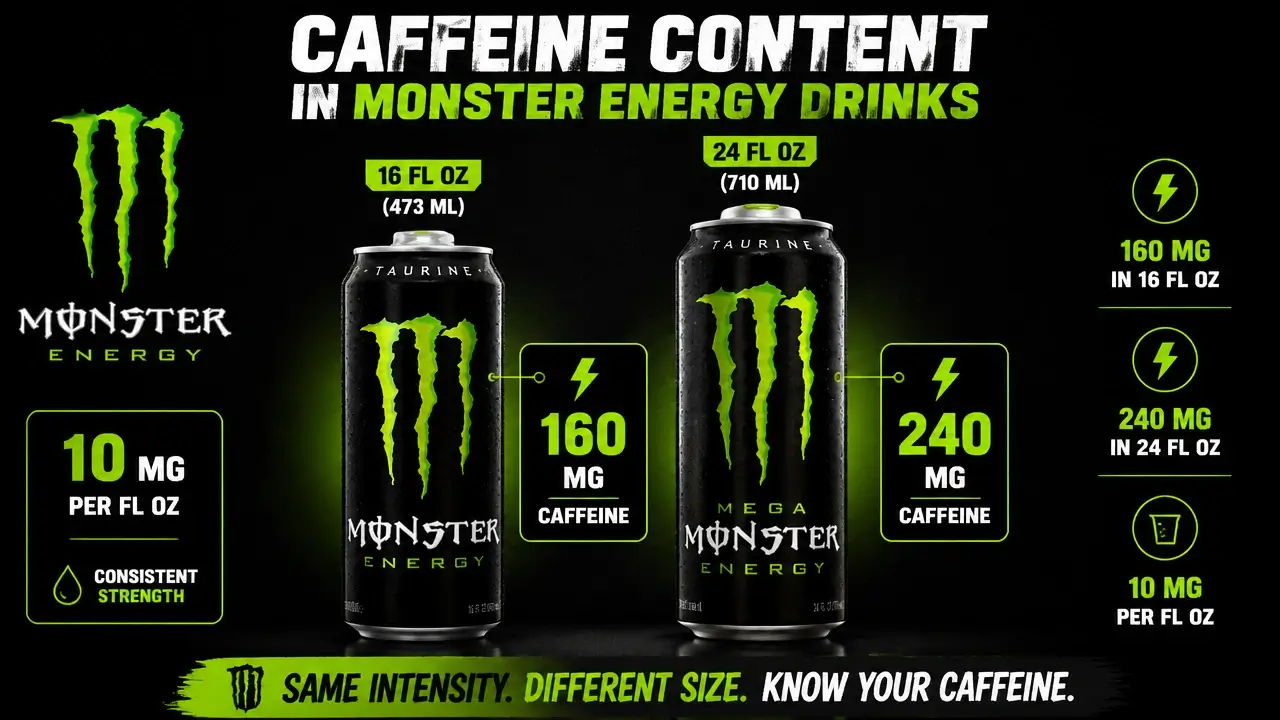
Here’s the math that makes this useful. Monster runs at 10 mg of caffeine per fluid ounce, which means the can size isn’t just a packaging decision (it’s a dosage decision). Grab the Mega Monster 24-oz can instead of the standard, and you’ve just jumped from 160 mg to 240 mg without changing a single ingredient. Same formula, bigger vessel, 50% more caffeine in your hand.
Now put those numbers against the FDA’s 400 mg daily limit for healthy adults. One standard Original Monster Energy takes up 40% of that ceiling before your day has really started. One Mega Monster? You’re already past the 60% mark on a single drink.
Any time you pick up a Monster can (or any energy drink), glance at the fluid ounces, multiply by 10, and you’ve got a working estimate before you even read the nutrition label. It won’t be exact across every product in the lineup, but for the Original formula, it holds clean.
And that’s the catch: not every Monster is the Original formula. The 160 mg and 240 mg numbers we just covered are the starting point, not the full picture.
Monster Energy Drink Varieties Span a Wild Caffeine Range
Monster Energy drink varieties don’t come in one flavor of intensity: they span a caffeine range so wide that two cans sitting side by side on the same shelf could deliver 0 mg or 300 mg depending on which one you grabbed. That’s not a minor difference. That’s the difference between hydration water and a dose that puts you at 75% of the FDA’s daily ceiling in a single sitting.
The color of the can, the word “Ultra,” the word “Zero” (none of that tells you what you actually need to know). The milligrams on the back label do.
Here’s the full picture in one place:
| Variant | Can Size | Caffeine (mg) |
|---|---|---|
| Java Monster “Killer Brew” | 15 oz | 300 |
| Java Monster (standard varieties) | 15 oz | 200 |
| Monster Import | 18.6 oz | 179 |
| Original Monster Energy | 16 oz | 160 |
| Juice Monster / Monster Assault | 16 oz | 160 |
| Monster Zero Sugar / Ultra line | 16 oz | 140–150 |
| Monster Hydro / Electrolyte Sports | bottle | 150 |
| Monster Tour Water | 16 oz | 0 |
The Original Monster Energy (the classic green can most people picture) lands at 160 mg per 16 oz. That’s your baseline. Everything else on this list is a deviation from that number, sometimes dramatically.
Java Monster Killer Brew sits at the top at 300 mg. That’s nearly double the Original in a can that’s actually one ounce smaller. The standard Java Monster varieties aren’t far behind at 200 mg. Both are coffee-based, which is part of why the caffeine climbs: you’re getting it from two sources at once.
Monster Import and the Juice Monster and Monster Assault lines cluster in the 160–179 mg range, close enough to the Original that the practical difference is small.
The trap most people fall into is at the bottom of that table. Monster Ultra and Monster Zero Sugar sound like they’ve been dialed back (and they have been, but only in terms of sugar). Caffeine sits at 140–150 mg per can. That’s not a light option. You’re still taking in roughly the equivalent of a strong cup of coffee, just without the sugar spike alongside it.
Monster Tour Water is the only true outlier: zero caffeine, full stop. It’s essentially branded hydration, not an energy product. If someone handed you one without context, you’d have no way to know that from the logo alone.
That’s the core reason to flip every Monster can over before you drink it. Marketing names like “Java” or “Import” hint at strength but don’t quantify it. The serving size matters too (a 15 oz Java Monster and a 16 oz Original look nearly identical in your hand, but one carries 140 mg more caffeine). The back label is the only place where the actual number lives.
Monster vs. Coffee vs. Other Energy Drinks
Straightforward caffeine comparisons between Monster Energy Drink and its competitors get misleading fast, because the drinks don’t come in the same container size, and the raw milligram numbers hide more than they reveal.
Here’s what the label math looks like at face value:
| Drink | Serving Size | Caffeine |
|---|---|---|
| Coca-Cola Classic | 12 oz | 34 mg |
| Red Bull | 8.4 oz | 80 mg |
| Standard Monster Energy | 16 oz | 160 mg |
| Brewed Coffee | 16 oz | ~180 mg |
| Bang / Celsius Fast | 16 oz | 300 mg |
Looks like Monster doubles Red Bull, right? And Bang looks like it just doubles Monster back. That’s the trap.
You’re not comparing the same drink in different strengths. You’re comparing a shot glass to a tall glass to a pint. The number on the label tells you total caffeine delivered, not how concentrated that caffeine actually is.
The only honest measuring stick here is milligrams per fluid ounce. That’s the number that tells you how hard the drink hits relative to how much liquid you’re putting down.
Once you normalize for volume, the Red Bull vs. Monster rivalry basically disappears. Monster sits at roughly 10 mg per ounce. Red Bull lands at about 9.5 mg per ounce. That 80-vs-160 gap on the label? Almost entirely a story about can size, not potency. You’re drinking nearly twice as much liquid (of course you’re getting twice the caffeine).
Bang and Celsius Fast are a different conversation entirely. Both clock in around 18–19 mg per ounce, nearly double Monster’s concentration, not just double the total. When someone says Bang “feels way stronger” than Monster, this is why. It’s not just more caffeine; it’s more caffeine packed into every sip.
Brewed coffee is the wildcard that makes any clean comparison impossible. A 16-oz light-roast drip coffee might land around 180 mg, which already nudges past a standard Monster can. But a strong pour-over or a dark espresso-based drink can push well past 300 mg in the same volume. There’s no single “coffee number”: it’s a range, and depending on where your coffee falls in that range, your Monster might be weaker, roughly equivalent, or stronger. It’s not a binary fight; it’s a sliding scale.
The practical takeaway: if you’ve been thinking of Monster as the heavy hitter in your lineup, the caffeine comparison tells a more nuanced story. It’s a moderate-concentration drink in a large can, which is exactly why it feels like “a lot” of caffeine without being particularly potent per ounce. That distinction matters when you’re trying to understand why it hits the way it does.
What Else Is in a Monster? Sugar, Taurine, and the Energy Blend
Monster Energy ingredients don’t stop at caffeine: a standard 16-oz Original Monster packs 54 grams of sugar, a proprietary energy blend of taurine and guarana seed extract, a B-vitamin complex, and L-carnitine, all working in parallel with the caffeine you already counted. That’s not a simple stimulant. That’s a layered formula where several compounds are hitting your system at once, each doing something different.
The sugar alone is worth slowing down on. Fifty-four grams is roughly the equivalent of 13 teaspoons (more than what’s in a 12-oz can of Coke). That glucose floods your bloodstream fast, giving you a sharp secondary lift on top of the caffeine. But what goes up quickly comes down quickly. That familiar mid-morning slump or post-gaming wall? A lot of it isn’t caffeine wearing off, it’s your blood sugar crashing after the spike. The caffeine is still working. Your glucose just bailed on you.
Taurine’s Role in Caffeine Processing
Taurine is an amino acid your body produces naturally, and it’s been included in energy drinks for its alleged benefits to muscle function and cardiovascular modulation. The important word there is alleged (the research is still thin). What we do know is that taurine isn’t a stimulant. It won’t make you feel wired on its own. But there’s evidence it influences how your body processes caffeine, potentially moderating some of the cardiovascular stress that comes with high-caffeine intake. Think of it less as an accelerator and more as a co-pilot that may affect how the ride feels.
The B-vitamin complex (B2, B3, B6, and B12) along with L-carnitine round out the metabolic side of the formula. These are co-factors: they support energy metabolism at the cellular level, helping your body convert nutrients into usable fuel. They’re not stimulants, and you shouldn’t expect a noticeable buzz from them. But they’re doing background work that the formula leans on.
Guarana Seed Extract’s Hidden Caffeine
Here’s where the label gets quietly deceptive. Monster’s proprietary blend includes guarana seed extract, and guarana naturally contains caffeine, roughly 3.6% caffeine by weight. Because it’s listed under a proprietary blend rather than called out as a separate caffeine source, that contribution doesn’t show up in the “160 mg of caffeine” figure on the can. Conservative estimates put the hidden guarana caffeine at an additional 10–30 mg per can. That’s not enormous, but if you’re already close to your daily ceiling, it matters.
This is exactly the concern researchers have been raising. Dr. Katherine M. S. and co-authors02873-5/abstract), writing in Heart Rhythm (2024) on sudden cardiac arrest events in temporal proximity to energy drink consumption, put it plainly:
“However, most of these energy drinks contain other stimulating ingredients in addition to caffeine that are unregulated by the FDA, such as taurine and guarana. The industry’s growth has raised concerns about the potential combined effects of caffeine consumption and additional unregulated ingredients in these beverages.”
The phrase “combined effects” is doing real work there. No single ingredient in Monster is necessarily the problem. The question is what happens when all of them land together, and that’s a question the FDA hasn’t fully answered yet.
For people trying to cut the sugar load, Monster’s zero-sugar and Ultra variants swap the 54 grams of sugar for artificial sweeteners like sucralose. The glucose spike and the crash that follows it disappear. But sucralose brings its own set of questions (ones we’ll get into later in this guide).
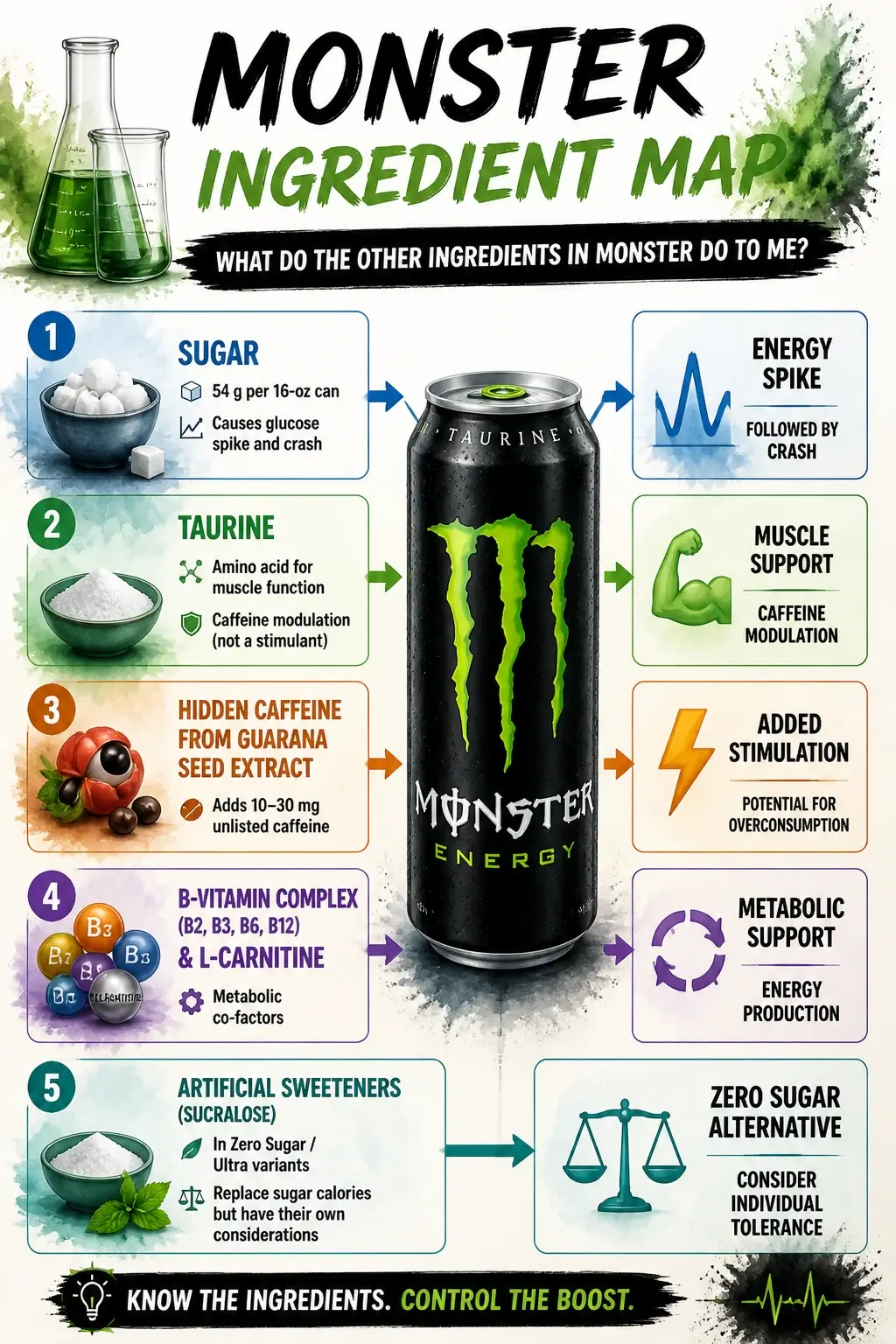
The bottom line: when you drink a Monster, you’re not just dosing caffeine. You’re triggering a sugar spike, introducing amino acids that interact with your cardiovascular system, absorbing metabolic co-factors, and taking in more caffeine than the label admits. The next question is how fast all of that actually hits you, and what the sequence looks like inside your body once it does.
How Monster Hits Hard, Then Leaves You Flat
The biological response to Monster Energy Drink starts before you’ve finished the can. Liquid caffeine doesn’t wait around for your digestive system to process it: it’s already moving toward your bloodstream while you’re still reading the back label. That speed is the whole point, and it’s also the root of every crash, headache, and “why do I need another one” moment you’ve experienced.
Fast Caffeine Absorption, Adenosine Blockade, and the Crash
Caffeine absorption kinetics in liquid form are genuinely fast. Unlike caffeine bound up inside a food matrix (say, a piece of chocolate) the caffeine in a Monster reaches your small intestine within minutes of swallowing. The small intestine’s absorption rate for dissolved caffeine is nearly instantaneous compared to solid food, which means peak blood concentration lands somewhere in the 30–60 minute window. Drink a Monster on an empty stomach, and that window shrinks toward the low end. You’re not imagining the rush, you’re feeling the express lane.
Once caffeine hits your brain, it does something elegant and a little deceptive. Your brain normally tracks fatigue through a molecule called adenosine, which accumulates the longer you’re awake and docks onto specific receptors to signal “slow down.” Caffeine’s molecular shape is close enough to adenosine’s that it physically occupies those same receptor sites (A₁ and A₂A receptors, specifically) without triggering the “slow down” signal. It’s a lock-and-key situation where caffeine is the wrong key that jams the lock. The door never opens, adenosine never delivers its message, and your brain reads the situation as: no fatigue detected. Meanwhile, with those inhibitory pathways blocked, excitatory neurotransmitters like dopamine and norepinephrine surge. That’s the alertness you feel.
Research published through the National Institutes of Health confirms that micromolar concentrations of caffeine in the body “effectively block the inhibitory pathways of adenosine,” producing exactly this cascade of heightened focus and wakefulness.
The crash is just the bill coming due, and it arrives from two directions at once.
First, the blood glucose spike. A standard 16 oz Monster carries around 54 grams of sugar, and that spike is sharp. Your body responds with an insulin surge to bring glucose back down, often overshooting, which is what produces the slump, brain fog, and sudden craving for something sweet. Second, and harder to shake, is the adenosine flood. Caffeine’s half-life is roughly 5–6 hours, so as it clears your system, every adenosine molecule that’s been building up while you were “alert” rushes back onto those now-unblocked receptors all at once. The tiredness you postponed doesn’t disappear: it just waits, and then it arrives with interest.
Caffeine Tolerance, Withdrawal, and Breaking the Cycle
Caffeine tolerance development is quiet at first. After a few weeks of daily Monster consumption, the brain responds to chronic receptor blockade by growing more adenosine receptors (a compensatory upregulation). Now you need more caffeine just to block the same proportion of receptors you blocked on day one. The 160 mg that used to feel like a clean lift starts feeling like maintenance. Some people migrate toward Monster’s stronger lines (Ultra or Assault) without realizing the mechanism driving that drift.
The harder truth is that this isn’t just tolerance. It’s physiological dependence, and skipping a day makes it undeniable. Classic caffeine withdrawal (headache concentrated behind the eyes, fatigue that coffee can’t touch, low-grade irritability) peaks around 24–48 hours after the last dose. According to Circana’s large-scale U.S. survey data, approximately 48–50% of regular caffeine consumers report at least one withdrawal symptom within 24 hours of stopping their usual daily intake. Nearly half. That’s not a fringe experience, that’s the statistical norm for anyone who drinks Monster most days of the week.
The good news is that tolerance is a predictable cycle, which means it’s a manageable one.
- Caffeine cycling: Designate one or two days per week as caffeine-free. It feels rough the first few times, then the body recalibrates and your regular can starts working again.
- Gradual taper before a caffeine holiday: Rather than going cold turkey (which is where the worst withdrawal hits), step down over 5–7 days. Half a can, then a coffee, then nothing. The headache barely registers.
- Stay at the lowest effective dose: If 160 mg still moves the needle for you, don’t chase 240 mg or 300 mg products. The moment you escalate, you’re spending future efficacy for today’s lift.
Tolerance management isn’t something you’ll find on the Monster can. But for anyone drinking three or four cans a week, it’s the difference between a reliable tool and a spiral where every can delivers less and every skipped day delivers pain.
Common Myths About Monster Energy Drinks
Three myths keep circulating about Monster Energy Drink, and each one leads people to make worse decisions than if they’d just read the label carefully. Let’s clear them out one at a time.
Sugar-Free Doesn’t Mean No Trade-Offs
The sugar-free misconception is the most widespread one. Monster’s Zero Sugar and Ultra lines genuinely do drop the calories, and that’s a real benefit if you’re watching your sugar intake. But “no sugar” gets mentally filed as “no downside,” and that’s where the logic breaks down.
Some zero-sugar formulas run higher in sodium than their regular counterparts (worth knowing if you’re already watching your sodium intake). More importantly, the artificial sweeteners replacing that sugar, primarily sucralose, are still being studied for long-term metabolic effects at habitual, high-volume consumption. The science isn’t alarming, but it isn’t settled either. You’re not making a risk-free swap. You’re making a different trade-off.
Pre-Workout Drinks Hiding in the Cooler
Here’s the one that catches people completely off guard. Pre-workout drinks like C4 and Ghost are increasingly stocked right next to Monster in gas station and grocery coolers. Same size can, same general vibe, but they are not designed for casual consumption.
The confusion is so common that entire Reddit threads are dedicated to people who accidentally grabbed the wrong can. So here’s exactly how to spot the difference.
These cans often carry caffeine well above 300 mg per serving. But the caffeine isn’t even the main event. They contain beta-alanine, a compound that causes a real, physical tingling or itching sensation across your skin (harmless, intentional for gym performance, but genuinely alarming if you weren’t expecting it while sitting in a lecture hall or behind the wheel). They also contain niacin in doses that trigger a temporary skin flush: warmth, redness, a feeling that something is wrong when nothing actually is.
The fix is simple: flip the can and read the supplement facts before you crack it open. If you see beta-alanine or niacin flush warning language, you’re holding a pre-workout, not an energy drink.
Here’s a real-world label comparison so you can see exactly what to look for:
Video: C4 Energy vs Monster Energy – Side-by-Side Label Comparison
The Hidden Caffeine You’re Not Counting
Even careful label-readers can underestimate their total caffeine intake from a Monster Energy Drink if they only look at the “caffeine” line and stop there.
Guarana seed extract, which appears in several Monster formulations inside the energy blend, contains its own naturally occurring caffeine. It doesn’t always get counted in the headline number. Depending on the formula, that adds roughly 10–30 mg on top of whatever the label declares directly. Not catastrophic on its own, but if you’re already close to your personal tolerance ceiling, that gap matters.
The habit to build: read the full ingredient list, not just the highlighted caffeine figure. If you see guarana seed extract listed, mentally add a buffer to your mg count for the day.
One concern that doesn’t hold up under scrutiny is heavy metal contamination (a fear that circulates in energy drink communities). Dr. Eliza Blicharska, PhD, Assistant Professor and Analytical Chemist at the Medical University of Lublin, Poland, analyzed energy drinks as part of a 2024 study published in Nutrients:
“All the samples had a hazard quotient and hazard index < 1, indicating no non‑carcinogenic risk from exposure to single or multiple heavy metals in both the adolescent and adult age groups.”
That’s a narrow but real reassurance: the heavy metal angle, at least, isn’t the threat some corners of the internet suggest.
Strip away these three myths and you’re left with a cleaner picture, Monster is a known quantity if you read it correctly. The harder question is what that correct reading means for your specific situation, which is exactly where we’re headed next.
Safe Consumption: How Many Monsters Can You Really Have?
Safe consumption limits for Monster Energy Drink aren’t a single number: they’re a personal ceiling that shifts based on your body, your age, and everything else you’ve already consumed that day. The FDA’s 400 mg daily limit gives you a technical boundary, but that number was built to prevent acute toxicity in healthy adults, not to serve as a daily prescription for everyone. One standard 16-oz Monster delivers 160 mg, which technically keeps you well inside that boundary, but “technically safe” and “right for you” aren’t always the same sentence.
Monster’s One-Can Rule and the 400 mg Adult Ceiling
The 400 mg daily limit is where the FDA and EFSA both land, and by that measure, one standard Monster sits comfortably inside it. You’ve got 160 mg in the can, which leaves you theoretical room for a morning coffee or an afternoon tea without crossing the line.
The problem starts when you reach for the bigger can or stack your sources without counting. A single 24-oz Mega Monster at 240 mg consumes 60% of your entire daily quota before lunch. Add one cup of coffee and you’re already at 380 mg. Add a pre-workout shake, a soda, or a medication that contains caffeine, and you’ve blown past 400 mg without a single moment of conscious decision-making.
That’s the real trap: not the can itself, but the invisible accumulation. Monster is rarely the only caffeine in a person’s day, and the 400 mg ceiling doesn’t reset just because the sources are different.
There’s another layer the blanket limit misses entirely. The 400 mg figure was designed around the average healthy adult, and the word “healthy” is doing serious work in that sentence. People with undiagnosed cardiovascular irregularities, anxiety conditions, or caffeine sensitivity can hit palpitations, insomnia, and elevated stress responses at doses well below that ceiling. If one standard can already leaves you jittery or gives you a racing heartbeat, your personal safe limit isn’t 400 mg, it’s somewhere south of 160 mg, and no published guideline will tell you that. Only your own body will.
The practical rule is this: one can per day is your ceiling, not your target. Treat it as the outer boundary of an occasional choice, not a daily baseline.
Monster Energy Drink and Special Populations
For teenagers, pregnant individuals, and anyone managing a medical condition, the 400 mg adult ceiling doesn’t apply, and Monster Energy Drink’s standard 160 mg can already exceeds the recommended limit for two of those three groups.
Adolescents and teenagers carry a recommended daily caffeine ceiling of just 100 mg. One standard Monster delivers 60% more than that in a single sitting. The developing cardiovascular and nervous systems in younger people respond more intensely to caffeine, and the risk of anxiety, sleep disruption, and elevated heart rate is meaningfully higher than it is for adults. One can isn’t a borderline call for a teenager, it’s already over the line.
For pregnant individuals, the widely accepted medical threshold sits at 200 mg per day, a number that accounts for slower caffeine metabolism during pregnancy and the compound’s ability to cross the placental barrier. A standard Monster takes up 80% of that entire daily allowance. A Mega Monster at 240 mg exceeds it outright.
Anyone managing hypertension, anxiety disorders, or taking prescription medications (particularly stimulants, certain antidepressants, or thyroid medications) should treat the 400 mg rule as irrelevant to their situation and check with a doctor before making Monster a regular habit. Caffeine interacts with several drug classes in ways that amplify both the medication’s effects and the stimulant’s side effects simultaneously.
The cleaner framework, regardless of which group you fall into, works like this: start with half a can to gauge your personal tolerance before committing to a full one. Never exceed one full can within any 24-hour window. Build in caffeine-free days regularly to prevent tolerance from quietly climbing, because tolerance doesn’t just reduce the benefit, it raises the dose you feel compelled to reach for next time. And treat the one-can-a-day rule as a ceiling you touch occasionally, not a daily quota you’re entitled to fill.
Monster is a useful tool when you use it deliberately. The people who run into trouble are almost always the ones who stopped treating it like one.
Key Takeaways on Monster Energy Drink
- Monster’s real caffeine dose isn’t just the label number—guarana adds up to 30 mg more.
- The sugar crash after a regular Monster often hits harder than the caffeine crash itself.
- Tolerance to Monster builds silently, raising your needed dose and withdrawal severity.
- One can daily isn’t a target—your personal safe ceiling may be far below 400 mg.
- That ‘energy drink’ next to Monster might be a pre-workout with skin-tingling beta-alanine.
- Monster Ultra eliminates the sugar crash, but the caffeine crash still lands after 5-6 hours.
Frequently Asked Questions About Monster Energy Drink
Q: Why does Monster hit harder on an empty stomach than with food?
A: Liquid caffeine already absorbs fast, but an empty stomach speeds peak levels to around 30 minutes instead of 60. Your small intestine absorbs it almost instantly without food slowing it down, making the rush feel sharper and more intense.
Q: Why do I suddenly crave something sweet after finishing a regular Monster?
A: The 54 grams of sugar spike your blood glucose, triggering an insulin surge that often overshoots. The resulting blood-sugar dip causes brain fog and a strong craving for more sugar to bring levels back up.
Q: Can a single Monster trigger heart palpitations even if I’m under 400 mg for the day?
A: Absolutely. Undiagnosed heart conditions, anxiety, or personal sensitivity can cause palpitations at doses well below 400 mg. The sugar and taurine combination may amplify cardiovascular effects, making a single can a trigger for some.
Q: Why would an energy drink make my skin tingle or itch?
A: You likely grabbed a pre-workout drink mistakenly shelved with energy drinks. These contain beta-alanine, which causes a harmless but startling tingling, and niacin that produces a skin flush. Check the label for those ingredients.
Q: Do the B-vitamins in Monster actually make you feel more awake?
A: No. B-vitamins help convert food into energy at the cellular level but provide no stimulant buzz. The wakefulness you feel comes entirely from caffeine and the sugar spike—B-vitamins just quietly support the metabolic background.
Q: If I switch to Monster Ultra, will I still experience an energy crash?
A: You’ll dodge the sugar crash since Ultra uses sucralose, but the adenosine crash remains. As caffeine leaves your system, built-up fatigue floods back, often hard. The timing and intensity of the caffeine crash still apply.
References
- Sudden Cardiac Arrest Events in Temporal Proximity to Energy Drink Consumption – Heart Rhythm Journal
- Caffeine for the Sustainment of Mental Task Performance: Formulations for Military Operations – National Center for Biotechnology Information
- American Caffeine Statistics – Circana
- Heavy Metal Risk Assessment in Energy Drinks – Nutrients (MDPI)
- C4 Energy vs Monster Energy – Side‑by‑Side Label Comparison – YouTube