
Cortado vs macchiato is one of those comparisons that looks simple on the surface – two small, milk-touched espresso drinks sitting side by side – until you realize they were built on entirely different ideas about what milk should do to coffee. One cuts the intensity. The other barely whispers at it.
The gap between them lives in the ratio, the foam texture, and a century of cultural habit. Get those three things straight, and every other difference falls into place on its own.
Origins: How Spain’s Cortado and Italy’s Macchiato Shaped Espresso Culture
Both the cortado and macchiato are practical modifications of straight espresso – not ancient rituals, but working solutions to a very human problem: espresso is intense, and sometimes you want just enough milk to take the edge off without turning it into something else entirely.
The word “cortado” comes from the Spanish verb cortar – to cut. The idea was literal: a shot of bold, dark-roasted espresso, cut with a small measure of milk to soften the bitterness. In Spain, this was everyday fuel for the working class, typically consumed in the afternoon as a quick, efficient break. Not a luxury. Not a ceremony. Just a reliable coffee that didn’t knock you sideways.
“Macchiato” takes a different angle. It comes from the Italian macchiare, meaning to mark or stain. The story goes that Italian baristas would “mark” an espresso with a small spot of milk foam – a visual cue, originally, to distinguish a slightly softened espresso from a straight one on a busy bar counter. Where the cortado was built to be consumed seated and at leisure, the macchiato fit Italy’s stand-at-the-bar, drink-in-sixty-seconds espresso culture.
Gemma Boothroyd, writing for Barista Magazine, captures the cultural divide precisely: Spaniards consume far more milk than Italians, don’t restrict milky drinks to morning hours the way Italians do, and built a coffee culture around sitting down with something smooth. The cortado was the natural result – small and efficient, yet slightly luxurious, designed to be savored rather than slammed.
Both drinks became codified by the mid-20th century, but they gained global momentum as specialty coffee expanded. That expansion came with a cost: chain cafes created their own interpretations, stretching both names onto drinks that bear little resemblance to the originals. The cortado got bigger. The macchiato got sweeter. Understanding where each drink came from is the first line of defense against ordering the wrong thing.
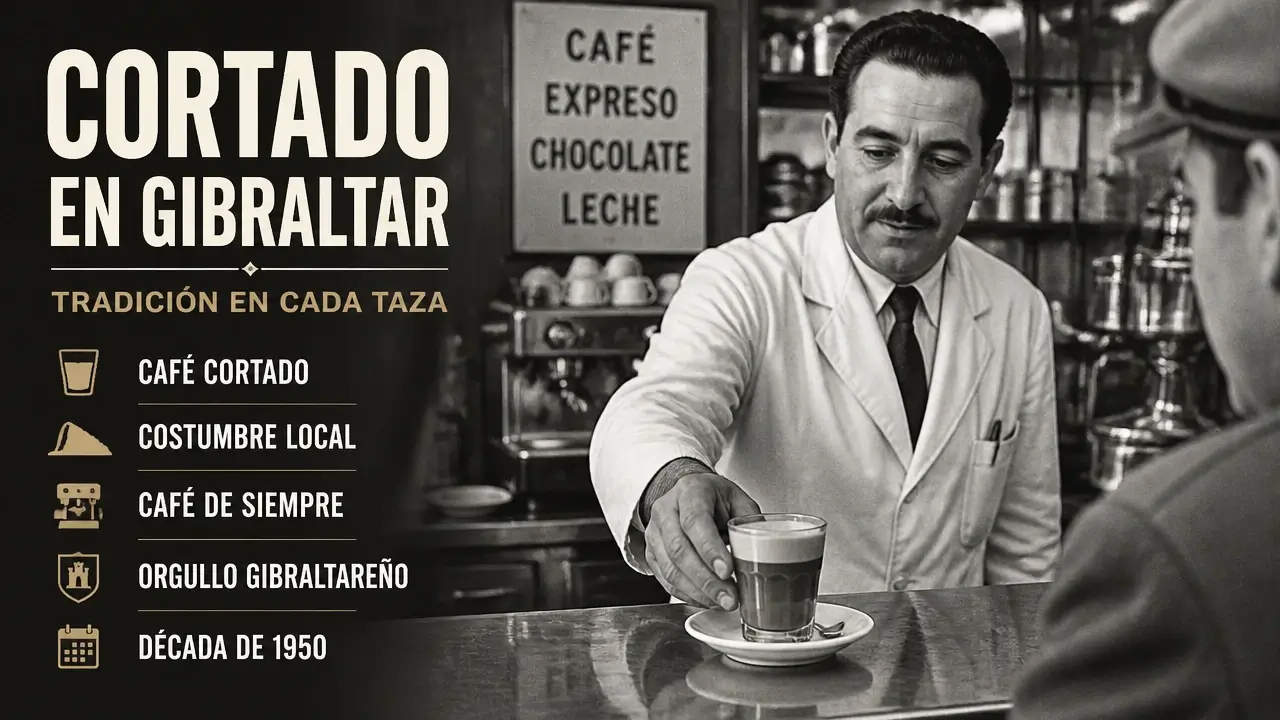
The traditional serving customs still carry the original intent. A cortado arrives in a small glass – often a 4.5 oz Gibraltar or vaso cortado – which keeps the volume honest and the temperature right. A macchiato comes in a demitasse cup, typically without latte art, because there’s almost no milk canvas to work with.
Here’s what a traditional cortado service looks like in its natural habitat:
The Cortado Under the Hood: Steamed Milk Science and Espresso Harmony
The canonical cortado ratio is equal parts espresso and steamed milk – a 1:1 build that sounds simple until you realize how much technique lives inside those two equal parts.
A standard build starts with a double shot pulled at a 1:2 brew ratio, yielding roughly 2 oz of espresso. That’s your base – not a ristretto, not a lungo, just a balanced, full-extraction double that gives you both the brightness and the body you need. Then comes 2 oz of steamed milk, bringing the finished drink to 4–5 oz in a Gibraltar glass.
The milk is where most home brewers lose the thread. Whole milk gets stretched only slightly in the first three to five seconds of steaming – just enough air to create fine bubbles – then the wand tip submerges to mix and heat the milk to around 130–140°F. You’re not building a foam cap. You’re building what baristas call “wet microfoam”: a glossy, dense, almost paint-like texture that integrates into the espresso rather than sitting above it.
That integration is the whole point. The milk pours continuously into the shot, producing a uniform temperature throughout the drink and a velvety mouthfeel that makes the cortado easy to sip in a few comfortable pulls. There’s no layer to push through, no temperature contrast to manage. It’s a seamless blend.
The flavor outcome reflects the physics: the milk softens acidity and bitterness without erasing the espresso’s character. You still taste the origin notes, the roast level, the extraction quality – but the sharp edges are gone. Balanced, creamy, smooth.
One practical note worth keeping: if a cafe serves you an 8 oz drink and calls it a cortado, the math doesn’t add up. Two shots of espresso at 2 oz plus 2 oz of milk equals 4 oz. An 8 oz cortado either has four shots or a lot of extra milk – and either way, it’s no longer a 1:1 build. When in doubt, ask for the shot count and total volume before you commit.
The Macchiato Deconstructed: Foam as Flavor Amplifier
The traditional espresso macchiato operates on almost the opposite philosophy: the espresso dominates, and the milk is barely a guest.
A single or double shot of espresso – roughly 2 oz for a double – gets marked with a small dollop of milk foam, typically about a tablespoon. The finished drink lands at 2–3 oz. That’s it. The milk’s job isn’t to integrate or balance. It’s to temper the very first sip, just enough to soften the sharpest edge of acidity, and then get out of the way.
Ollie Futcher, Head Roaster at Saint Espresso in London, describes it cleanly: a macchiato is a double espresso with milk foam that’s been textured smoothly and spooned on top. The spooning matters. You’re not pouring steamed milk – you’re placing foam. That distinction shapes everything about how the drink tastes.
The foam technique runs opposite to the cortado’s. Milk gets aerated more aggressively, stretched to a 30–50% increase in volume, then left to rest before you spoon only the top layer – the driest, airiest part – onto the espresso. The liquid milk underneath stays in the pitcher. What lands on the shot is a light, airy cap with larger bubbles, not the dense microfoam of a cortado.
The science behind why this matters is more concrete than most guides let on. Research published in LWT – Food Science and Technology found that bubble size in foamed milk directly affects sensory scores for smoothness, body, and perceived sweetness – smaller, finer bubbles score higher across the board. That’s the microfoam world of the cortado. The macchiato’s larger, drier foam bubbles serve a different purpose: textural contrast, not integration.
A separate study in Food & Function found that the standard volume of crema and foam on an espresso maximizes the release of high-volatility aroma compounds and amplifies roasted flavor perception in the mouth. Reducing that foam layer cuts volatile release and dulls the sensory experience. This is precisely why the macchiato’s foam cap – minimal as it looks – isn’t decorative. It’s actively shaping the first aromatic hit you get before the espresso even reaches your palate.
The result is a bold, intense drink where the espresso’s full character – acidity, bitterness, roast – is on full display. The foam softens only that first encounter. After that, you’re drinking straight espresso in a demitasse cup, at close to 160°F, with roughly 5–18 calories depending on how much foam made it in.
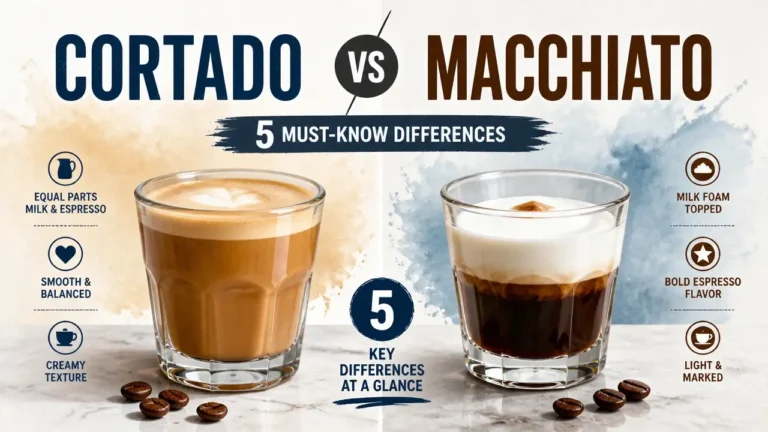
5 Must-Know Differences: Cortado vs. Macchiato Side-by-Side
A cortado differs from a macchiato in ways that compound on each other – the ratio drives the texture, the texture drives the temperature experience, and the temperature experience shapes the flavor. Here’s how each dimension breaks down.
The table below puts all five differences – plus calories – in one place:
| Dimension | Cortado | Macchiato |
|---|---|---|
| Milk-to-Espresso Ratio | 1:1 (equal parts) | ~4:1 espresso-dominant |
| Milk Texture | Wet, integrated microfoam | Dry, spoonable foam dollop |
| Total Volume | 4–5 oz | 2–3 oz |
| Drinking Temperature | ~130°F immediately | ~160°F under foam cap |
| Flavor Balance | Mellow, creamy, smooth | Bold, intense, espresso-forward |
| Approximate Calories | 10–37 kcal | 5–18 kcal |
The ratio difference is the root of everything else. At 1:1, the cortado’s steamed milk integrates completely, dropping the drinking temperature to a comfortable 130°F right away and creating a uniform, velvety texture throughout. You can sip it immediately without burning your tongue.
The macchiato’s 4:1 lean toward espresso means the shot stays near 160°F under that foam cap. You encounter the foam first – a brief textural counterpoint – and then the full force of hot espresso. It cools gradually as you drink, not all at once.
The milk texture contrast reinforces this. Cortado microfoam is wet and dense by design, meant to merge with the espresso invisibly. Macchiato foam is dry and airy, meant to sit on top and deliver a momentary softening before the espresso takes over. Same ingredient, two completely different roles.
One real-world caveat deserves its own flag: at chain cafes, the word “macchiato” almost never means the traditional espresso macchiato described above. What you’re actually getting is a latte macchiato – steamed milk poured first, espresso added on top, yielding a sweet 8–12 oz drink with an entirely different flavor profile. If you see a macchiato on a menu with flavor options and multiple sizes, assume it’s the latte variant unless the barista confirms otherwise. The traditional espresso macchiato survives primarily in specialty coffee settings.
The Enthusiast’s Verdict: Choosing-and Getting-Your Ideal Milk-Touched Espresso
The decision between a cortado and a macchiato isn’t about which drink is better. It’s about which one matches what you actually want right now – and then knowing how to ask for it in a way that gets you exactly that.
Matching Flavor Profile to Your Taste and Use Case
Clear selection criteria for a cortado or macchiato start with one honest question: do you want milk to balance the espresso, or do you want the espresso to dominate while milk barely shows up?
Here’s how that maps to specific use cases:
- The espresso purist who finds straight shots occasionally too harsh: macchiato – you get the intensity with a fraction of the milk.
- The texture lover who values silkiness and a comfortable drinking temperature: cortado – the microfoam integration delivers exactly that.
- The calorie-conscious drinker: macchiato wins by a meaningful margin at 5–18 kcal versus the cortado’s 10–37 kcal.
- The person who wants a quick caffeine hit without a full latte: cortado – enough volume to feel substantial, small enough to finish in a few minutes.
Both drinks carry essentially the same caffeine load when built on a double shot, so energy output isn’t a differentiating factor. The choice is purely about taste, texture, and experience.
Practical Ordering Strategies for Cortado and Macchiato in Any Cafe
Ordering strategies for a cortado and macchiato need to account for where you’re ordering – because the gap between a specialty cafe and a chain location is wider than most people expect.
In a specialty cafe, both drinks are typically prepared traditionally. Ask for a cortado and you’ll likely get a 4–5 oz Gibraltar glass with a proper 1:1 build. Ask for a macchiato and a knowledgeable barista will hand you a demitasse with a foam dollop. These are the easiest, most reliable orders you can make in that environment.
At large chains – Starbucks being the clearest example – the cortado may be slightly oversized but still recognizable. The macchiato, however, is almost always a latte macchiato: layered, sweetened, available in multiple sizes. Treat it as a completely different drink that happens to share a name.
If a cafe doesn’t have a labeled macchiato on the menu, you can still get close to the traditional drink by asking for an espresso with a spoonful of foam on top. Most baristas who know their craft will understand exactly what you mean.
The size inversion problem is real at third-wave cafes, too. Some specialty shops serve cortados in 8 oz cups and call their latte macchiatos simply “macchiatos.” Don’t anchor to size expectations when you walk into an unfamiliar shop. The cup tells you almost nothing.
Barista Magazine Online offers a useful model for what good ordering communication looks like from the other side of the counter: a skilled barista will ask whether you want a traditional macchiato – espresso with a touch of foam – or a larger, sweeter drink. That question is the barista doing their job well. When you hear it, you’re in good hands.
The one safeguard that works everywhere, every time: ask the barista for the shot count, the total volume, and whether the macchiato is a traditional espresso macchiato or a latte macchiato. It costs nothing, takes ten seconds, and eliminates every source of confusion this article has described.
Here’s a simple decision guide you can use before you step up to any counter:
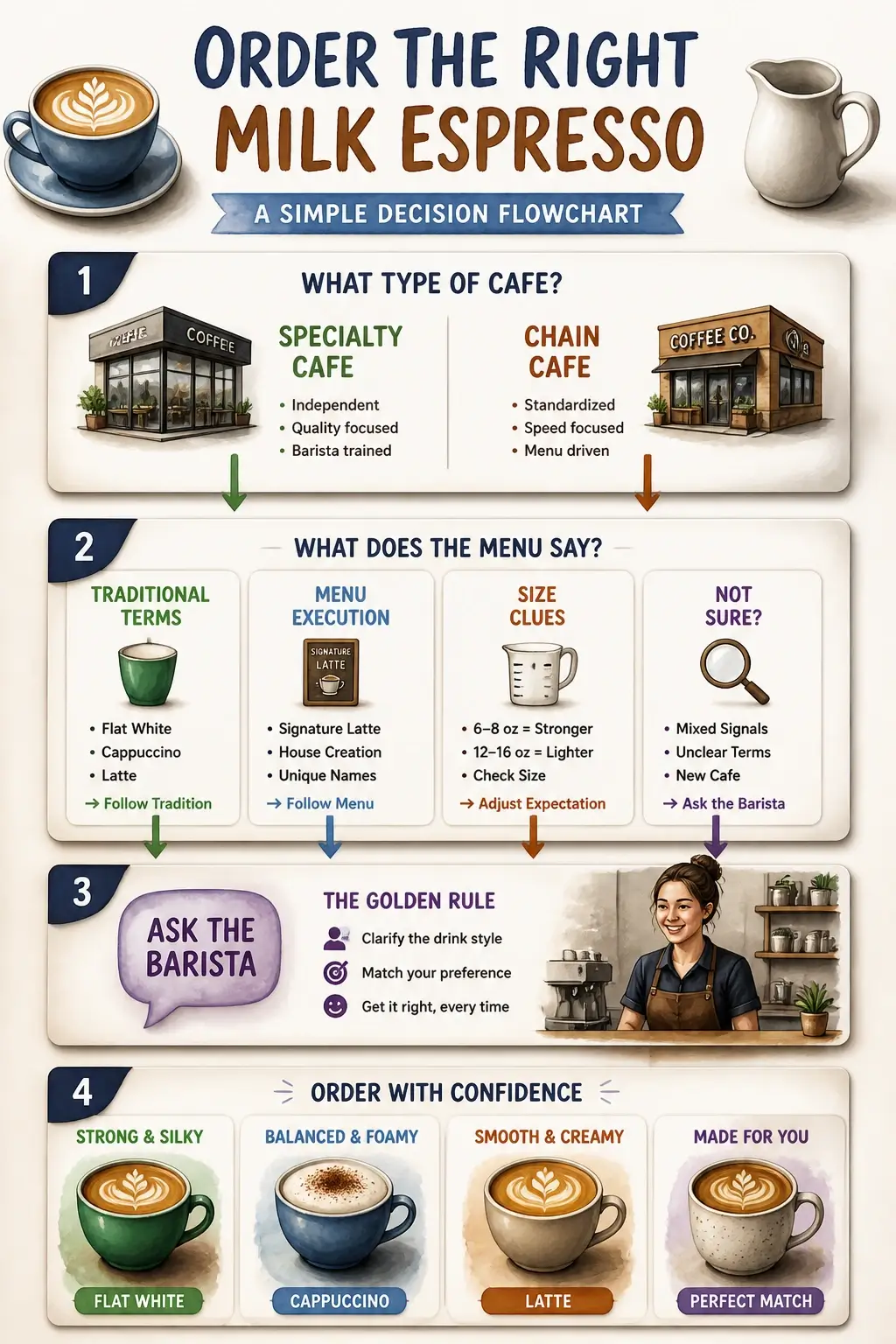
The market has already split into two parallel realities: the traditional espresso macchiato lives in specialty coffee circles, while the mass-market macchiato is the latte macchiato – sweetened, layered, and usually iced. Reading the menu clues tells you which world you’re in. Flavored options, multiple sizes, iced variants – those are latte macchiato signals. A plain two-line menu entry with no size options is a strong sign you’re getting the real thing.
Your confidence at the counter doesn’t come from memorizing ratios. It comes from asking one clarifying question. That’s the entire difference between walking away with exactly the milk-touched espresso you wanted and walking away with something you didn’t order.
Key Takeaways on Cortado vs Macchiato
- “Cortado” means to cut in Spanish; “macchiato” means to mark or stain in Italian – each name is a precise description of what the milk actually does.
- A cortado uses a 1:1 espresso-to-milk ratio with wet, integrated microfoam; a macchiato uses a 4:1 espresso-dominant ratio with a dry foam dollop on top.
- The cortado’s steamed milk drops the drinking temperature to roughly 130°F immediately; the macchiato stays near 160°F under its foam cap.
- At chain cafes, “macchiato” almost always means a latte macchiato – a sweet, milk-heavy layered drink with no resemblance to the traditional version.
- Both drinks carry the same caffeine load when built on a double shot, so the choice is purely about taste and texture, not energy.
- The single most reliable ordering strategy in any cafe is confirming shot count, total volume, and which macchiato style before you order.
Frequently Asked Questions About Cortado vs Macchiato
Which is stronger, macchiato or cortado?
A traditional espresso macchiato is stronger in taste because it’s roughly 90% espresso with only a spoonful of foam, so the coffee’s full intensity comes through uncut. A cortado has the same shot count but a 1:1 milk ratio that genuinely softens acidity and bitterness – it’s measurably milder in flavor, not just perception.
Is a cortado the same as a flat white?
They’re close but not the same. Both use wet microfoam and a double shot, but a flat white runs 5–6 oz with a slightly higher milk volume and a more pronounced microfoam layer, while a cortado sits at 4–5 oz with a stricter 1:1 ratio and less foam texture overall.
Is a Starbucks cortado a real cortado?
Starbucks’s cortado is closer to the traditional version than their macchiato is – it’s built on two ristretto shots with a small amount of milk foam – but the total volume and milk preparation often deviate from the classic 1:1 Gibraltar build you’d get at a specialty cafe.
Do Italians drink cortado?
Not traditionally. The cortado is a Spanish drink, and Italy’s espresso culture has its own parallel answer to “slightly softened espresso” – the macchiato. You won’t find cortado on a standard Italian cafe menu, though specialty coffee shops in major Italian cities have started offering it as the third-wave scene has grown.
What happens if I ask for a macchiato at a regular cafe and get something wrong?
You’ll likely receive a latte macchiato – a large, layered, often sweetened drink with steamed milk poured first and espresso on top. If you wanted the traditional espresso macchiato, ask specifically for “espresso macchiato” or “espresso with a small amount of foam on top” to avoid the mix-up.
Can I make a cortado at home without a steam wand?
You can get close using a French press to froth warm whole milk – pump it rapidly for 30–45 seconds to build microfoam, then let it settle for 10 seconds before pouring. It won’t match the density of a properly steamed microfoam, but the 1:1 ratio and integrated pour will still produce a noticeably different result than a latte.
Why does the macchiato foam sit on top instead of mixing in?
Because dry foam has a lower density than liquid espresso, it floats rather than integrating. That’s by design – the point is a textural contrast on the first sip, not a uniform blend. If you stir a macchiato, you’ve essentially made a very small, slightly diluted espresso, which defeats the purpose entirely.
Does milk fat percentage change which drink you should order?
It matters more for the cortado than the macchiato. Whole milk’s fat content is what enables the dense, glossy wet microfoam that makes a cortado’s texture distinctive. For a macchiato, where you’re using only a tablespoon of dry foam, lower-fat or non-dairy milks can work reasonably well – though the foam stability and sweetness will differ.
References
- Tiny Drink, Big Influence: The History of the Cortado – baristamagazine.com
- What Is a Macchiato? – perfectdailygrind.com
- Navigating the Best Customer Drink Order – baristamagazine.com
- LWT – Effects of manufacturing conditions on the foaming properties of milk and sensory characteristics of foamed milk – sciencedirect.com
- Food & Function – Impact of crema on the aroma release and the in-mouth sensory perception of espresso coffee – pubs.rsc.org