
The Cookies and Cream Frappuccino sits at an interesting crossroads: it looks like a milkshake, gets ordered like a coffee drink, and gets copied at home with Oreos and a blender. But the official formula and the copycat version are not the same drink. The base system, the stabilizers, and the chocolate components each do a specific job.
Understanding what’s actually in the cup changes how you order it, how you make it, and whether it fits your caffeine or allergen limits. Let’s pull it apart layer by layer.
Key Takeaways on Cookies and Cream Frappuccino
- The commercial formula uses Frappuccino Cream Base Syrup, white chocolate sauce, and Frappuccino chips, not ice cream and crushed Oreos.
- Ordering a creme base instead of a coffee base removes the coffee component, but trace caffeine from cocoa in chips, cookies, and drizzle remains.
- Dutch cocoa alkalization removes acidity and deepens chocolate color and flavor, which is why the drizzle tastes richer than plain cocoa powder would.
- Xanthan gum in the commercial base slows ice recrystallization; without it, home blends separate and turn grainy faster.
- Allergen cross-contact from shared equipment cannot be guaranteed, regardless of what the standard ingredient list shows.
- Published caffeine figures for this drink conflict across sources; treat exact caffeine as unresolved and verify before ordering if it matters to you.
What Is a Cookies and Cream Frappuccino?
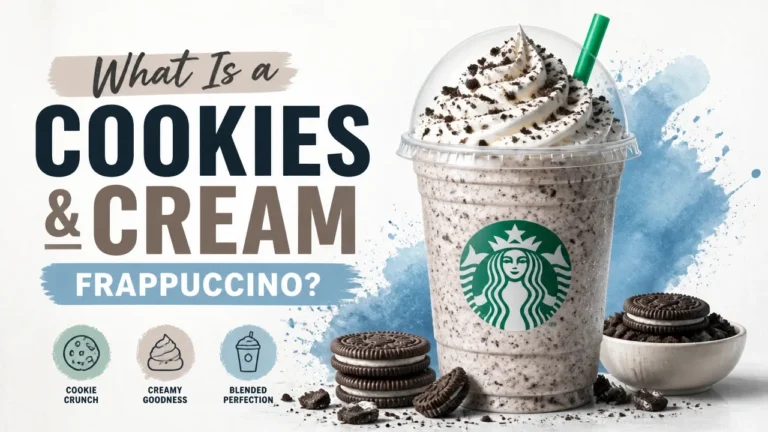
A Cookies and Cream Frappuccino is a blended iced beverage built around a cookies-and-cream flavor: cold milk, ice, a sweetened base, cookie pieces, whipped cream, and a chocolate drizzle. It is not automatically a coffee drink. The “creme” style of this Frappuccino skips the coffee roast base entirely, which puts it closer to a dessert than to a latte.
That distinction separates it from a generic frappe. A frappe, in the broad sense, is any blended iced drink. A Starbucks Frappuccino is a proprietary blended beverage built on a specific base syrup system with standardized components. A homemade Oreo milkshake uses vanilla bean ice cream as its body. The commercial Frappuccino uses a Cream Base Syrup with emulsifiers and stabilizers to achieve a similar texture without relying on ice cream at all.
The everyday appeal is obvious. It is cold, thick, and creamy. The cookie pieces add crunch. The chocolate drizzle adds a visual and flavor layer on top. And because it is not coffee-based by default, it is one of the few Starbucks drinks a non-coffee drinker can order without modification. Available in Tall, Grande, and Venti, the size mostly affects the sugar and calorie count rather than changing the flavor profile in a meaningful way.
The Ingredient Stack: What’s Actually in the Cup
Commercial Formula Composition
The official-style Cookies and Cream Frappuccino uses five core categories of ingredients, and none of them is simply “Oreos and milk.”
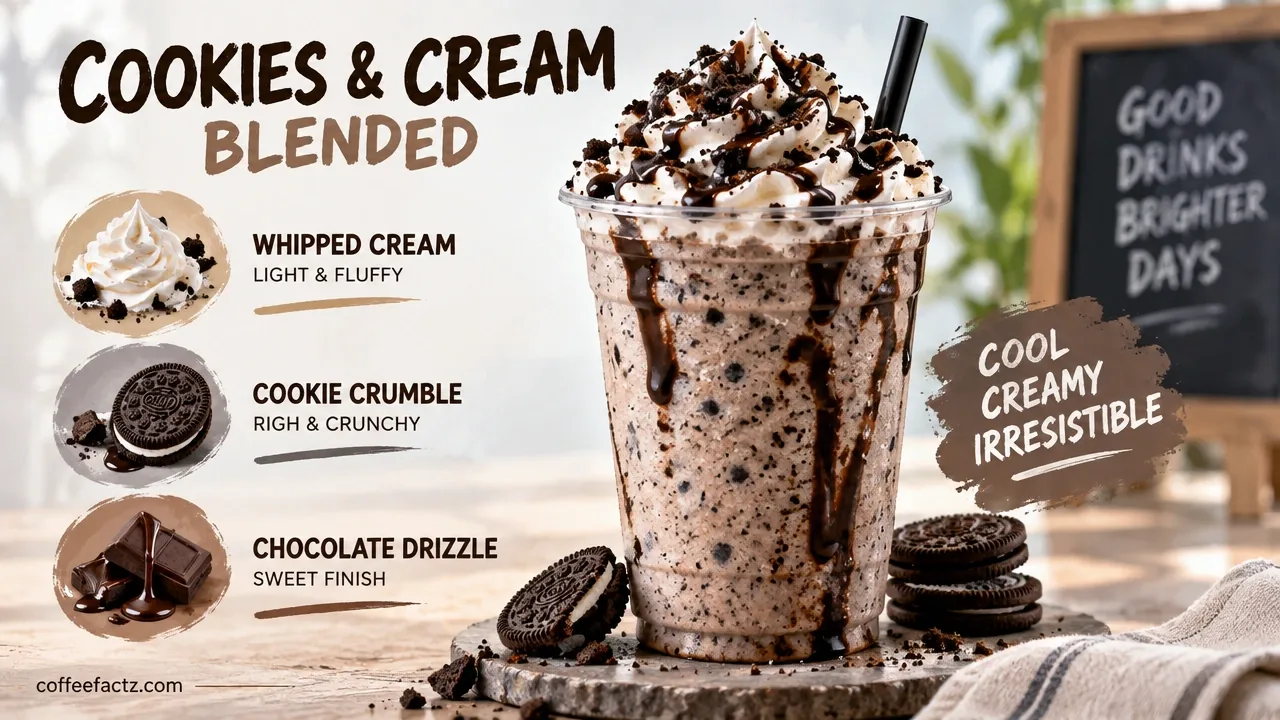
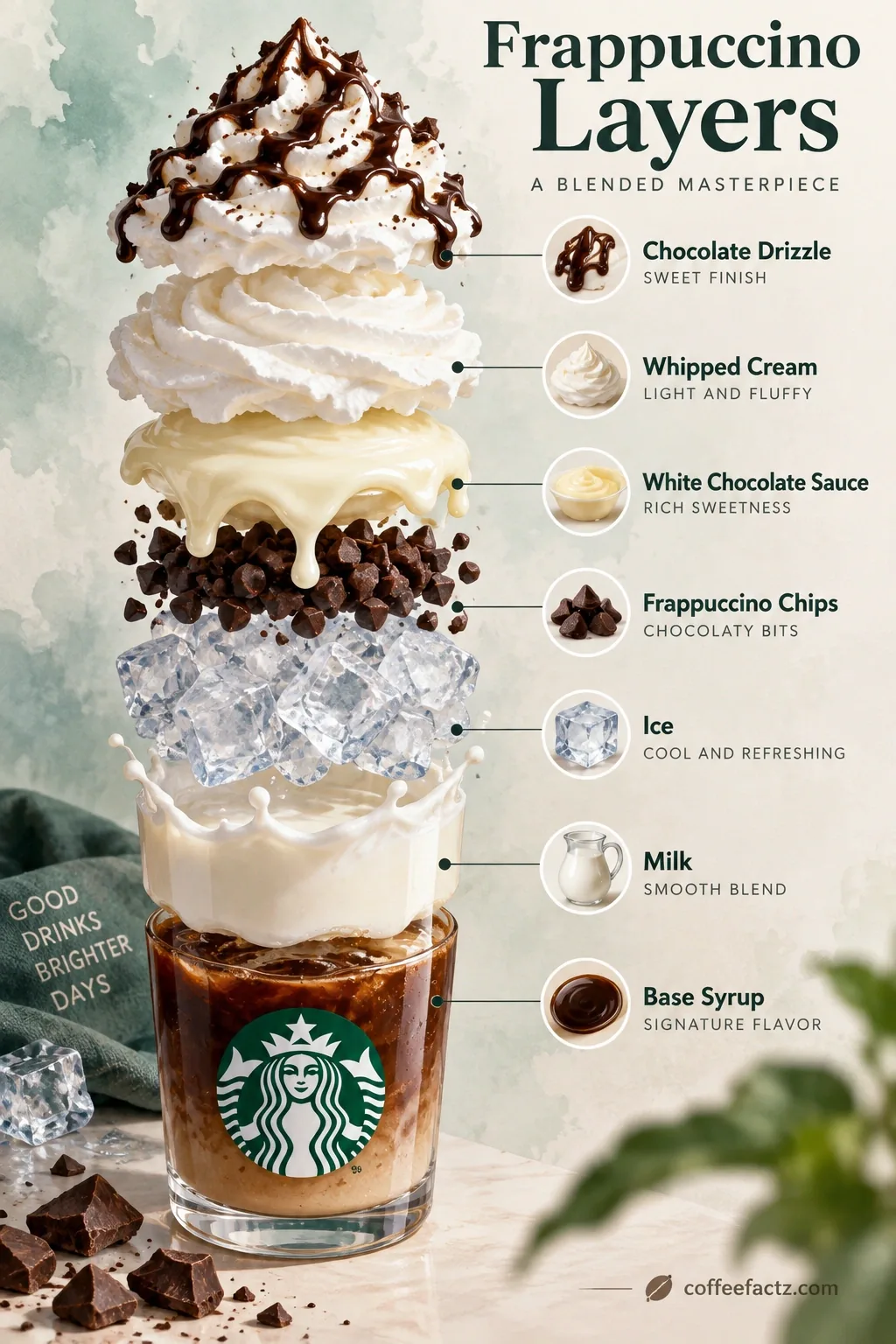
The base is cold milk and ice, blended with Frappuccino Cream Base Syrup, a sweetened dairy-and-stabilizer concentrate that gives the drink its body. On top of that goes white chocolate sauce, which adds sweetness and a smooth, milky richness. The cookie component comes from Frappuccino chips, which are small chocolate cookie pieces designed specifically for blending, not standard sandwich cookies crushed by hand. The whole thing is topped with vanilla whipped cream and finished with a chocolate drizzle.
Starbucks Australia describes the build this way: white chocolate sauce and Frappuccino chips blended with milk and ice, then topped with vanilla whipped cream and chocolate drizzle, with the layers designed so each sip is consistent all the way to the bottom of the cup.
That layering logic is not accidental. The chips are engineered to blend partially, leaving small cookie fragments suspended throughout the drink rather than dissolving completely. The white chocolate sauce distributes evenly because it is liquid at blend temperature. The result is a drink with textural variation in every sip rather than a uniform smoothie.
Home Copycat Components
The home copycat version uses a fundamentally different set of ingredients, and that matters for texture and flavor.
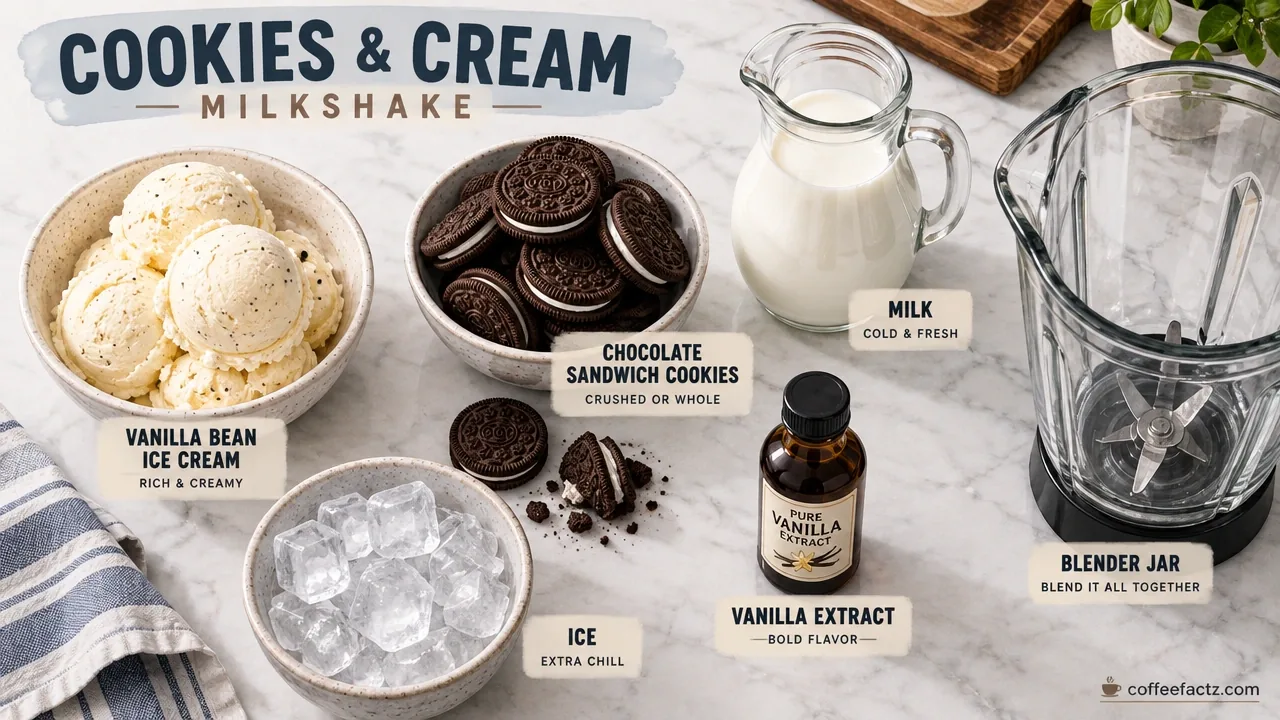
Instead of Cream Base Syrup, home recipes use vanilla bean ice cream as the body. Instead of Frappuccino chips, they use chocolate sandwich cookies (typically Oreos) crushed by hand or in the blender. The liquid is standard milk, sometimes with a splash of vanilla extract to boost the cream note. Ice goes in to thin the ice cream to a drinkable consistency.
The sweetness in the copycat comes from multiple simultaneous sources: the ice cream itself, the cookie filling, the cookie shell, the milk, and any whipped cream or drizzle added on top. That stacking of sweetness can make the home version taste richer or cloying depending on ratios. It also makes it harder to control.
The bigger issue is texture. Without a stabilizer system, home blends separate faster and can turn icy or watery within minutes of sitting. Recipe blogs often suggest using a quality blender and a freeze-thaw-reblend cycle as fixes. Those help, but they are working around the absence of the stabilizer system that the commercial formula includes by design.
Vanilla Bean Creme Base vs. Coffee Roast Base: The Caffeine Fork
Dessert-Style Emulsion Foundation
The Frappuccino base is the ingredient most people never think about, and it is the one that determines whether you are ordering a dessert drink or a coffee drink.
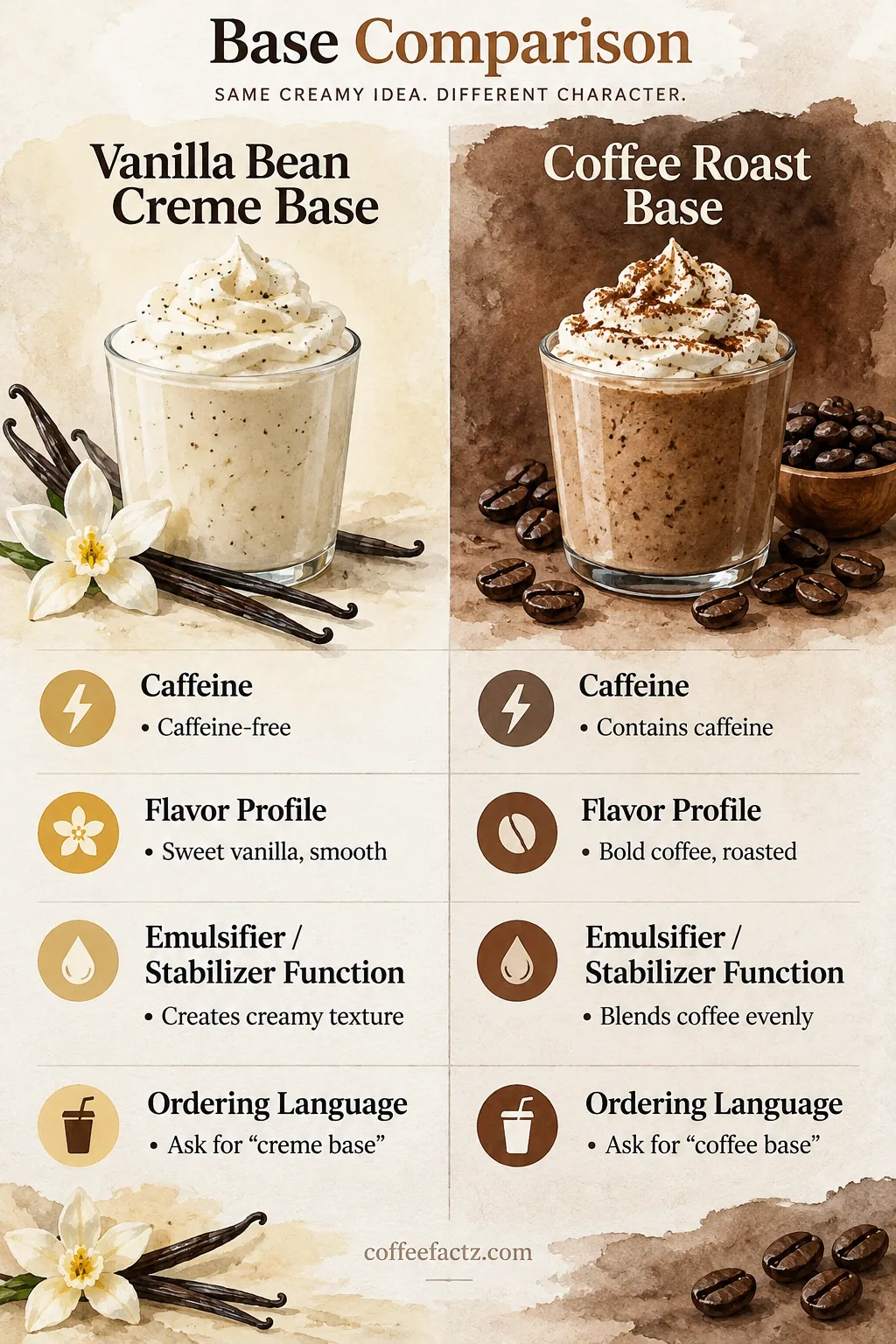
The vanilla bean creme base is a sweetened dairy concentrate with emulsifiers and stabilizers blended in. It contains no coffee. By design, it is caffeine-free at the base level. This is the foundation for all creme-style Frappuccinos, and the Cookies and Cream Frappuccino in its standard form uses this base. The emulsifiers help fat and water stay combined during blending. The stabilizers slow separation as the drink warms. The result is a thick, smooth texture that holds together longer than a plain ice-and-milk blend would.
This distinction matters most for people who avoid caffeine. Ordering a creme-style Frappuccino gets you a caffeine-free base. But the base is only one part of the drink.
Java-Infused Emulsion Variant
The coffee roast base contains actual coffee. It adds both coffee flavor and caffeine, and it is the foundation for coffee-style Frappuccinos. If someone orders a Cookies and Cream Frappuccino with a coffee base, or if the shop defaults to a coffee base, the drink shifts from a dessert beverage to a coffee-forward one.
The ordering language to know: “creme base” versus “coffee base.” Asking for the creme base explicitly is the clearest way to avoid coffee in the blend. But even then, the chocolate drizzle and any cocoa-containing add-ins can contribute trace caffeine from cocoa solids. Chocolate is not caffeine-free. The base system is the biggest caffeine gate, but it is not the only one.
Dutch Cocoa Mocha Drizzle and Crushed Dark Chocolate Sandwich Cookies: The Flavor Build
The chocolate flavor in a Cookies and Cream Frappuccino runs deeper than a plain Oreo topping, and the reason is the specific type of cocoa used in the drizzle and the cookies.
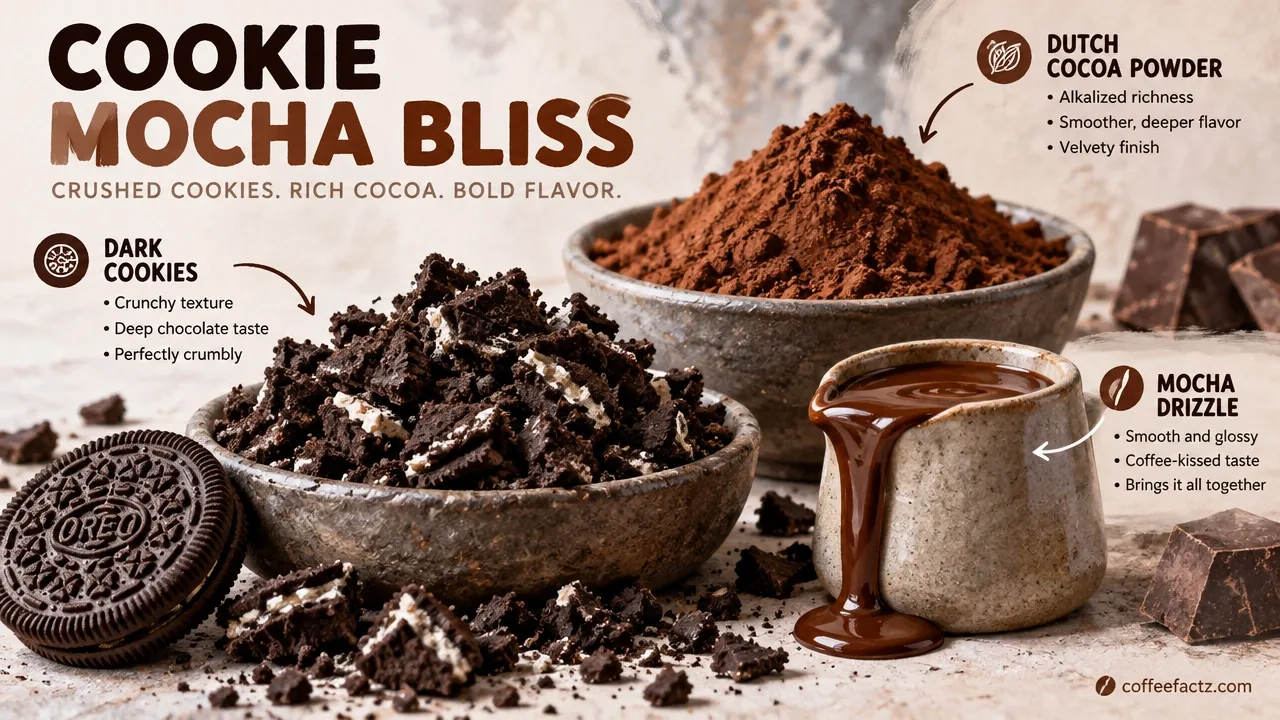
Dutch cocoa is alkalized cocoa powder. The alkalization process neutralizes the natural acidity of raw cocoa, which does two things: it darkens the color significantly, and it smooths out the flavor, removing the sharp, tannic edge that natural cocoa has. The result is a darker, rounder, less acidic chocolate taste. When used in a drizzle or cookie shell, it reads as richer rather than bitter.
The mocha drizzle is a chocolate-coffee flavor compound. If a coffee base is in the blend, the mocha drizzle amplifies the coffee note and introduces additional caffeine through the cocoa solids. Even on a creme-base drink, the drizzle contains cocoa, which means trace caffeine is present regardless of the base choice.
The crushed dark chocolate sandwich cookies add two distinct elements. The cookie shell uses a darker cocoa formula, which contributes a bittersweet note that contrasts with the sweet vanilla cream base. The cream filling adds sweetness. When crushed to variable sizes during blending, the cookies create a texture gradient: fine crumbs that dissolve into the drink body, and larger fragments that deliver a distinct crunch. That variation is what separates this drink from a smooth chocolate shake. The crunch is structural, not decorative.
The overall flavor profile stacks like this: sweet vanilla cream from the base and whipped cream, bittersweet cocoa from the cookie shells and drizzle, textural contrast from cookie fragments, and coffee notes only if the coffee base or mocha drizzle is present in a coffee-forward build.
How It’s Made: High-Shear Emulsion, Xanthan Gum, and Ice-Melt Stability
Rotor Dynamics and Hydrocolloid Mechanics
The difference between a creamy Frappuccino and an icy, gritty one comes down to what happens inside the blender during those first ten seconds.
High-shear emulsification is the mechanism. The blender blades spin fast enough to generate shear forces that physically break ice crystals into smaller fragments and simultaneously force fat globules, cocoa particles, and water into a tightly dispersed mixture. When those components are dispersed at fine enough scale, your mouth reads the result as creamy rather than icy or gritty. The particle size is below the threshold your tongue detects as rough.
Xanthan gum is the stabilizer that keeps that emulsion from falling apart after blending stops. It works by thickening the water phase of the drink, which slows the movement of ice crystals and suspended cookie particles. When ice melts, xanthan creates enough viscosity in the liquid phase that the solid components stay suspended rather than sinking or separating.
A Journal of Dairy Science study on dynamically frozen ice cream systems found that xanthan gum retarded ice recrystallization by holding water and forming a gel-like network that limited crystal growth. Specifically, it promoted a melt-and-regrow pattern rather than the melt-diffuse-grow pattern that produces large, coarse ice crystals. That mechanism explains why commercial Frappuccinos maintain a smoother texture as they sit compared to home versions made without a stabilizer.
Without xanthan, the ice crystals in a home blend recrystallize faster. The drink turns grainy and watery within minutes. That is not a blender quality problem. It is a stabilizer absence problem.
Blending Sequence and Home Recovery
The correct build sequence matters for texture, even at home.
Add liquid and base first, then ice, then powders and cookie pieces. Blending liquid first prevents the blades from air-locking on dry ingredients. Ice goes in before cookies so the shear hits the ice first and generates the cold slurry that keeps cookie fragments from over-blending into dust. Blend at high speed until the mix is smooth and uniform, then stop. Over-blending warms the mixture and accelerates melt.
Top with whipped cream and drizzle after the blend, not before. Both components are meant to sit on the surface, not integrate into the body.
For home recovery when the texture turns icy: pour the blend into a container, freeze for 20 to 30 minutes until partially solid, then reblend at high speed. The partial freeze forces the water phase to re-solidify into smaller crystals, and the second high-shear cycle breaks those into a finer texture. It works. But the underlying reason it works is that you are manually approximating what xanthan gum does passively in the commercial formula.
A quality blender helps. But the honest answer is that the commercial texture advantage comes from the stabilizer system, not from the equipment.
Ordering, Allergens, Caffeine, and the Final Answer: What You’re Actually Drinking
Customization and Safety Caveats
Ordering a Cookies and Cream Frappuccino with full awareness of what’s in it takes about four decisions.
Base: Ask for the vanilla bean creme base if you want to avoid coffee. This is the most important call. The default may vary by location, so ask explicitly.
Drizzle: The mocha drizzle contains cocoa and potentially coffee flavoring. If you are avoiding all caffeine, ask for plain chocolate drizzle or skip the drizzle entirely.
Chips and cookies: Both contain cocoa. Neither is caffeine-free. The amounts are small, but they are not zero.
Size: Tall, Grande, or Venti changes the total volume and, proportionally, the total sugar, caffeine, and calorie load.
On allergens: the drink contains milk, soy, wheat, and gluten components. More importantly, shared equipment at most locations means cross-contact cannot be ruled out. If you have a serious allergy, the safest step is to ask the barista about that specific location’s equipment and practices on that day. A general menu disclaimer does not resolve individual cross-contact risk.
On caffeine: the numbers are not fully settled.
Open Food Facts records a caffeine value of 75 mg per 250 g serving for the Starbucks Cookies & Cream Frappuccino. – Source: Open Food Facts
That 75 mg figure has also appeared on some official pages alongside a 0 mg entry for other size or regional variants, creating a direct conflict in published data. Recipe blogs that claim the drink is “caffeine-free unless coffee is added” are ignoring the cocoa caffeine in the drizzle, chips, and cookie shells. The honest position: caffeine content is not zero, the exact amount varies by build and location, and if caffeine matters to you, verify it directly with the shop or the current label.
Misconception Audit and Concluding Synthesis
Three common assumptions about this drink do not hold up.
First: a home copycat tastes “exactly like the original.” It tastes similar. Vanilla ice cream, crushed Oreos, and milk produce a recognizable cookies-and-cream flavor. But the texture, sweetness distribution, and stability are different because the formulas are different. Whether that gap matters is subjective, but it is real.
Second: the drink is caffeine-free. With a creme base, it is lower in caffeine than a coffee Frappuccino. It is not caffeine-free. Cocoa in the drizzle, chips, and cookie shells contributes trace caffeine regardless of the base.
Third: it is a light or health-conscious option. It is a dessert drink. The sugar load from the base syrup, white chocolate sauce, cookie filling, whipped cream, and drizzle stacks quickly. Ordering it in a smaller size reduces the load; ordering it with modifications can help further. But the baseline product is not low-sugar.
What the Cookies and Cream Frappuccino actually is: a blended, sweet, creamy beverage whose texture depends on high-shear emulsification and a stabilizer system, whose chocolate depth comes from alkalized Dutch cocoa rather than plain cocoa powder, and whose coffee content is genuinely optional if you order the creme base. The identity of the drink sits at the intersection of the base you choose, the cocoa components in the build, and the stabilizer system holding it together. Coffee-free is achievable. Caffeine-free and allergen-safe require a conversation with the shop, not just a menu assumption.
Frequently Asked Questions About Cookies and Cream Frappuccino
What is in the cookies and cream frappuccino?
The standard build includes cold milk, ice, Frappuccino Cream Base Syrup, white chocolate sauce, Frappuccino chips, vanilla whipped cream, and a chocolate drizzle. The chips are engineered cookie pieces designed to blend partially rather than dissolve completely.
Does a Cookies and Cream Frappuccino have coffee in it?
Not by default. It’s built on a vanilla bean creme base, which contains no coffee. If the shop uses a coffee roast base, or if you add mocha drizzle, coffee flavor and caffeine enter the drink.
Is the Cookies and Cream Frappuccino actually caffeine-free?
No. The creme base is caffeine-free, but the cocoa in the chocolate drizzle, Frappuccino chips, and cookie shells contributes trace caffeine. Exact amounts vary by build, and published figures conflict across sources.
How to make a Cookies and Cream Frappuccino at home?
Blend vanilla bean ice cream, chocolate sandwich cookies, cold milk, a splash of vanilla extract, and ice at high speed until smooth. For better texture, partially freeze the blend, then reblend; this mimics the stabilizer effect that commercial formulas achieve with xanthan gum.
Why does a Frappuccino turn icy and watery so fast?
Without xanthan gum or a similar stabilizer, ice crystals recrystallize quickly once blending stops. The water phase separates from the suspended solids, and the drink loses its creamy consistency within minutes. Commercial formulas slow this process with hydrocolloid stabilizers built into the base syrup.
What makes the chocolate in this drink taste darker than a regular chocolate shake?
The drizzle uses Dutch-process cocoa, which is alkalized to neutralize acidity. That process produces a darker color and a smoother, rounder chocolate flavor without the sharp tannic edge of natural cocoa powder.
Can someone with a gluten allergy safely order a Cookies and Cream Frappuccino?
The drink contains wheat and gluten components, and shared equipment at most locations means cross-contact is a real risk. A menu listing alone doesn’t resolve that. Talk directly to the barista about that location’s current equipment setup before ordering.
What’s the actual difference between a Frappuccino and a frappe?
A frappe is a broad term for any blended iced drink. A Frappuccino is a Starbucks-specific product built on a proprietary base syrup system with standardized emulsifiers and stabilizers. The base system is what separates the commercial texture from a generic blended drink.
References
- Starbucks Australia – Cookies and Cream Frappuccino product page | starbucks.com.au
- Journal of Dairy Science – Effect of Biopolymers on Structure and Ice Recrystallization in Dynamically Frozen Ice Cream Model Systems | exa.ai
- Starbucks Cookies & Cream Frappuccino nutritional data | world.openfoodfacts.org