
Spiked coffee is a simple idea with serious consequences: take drip coffee, drive an espresso shot into it, and watch the caffeine math change fast. Red Eye, Black Eye, and Dead Eye follow that same logic: one shot, two shots, three, each step up reshaping the flavor balance and pushing the caffeine window well beyond what a standard cup delivers.
These aren’t novelty drinks. They’re a deliberate system for dialing in exactly how hard your coffee hits, and knowing which one suits you means understanding what each shot actually does.
How to Compare Spiked Coffees: Caffeine Isn’t Everything
Spiked coffee is straightforward by definition: you take an 8 oz cup of drip coffee and pour one or more shots of espresso directly into it. What isn’t straightforward is how to compare the three versions intelligently, because the moment you reduce this to a caffeine number, you’ve already missed half the story.
The three drinks on the table are the Red Eye (1 espresso shot), the Black Eye (2 shots), and the Dead Eye (3 shots). You’ll see them listed under aliases depending on where you order: Shot in the Dark, Depth Charge, and Turbo Hot are the most common menu names. Same builds, different badges.
Most guides stop at milligrams and call it a day. That’s an issue, because caffeine content alone tells you how wired you might get; it says nothing about whether the drink still tastes like something you’d want to finish. The three axes that actually matter when comparing these drinks are:
- Caffeine load: the per-drink milligram range, used as a rough orientation, not a precise measurement
- Flavor balance: how aggressively the espresso shots push the drip base into the background, changing body, bitterness, and mouthfeel
- Tolerance fit: your personal ceiling, which determines whether a given drink is a tool or a mistake
The FDA’s 400 mg daily caffeine guideline gives us a useful starting line. It’s not a hard rule carved in stone, individual sensitivity, body weight, and medications all shift that number for any given person, but it’s the best public reference point we have for anchoring the conversation.
Here’s where the single-number estimates get slippery, though. Espresso shot count is the primary differentiator between these three drinks, but it’s not the only variable moving the needle. Bean origin, roast level, and extraction method all shift both the caffeine content and the flavor profile of the final cup. And the bean origin piece is bigger than most people realize.
Robusta beans carry 2.2%–2.7% caffeine by weight, while Arabica beans sit at 1.2%–1.5%. That’s Robusta vs Arabica caffeine bean variation. So when a popular guide tells you a Red Eye contains “around 160 mg of caffeine,” that estimate quietly assumes a specific bean type, grind, and extraction, none of which are standardized across cafés or home setups. Treat every milligram figure in this guide, and anywhere else, as a well-informed estimate, not a lab certificate.
One more mechanical detail worth locking in before we go drink by drink: the standard build is espresso poured into the brewed coffee, not the other way around. That pour order is what creates the signature layering and the crema sitting on top, both of which matter for how the drink tastes on the first sip and how it integrates as you drink it down. We’ll come back to that when we get into the crafting steps.
Red Eye Coffee: The Smooth One-Shot Daily Driver
Red Eye coffee is the most balanced entry point into spiked coffee: 8 oz of drip coffee paired with a single 1 oz espresso shot, landing you somewhere between 160 and 190 mg of caffeine depending on your beans and how hard you pull that shot. The drip coffee stays in charge. The espresso doesn’t take over; it just makes everything a little richer, a little more alive.
That’s the key distinction worth understanding before you order or brew one. This isn’t espresso with a drip coffee chaser. The drip coffee is still the anchor: its brightness, its body, its origin character, and the espresso shot plays a supporting role. What it contributes is a thin, glossy crema ring on the surface and a subtle sweetness that rounds out the finish. If you see that golden-brown ring floating on top, that’s your signal the pour went right.
The Caffeine Window and Why It Varies
The 160–190 mg range is a realistic estimate, not a guarantee. A light-roast drip coffee pulled from a high-grown Ethiopian bean is going to hit differently than a dark-roast blend from a grocery shelf. Same goes for the espresso: a ristretto pulls less caffeine than a long shot even at the same dose weight. So the actual number you’re drinking depends on bean origin, roast level, grind size, and extraction time all working together. What you can count on: one Red Eye is a meaningful but manageable caffeine lift, not a stress test.
Where the Name Comes From
Two origin stories float around, and honestly both are plausible enough to coexist.
The more cinematic one ties the drink to aviation slang: overnight red-eye flights where pilots and crew needed something stronger than standard drip to stay sharp through fatigue. The other points to Southern American kitchens, where “red-eye gravy” (a pan sauce made from ham drippings and black coffee) shares the same dark, coffee-forward spirit. Neither story is definitively documented, but both capture the same idea: this is a drink built for people who need to stay awake and functional.
You’ll also hear it called a Shot in the Dark in some regions. Same drink, different nickname.
How to Make It Properly
The preparation is straightforward, but the sequence matters if you want that crema ring intact:
- Brew your drip coffee first: whatever method you prefer, 8 oz is your target volume.
- Pull a single espresso shot directly into the cup: aim for the center so the crema spreads outward naturally.
- Serve immediately: crema dissipates fast, and the thermal window for optimal flavor integration is short.
The one variation worth knowing is the Canadiano: where you reverse the pour and add the drip coffee over the espresso instead. The integration is softer that way, the crema folds in gradually rather than sitting on top, and some people prefer that more blended result. If the visual crema ring isn’t important to you and you want a slightly more uniform cup, that’s a legitimate choice.
Video: How to Make Red Eye Coffee
The Red Eye works because it respects the balance. You’re not replacing your drip coffee: you’re upgrading it with one precise addition. Once you understand that logic, you already know what doubling the shot is going to do to that balance.
Black Eye: When One Shot Isn’t Enough
Black Eye coffee takes the Red Eye’s foundation (8 oz of drip coffee) and doubles the espresso shot to a full 2 oz pull. That single change doesn’t just add caffeine. It shifts the entire center of gravity of the drink.
With a single shot, the drip coffee still calls the shots. With a double, espresso takes over. The drip becomes the backdrop, and what you’re really drinking is a concentrated espresso experience with a hot, dark chorus behind it.
What’s in the cup: The caffeine lands between 220–270 mg per serving. The FDA’s generally cited daily ceiling for healthy adults is 400 mg, so a Black Eye alone accounts for more than half that budget before lunch. That’s not a warning to stop you. It’s just the math you should know before you order a second one.
The flavor profile changes in ways that go beyond “stronger.” A well-pulled double shot brings a dark swirling crema to the surface, a heavy almost-chewy mouthfeel, and the bitter-smoky complexity that espresso is built around. The delicate, slightly sweet character of a good drip coffee? Gone. The Black Eye doesn’t preserve it; it replaces it.
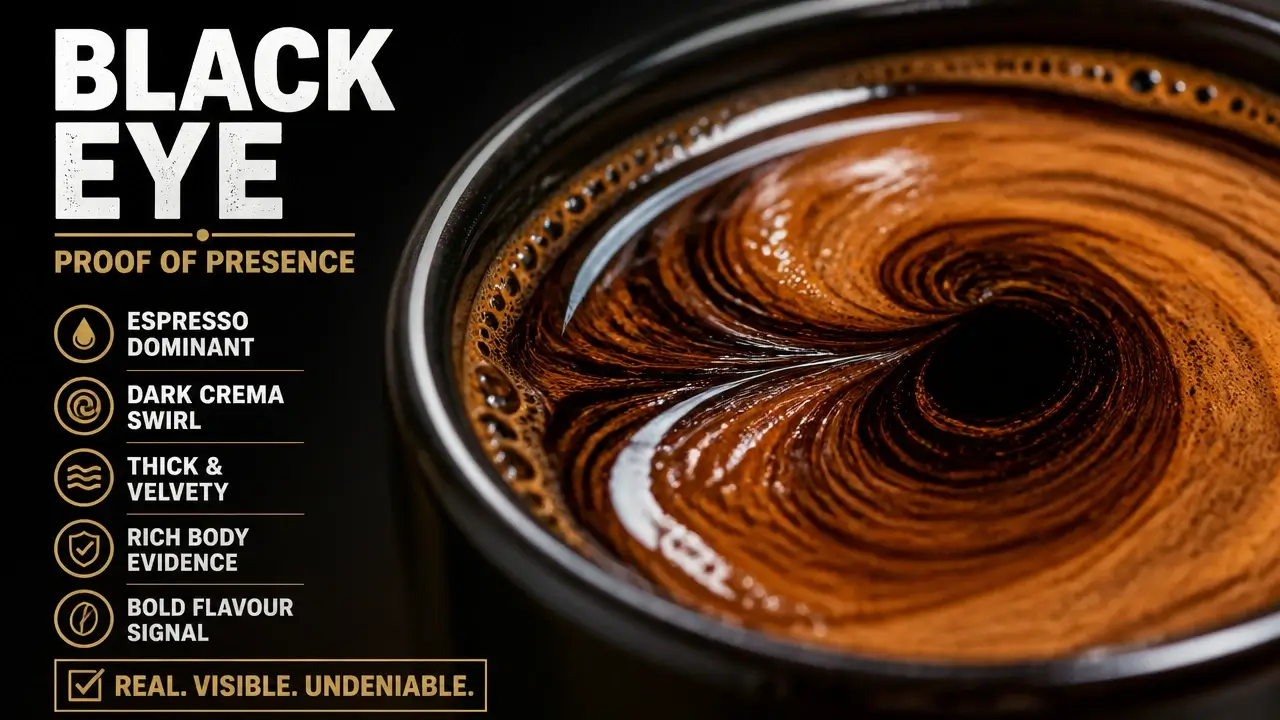
That crema isn’t just visual. It’s the first thing your palate hits, and it signals exactly what kind of drink you’re dealing with: espresso-forward, dense, and uncompromising.
The name follows the logic. Red Eye was a single punch. Black Eye is what happens when that punch lands harder: a natural escalation in the naming chain that mirrors the escalation in the cup.
Pulling the Double Shot Right
The preparation mirrors the Red Eye, but the double shot raises the stakes on execution. Grind consistency and tamp pressure matter more here because you’re extracting twice the volume from the same portafilter. An uneven tamp or a grind that’s too coarse gives you a watery, bitter pull, and that bitterness gets amplified when it hits the drip coffee.
Pull the double shot to roughly 2 oz, pour it directly into the hot drip, and let the crema settle on top before you drink. Don’t stir. The layered density is part of the experience.
Ivan Laranjeira Petrich coffee expert, author at Perfect Daily Grind, puts the extraction logic plainly:
“A low yield and high dose (such as a ristretto) lead to a more concentrated, full-bodied, acidic, and less sweet beverage.”
That same principle applies here in reverse: a higher yield double shot, if pulled sloppy, drifts toward thin and harsh. Precision on the front end is what keeps the Black Eye rich instead of punishing.
One honest heads-up: if your palate isn’t already comfortable with espresso dominance, the Black Eye can feel more like a challenge than a pleasure. This isn’t a drink that hides what it is. The espresso is front and center, the mouthfeel is heavy, and the bitterness is real. For the right person on the right morning, that’s exactly the point. For everyone else, it’s a lot to take on before 8 a.m.
Dead Eye: The Extreme-Caffeine Heavyweight
Dead Eye coffee is the most aggressive entry in the spiked coffee lineup: 8 oz of drip coffee carrying three full espresso shots (roughly 3 oz total), built for situations where moderate caffeine simply won’t cut it. At that ratio, the espresso doesn’t complement the drip coffee anymore. It absorbs it.
The flavor reality is stark. Three shots of espresso generate enough intensity to reduce the drip coffee to a thin carrier fluid: you’re tasting dark, concentrated bitterness with a heavy, syrupy body, and almost none of the base coffee’s original character survives. If you brewed a single-origin Ethiopian for its bright, floral notes, those are gone. What remains is thick, roast-forward, and relentless. Using dark-roasted beans for the espresso pulls actually helps here: the roast profile’s natural bitterness blends more cohesively with the intensity instead of creating a jarring two-layer clash.
Caffeine Load and the 400 mg Reference Point
The caffeine bracket for a Dead Eye sits at roughly 300–340 mg per drink, which puts it close to, but still under, the FDA’s 400 mg reference point for healthy adults. The operative word there is reference. The FDA’s own consumer guidance describes that number as a “generalized reference guideline for healthy adults,” not a hard ceiling where safety ends and danger begins.
The science behind that nuance matters. A systematic review published in Pharmacological Reviews on caffeine metabolism found that genetic polymorphisms, specifically the CYP1A2 rs762551 variant, along with environmental factors like smoking, oral contraceptives, and liver function create enormous variability in how fast individuals clear caffeine from their system. Some people metabolize it quickly and feel almost nothing at 300 mg. Others experience heart-rate spikes well below that threshold. A peer-reviewed review in Nutrients reinforces this directly, noting that “physiological responses like heart-rate spikes occur well below this threshold for sensitive populations.”
So treating the Dead Eye as automatically safe because it clears 400 mg is the wrong frame. The more useful question is: where does your tolerance actually sit, and what else have you consumed today? A Dead Eye on top of a morning cup and an afternoon energy drink can push total daily intake well past 500 mg before dinner.
The Green Eye Variant and Cumulative Risk
There’s a related drink worth knowing: the Green Eye, a three-shot variant that circulates in Starbucks secret-menu lore. Depending on the base drink size and the espresso used, caffeine estimates for the Green Eye range up to 540 mg in a single serving: a number that crosses the FDA reference point by a meaningful margin and enters territory where even moderate-tolerance drinkers should pay attention. If you’re pregnant, on certain antidepressants or antibiotics, or managing a heart condition, that number isn’t a badge of honor. It’s a genuine interaction risk.
How to Pull a Dead Eye Correctly
Technique matters more here than with a Red Eye or Black Eye. You need an espresso machine capable of pulling a clean triple shot, or three consecutive singles pulled without delay. That last part is non-negotiable: espresso begins oxidizing almost immediately after extraction. If you pause between shots, the later ones will carry a stale, metallic bitterness that compounds the already-intense flavor profile. Pour all three shots into the drip coffee in one steady stream while the espresso is still hot and alive.
Dark-roasted beans are the right call for the espresso component. Their lower acidity and heavier body integrate more smoothly into the concentrated drink, and their flavor profile can actually carry the load without tasting burnt on top of bitter.
When the Dead Eye Actually Makes Sense
This is a situational tool, not a morning ritual. All-nighters before a deadline, extended shift work, or recovery from serious sleep debt, those are the legitimate use cases. As a daily driver, the Dead Eye asks your nervous system to operate at near-maximum caffeine stimulation every single day, which builds tolerance fast and makes the drink progressively less effective at the one thing it’s designed to do.
If you find yourself reaching for a Dead Eye every morning just to feel functional, that’s not a coffee problem. That’s a sleep problem wearing a coffee costume.
Which Spiked Coffee Actually Fits You?
The biggest gap in every spiked-coffee guide out there isn’t another caffeine table; it’s the part where someone finally tells you which drink belongs in your hand. You’ve seen how Red Eye, Black Eye, and Dead Eye are built. Now let’s close the loop on the only question that actually matters at 6 a.m.
Here’s the head-to-head snapshot first, so all three live in one place:
| Drink Name | Shot Count | Caffeine Range (mg) | Flavour Tagline | Best-For Persona |
|---|---|---|---|---|
| Red Eye | 1 | ~150–170 | Balanced daily lift | The Balanced Daily Drinker |
| Black Eye | 2 | ~210–240 | Espresso-forward, rich, dense | The Bold Seeker |
| Dead Eye | 3 | ~270–310 | Extreme bitter hit | The Extreme Alertness Junkie |
Now let’s translate those numbers into real decisions.
The Three Personas, Plainly Stated
If you love your morning coffee and just want it sharper: the Red Eye is your drink. One shot of espresso folds into drip coffee without hijacking it. You still taste the character of whatever beans you brewed. The espresso adds a silky body and a gentle intensity, but the drip coffee is still leading the dance. This is the spiked coffee recommendation for someone who wants a moderate lift without sacrificing the comfort of their morning ritual.
If you want espresso to run the show: the Black Eye is the honest answer. Two shots shift the center of gravity completely. The drip coffee becomes the supporting cast; espresso is the headliner. If that sounds appealing rather than alarming, you’re the right audience for it. Experienced caffeine consumers who’ve already outgrown the Red Eye and genuinely crave that dense, wake-up-punch weight will find the Black Eye earns its place.
If you have confirmed high caffeine tolerance and need unapologetic firepower for a specific window: the Dead Eye exists for you, and only for that moment. Three shots is not a daily driver. It’s a strategic tool for the high-stakes stretch: a brutal deadline, a red-eye flight, a double shift. The bitterness is real and the caffeine load demands respect. If you’re reaching for the Dead Eye because it sounds impressive rather than because you’ve genuinely tested your tolerance ceiling, put it back.
The Crafting Rules That Actually Matter
The persona-based recommendations above only hold up if the drink is built right. A poorly pulled shot ruins a Red Eye just as fast as it ruins a straight espresso. These aren’t preferences: they’re the floor:
- Match your beans to the drink. Medium-dark roast for Red Eye: you want the espresso to complement the drip, not bulldoze it. Dark roast for Black Eye and Dead Eye: the higher extraction tempers the bitterness that three shots would otherwise amplify into something unpleasant.
- Pull your espresso shots immediately before pouring. A shot that’s been sitting for 30 seconds has already started oxidizing. The crema collapses, the brightness flattens, and the bitter notes surge forward. There’s no recovering it.
- Never let a shot sit. This one bears repeating because it’s the step most people skip when they’re rushing. If the shot isn’t going straight into the cup, it shouldn’t be pulled yet.
- Use a pre-warmed cup. Pour hot water into your cup, let it sit for 20 seconds, dump it, then build your drink. A cold cup drops the espresso temperature the moment it lands and throws off the entire flavor balance.
The Safety Layer Nobody Prints
Here’s the part that gets left out of every caffeine guide: your body is a better data source than any table.
If a Red Eye already makes you jittery, anxious, or gives you that hollow, heart-racing feeling, the Black Eye is not “stronger in a good way.” It’s just overboard for your system. Caffeine tolerance is genuinely individual. It’s shaped by body weight, metabolic rate, sleep quality, and how consistently you consume caffeine. The numbers in that table are averages, not guarantees.
Start at the Red Eye. Live with it for a week. If it’s doing exactly what you need, you’ve found your drink. If you’re chasing more, move to the Black Eye with intention, not habit. The Dead Eye should never be a default.
The Ultimate Decision Rule
Choose your spiked coffee by two factors, not one. Yes, pick by the caffeine boost you need. But also ask yourself: do I still want to taste my drip coffee?
If the answer is yes, Red Eye, every time. If you’re ready to let espresso lead, Black Eye. If you need maximum firepower and flavor is secondary for this specific stretch, Dead Eye, with full awareness of what you’re signing up for.
That’s the decision the caffeine tables never helped you make. Now you can make it yourself.
Key Takeaways on Spiked Coffee
- Caffeine content varies wildly based on bean type; Robusta can deliver double the caffeine of Arabica in the same shot size.
- A spiked coffee’s flavor balance shifts dramatically with each added shot, often overshadowing the base coffee’s character.
- The Dead Eye is a situational tool, not a daily driver, and regular use signals a sleep problem, not a coffee solution.
- Technique trumps ingredients: a pre-warmed cup and freshly pulled shots prevent bitterness and preserve crema integrity.
- Personal caffeine tolerance should dictate your choice—start with a Red Eye and escalate only if necessary.
Frequently Asked Questions About Spiked Coffee
Q: What happens if I use a ristretto shot instead of a standard shot in a Red Eye?
A: A ristretto shot pulls less liquid, so the caffeine bump is smaller, but the flavor is more concentrated and less bitter. The balance tips slightly sweeter, but the drip coffee’s character still dominates.
Q: Can I build a spiked coffee with cold brew instead of hot drip?
A: You can, but the low acidity of cold brew doesn’t integrate as well with hot espresso. The temperature clash mutes the espresso’s brightness, and you lose the aromatic crema layer that defines a properly built spiked coffee.
Q: Why does the crema in a spiked coffee vanish so quickly?
A: Crema is delicate, made from coffee oils and CO2. It dissipates within 90 seconds because the bubbles burst and the foam collapses, accelerated by the heat of the drip coffee. Drinking immediately is the only fix.
Q: Is it worse to use dark roast beans for the espresso in a Dead Eye?
A: No, it’s the opposite. Dark roasted beans for the espresso in a Dead Eye actually help; their lower acidity and smoky notes blend with the intensity rather than creating a harsh, acidic clash.
Q: What’s the actual caffeine difference between a Green Eye and a Dead Eye?
A: A Green Eye is a secret-menu variant with three shots but often larger volume or blonde espresso, potentially pushing caffeine over 500 mg. The Dead Eye sticks to an 8 oz drip base, typically capping around 340 mg.
Q: Does the order of pouring really affect the taste, or is it just visual?
A: Pouring espresso onto drip coffee preserves a layered structure: the crema hits your palate first, softening the initial bitterness. Reversing the pour blends everything immediately, resulting in a more uniform but less dynamic taste.
References
- Spilling the Beans: How Much Caffeine is Too Much? – FDA
- The Great Coffee Debate: Arabica vs Robusta – Enderly Coffee
- Caffeine Metabolism and Genetic Variants – Pharmacological Reviews
- Caffeine and Physiological Responses – Nutrients
- How to Better Control Your Espresso’s Brew Ratio – Perfect Daily Grind