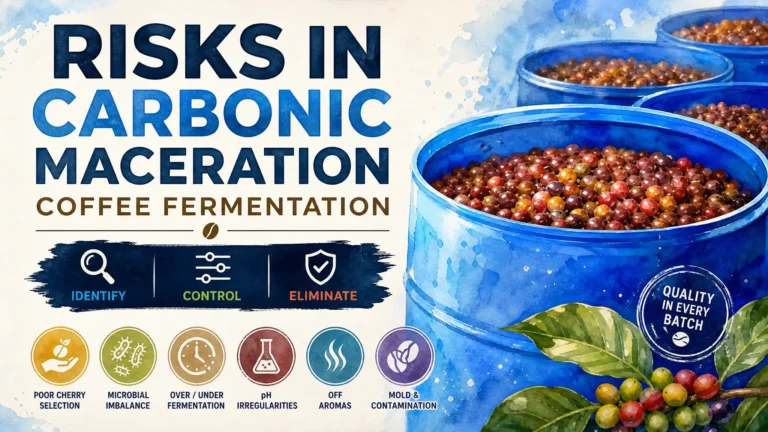

Poorly managed carbonic maceration coffee fermentation doesn’t just underperform – it produces irreversible chemical defects that no roast profile can rescue. The same sealed-tank environment that concentrates fruity aromatic compounds also creates the exact conditions where acetic acid bacteria and Brettanomyces thrive the moment oxygen finds a way in.
Understanding where the process breaks down is the first step toward controlling it. What follows is a precise, mechanism-by-mechanism account of every major risk in CM fermentation – and the documented controls that eliminate them.
Just as proper tank sealing prevents spoilage during processing, you must also protect anaerobic coffee beans from environmental degradation once drying is complete.
For roasters and producers looking to deepen their foundational knowledge, this anaerobic processing overview provides essential context on how controlled fermentation environments influence overall cup quality.
To eliminate these variables and achieve consistently exceptional results, producers must implement a rigorous producer fermentation protocol that governs every stage from cherry intake to tank sealing.
For roasters and producers seeking a holistic understanding of these processing methods, Carbonic Maceration Coffee The Complete guide provides an exhaustive breakdown from farm-level science to final cup evaluation.
Volatile Acidity Is the Primary Chemical Risk in CM
Volatile acidity (VA) is the fraction of total acidity detectable by smell rather than taste alone – and in coffee fermentation, it is almost entirely composed of acetic acid. The sensory threshold at which VA crosses from complexity into defect sits at roughly >0.1% acetic acid equivalents in green coffee. Once that line is crossed, the lot is compromised. There is no roasting fix, no blending correction, and no processing step downstream that reverses it.
The biochemical pathway is straightforward and brutal. Under micro-oxic conditions – meaning not fully anaerobic, but not openly aerobic either – acetic acid bacteria (AAB) oxidize ethanol into acetic acid through membrane-bound dehydrogenases located in their periplasmic space. A 2022 review in Frontiers in Microbiology details how electrons from this oxidative fermentation chain transfer to ubiquinone, driving continuous acetic acid production as long as both ethanol and even trace oxygen are present. The reaction doesn’t require much oxygen – it requires only enough.
This is precisely why carbonic maceration carries a unique vulnerability. CM tanks hold whole cherries in a CO₂ atmosphere, not in liquid brine. Every lid opening, every micro-crack in a gasket, and every pressure drop during temperature fluctuation represents a potential oxygen ingress event. The tank is never perfectly sealed across an entire multi-day fermentation cycle, and AAB exploit that imperfection rapidly.
The distinction that matters for quality managers is this: the fruity, bright acidity that makes a well-executed CM lot extraordinary comes from controlled yeast metabolism – malic acid conversion, ethyl ester production, and CO₂-driven intracellular fermentation within intact cherries. Volatile acidity from AAB contamination mimics that brightness on paper but registers as sharp, vinegary, and astringent in the cup. Separating the two requires understanding not just what went wrong, but which organism caused it – which leads directly to the three main spoilage actors in any CM failure.
It’s also worth noting that CM’s microbial dynamics differ structurally from other fermentation styles; understanding the key differences between CM and anaerobic fermentation clarifies why oxygen management carries a different risk profile in each process and why the same sealing standard cannot be applied uniformly across methods.
Spoilage Microbes That Drive CM Defects
Three organisms account for the vast majority of defect failures in carbonic maceration coffee fermentation: Acetobacter, Gluconobacter, and Brettanomyces bruxellensis. Each operates through a different mechanism, thrives under slightly different conditions, and produces a distinct sensory signature. Knowing which one you’re dealing with turns a cupping defect from a mystery into a correctable process failure.
Acetobacter and Gluconobacter
Acetobacter and Gluconobacter are obligate aerobic bacteria – they cannot metabolize without oxygen. Both convert ethanol to acetic acid through the same periplasmic oxidation pathway described above, which is why their primary sensory output is the sharp, vinegar-like volatile acidity that defines a failed CM lot. Industry practice targets dissolved oxygen below 1 mg/L specifically to suppress their metabolism; above that threshold, both genera become metabolically active within hours.
The practical difference between them is speed and substrate preference. Acetobacter is the more aggressive acetic acid producer and tolerates a wider pH range, making it the more dangerous of the two once oxygen ingress occurs. Gluconobacter tends to dominate at higher sugar concentrations early in fermentation, before ethanol accumulates – meaning it poses the greatest risk in the first 24–48 hours when the tank is being loaded and sealed.
Brettanomyces and Its Persistence Problem
Brettanomyces bruxellensis presents a categorically different challenge. As a facultative anaerobe, it can survive at very low oxygen tensions – meaning it doesn’t need a significant seal failure to remain viable. It can persist through the early anaerobic phase of fermentation if it colonizes the tank or cherry surface before sealing. Its primary metabolic outputs are 4-ethylphenol and 4-ethylguaiacol, the compounds responsible for the phenolic, “barnyard,” medicinal, and Band-Aid descriptors that appear on cupping forms for failed CM lots.
What makes Brettanomyces particularly difficult to manage is its low-pH tolerance. While acidification naturally suppresses Acetobacter and Gluconobacter, Brett can remain active well below pH 4.0 – the acidification target most CM protocols use as a termination benchmark. If it enters the tank via cherry skin, equipment biofilm, or residue from a previous batch, oxygen exclusion alone will not eliminate it.
Mapping Defects to Their Source
The practical value of this microbial profile is that it allows quality managers to work backward from the cup to the cause:
| Sensory Descriptor | Likely Source Organism | Primary Trigger |
|---|---|---|
| Vinegar / sharp acetic | Acetobacter, Gluconobacter | Oxygen ingress, dissolved O₂ >1 mg/L |
| Band-Aid / medicinal / phenolic | Brettanomyces bruxellensis | Pre-seal contamination, equipment biofilm |
| Volatile astringency | Combined AAB + Brett activity | Extended fermentation + micro-oxic conditions |
| Musty / earthy | Mold contamination | Damaged cherries, excessive humidity |
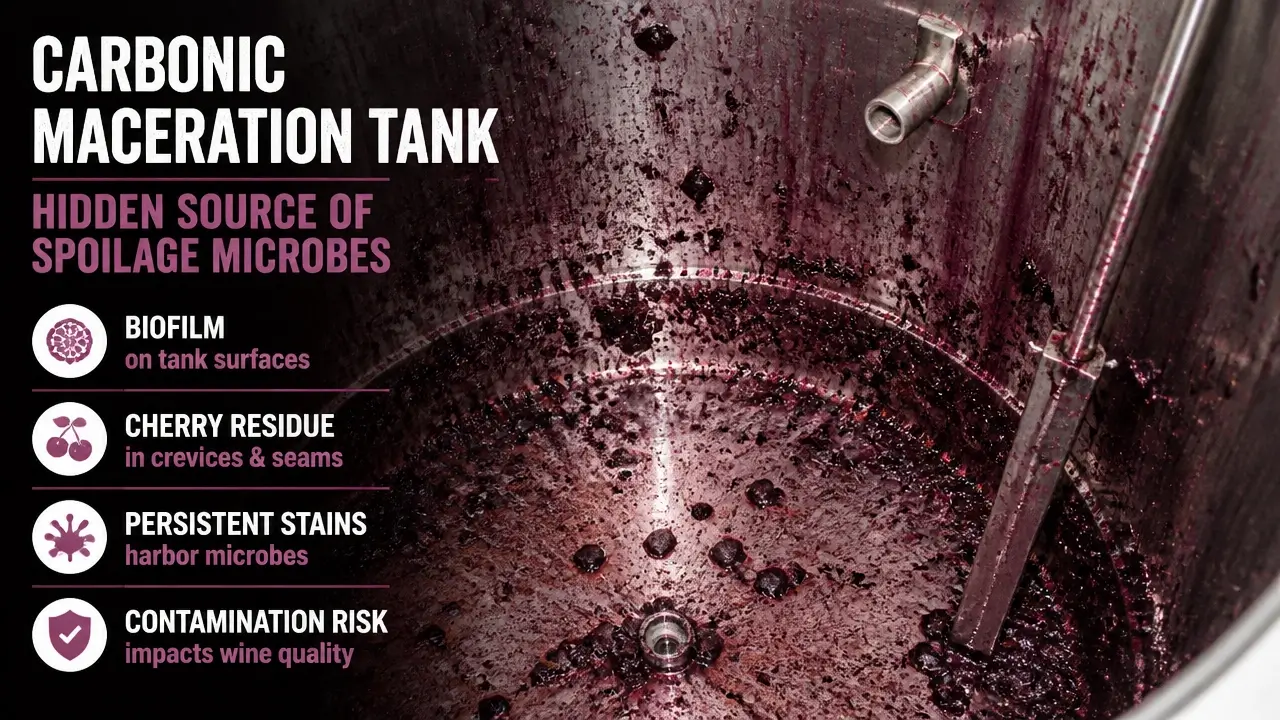
Below is a visual reference for what tank biofilm contamination looks like at the surface level – the physical evidence that often precedes a microbial defect in the cup.
Oxygen Management Starts Before You Close the Lid
Oxygen management in carbonic maceration fermentation is not a passive outcome of sealing a tank – it is an active, multi-step process that begins with headspace preparation and continues through daily pressure monitoring. The goal is a sustained positive-pressure CO₂ blanket that denies Acetobacter, Gluconobacter, and Brettanomyces the one resource they share: access to atmospheric oxygen.
One-Way Valves and Pressure Thresholds
One-way (airlock) valves serve a dual function: they allow CO₂ generated by yeast metabolism and intracellular cherry fermentation to escape without permitting atmospheric oxygen to re-enter. For this to work reliably, the tank must maintain a positive pressure of >0.5 psi above ambient at all times. Below that threshold, a pressure drop – caused by temperature cooling, CO₂ absorption into liquid, or a seal micro-leak – can create a transient vacuum that draws ambient air through the valve or any imperfect gasket joint.
Valve selection matters. Cheap plastic airlocks used in homebrew applications are not rated for the temperature cycling or acid exposure of commercial CM fermentation. Specify food-grade stainless or HDPE one-way valves with documented backpressure ratings, and replace them on a scheduled cycle rather than waiting for visible failure.
Gaskets, Seals, and the Hidden Leak Points
The lid-to-tank interface is the most common oxygen ingress point in practice. Gasket materials must be compatible with fermentation acids – standard EPDM rubber degrades over time in low-pH environments, while food-grade silicone maintains its compression seal through repeated thermal cycling and acid exposure. Inspect gaskets before every batch for surface cracking, compression set, or deformation at the bolt points. Apply food-grade silicone lubricant to the sealing surface to prevent micro-gaps at the rim contact zone.
A Practical Sealing Protocol
Before a fermentation is considered started, the following sequence should be standard operating procedure:
- Fill the tank to leave <10% headspace by volume to minimize the oxygen reservoir available before CO₂ displaces it.
- Purge the headspace with food-grade CO₂ before sealing to displace residual atmospheric oxygen.
- Seal the lid and verify closure torque at all fastener points.
- Connect a manometer to the valve port and confirm positive pressure builds within 2–4 hours as fermentation initiates.
- Log pressure at 12 hours – zero pressure drop over that window confirms seal integrity before the fermentation is active.
Dissolved Oxygen as a Batch Monitoring Tool
Seal verification is a point-in-time check; dissolved oxygen (DO) measurement provides continuous insight into whether the anaerobic environment is holding. Target dissolved oxygen ≤0.5 mg/L in any liquid phase within the tank. Readings above this level should trigger an immediate seal inspection and corrective re-purge – not a note in the log for review at the end of the batch.
This also clarifies the structural difference between CM and fully submerged anaerobic fermentation. In anaerobic fermentation, cherries or parchment are submerged in liquid, which provides a physical oxygen barrier. In CM, the cherries sit in a gas-phase CO₂ atmosphere, which means any pressure equilibration event – however brief – can expose cherry surfaces to oxygen directly. The DO target in CM must therefore be treated as a hard limit, not a guideline.
Temperature and pH Are Your Chemical Suppression Layer
A perfect seal is necessary but not sufficient. Temperature and pH control function as a second, independent suppression layer that operates chemically rather than physically – and a producer who maintains one without the other is still exposed to significant spoilage risk.
The Fermentation Temperature Window
The recognized best-practice temperature range for specialty CM fermentation is 20–25°C. Within this band, Saccharomyces cerevisiae and other desirable fermentation organisms maintain metabolic dominance while Acetobacter and Gluconobacter remain relatively slow. Below 20°C, spoilage bacteria are suppressed, but desirable fermentation also slows, extending total duration and increasing the cumulative exposure window for any oxygen ingress event. Above 28°C, AAB metabolism accelerates sharply – even at dissolved oxygen levels near the 0.5 mg/L target, the combination of heat and trace oxygen can produce measurable VA within 12–24 hours.
Sasa Sestic, the 2015 World Barista Champion and a key figure in popularizing CM techniques in specialty coffee, articulates the flavor logic behind temperature selection precisely:
For producers chasing complex acidity, Sestic recommends fermentation temperatures as low as 4–8°C, where slower metabolism concentrates volatile aromatic compounds. For sweetness development, he points to the 18–20°C range, where sugar conversion is more complete.
The practical implication for quality managers is that temperature isn’t just a spoilage variable – it is a flavor architecture decision that must be made deliberately before the tank is sealed, not adjusted reactively when a defect appears.
Diurnal Shifts and Condensation Risk
Open-air processing facilities in equatorial growing regions routinely experience diurnal temperature swings of 8–15°C between afternoon peaks and pre-dawn lows. Each cooling cycle causes condensation on tank walls and lids, creating localized micro-oxic pockets at the gas-liquid interface – exactly the microenvironment Acetobacter requires. Insulated tank jackets or jacketed stainless vessels with temperature-controlled water circulation eliminate this risk. At minimum, tanks should be positioned to avoid direct solar exposure and covered with reflective insulation during peak hours.
Fermentation duration also compounds temperature risk. Beyond 192 hours (8 days), the probability of enzymatic degradation and off-flavor accumulation increases substantially – not only from spoilage organisms but from the coffee’s own endogenous enzymes acting on a deteriorating cherry matrix.
pH as a Fermentation Trajectory Audit
The target pH termination range of 4.0–4.5 is the acidification benchmark at which most spoilage bacteria – including Acetobacter and Gluconobacter – are naturally inhibited by the acid environment they helped create. Measuring pH daily does two things simultaneously: it confirms that desirable fermentation is proceeding on trajectory, and it provides an auditable record that can be correlated with sensory outcomes after the fact.
Probe placement and calibration discipline determine whether these measurements are meaningful. Use in-tank thermowells for temperature sensors to avoid the lag and error introduced by surface probes. Calibrate pH meters daily against pH 4.01 and 7.00 buffer solutions, and log the calibration result alongside the fermentation reading. A pH drift that looks gradual in retrospect often shows a sharp inflection point in the log – the exact moment a corrective action should have been triggered.
Competitive Exclusion Protects the Fermentation from the First Hour
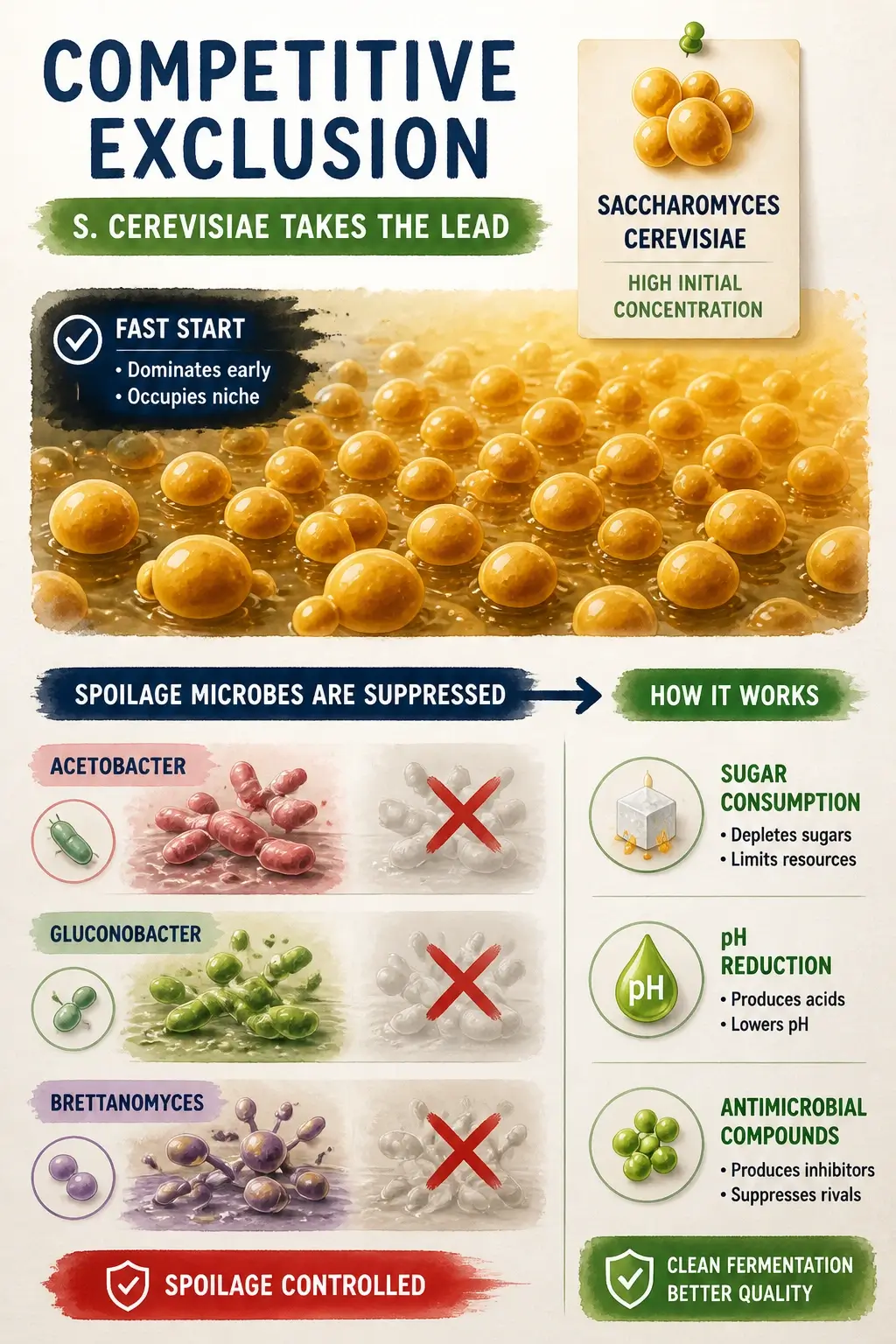
Competitive exclusion is the principle that a microorganism already dominating an environment – consuming available nutrients, lowering pH, and producing antimicrobial compounds – leaves no metabolic foothold for late-arriving competitors. In CM fermentation, it translates to a straightforward strategy: inoculate with a high concentration of Saccharomyces cerevisiae before spoilage organisms can colonize.
At an initial concentration of ≥10⁶ CFU/mL, S. cerevisiae rapidly consumes the available sugars released from cherry tissue, drives pH downward, and produces ethanol at levels that are toxic to Acetobacter and Gluconobacter at the concentrations where those bacteria cause damage. The result is a fermentation environment that is chemically hostile to spoilage organisms within the first 12–24 hours – before oxygen management or temperature control has had time to establish full suppression.
Active Dry Yeast vs. Pied de Cuve
Two inoculation strategies are in common use, and each has a distinct risk-benefit profile:
Active dry yeast (ADY) – typically Saccharomyces cerevisiae strains selected for low volatile acidity production and temperature tolerance – offers consistency. Rehydrate per the manufacturer’s protocol (typically in 35–38°C water for 20–30 minutes before pitching), and apply at 2–5 g/hL of cherry mass. The strain is known, the inoculation rate is precise, and the fermentation trajectory is predictable. The tradeoff is reduced microbial complexity compared to spontaneous or native-culture fermentation.
Pied de cuve – an in-house starter cultured from the same farm’s ripe cherries and propagated under controlled conditions – preserves microbial diversity and regional character. The protocol: select 100–200 g of the ripest, cleanest cherries from the lot, add sterile water at a 1:5 ratio, monitor pH daily until it reaches 3.8–4.0 (typically 48–72 hours), then add the active starter at 5–10% v/v to the main fermentation tank. The advantage is that the dominant organisms are native to the farm’s microbiome. The risk is batch-to-batch variability in inoculation strength if propagation conditions aren’t tightly controlled.
Does Inoculation Erase Terroir?
This is the most common objection from producers experimenting with CM for the first time, and it deserves a direct answer: no. Inoculated CM lots consistently express regional character – elevation-driven acidity, variety-specific aromatics, and the intracellular flavor compounds produced by CO₂-driven cherry fermentation – while eliminating the spoilage noise that obscures those qualities. The terroir is in the cherry, the soil, and the altitude. What inoculation removes is the random microbial lottery that can overwrite those qualities with vinegar and phenol.
Inoculation is not a substitute for the oxygen and temperature controls described in the previous sections. It functions as insurance against residual risk – the contamination event that occurs despite a good seal, or the brief temperature spike that allows AAB to gain a foothold before S. cerevisiae has fully dominated. Think of it as the last line of biological defense, not the first.
For producers new to CM who want to understand how inoculation fits into the broader process architecture, the complete guide to carbonic maceration coffee provides essential context on how each fermentation stage connects.
The infographic below maps how S. cerevisiae dominance suppresses spoilage pathways across the fermentation timeline.
Cupping for Defects Is a Quality Gate, Not an Afterthought
Cupping for defects after CM fermentation is the sensory checkpoint that prevents a compromised lot from consuming drying, milling, and export resources. The producer who treats post-fermentation cupping as a formality is the one who discovers a VA defect at the export sample stage – after three months of processing investment.
The First Sensory Check Happens at Tank Opening
Before any cupping protocol is run, conduct an immediate aroma assessment the moment the tank is opened. The headspace gas carries the concentrated fermentation signature of the entire batch. Vinegar, nail-polish remover (ethyl acetate), or musty notes at this stage are unambiguous indicators of spoilage activity. Simultaneously, inspect cherry skin for slimy texture, unusual discoloration, or surface mold – visual and tactile signals that confirm microbial contamination.
A lot that fails the tank-opening aroma check should be flagged immediately for a full cupping investigation before proceeding to the drying bed.
Standardized Cupping Protocol for CM Defect Detection
The roast profile used for defect cupping must expose defects, not mask them. An overly aggressive roast – high development time ratio, dark color – can suppress volatile acidity and phenolic notes through caramelization and Maillard reactions, producing a false clean result. Conversely, an underdeveloped roast introduces its own grassy, astringent notes that obscure fermentation defects.
The target for CM defect cupping is City+ roast level, with a development time ratio (DTR) of 16–18%. This profile is light enough to preserve volatile fermentation compounds while being developed enough to avoid raw-grain interference.
Cupping parameters:
- Brew ratio: 1:18 (coffee to water by weight)
- Water temperature: 93°C
- Grind: Standard SCA cupping grind (medium-coarse)
- Evaluation categories: Acetic intensity, phenolic character, ferment-fault, and overall clean cup score per SCA cupping form standards
Evaluate specifically at 4 minutes post-pour (when volatile compounds are most detectable) and again as the cup cools to 45°C (when phenolic notes from Brettanomyces become more pronounced).
The Defect Decision Threshold
The disposition decision requires a clear numerical trigger, not a judgment call. If any cupper scores acetic or phenolic intensity ≥3 on a 15-point scale, or if ≥1 taint or defect cup per SCA protocol is identified, the lot is flagged. Flagged lots move to a secondary investigation – cross-referenced against the fermentation batch record – before receiving a final disposition: rework (where feasible), downgrade to lower-grade commercial channels, or rejection.
Retain a 100g green reference sample from every fermentation batch, stored in a sealed, labeled container at ambient temperature. If a quality dispute arises weeks or months later – from a buyer, an export sample, or an internal audit – that reference sample allows the cupping result to be correlated directly with the processing parameters logged during fermentation.
Building a Quality Control Protocol for CM Processing
A quality control protocol for CM fermentation is not a checklist pinned to a wall – it is a living document that captures every process variable, assigns responsibility for every monitoring step, and creates an auditable trail that turns defect events into process improvements rather than unexplained losses. The individual controls described in every preceding section have limited value if they are applied inconsistently across batches or operators. Formalization is what makes them reliable.
Understanding how quality control impacts commercial viability is essential context here – a documented QC system is not just an operational tool, it is a direct input into the premium price negotiations that justify the additional cost of CM processing.
Critical Control Points in the CM Process
The Critical Control Point (CCP) framework identifies the three moments in the CM process where a deviation will predictably cause a defect – and assigns a defined tolerance, monitoring method, and corrective action to each:
| CCP | Stage | Tolerance | Monitoring Method | Corrective Action |
|---|---|---|---|---|
| CCP-1 | Tank sealing verification | Zero pressure drop over 12 hours post-seal | Manometer reading at seal + 12h | Re-inspect gasket, re-purge with CO₂, re-seal |
| CCP-2 | Temperature and pH at 24h intervals | Temp: 20–25°C; pH trajectory toward 4.0–4.5 | In-tank thermowell + calibrated pH meter | Insulate/cool tank; assess for early termination if pH stalls |
| CCP-3 | Post-fermentation aroma and cupping screen | Zero vinegar/phenolic at tank open; no acetic/phenolic score ≥3 at cupping | Aroma assessment + standardized cupping | Flag lot; cross-reference batch record; determine disposition |
The Batch Record Sheet
Every fermentation batch requires a batch record sheet that captures the following fields:
- Cherry variety and harvest date
- Lot size (kg) and tank ID
- Seal pressure test result (pass/fail, pressure reading)
- Inoculation strain, rehydration date, and pitch rate
- Daily temperature and pH readings (time-stamped)
- Fermentation start and end timestamps (total duration in hours)
- Post-open aroma notes (free text)
- Cupping scores by category (acetic, phenolic, clean cup, overall)
- Final lot disposition: Pass / Rework / Reject
- Operator signature and reviewer sign-off
This record is not administrative overhead – it is the data set that makes root-cause analysis possible. When a defect occurs, the batch record narrows the investigation from “something went wrong” to “the pH stalled at hour 72 and the temperature exceeded 27°C for 6 hours on day 3.” That specificity is what enables a corrective action that actually prevents recurrence.
Roast Guidance as a QC Handoff
The QC protocol should include a roast recommendation note as part of the lot documentation handed to the roaster or buyer. This note acknowledges that overly aggressive development profiles can amplify residual processing character – particularly any trace acidity or phenolic notes that passed the green-coffee cupping gate at low intensity. The recommendation is City+ with 16–18% DTR for evaluation roasts, and a longer, lower development profile for commercial roasts where sweetness expression is the priority. This is a collaborative point, not a producer-controlled one, but documenting it protects the producer if a buyer reports a defect that originated at the roasting stage.
Implementation Sequence for the Next Production Cycle
Begin with what is immediately controllable, then build:
- Implement CCP-1 on every tank this cycle – manometer verification, 12-hour pressure hold, logged result.
- Add pH logging at 24-hour intervals using a calibrated meter with documented buffer checks.
- Introduce inoculation on 50% of your lots as a controlled trial – match lot size, cherry variety, and fermentation conditions as closely as possible between inoculated and uninoculated tanks to isolate the variable.
- Run a standardized cupping gate on every lot before it moves to the drying bed, using the City+ protocol and the 15-point defect scoring threshold.
- Review batch records at the end of the cycle to identify any parameter that correlated with elevated defect scores, and adjust the tolerance or monitoring frequency accordingly.
The protocol is designed to be refined. The first cycle generates data; the second cycle uses it.
Key Takeaways on Risks in Carbonic Maceration Coffee Fermentation
- Volatile acidity from acetic acid bacteria is irreversible once formed and cannot be corrected by roasting or downstream processing.
- Acetobacter and Gluconobacter require dissolved oxygen above 1 mg/L to become active; keeping DO ≤0.5 mg/L is the primary physical suppression target.
- Brettanomyces bruxellensis survives at low oxygen and low pH, making pre-seal sanitation of tanks and equipment the only reliable control point.
- Temperature above 28°C accelerates AAB metabolism even in near-anaerobic conditions, making thermal management an independent risk vector, not a secondary concern.
- Saccharomyces cerevisiae inoculation at ≥10⁶ CFU/mL suppresses spoilage organisms biologically without erasing regional flavor character.
- A documented CCP framework with batch records converts individual best practices into a traceable, auditable system that supports both defect prevention and premium price negotiation.
Frequently Asked Questions About Risks in Carbonic Maceration Coffee Fermentation
How quickly can volatile acidity develop if oxygen enters a CM tank?
Under warm conditions (above 25°C) with dissolved oxygen above 1 mg/L, acetic acid bacteria can produce detectable volatile acidity within 12–24 hours of oxygen ingress. This is why a pressure-hold verification at 12 hours post-seal is a non-negotiable monitoring step, not a precaution.
Can you detect a CM defect in green coffee before roasting?
Yes – the most reliable early indicator is aroma at tank opening. Vinegar, nail-polish, or musty notes in the headspace gas are direct evidence of spoilage activity and should trigger a cupping investigation before the lot proceeds to the drying bed.
What are the disadvantages of carbonic maceration compared to washed or natural processing?
CM requires tighter equipment investment, more active monitoring, and stricter sanitation than most conventional methods. The sealed-tank environment amplifies both the rewards of good process control and the consequences of poor control – there’s less margin for error than in open-fermentation methods.
Will using active dry yeast change the flavor profile of my CM lot?
It can shift the profile toward consistency and reduce the random aromatic variation of spontaneous fermentation, but it doesn’t eliminate terroir expression. Elevation, variety, and intracellular cherry fermentation still drive the core flavor – inoculation primarily removes spoilage noise that would otherwise obscure those qualities.
How long can a CM fermentation run safely before defect risk becomes unacceptable?
Beyond 192 hours (8 days), the risk of enzymatic degradation and off-flavor accumulation increases substantially regardless of oxygen and temperature control. Most producers targeting specialty cup scores terminate between 72 and 144 hours, using pH reaching 4.0–4.5 as the primary endpoint indicator rather than a fixed time.
Is Brettanomyces contamination recoverable once it’s established in a tank?
Not within that fermentation batch – the phenolic compounds it produces are already in the coffee matrix. For equipment, thorough cleaning with a food-grade alkaline detergent followed by a citric acid rinse and heat sanitization can reduce biofilm, but Brett is notoriously persistent. Any tank with a confirmed Brett defect history should be treated as a high-risk vessel until clean consecutive batches confirm the contamination has been cleared.
What’s the minimum equipment needed to implement the CCP framework described here?
At the core level: a manometer or pressure gauge fitted to the tank valve port, a calibrated pH meter with 4.01 and 7.00 buffer solutions, an in-tank or immersion thermometer, and a dissolved oxygen meter for batch verification. The batch record sheet itself is a paper or spreadsheet document – the investment is in discipline and logging frequency, not expensive instrumentation.
How does roast profile affect the detection of CM fermentation defects?
An overly dark roast can mask volatile acidity and phenolic notes through caramelization, producing a false clean result on the cupping table. Always evaluate CM lots at City+ roast level with a 16–18% development time ratio when screening for defects – this profile exposes rather than conceals fermentation faults.
References
- Frontiers in Microbiology – Oxidative Fermentation of Acetic Acid Bacteria and Its Products | frontiersin.org
- How Does Fermentation Affect Coffee Flavour Development? | perfectdailygrind.com