
High-grown coffee carries a reputation that shows up on every specialty bag, but most drinkers have no idea what the elevation is actually doing to the bean. The label isn’t decoration. It’s a shorthand for a specific set of biological conditions that unfold over weeks inside a single cherry.
Understanding those conditions doesn’t just satisfy curiosity. It changes how you read an origin, evaluate a roaster’s sourcing notes, and make sense of why a 1,900-meter Ethiopian lot from Yirgacheffe tastes nothing like a lowland Brazilian. The altitude story starts with temperature, and it ends in the cup.
To fully appreciate how these environmental factors translate into your morning cup, it helps to explore the specific aroma and body compounds that develop during this prolonged maturation process.
Beyond environmental factors, ethical sourcing practices like those verified by a fair trade coffee certification also play a crucial role in bringing exceptional specialty lots from these remote mountain farms to your cup.
Once you appreciate how meticulous agricultural practices shape the bean, it is equally fascinating to explore the latte art history and evolution that transforms those carefully brewed shots into visual masterpieces.
Beyond elevating the taste in your cup, embracing these rich antioxidant properties is thoroughly explored in Coffee Benefits Unlocked The Definitive guide.
Key Takeaways on High Altitude Coffee
- High altitude coffee grows above 1,200 meters, but the real driver of quality is the cooler temperature that elevation creates, not the altitude itself.
- Every 100 meters of elevation gain drops average temperature roughly 0.6 °C, slowing cherry ripening by weeks and extending the window for sugar and acid accumulation.
- Sucrose in high-altitude Arabica seeds reaches 8–18% of dry weight at full ripeness, providing the raw material for aromatic complexity during roasting.
- Denser beans are a physical consequence of slow growth: more dry matter per cell means more soluble flavor-active material per gram of coffee in the cup.
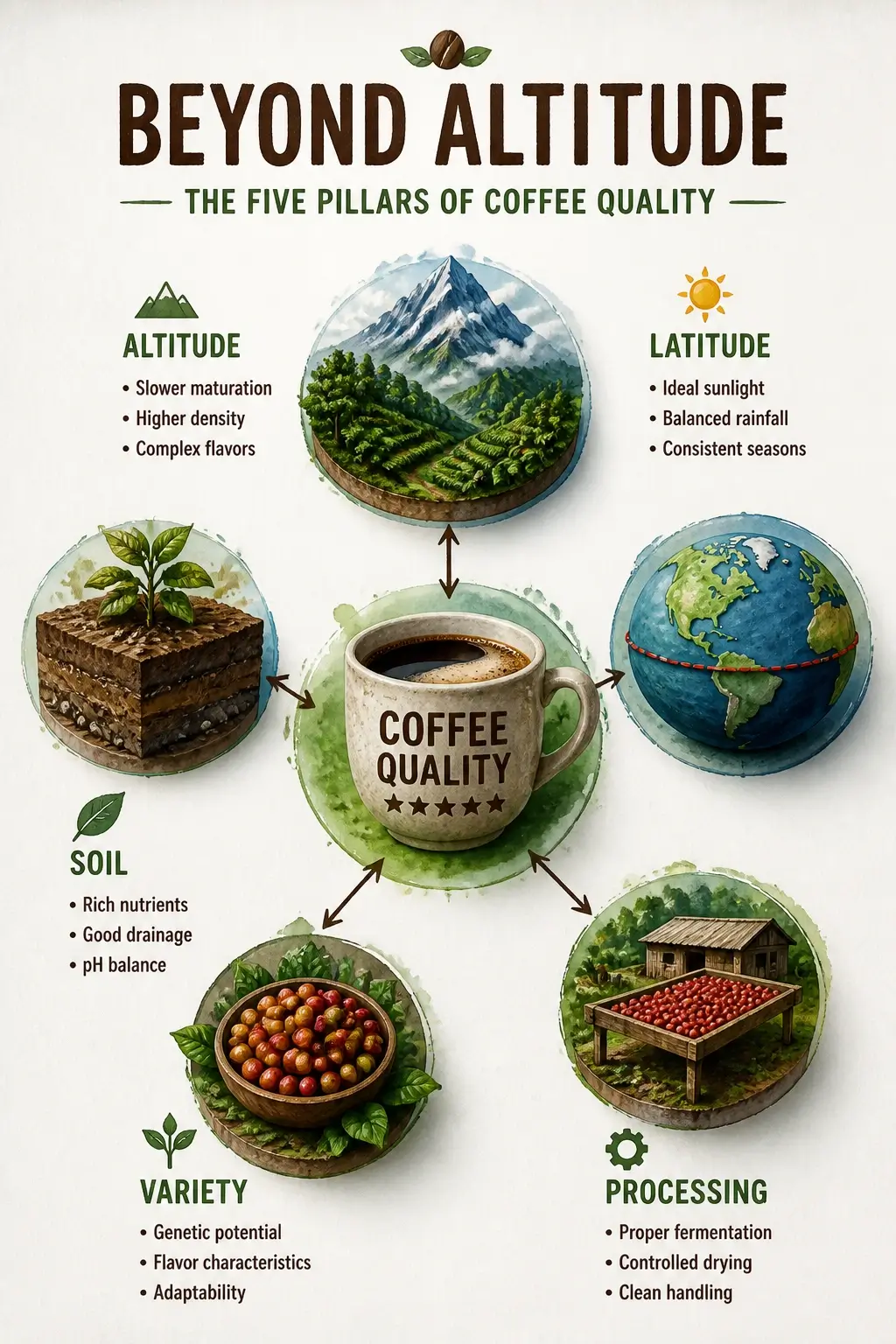
- Altitude is a strong quality proxy, but latitude, volcanic soil, processing method, and coffee variety all shape the final result alongside elevation.
- The world’s most celebrated high-altitude regions – Ethiopia, Kenya, Colombia, Guatemala – consistently deliver the brightness and complexity the science predicts.
What “High-Grown” Really Means Above 1,200 Meters
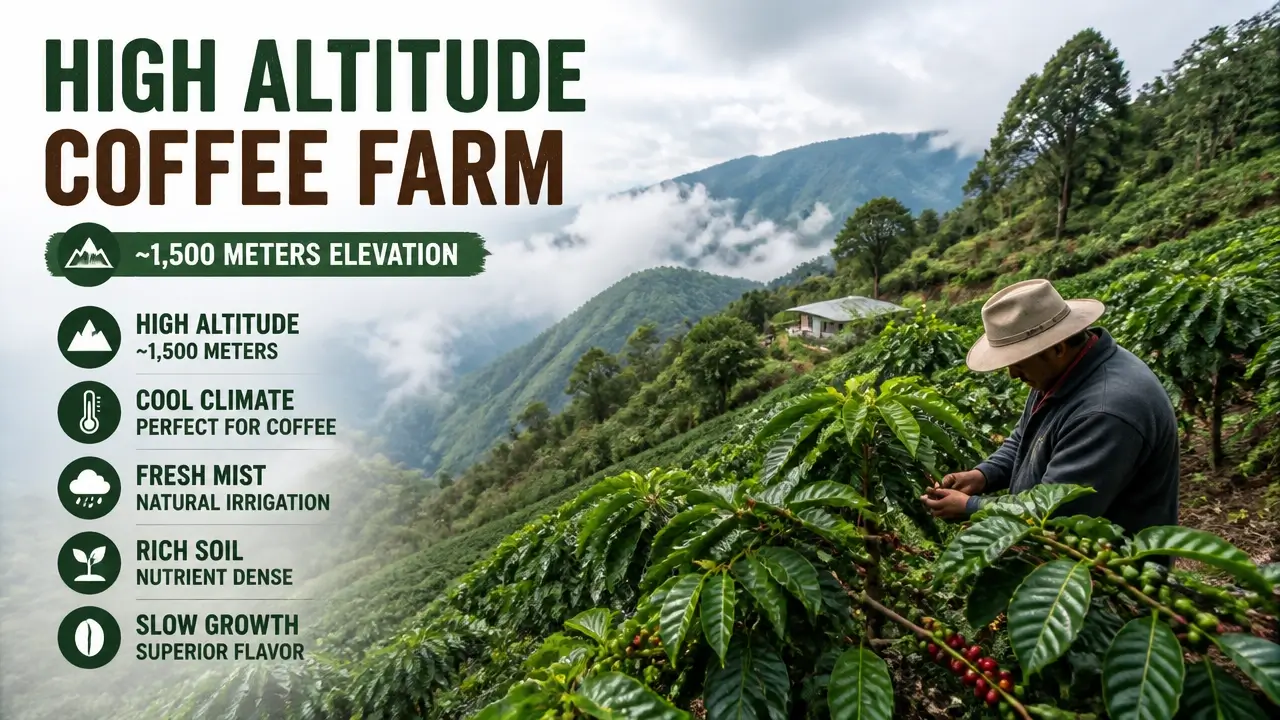
High altitude coffee begins at roughly 1,200 meters above sea level (about 4,000 feet), and the most prized lots in the world sit between 1,500 m and 2,200 m. Below that threshold, you’re still growing coffee. You’re just growing it fast.
The mechanism is straightforward. For every 100 meters you climb, average air temperature drops approximately 0.6 °C. That sounds minor until you stack it up: a farm at 1,800 m sits in air that is roughly 3.6 °C cooler than a farm at 1,200 m. That difference is enough to fundamentally change how the coffee plant does its job.
At lower temperatures, the metabolic processes inside a coffee cherry slow down. The cherry doesn’t rush to ripen. Where a lowland cherry might complete its journey from flower to harvest in 6 to 7 months, a high-altitude cherry can take 9 to 11 months, sometimes longer. Those extra weeks aren’t empty time. They’re the window in which everything that makes specialty coffee worth drinking actually builds.
High-altitude growing zones also tend to experience wider diurnal temperature variation, the swing between daytime warmth and cool nights. That daily thermal stress isn’t damaging to the plant; it’s a mild pressure that pushes the cherry to concentrate beneficial compounds as a kind of biological response. The altitude creates the cool microclimate. The cool microclimate stretches the ripening period. The extended ripening period is where quality is made.
That chain of events is the foundation of everything else in this article.
Slow Growth: What Extra Weeks Do Inside the Cherry
The extended ripening period is time the coffee cherry uses productively. To understand what happens, think of the developing seed inside the cherry as a storage tank. The plant’s leaves are running photosynthesis continuously, producing sugars. Those sugars travel down to the fruit, and the seed absorbs them. A longer ripening window means a longer fill time.
Sucrose Builds to Exceptional Levels
The primary sugar accumulating in the seed is sucrose. In lowland cherries that ripen quickly, the seed doesn’t have time to reach peak sugar loading before harvest. In a high-altitude cherry, that fill time extends by weeks, and the sucrose concentration climbs accordingly.
Academic Evidence: Sucrose accumulates exclusively in the seeds of Coffea arabica cultivars, reaching 8–18% of dry weight at full ripeness, while organic acid profiles differ by tissue type – citric acid concentrates in seeds, whereas malic and oxalic acids are higher in the pericarp. – From the study “Changes in the Content of Sugars and Organic Acids During Ripening of Coffea arabica and Coffea canephora Fruits“
That range of 8–18% sucrose by dry weight matters because sucrose is not just sweetness waiting to happen. In the roaster, it’s raw material. Sucrose drives Maillard reactions and caramelization, producing the aromatic compounds responsible for body, complexity, and depth. A seed that arrives at the roaster with a higher sucrose load arrives with more potential. A quickly ripened lowland bean, arriving with less, has a ceiling.
Organic Acids Develop Nuance, Not Harshness
Organic acids tell a similar story. Citric, malic, and phosphoric acids are present in all coffee cherries, but the balance and character of those acids shifts depending on how long and how gently ripening proceeds. In fast-ripening lowland cherries, acids can degrade into simpler compounds that register as flat, harsh, or metallic in the cup. In a slowly ripened high-altitude cherry, those acids develop more layered, integrated profiles.
The result is a brightness that feels clean and lively rather than aggressive. This is the chemical origin of what coffee professionals describe as “well-structured acidity,” and it has nothing to do with roasting technique. The structure was built in the cherry, on the slope, over months.
Aromatic Precursors Reach Peak Concentration
The third category is the one that produces the most dramatic sensory payoff: volatile aromatic precursors. These are compounds that don’t smell like much in the green bean, but transform during roasting into the florals, stone fruits, and wine-like bouquets that define elite specialty lots. A longer, cooler development window allows these precursors to accumulate to their peak concentration before harvest. Rush the ripening, and you harvest them before they’re ready. The roaster can’t manufacture what wasn’t there.
The source-sink model ties it together: the cherry is a sink for the plant’s resources, and a longer fill time produces a seed with higher dry-matter content across all three categories. That’s the chemical foundation of cup quality.
Dense Beans Are Not Harder to Crack – They’re More Loaded
Coffee bean density is where the chemistry becomes something you can hold in your hand. As the seed fills more completely with stored compounds during slow, cool maturation, the cellular structure packs tighter. Less microscopic air space remains. The result is a bean that is physically harder and heavier for its size.
This isn’t a cosmetic difference. Higher density means a higher proportion of soluble flavor-active material per gram of coffee. When you brew a dense high-altitude bean, more of what dissolves into your cup is flavor-carrying compounds. The extraction potential is simply greater.
Density is also measurable without a lab. The coffee industry has used water float tests for decades: beans with lower density float, while denser beans sink. Screens and physical hardness checks serve the same purpose. These are traditional tools, but they’re grounded in the same bean structure that the altitude-driven slow growth created.
Statistical Data: An analysis of 500 coffee samples found a correlation coefficient of 0.63 between float percentage and cupping score. – Source: Bean of Coffee
A 0.63 correlation is meaningful. It tells you density is a strong statistical proxy for quality, not a perfect predictor. Exceptionally dense beans can occasionally come from unique low-altitude microclimates where cool temperatures mimic high-elevation conditions. But the link between altitude, density, and cup quality remains one of the most robust in coffee science. When a roaster tells you a lot was grown at 1,800 m, the density implied by that elevation is part of what they’re communicating.
The Flavor Blueprint High Altitude Leaves in the Cup
High altitude coffee flavor is the payoff for everything that built in the cherry. The sucrose, the acids, the aromatic precursors – they all converge in a recognizable sensory signature once the roaster does their job.
The first thing you notice is the acidity. But calling it “acid” undersells it. High-altitude acidity registers as citric, malic, or phosphoric brightness: lemon, stone fruit, green apple, or a wine-like tartness that makes the palate respond. It’s lively. It pulls the other flavors into focus. Compare that to the flat, sometimes metallic sourness that can appear in rapidly grown lowland coffee, and the difference isn’t subtle.
According to Mané Alves, Founder of Coffee Lab International, Q instructor, international tasting judge, and former Director of the SCA Technical Standards Committee, the way a cupper identifies acidity in the cup is by the sharpness the coffee leaves in the mouth. No sharpness means no acidity – or very low acidity.
That physical sensation – the sharpness Alves describes – is the direct sensory output of the organic acid profiles built during slow ripening. When those acids are well-developed and balanced, the sharpness feels clean and precise. When they’re underdeveloped or degraded, it turns dull or harsh. High-altitude conditions produce the conditions for the former.
Above the acidity, the aromatic complexity opens up. Floral notes like jasmine and bergamot, fruit notes ranging from blueberry to peach, and a tea-like delicacy that sits above the earthier, chocolate-heavy base typical of lower-grown coffees. These are the volatile aromatic precursors from the previous section, transformed by heat.
The clean finish is the third hallmark. High-grown coffees tend to leave little residue on the palate after swallowing. The fruit and floral notes linger, then clear. There’s no muddy aftertaste crowding them out.
A practical comparison anchors the spectrum: a high-altitude washed Ethiopian from Yirgacheffe typically presents floral, citrus, and clean brightness. A low-altitude Brazilian natural typically presents nut, chocolate, low acidity, and heavier body. Neither is wrong. But they are expressions of radically different growing conditions, and altitude is one of the primary variables separating them.
Altitude Isn’t the Only Lever: Latitude, Soil, and Processing
Coffee quality factors extend well beyond the number on the elevation label. Altitude is the most commonly cited proxy for quality, but what it’s actually pointing to is a consistent, cool growing climate – and altitude is only one way to get there.
Latitude is the clearest example. A farm at 1,000 meters in southern Brazil, farther from the equator, can experience average temperatures similar to a farm at 1,500 meters near the equator in Colombia. Both farms produce slow cherry maturation. Both can produce complex, bright coffees. The mechanism is identical; the path to it differs.
Volcanic soils add another layer. Rich mineral content and strong water retention create growing conditions that amplify quality independent of elevation. Cloud cover and consistent rainfall matter too. Farms in perpetually misty, humid highland zones can maintain the cool, steady conditions that altitude creates elsewhere, even at modest elevations.
Processing is where things get most interesting for the buyer. Washed processing strips the fruit from the seed before drying, which tends to amplify the clean acidity and floral notes that high altitude builds into the cherry. Natural processing, where the cherry dries intact around the seed, can inject a concentrated fruity intensity that makes a lower-grown bean taste strikingly vibrant. Processing can effectively mask or amplify the altitude signal. A natural-processed bean from 1,200 m can taste more fruit-forward than a washed bean from 1,800 m, at least on first impression.
Variety carries its own weight. Gesha (also spelled Geisha) has a genetic flavor ceiling so high that it can outperform lower-potential varieties planted at greater elevations. Caturra at 1,900 m will produce a different result than Gesha at 1,600 m, even accounting for the altitude advantage.
The synthesis: altitude is one of the most reliable quality indicators available, but it operates inside a system. Evaluating it alongside latitude, soil, processing, and variety gives you a far more accurate picture than elevation alone.
Where the World’s Best High-Altitude Regions Actually Deliver
High altitude coffee regions are not evenly distributed. The geography of great coffee is concentrated in a narrow band around the equator where tropical climates, volcanic topography, and sufficient elevation converge. A handful of regions have built their entire reputation on this combination.
| Region | Key Growing Areas | Elevation Range | Typical Cup Character |
|---|---|---|---|
| Ethiopia | Yirgacheffe, Sidamo | 1,500–2,200 m | Floral, citrus, jasmine, bergamot, clean finish |
| Kenya | Nyeri, Kirinyaga | 1,600–2,100 m | Blackberry, winey, full body, bright acidity |
| Colombia | Huila, Nariño | 1,500–2,000 m | Caramel, bright apple, stone fruit, balanced |
| Guatemala | Huehuetenango | 1,500–2,000 m | Dark chocolate, peach, complex sweetness |
| Costa Rica | Tarrazú | 1,200–1,900 m | Honey, citrus, clean, medium body |
High altitude is not a myth, and it’s not just a label. It’s a reliable statistical signal that the cherry had time to build complexity before harvest. But the smartest way to use that signal is alongside everything else: what variety was planted, how the cherry was processed, and who grew it. Elevation tells you the conditions were favorable. The rest of the story tells you whether those conditions were used well.
Next time you pick up a bag and see 1,800 m printed on the label, you’ll know exactly what that number is shorthand for: weeks of extra ripening time, higher sucrose and organic acid concentrations, a denser bean loaded with flavor-active compounds, and the bright, complex, clean cup that follows.
Frequently Asked Questions About High Altitude Coffee
Does higher always mean better when comparing two high-altitude coffees?
Not automatically. Above roughly 2,200 meters, temperatures can drop low enough to stress the plant and stall development rather than improve it. The sweet spot for most Arabica varieties sits between 1,500 m and 2,000 m, where slow ripening and healthy photosynthesis both occur.
Why do high-altitude coffees often taste more acidic than low-altitude ones?
The organic acids that produce bright, lively acidity – citric, malic, phosphoric – develop more nuanced, stable profiles during slow ripening. In quickly grown lowland cherries, those same acids can degrade into simpler compounds that taste flat or harsh rather than clean and bright.
Can roasting destroy the quality that altitude built into the bean?
Yes. A dark roast will burn off the volatile aromatic precursors and degrade the organic acids that slow maturation spent months building. High-altitude beans typically show their full complexity under a light to medium roast, where those compounds survive and express themselves.
What does “SHB” or “Strictly Hard Bean” mean on a coffee label?
It stands for Strictly Hard Bean, a Guatemalan grading term for coffee grown above roughly 1,350 meters. The “hard” refers to bean density – the same density created by slow, cool maturation that this article covers. It’s a quality tier, not a description of flavor.
Is high-altitude coffee always washed processed?
No. Ethiopia produces both washed and natural-processed lots from the same high elevations. Natural processing can add fruity intensity on top of the complexity altitude builds, while washed processing tends to express the clean acidity and floral notes more transparently.
Why do some specialty roasters list the exact farm elevation rather than just the country?
Elevation within a single origin can vary dramatically. In Colombia, a farm in Nariño at 2,000 m produces a different cup than a farm in the lowland Magdalena Valley at 800 m, even if both carry the same “Colombian” label. The elevation tells you which growing conditions actually applied.
Does brewing method affect how much of the altitude-driven flavor you taste?
Yes. Brewing methods that use a longer extraction time and lower water temperature – like pour-over or cold brew – tend to preserve and express the delicate florals and bright acidity that high-altitude beans carry. High-pressure methods like espresso compress those nuances into intensity rather than clarity.
Do high-altitude beans require different storage than lower-grown coffee?
The chemistry that makes high-altitude beans distinctive – volatile aromatic compounds in particular – also makes them more sensitive to oxygen, light, and heat after roasting. The same care applies to all specialty coffee, but the potential loss is higher with beans that arrived with more aromatic complexity to begin with.
References
- Changes in the Content of Sugars and Organic Acids During Ripening of Coffea arabica and Coffea canephora Fruits | ecb.poly.pt (via doi.org)
- Why Do Some Beans Float in Water and What Does It Mean for Quality? | beanofcoffee.com
- Why Are Some Coffees More Acidic Than Others? A Brew & Roast Guide | perfectdailygrind.com