

The cortado cup is the most overlooked variable in a drink built entirely around precision. Baristas obsess over grind size, water temperature, and milk texture – then serve the result in whatever glass is closest to the portafilter. That gap between extraction discipline and vessel indifference is exactly where a good cortado goes wrong.
Understanding why the cup matters means understanding how a small, fast-cooling drink behaves inside different geometries and materials. Once that clicks, the question isn’t “which cup should I buy” – it’s “what is my cup actually doing to my ratio, my temperature, and my pour?”
Key Takeaways on Cortado Cup
- The cortado’s 1:1 ratio is fixed, but the cup is the variable that preserves or silently breaks it before the first sip.
- No universal cortado cup size exists – published sources span 60 ml to 133 ml, and practitioners calibrate to their own yield.
- A ceramic vessel retains heat better than glass in real-world use, despite glass having lower thermal conductivity on paper.
- The Libbey Gibraltar is barware that became a benchmark – its price reflects a whiskey tumbler, not specialty coffee-ware.
- Dishwasher safety for cortado glassware is largely unverified; confirm directly with the manufacturer, not from reviews.
- The best cortado cup is the one that fixes the specific failure in the cup you already own – temperature, mouthfeel, or pour control.
What a Cortado Actually Is – and Why 1:1 Is the Only Number That Matters
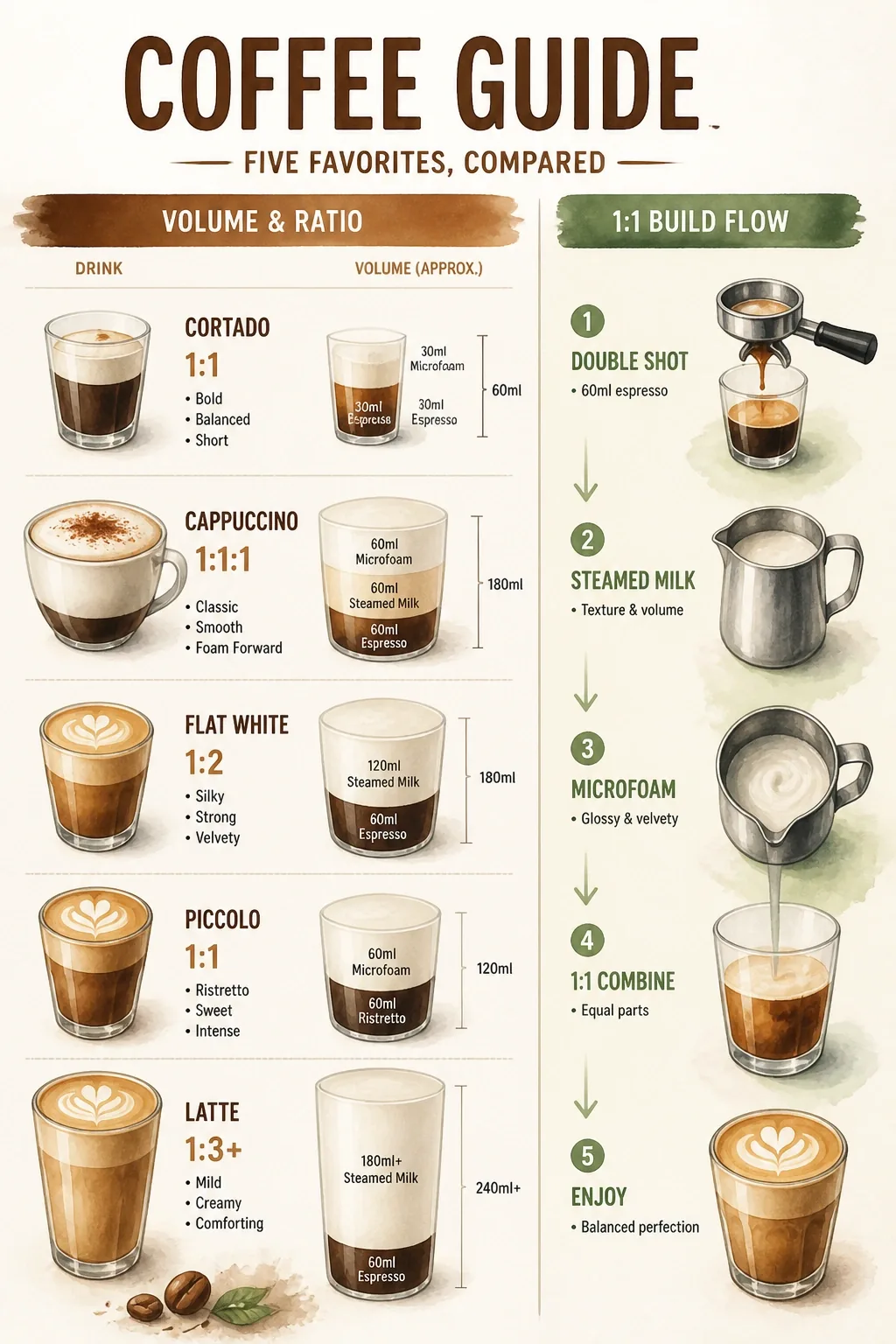
A cortado is a Spanish-origin drink of espresso and steamed milk, where the milk cuts the shot rather than dilutes it. That’s the etymology: cortar, to cut. The milk’s job isn’t to add volume or sweetness – it’s to round off the espresso’s acidity while leaving its structure intact. The result sits somewhere between a straight double shot and the milkier drinks that dominate most café menus.
To understand where it fits, it helps to line it up against its neighbors. A latte runs anywhere from 8 to 12 oz and is milk-forward. A cappuccino sits around 5-6 oz with a defined foam layer. A flat white lands at roughly 5-6 oz with microfoam worked into the espresso rather than resting on top. A piccolo is close in spirit to a cortado but typically a single ristretto with a smaller milk volume. The cortado, at roughly 4-4.At 5 oz total, the Cortado is the most concentrated drink in that family – and the most unforgiving of imprecision.
To fully appreciate why this balance defines the beverage, review the foundational anatomy detailed in What Is a Cortado Everything before evaluating the vessels designed to hold it.
The Build in Concrete Numbers
The standard cortado starts with a double shot: approximately 18 g of ground coffee in, 36-37 g of espresso out, extracted over 25-30 seconds. That yields roughly 2 oz of espresso. The milk – microfoam steamed to around 140°F – matches that volume, landing the total in the 4-4.5 oz range. The foam is minimal: just enough texture to integrate, not enough to create a separate layer.
One honest caveat: published sources genuinely disagree on whether the 1:1 is measured by volume or by weight. At this scale, the difference is real. A 1:1 by weight produces a slightly thicker result than 1:1 by volume because milk is denser than espresso. Most practitioners work by feel and eye, calibrating to their own espresso yield rather than a fixed number.
The Quality Floor No Cup Can Bypass
No vessel rescues a poorly extracted shot. Beans should sit roughly 1-5 weeks post-roast – fresh enough to have degassed, old enough that CO₂ isn’t fighting the extraction. Ground fresh on a burr grinder for uniform particle size. Brewed with controlled water temperature and mineral content. These aren’t refinements; they’re the baseline the cup is designed to preserve.
A cortado is also a drink with a purpose-built drinking ritual: consume it promptly, without lengthy stirring. The small format concentrates the sensory experience into a short window. Letting it sit defeats the design – and, as we’ll see, the cup either extends that window or collapses it.
Size Is a Variable You Own
Here’s where the received wisdom starts to crack. Everyone quotes “4-4.5 oz” as if it were law, but the cortado has never had a single canonical size. Published sources span 60 ml to 133 ml, and serious practitioners treat cup capacity as a tunable spectrum they calibrate to their own espresso yield, milk volume, latte-art ease, and hand feel.
The reframe matters: size is a variable you own, not a spec you obey. A cup that’s too large silently pushes the milk past 1:1 – the ratio drifts before you’ve taken a sip. A cup that’s too small leaves no headroom for the pour. Both are vessel failures, not recipe failures. That’s the lens the rest of this guide uses.
Understanding these volumetric differences clarifies why this traditional Spanish drink demands entirely different proportions than larger milk-based beverages, as outlined in our cortado and latte comparison.
How a Whiskey Tumbler Became the Cortado’s Uniform
The cortado arrived in the US carrying its Spanish identity intact: a double shot, equal milk, minimal foam. What it didn’t arrive with was a dedicated vessel. Standard café cups of the early 2000s were sized for lattes and cappuccinos – too large for a drink that tops out at 4.5 oz. The 1:1 ratio disappeared into the excess headroom.
The Gibraltar Adoption Story
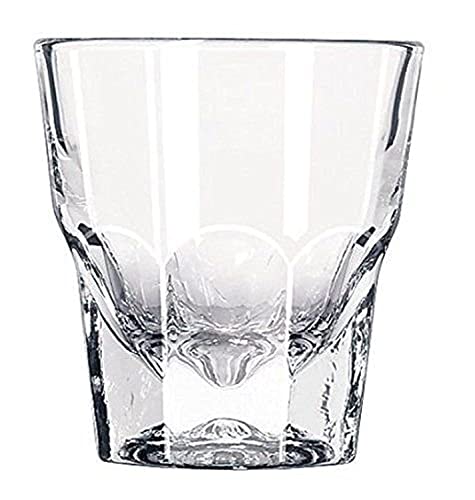
In 2005, Blue Bottle Coffee in San Francisco solved this problem with a piece of barware: the Libbey Gibraltar 4.5 oz whiskey tumbler. It fit the drink almost exactly. The glass became the default vessel, and its name – Gibraltar – started bleeding into the drink itself. Regulars began ordering “a Gibraltar” when they meant a cortado in that specific glass. The vessel and the drink became linguistically fused in the US market.
What Is a Gibraltar Coffee? Drink vs. Glass Demystified
The confusion this created is still the most common beginner mistake in this category: a Gibraltar is a standard 1:1 cortado served in a Libbey Gibraltar glass. The name refers to the serving vessel, not a different recipe, ratio, roast profile, or milk temperature. Same drink. Different label – one that names the cup it arrived in.
Outside the US, this terminology mostly doesn’t exist. Order a Gibraltar in Madrid or Melbourne and you’ll get a blank look. Order a cortado and you’ll get the same drink, possibly in the same glass, simply called what it is.
Why Glass, and Why Ceramic Works Too
Glass became the traditional presentation for two reasons: visibility and café culture. The clear straight wall shows the espresso-to-milk gradient as the drink settles – the layering is part of the experience in a counter-service environment where the drink is made and consumed in full view. It also reads as precision rather than comfort.
Ceramic is an equally legitimate modern choice. It offers greater thermal mass, warmth in the hand, and a surface that flatters latte art in ways bare glass doesn’t. The choice between them isn’t about authenticity – the cortado predates the Gibraltar glass entirely. It’s about what you want the cup to do.
The dominant community myth worth correcting here: a cortado does not have to be served in a Gibraltar glass. The Gibraltar was one historical solution to a size problem. It became a convention, not a definition.

Why Cup Geometry Changes the Drink – The Five Criteria Nobody Lists
The question “does the cup really matter?” sounds aesthetic. It isn’t. A cortado is a small, fast-cooling drink with a fixed ratio and a short drinking window. Every physical property of the vessel – material, wall thickness, rim profile, internal geometry, and capacity – either protects that window or compresses it. Here are the five criteria that published guides almost universally skip.
“The cup is the final point of contact between the coffee and the drinker. If it’s poorly designed – too thick or thin at the rim, uncomfortable in the hand, or the material doesn’t retain heat well – it can undermine the entire sensory experience.” – Daniel Baer, founder of Monoware, premium tableware designer supplying specialty cafés and roasteries including Origin Coffee and WatchHouse
Baer’s framing cuts through the aesthetics debate cleanly. Cup design isn’t decoration added after the engineering – it is the engineering, and for a 4 oz drink with no margin for error, every design decision compounds.
Thermal Retention and Vessel Material
A cortado is roughly 4 oz of hot liquid in an uninsulated vessel. The drinking window – the range between “served correctly” and “gone cold” – is genuinely short, and the cup’s thermal properties determine how short.
Thermal mass, wall thickness, and double-wall construction are the three levers. A thicker ceramic wall absorbs heat from the liquid more slowly than thin glass, releasing it back into the drink over time. Double-wall construction adds an air gap that functions as insulation, slowing heat transfer to the ambient environment significantly.
The material science here is counterintuitive. Glass has a lower thermal conductivity than porcelain – meaning heat passes through it more slowly at the molecular level. But in practice, a published study in the International Journal of Heat and Technology that monitored actual beverage cooling in glass, porcelain, plastic, and stainless steel vessels found that the porcelain mug retained heat better than the glass vessel across the measured cooling period. The practical behavior diverges from what the conductivity number alone would predict – wall geometry, surface area, and thermal mass interact in ways that favor ceramic in real-world use.
Glass offers something ceramic can’t: visibility of the layers. The espresso-to-milk gradient is part of the cortado experience in a café setting, and a clear vessel makes it readable. The trade is thermal performance. Neither material is wrong; they serve different priorities.
Rim, Internal Form, and Pour Headroom
Rim thickness changes the drink before it hits your palate. A thin rim – typical of precision glassware – delivers liquid cleanly and reads as sharp, precise, glass-like. A thick rim – common in hand-thrown ceramics – creates a different sip volume and a sense of warmth that changes how the foam and liquid register. Neither is superior. They produce genuinely different sensory experiences from the same liquid.
Internal geometry – taper, straight wall, or domed bottom – determines how espresso and microfoam fold together during the pour and how confidently a free-pour latte art pattern lands. A straight-walled vessel like the Gibraltar gives the pourer a predictable canvas; a domed or tapered bottom concentrates the flow differently and can make patterns easier to establish once you’ve calibrated to it.
Capacity and headspace are the most consequential variables. A cup that’s too large – say, a 6 oz vessel for a standard 4 oz cortado – creates passive headroom that invites more milk. The 1:1 drifts without any conscious decision from the barista or the drinker. A cup that’s too small leaves no room for a controlled pour, and the microfoam lands outside the intended pattern.
Practitioner benchmarks to calibrate against: the Libbey Gibraltar at 4.5 oz / ~133 ml, the notNeutral Vero at 4.25 oz, Loveramics at 120 ml, Mk-ceramics at 90/130 ml, and Acme at 110 ml. Serious drinkers work in millilitres, not ounces, because the precision matters at this scale. Treat any “one true size” claim from a blog with appropriate skepticism – practitioners describe the field as a spectrum, and their cup choices move with their espresso yield.
The Libbey Gibraltar 4.5 oz, Dissected
The Gibraltar is the reference point every other cortado vessel gets measured against. Understanding exactly what it does – and what it doesn’t – clarifies why specialty cups exist and what they’re actually solving.

Specifications and What They Actually Mean
At 4.5 oz / approximately 133 ml, the Gibraltar sits at the larger end of the cortado spectrum. Filled correctly – a 2 oz double shot, 2 oz microfoam – it leaves usable headroom for the pour without so much excess that the ratio drifts. That’s not an accident; it’s why baristas reached for it in the first place.
Libbey’s DuraTuff treatment gives the glass high thermal-shock resistance: the ability to absorb a hot espresso pull, handle temperature swings from dishwasher to counter, and survive café-level daily handling without cracking. In a commercial environment where glassware takes punishment, that durability matters more than it might in a home setting.
Facet Ergonomics and Optics
The hexagonal facets on the Gibraltar’s exterior are a grip feature, not decoration. A hot, smooth glass cylinder is difficult to hold without scalding your fingers; the facets create purchase points that make handle-free handling practical. This is a bartender’s solution to a bartender’s problem, applied to coffee.
The clear straight wall does something no ceramic cup can: it displays the espresso-to-milk color gradient as the drink settles. Watching the integration happen – the espresso darkening toward the base, the milk lightening toward the surface – is the closest thing in this category to seeing the 1:1 ratio in real time.
Honest Limitations
Glass insulates nothing. The Gibraltar’s thermal performance is essentially that of the ambient air around it, which means your drinking pace becomes a specification. Drink slowly and the cortado goes cold before you finish. The small format was designed for a short, focused ritual – the vessel enforces that whether you intend it to or not.
The other limitation is one of origins: the Gibraltar is barware that became a benchmark. It was never designed as coffee-ware. Its price reflects a whiskey tumbler’s economics, not a specialty-coffee object’s. The premium you pay for the cups in the next section buys thermal engineering, purpose-built geometry, and craft – not more authenticity than the original. That distinction is the axis the comparison runs on.
The cooling problem is significant enough that it produced a temperature-controlled mug category in response, with a recommended drinking temperature around 135°F as a reference point. A bare glass vessel offers no path to that consistency – your pace is the only variable you control.
Cortado Cup Head-to-Head: Libbey Gibraltar vs notNeutral Vero vs Fellow Monty vs KRUVE Imagine
Four cups. Five criteria. No single winner – but a clear picture of what each one trades away to deliver what it does best.
The five criteria established in H2-3 are the scoring framework: heat retention, rim profile, durability and dishwasher safety, latte-art ease, and capacity fit for a 1:1 build. Price tier is the sixth variable, because what you give up financially should be legible against what you gain functionally.
Capacity Alignment
| Cup | Capacity | Material | Price Tier |
|---|---|---|---|
| Libbey Gibraltar | 4.5 oz / ~133 ml | Single-wall glass | $ |
| notNeutral Vero | 4.25 oz / ~126 ml | Ceramic | $$ |
| Fellow Monty | 4.5 oz / ~133 ml | Ceramic (domed bottom) | $$ |
| KRUVE Imagine | 150 ml / ~5 oz | Double-wall glass | $$$ |
The Libbey Gibraltar and Fellow Monty share the same nominal capacity but deliver it through completely different geometries. The notNeutral Vero runs slightly smaller, which suits a tighter espresso yield. The KRUVE Imagine at 150 ml sits at the upper edge of the cortado spectrum – workable for a 1:1 build, but less forgiving of a generous milk pour.
Heat Retention
The Gibraltar loses here by design. Single-wall glass has no thermal mass and no insulation. A cortado poured into it begins cooling immediately and noticeably.
The notNeutral Vero and Fellow Monty, as ceramic vessels, offer meaningfully better heat retention through thermal mass – consistent with the material behavior documented in the International Journal of Heat and Technology study cited earlier. The KRUVE Imagine’s double-wall construction adds an air-gap insulation layer that outperforms both, at the cost of the visible layering that makes glass appealing in the first place.
Rim Profile and Latte-Art Ease
The Gibraltar’s straight wall and open rim make it a predictable canvas for latte art – the pour path is unobstructed and the geometry doesn’t redirect flow. It rewards a pourer who knows their pattern.
The Fellow Monty’s domed bottom is reported by practitioners to make latte art easier to establish – the dome concentrates the espresso pool and gives the microfoam a natural surface to land on. This is a community observation rather than a manufacturer-tested specification, but it’s consistent across enough practitioner accounts to take seriously.
The notNeutral Vero’s tapered form and refined rim produce a sip that many users describe as more intentional than the Gibraltar – the thin ceramic lip delivers liquid cleanly in a way the glass tumbler doesn’t quite replicate.
Durability and the Dishwasher Question
This is where the comparison gets genuinely uncomfortable. Dishwasher safety is the single most-asked, least-answered question in cortado glassware, and published guides don’t address it at all.
The Gibraltar’s DuraTuff treatment makes it commercially dishwasher-tolerant. The KRUVE Imagine’s double-wall construction introduces a point of vulnerability: the seal between the two glass layers can degrade under repeated high-heat dishwasher cycles. The Fellow Monty’s dishwasher safety is actively disputed among users, with enough community-level disagreement that treating it as unverified until the manufacturer confirms it for your specific model is the only defensible position.
The practical rule: verify dishwasher guidance directly with the manufacturer, not with a review or a forum post.
What the Comparison Actually Produces
No model in this shortlist is the ideal cortado cup. The comparison narrows your options against specific criteria; it doesn’t produce a ranking. The Gibraltar wins on authenticity, transparency, and price. Ceramic options win on thermal performance and rim refinement. The KRUVE Imagine wins on heat retention but sacrifices the layering visibility that makes glass meaningful. The Fellow Monty’s domed geometry is a genuine functional differentiator – but buy the geometry and verify the construction separately.


Buying for Your Own Counter: Capacity, Material, Budget, and the Test Nobody Runs
Analysis narrows the field. Your counter decides it. Here’s a four-step protocol that works regardless of which cup you’re evaluating.
Step 1: Choose Capacity from Your Own Yield
Don’t start with the cup. Start with your espresso output and your intended milk volume. Measure both in millilitres. Add them together, then add roughly 15-20 ml of working headroom for a controlled pour. That number is your minimum cup capacity. Work in millilitres – the precision matters at this scale, and ounce fractions obscure real differences between vessels.
Step 2: Match Material to Ritual
Glass suits a fast, focused ritual where the layering is part of the experience. Ceramic suits a slower pace where thermal mass extends the drinking window and warmth in the hand is part of the pleasure. Double-wall construction suits anyone who sips slowly and wants heat retention to do the work their pace can’t.
None of these is more “correct” than the others. They reflect different relationships with the same drink.
Step 3: Interrogate the Edge and the Base
Three details that decide whether you reach for the cup daily: rim thickness for mouthfeel, base shape for pour confidence, and foot stability on your counter. A cup that wobbles during a free pour introduces error. A rim that delivers liquid awkwardly changes the experience regardless of what’s in the cup. These are worth testing physically before committing.
Step 4: Run a Durability Reality Check
Confirm thermal-shock tolerance before exposing any vessel to the temperature swing of a hot espresso pull. Note that handle-free glassware demands different handling habits than a mug – you’re gripping heated glass, and the Gibraltar’s facets exist for exactly this reason. Verify dishwasher guidance directly with the manufacturer rather than assuming from the product listing.
The Test Nobody Runs
Pour your normal cortado into the cup you already own. Drink it at your normal pace. Note where it fails: temperature drop, mouthfeel, or pour control. Buy to fix that specific failure – not to collect, not to upgrade for its own sake.
A practitioner shortcut worth knowing: a thrift-store 5-6 oz tea cup can reportedly handle latte art for about a dollar versus $30-40 for specialty mugs. Learn your pour on a cheap vessel; upgrade once you know which criterion you’re actually chasing.
One material myth worth discarding: a crackle glaze does not automatically mean the cup will stain. Glaze quality and sealing matter far more than the visual pattern. A crackle-glaze ceramic isn’t disqualified on appearance alone – assess the sealing, not the aesthetic.
Verdict: The Perfect Cortado Cup Is a System, Not a Glass
The cortado’s identity is fixed: equal parts espresso and steamed milk, a double shot as the engine, microfoam as the texture layer, consumed in a short focused window. That ratio doesn’t flex. The vessel is the variable that either preserves it or quietly dismantles it.
Capacity governs the ratio. A cup that’s too large invites more milk without any conscious decision. A cup that’s too small removes the pour control that makes the 1:1 achievable. Geometry governs integration and pour confidence. Straight walls, tapered forms, and domed bottoms each create different conditions for how espresso and microfoam meet. Material governs the drinking window. Glass is honest about its thermal limitations; ceramic and double-wall construction extend the window for drinkers whose pace demands it.
Decision Paths, Not a Single Winner
Choose the Libbey Gibraltar if you want the benchmark vessel – the historical form, the visible layering, the café-counter authenticity, and the price that reflects a whiskey tumbler rather than a specialty object. It’s the right starting point precisely because it defines what everything else is measured against.
Choose a ceramic or domed-bottom cup – the notNeutral Vero or Fellow Monty – if latte art and warmth in the hand matter more than visible layering. The thermal mass works in your favor if you drink at a measured pace, and the refined rim changes the sensory experience in ways that are worth the premium.
Choose a double-wall option like the KRUVE Imagine if heat retention is the primary failure you’re solving and you’re willing to trade the layer visibility for consistent temperature across a slower ritual.
The four-cup matrix is a shortlist. It is not a ranking.
Closing the Loop on Size
The “correct” cortado cup size is whichever capacity holds your double shot plus an equal volume of milk with working headroom, at a size that fits your hand. That’s why published sources can legitimately disagree on whether 4 oz or 4.5 oz or 130 ml is “right” – they’re all calibrating to slightly different espresso yields, milk volumes, and pour styles. The Gibraltar’s 4.5 oz is a starting point and a reference, not a mandate.
The Repeatable Self-Test
Pull the same espresso. Steam the same milk. Pour both into two different cups. Drink each at your normal pace. Whichever cup still tastes integrated at the last sip – and holds its temperature through your actual drinking speed – is your cup. The answer may change when your beans change, when your yield shifts, or when your milk does. That’s not a flaw in the system. That’s the system working.
Frequently Asked Questions About Cortado Cup
What cup should a cortado be in?
A cortado belongs in a vessel that holds 90-133 ml with working headroom for the pour – typically a 4-4.5 oz glass or ceramic cup. The Libbey Gibraltar is the historical reference, but any cup in that capacity range that suits your espresso yield and drinking pace is a valid choice.
Does a cortado have 1 or 2 shots?
A standard cortado uses a double shot – roughly 18 g in, 36-37 g out, over 25-30 seconds. The double shot yields approximately 2 oz of espresso, which pairs with 2 oz of microfoam to hit the 1:1 ratio at around 4 oz total.
What is the size of a cortado cup?
There’s no single mandated size. Most published sources land between 4 and 4.5 oz (roughly 120-133 ml), but practitioners work across a 60-150 ml spectrum depending on their espresso yield and milk volume. Choose the capacity that holds your specific build with about 15-20 ml of headroom.
How do you properly drink a cortado?
Drink it promptly and without lengthy stirring – the small format is designed for a short, focused window. The espresso and microfoam are integrated during the pour; stirring after the fact disrupts the texture rather than improving it.
Is a Gibraltar the same as a cortado?
Yes, in terms of recipe – a Gibraltar is a 1:1 cortado served in a Libbey Gibraltar glass. The name refers to the vessel, not a different drink. Outside US café culture, the same preparation is simply called a cortado regardless of what glass it arrives in.
Does it matter if my cortado cup is glass or ceramic?
It matters for thermal performance and sensory experience, not authenticity. Glass shows the espresso-to-milk gradient and cools faster; ceramic retains heat longer and delivers a different mouthfeel through its rim. Neither is more “correct” – they suit different drinking paces and rituals.
Can I use a double-wall glass for a cortado?
Yes, and it solves the Gibraltar’s main weakness – heat loss. The trade-off is that double-wall glass obscures the layer gradient that makes a clear vessel appealing, and the seal between layers can degrade under repeated dishwasher cycles. Verify durability claims with the manufacturer before committing.
Why does rim thickness affect how a cortado tastes?
A thin rim delivers liquid cleanly and directly, creating a sharper, more precise sensory impression. A thick rim changes the sip volume and creates a sense of warmth that alters how foam and liquid register on the palate. Same liquid, genuinely different experience – rim design is not cosmetic.
References
- Analytical, Experimental and Computational Analysis of Heat Released from a Hot Mug of Tea | International Journal of Heat and Technology | ijht.org
- Coffee Cup Design and the Drinking Experience | Perfect Daily Grind | perfectdailygrind.com